


 Copa America Logo PNG
The Copa América logo expresses the tournament’s significance as South América’s premier soccer competition. Its formal, recognizable design emphasizes the event’s sporting traditions and international status.
Copa América began in Buenos Aires in 1916 as part of Argentina’s independence centenary. Argentina, Uruguay, Brazil and Chile entered the first official championship for South American national teams. The competition prompted the creation of CONMEBOL that same year, making it the world’s first continental football confederation, founded before UEFA.
Uruguay and Argentina dominated most early tournaments and formed the competition’s main rivalry. Brazil later joined as a leading contender. Uruguay also won two Olympic titles before claiming the first World Cup in 1930. Formats and schedules changed repeatedly during the first half of the 20th century. Known by several names, the event adopted the Copa América name in 1975, along with a more organized group-and-knockout structure.
Guest teams from other confederations entered from 1993, beginning with Mexico, which became a regular participant. The 2016 centenary edition took place in the United States, the first tournament held outside South America. It expanded to a record 16 teams and ended with Chile defeating Argentina on penalties. Chile had won the 2015 edition by the same method.
After three final losses, Lionel Messi won the tournament with Argentina in 2021. The team defeated Brazil at the Maracanã, giving Messi his first senior international title. Argentina retained the trophy in 2024 and reached 16 Copa América championships, surpassing Uruguay and Brazil for the tournament record.
Meaning and History

What is Copa América?
It is the oldest international soccer tournament for national teams from South America. The championship features the continent’s top teams, along with guests, showcasing high-level soccer. Held every few years, it attracts global attention in soccer. Matches are known for emotional intensity, excitement, and fierce rivalries among top regional teams. Winning the tournament is highly prestigious for any South American team.
1979

In 1979, the Copa América was held under the auspices of the Paraguayan Football Federation, which presented the tournament’s emblem to the public. The association served as the championship’s organizer, as its name, inscribed in a white ring around the central composition, emphasized. The mention of the Asociación Paraguaya de Fútbol indicated national affiliation and reinforced the host country’s status.
The overall format was circular, visually echoing the shape of a ball. Inside the ring was a five-pointed orange star enclosed in a circle. From it, diagonal red and blue stripes spread out at an angle. They formed a St. Andrew’s cross-type structure, creating a dynamic intersection. This design drew on elements of Paraguay’s state symbols while highlighting cultural interaction.
The typographic part consisted of two blocks: the upper arc contained the inscription “Copa América,” and the lower one indicated the year 1979.
The palette consisted of three main colors: orange, red, and blue. Orange set the tone for the star and outlines, red and blue filled the diagonal segments, and the white background strengthened the contrast. The combination of shades linked the composition to Paraguay’s national symbolism and resonated with the visual codes of South American countries more broadly.
1983

In 1983, the organizers of the Copa América abandoned the circular format and presented a rectangular composition resembling a poster. The designers sought to move away from traditional tournament symbols, opting instead for a collage structure. The upper part of the construction featured the inscription “Copa America,” while the lower part indicated the event date.
The form was divided into nine equal cells. Each section was assigned to the national flag of a participating country, resulting in a composition resembling a tournament bracket. In the center, a green rectangle with the Brazilian flag stood out. The richness of its color intensified associations with the continent’s leading football power. The style resembled a commemorative poster, with the main idea conveyed through a mosaic of flags.
The typographic part was based on a dark, bold typeface. The lines were uneven, with a handwritten texture effect. The black text color served as a stabilizing element, balancing the palette’s saturation.
The color scheme encompassed almost the entire spectrum of South American symbolism. Red, blue, yellow, green, and white tones heightened perception, overloading the composition with detail.
1987

The organizers of the 1987 championship chose to emphasize the tournament’s national context by drawing on Argentine symbolism. The composition was built on a rectangle divided into three horizontal stripes: a light blue upper stripe, a white middle stripe, and a light blue lower stripe. This structure replicated the layout of the host country’s flag and served as the background for the entire composition.
On the right side was a circle representing a soccer ball. It was constructed from parallel black-and-white lines. As if behind them, golden hexagons appeared in the gaps, forming the ball.
The text block was divided into two parts. The upper zone displayed the tournament name, Copa América, while the lower zone featured the inscription “Argentina ’87.” The typeface was executed in strict black lettering without decorative excess. Its minimalism imparted a sense of order to the composition.
The color system was built on four key accents: light blue and white tied the emblem to Argentine identity, and black provided structure and was used in the typographic component. Gold enlivened the ball’s structure and reinforced the association with a sports trophy.
1989

Spectators of the 1989 tournament, held in Brazil, first noted the appearance of a new mascot. The bird Tico, a representative of the local species zorzal sabiá, accompanied the official identity and complemented the Copa América emblem, which retained the general style set in Argentina two years earlier. The tournament opened on July 1 and concluded on the 16th, with all ten South American associations participating. The hosts won the final for the first time since 1949, defeating Uruguay at the Maracanã Stadium.
The logo retained the style of the previous tournament while adding its own nuances. The composition’s base was a rectangle in the colors of the Brazilian national flag. The fields were divided into three horizontal stripes: green, white, and yellow. The construction emphasized the tournament’s territorial affiliation, creating a backdrop for the other elements to flourish.
The upper part contained the inscription Copa América, while the lower part featured the designation Brasil ’89. The typography was executed strictly, with black for maximum legibility.
The visual symbol was concentrated on the right side of the composition. A circle symbolized a soccer ball, but it was interpreted abstractly. Its surface was formed by a system of parallel blue and black stripes, with pink segments appearing as if in the background. These imitate the panel structure of a ball, but in a stylized, simplified form.
The color system was based on the national palette, which included green, white, and yellow, complemented by additional accents of blue, pink, and black.
1991

The organizers of the 1991 championship in Chile abandoned the usual scheme of placing the national flag at the center. Instead, they placed the symbolism of the entire continent at the center. The tournament was held from July 6 to 21, and for the first time, the emblem shifted the focus to South America, making it the championship’s main image.
The composition was built on a vertical rectangle with a red frame. Inside was a light blue circle filled with horizontal strokes. In the center of the circle, the outline of the continent was shown in white silhouette. This gave the emblem new meaning: not an individual country, but the union of all ten federations gathered in a single tournament.
To the left of the circle were three red lines, arched and spreading outward like a fan. They created the effect of a ball’s trajectory. In this case, the stylized ball was the circle with the continent’s outline.
The typographic block supported the overall minimalism. The inscription was executed in light blue, connecting it with the circle and reinforcing the sense of unity in the composition.
The palette was limited to three main shades: red for the frame and lines, light blue for the circle and text, and white for the background and the continent map. The restrained color palette highlighted Chile’s symbolism and alluded to the championship’s continental scale.
Among the innovations was the introduction of the mascot Guaso, whose image was based on the traditional Chilean huaso and designed in the colors of the national flag. Its use strengthened the local context and added a cultural dimension to the tournament.
1993

The 1993 tournament in Ecuador, held from June 15 to July 4, featured a logo that emphasized emotional expressiveness and closely resembled a poster-style design.
The core image was a silhouette of soccer players, composed of long, curved lines in a violet-blue hue. The strokes conveyed movement, suggested the plasticity of the human body, and heightened the sense of energy. The composition included a map of North and South America, executed in yellow, blue, and red, corresponding to the colors of the Ecuadorian flag.
The Copa América emblem featured two soccer balls. One was traditional, black-and-white, while the other included multicolored elements associated with the union of the region’s countries. The color palette is based on three key shades: yellow, blue, and red. They symbolize Ecuador’s national flag.
The mascot, Choclito, an anthropomorphic corn cob in the colors of the national flag, played a special role. It strengthened the local context and added cultural depth to the tournament, linking the sporting event with Ecuadorian symbolism.
1995

In the 1995 Copa América, held in Uruguay, twelve national teams participated, including the United States and Mexico as invited teams. The tournament ended with the hosts defeating Brazil in a penalty shootout. For the championship, a new horizontally extended emblem was created, with the main focus on text design.
At the center of the composition was the inscription Copa América. “Copa” was written in a light blue typeface with thin lines, while “América” stood out with massive geometric letters in a deep blue tone. The combination of different character weights and thicknesses enhanced the rhythm, and the angled letter “M” introduced a sense of movement.
Within the letter row, the silhouette of both Americas was embedded. The orange-colored contour passed through the letters “O” and “M,” linking parts of the text. To the right of the name was a circle featuring an abstract soccer player, with the inscription “Uruguay 95,” indicating the tournament’s location and date.
The palette was constructed from three primary shades. Blue, Uruguay’s traditional color, was used for the continent; orange highlighted the map; and red details added an energetic accent, enhancing the composition’s dynamism. The color combination tied local motifs to a universal sports theme.
The tournament’s mascot was Pepito, a bull figure created by artist José Luis Uhart. It was used alongside the emblem to form the championship’s overall visual style, though there was no compositional link between them.
1997

The 1997 tournament was held in Bolivia, and the organizers once again used the logo first introduced a decade earlier: a rectangular background in the colors of the host country’s flag, with a circular element on the right representing a soccer ball. It connected the championship to local identity and continued the line of a unified visual language for the Copa América. The upper part of the mark contained the inscription Copa América, while the lower part included the designation Bolivia 1997.
The rectangular base was designed to resemble the national flag, featuring three horizontal stripes of red, yellow, and green.
The circle on the right represented a stylized ball. Its construction was based on the rhythm of parallel blue lines, with red segments that stood out, forming hexagonal shapes that appeared to lie behind them. This created visual depth and gave the sports symbol structure.
The typographic part maintained functionality and a restrained character. The typeface was used as a neutral accompaniment, not distracting from the work’s focus on color and geometry.
The color system had two levels. The first was based on Bolivia’s national colors: red, yellow, and green. The second was supplemented by blue and black, used in the construction of the ball.
1999

The 1999 Copa América, hosted in Paraguay from June 29 to July 18, featured an emblem that combined national symbolism with global imagery. The tournament brought together all the continent’s federations under CONMEBOL and ended with Brazil’s victory over Uruguay in the final.
The composition was built on a trapezoidal block in the colors of the Paraguayan national flag: red, white, and blue. The geometric background reinforced the championship’s territorial affiliation and served as the foundation for two dominant circular forms.
On the left was a blue globe with a red silhouette of North and South America. A grid of parallels and meridians emphasized the international scale of the tournament. On the right was a soccer ball with a white base, featuring red and blue panels outlined in blue, in a classic design. The combination of the globe and the ball unified the sporting and geopolitical levels in a single visual field.
The upper part bore the inscription “COPA AMERICA,” while the lower part read “PARAGUAY-99.” Both blocks were executed in a blue sans-serif typeface. The strict lettering reinforced the impression of officiality and visually balanced the color-rich emblem.
2001

Colombia, which hosted the Copa América in July 2001, created a distinctive visual identity that combined the soccer theme with national symbolism. The tournament was held from July 11 to 29, and the emblem incorporated the colors of the national flag into the familiar composition inherited from the late 1990s.
The basis was a trapezoidal block colored yellow, blue, and red, matching the shades of the Colombian flag. Against this background was a large, stylized, soccer-ball-shaped circle. Its surface was divided into segments reminiscent of classic ball panels, but the interior outlined the American continent. The northern part was highlighted in yellow, while the southern part was colored blue and red, in accordance with the host country’s flag palette. The sports symbol became a metaphor for a united continent.
The text block consisted of two elements: the upper part contained the inscription “Copa América,” and the lower part contained the designation “Colombia 2001.” Both were executed in a dark blue italic sans-serif typeface.
2004

The 2004 championship was held in Peru from July 6 to 25, and the visual concept retained continuity with previous emblems while adding new accents tied to the local context.
The basis was a trapezoidal block executed in red-and-white stripes, a reference to Peru’s flag. On the right side of the composition was a circle shaped like a stylized soccer ball. Its surface was created using gray gradients, which imparted a sense of volume and metallic luster. On the ball’s panels, the outline of the Americas was painted red.
The upper part of the composition contained the inscription Copa América, while the bottom featured the designation Peru 2004. The typeface was italic, sans-serif, and blue. The slant gave the text dynamism, and the cool tone balanced the palette’s contrasting layers.
To the right of the circle, parallel blue lines extended. These added a sense of movement and symbolized the tournament’s development as a major international event.
2007

For Venezuela, hosting the 2007 Copa América was a precedent. The country held the championship for the first time, from June 26 to July 15. The tournament’s visual language reflected national identity and the desire to give the identity dynamism.
The composition was based on a diagonally arranged tricolor block that repeated the structure of the Venezuelan flag. The yellow, blue, and red stripes were interpreted as curved, resembling the fabric’s surface. Above them was an arc of eight white stars, borrowed from the national symbol.
Next to it was a three-dimensional soccer ball. Its surface was designed in a gray metallic range, creating the illusion of shine and volume. On the ball’s panels, the outlines of the Americas were highlighted in blue and red, with smooth gradient transitions.
The typographic part included two blocks. In the lower zone was the inscription COPA AMERICA, executed in an italic geometric typeface in red with shadow. Beneath it was another inscription, “VENEZUELA 2007,” set in the same typeface in blue with letter shadows.
The color system included the bright shades of the Venezuelan flag, complemented by the ball’s neutral gray tones. White stars and contours balanced the palette’s saturation, providing structural harmony.
The key element of the identity was the mascot Guaky, representing a macaw parrot, created through a children’s contest and later refined by Fractal Studio. The character was used in promotional materials and served as a link to the emblem, uniting the tournament’s official symbols.
2011

In 2011, Argentina hosted the 43rd Copa América, which took place from June 29 to July 24. The tournament’s visual mark demonstrated two levels: national and continental. The Copa América emblem was developed under CONMEBOL’s auspices and continued the tradition of combining the host country’s flag with regional symbolism.
The composition was built horizontally and included two dominant elements. On the left was the Argentine flag, with its familiar light blue and white stripes and the golden sun at its center. The cloth was rendered in a slightly wavy form, imitating the effect of fabric in motion and creating a ceremonial mood.
A soccer ball occupied the right part. It was executed in gray tones, with facets arranged to visually convey volume. On its surface, the outline of the Americas appeared in a pale blue.
The lower zone included the text part. Beneath the entire composition were the inscriptions “COPA AMERICA ARGENTINA” and “2011.” The typeface was geometric, sans-serif, and large. The main text was colored light blue, while the numbers were highlighted in yellow. This echoed the national flag’s palette and reinforced the association with Argentina.
The color system used light blue, white, and yellow for the national symbol’s shades and neutral gray for the ball. This balance emphasized the national context while maintaining the universal character of soccer symbolism.
2015

The organization of the 2015 tournament in Chile was accompanied by the creation of an identity that combined the host country’s cultural codes with universal soccer symbolism. The work was handled by the agency Brandia Central, which was commissioned to create a unified visual language for the competition held from June 11 to July 4.
The emblem took the form of a circle, interpreted as both a ball and a symbol of unity. At its center was a white five-pointed star, a reference to Chile’s national flag. Around it was an ornament of red and blue diamond-shaped figures forming an eight-pointed structure. The motif can be read as both a geometric pattern and an allusion to the panel design of a soccer ball.
An additional layer of meaning was conveyed through the number of cities hosting tournament matches, which was represented by the eight-pointed form. The symbolism combined national and sporting associations, rendering the logo a symbol of unity.
Around the perimeter were four pictograms with specific meanings: an orange silhouette of fans with a ball reflected celebration, a red heart symbolized passion, a green figure conveyed triumph, and a blue leaping player represented the “chilena” kick, symbolizing courage.
The inscription beneath the sign was executed in two styles. The upper part used a strict red sans-serif typeface with the text “COPA AMÉRICA.” Below was a blue calligraphic inscription, “Chile 2015,” that resembled handwriting. The combination of official and emotional levels made the composition more layered.
The color system included the palette of the Chilean national flag, reinforced by additional accents from the pictograms. Neutral white elements created balance and tied the bright, contrasting blocks into a unified structure.
As part of the communications campaign, the mascot was an Andean parrot named Guaky. It was selected through a children’s contest, with the final design executed by Fractal Studio. The character embodied the fan image and fit organically within the tournament’s visual system.
2016

The Centennial edition of the Copa América became a landmark event: for the first time, it was held outside South America, with the United States hosting the matches from June 3 to 26, 2016. The tournament was dedicated to the centenary of CONMEBOL and the championship itself, bringing together national teams from two confederations: South American and North American.
The identity was developed by the British agency The Works, Ltd. The composition was based on a stylized silhouette of the Copa América trophy, rendered in a golden palette with soft gradients that added depth and value. The silhouette included curved lines in three colors: blue, green, and red. They symbolized energy and cultural unity, as well as the link between the two confederations: blue for CONCACAF, green and red for CONMEBOL.
The cup was placed inside a ring divided into two arcs. The left part was colored blue with the date ‘1916’, and the right part was red with the number ‘2016’. An outer golden rim reinforced the association with a commemorative medal, emphasizing the centenary’s ceremonial nature and a hundred years of continuity.
The text block was built in three levels. The inscription “COPA AMERICA” was executed in uppercase golden letters in a massive sans-serif typeface. Below it was the word “CENTENARIO” in smaller scale, and the line “USA 2016” was presented in red and blue, referring to the U.S. flag.
A special commemorative Centenario trophy supported the visual campaign. It was created at Epico Studios (USA) and manufactured by the London company Thomas Lyte. The cup was made of 24-carat gold with a silver interior and was engraved with the dates “1916–2016” and a list of participating countries on the base.
The Centenario emblem became one of the most ceremonial in the tournament’s history. It united national and continental symbols, highlighted the century-long history of the Copa América, and elevated the anniversary to a truly exceptional event in world football.
2019

The 2019 tournament, held in Brazil from June 14 to July 7, featured an emblem that combined the national color system with the image of a massive soccer festival. The new Copa América logo appeared lighter and more emotional, reflecting the celebratory atmosphere.
The main element was the Copa América trophy, rendered in white with yellow and green accents. On its surface, the cup was adorned with silhouettes of players and a ball, serving as a metaphor for the game. The outlines were drawn with smooth curves, creating a sense of energy and continuous movement.
The background was a circular pattern in shades of green, yellow, and blue, evoking Brazil’s national symbolism. Within it were visible silhouettes of figures with their arms raised. This added an emotional layer and strengthened associations with the host country’s carnival culture.
The inscriptions were arranged in three levels below the composition. The first line contained the word “CONMEBOL,” set in a simple, blue sans-serif style. Below, in larger size, was “COPA AMERICA” in the same shade, rendered in massive uppercase letters. The final text block contained the inscription “BRASIL 2019,” executed in green handwritten type, creating a visual link with the fluidity of the main symbol and giving the composition an informal touch.
The color system was based on a white background, complemented by bright yellow and green shades associated with the national flag, as well as blue, reflecting CONMEBOL’s corporate identity.
2021

The relocation of the Copa América due to the COVID-19 pandemic made the 2021 Brazilian edition particularly notable. The competition ran from June 13 to July 10 and marked the 47th in history. The tournament’s visual identity centered on unity and was anchored in the championship’s main symbol: the trophy.
The composition began with a white-and-gray silhouette of the Copa América trophy. It was placed inside a circle divided into multicolored segments. The circle was divided into two parts: the left side was executed in shades of yellow and blue, while the right side was in light blue and white. Between them were abstract fragments in red, green, blue, and yellow.
The text structure was arranged in three levels beneath the emblem. The top line read “CONMEBOL,” set in a dark blue strict typeface. Below was the inscription “COPA AMERICA” in a larger format, in the same shade of blue. The final line contained “2021,” harmoniously integrated into the composition.
The color system combined white and gray in the trophy’s silhouette with the multicolored circle. Yellow, red, light blue, and green accents were intended to evoke cultural diversity and the energy of the spectators. Their arrangement enhanced the effect of layering: the trophy’s strict form found balance with the surrounding bright, dynamic elements.
2024

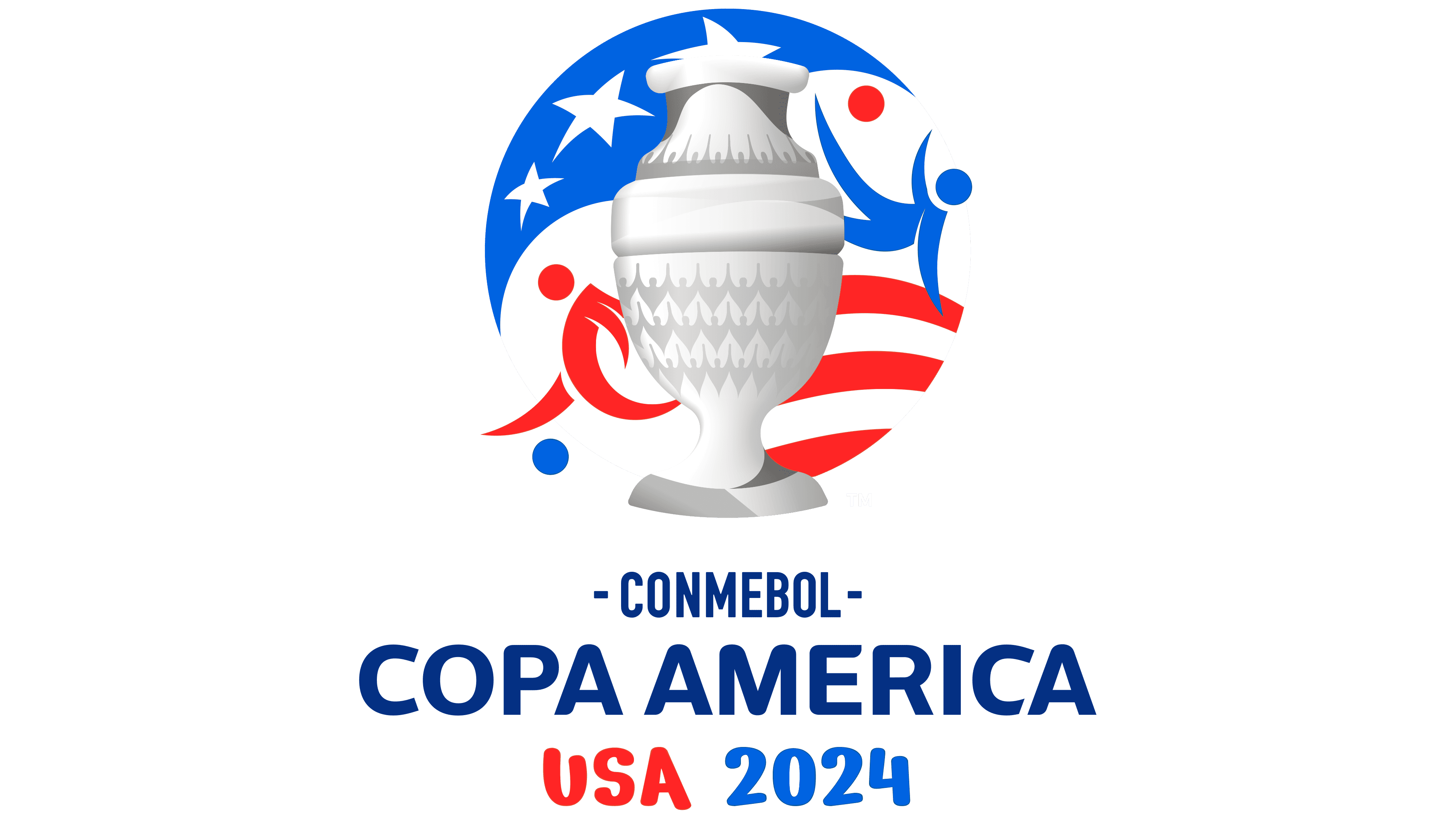
The joint CONMEBOL and CONCACAF tournament in 2024 gave the Copa América a new scale: the competition was held in the United States from June 20 to July 14, marking the championship’s 48th edition. The Copa América logo emphasized the union of the two continents, combining the trophy’s symbolism with the host country’s visual codes.
At the center of the composition was the Copa América trophy. It was executed in a white palette with light gray accents, giving it volume and highlighting the trophy as the focal point of the composition. The background was a stylized circle representing the American flag. The left part contained white stars on a blue field, while the right part consisted of red stripes with white intervals. Inside the circle were two player silhouettes. One was rendered in blue, the other in red, and their opposition emphasized sporting rivalry while simultaneously symbolizing the union of the two confederations.
Beneath the emblem was a three-level text block. The top line read “CONMEBOL,” set in a blue sans-serif typeface. The middle line carried the inscription “COPA AMERICA” in large uppercase letters, conveying a sense of officiality. The bottom line contained the inscription “USA 2024,” stylized as a handwritten signature: “USA” in red and “2024” in blue.
The American tricolor inspired the Copa América logo’s color palette. Red, blue, and white reinforced national identity, while the trophy’s gray-and-white tones balanced the intensity of the background color. As a result, the mark achieved unity and balance between ceremonial formality and festive brightness.
