 Democratic Party Logo PNG
The Democratic Party’s logo in the USA demonstrates respect for societal traditions and state norms. It embodies the sentiment prevailing among its representatives. It takes one back to the deep history of the 18th century, the very dawn of forming a unified democratic movement in the country.
The Democratic Party traces its origins to the anti-federalist movement of the 1790s, built around Thomas Jefferson and James Madison. Their Democratic-Republican faction opposed Alexander Hamilton’s Federalists, who favored a strong central government and closer ties with Britain. Jefferson’s victory in 1800 marked the first peaceful transfer of power between rival political forces in the United States.
In the 1820s, the Democratic-Republican Party broke into factions. Martin Van Buren, a New York political organizer, united Andrew Jackson’s supporters and helped turn a loose coalition into a modern party structure. Jackson defeated John Quincy Adams in 1828, a date often treated as the formal beginning of the Democratic Party. Jacksonian democracy expanded voting rights for white men without property requirements, attacked the National Bank, and included the Indian Removal Act of 1830.
From the 1830s to the 1850s, Democrats competed first with the Whigs and then with the rising Republican Party. Slavery split the party between southern defenders of the institution and more moderate northern Democrats. In 1860, the party nominated separate northern and southern candidates, helping Abraham Lincoln win the presidency. After the Civil War, Democrats remained dominant in the South through the long-lasting “Solid South” bloc.
The party returned to national strength under Franklin Roosevelt, whose 1932 New Deal shifted it toward federal action on jobs, welfare, and economic recovery. Later conflicts over civil rights reshaped its base. Harry Truman supported civil rights in 1948, and Lyndon Johnson signed the Civil Rights Act in 1964 and the Voting Rights Act in 1965. Later stages were marked by John Kennedy, Bill Clinton’s centrist course, Barack Obama’s 2008 election, and Joe Biden’s 2020 victory.
Meaning and History
The establishment of democracy in the United States began long ago, and over time, it has gained not only new supporters but also new identity markers. These emerged in various ways: some were related to the state structure, others to its symbolism, and others to poignant caricature drawings expressed through comprehensible images. The latter includes the donkey depicted by artist Thomas Nast. He turned the animal into a talisman of democracy, opposing old principles and monarchy and stubbornly overcoming obstacles.
The drawing was published in the January 1870 edition of Harper’s Weekly. The caption read: “The live donkey kicks the dead lion.” It metaphorically played on the proverb that a live donkey is better than a dead lion. The image’s relevance perfectly fits the desire to break established social canons and rid society of monopolism. The cartoonist cleverly played on the character since, in English, its name has two meanings, fitting well into the fabric of the times: “donkey” (a herbivorous hoofed animal) and “jackass” (a donkey as a “fool,” “weirdo,” or “blockhead”). Andrew Jackson’s opponents mockingly called him this, twisting his surname.
Democrats liked the satire and adopted this idea in their logo. The image, understandable to every ordinary person, was preserved and further developed because the donkey is, first and foremost, a symbol of endurance and overcoming difficulties. As a result, it has remained the Democratic Party’s unofficial symbol. Blue has become their unofficial color. It appeared on television news, where directors used color-coded maps during presidential elections. However, there was no universal standard at the time, so the media varied in how they marked candidates from different parties.
Some followed the British example: in the UK, republicans (conservatives) are marked with blue, and Democrats (liberals) are marked with red. However, during the 2000 U.S. presidential elections, broadcasters made a mistake by swapping the colors. The associations stuck, so since then, blue has been the personal color of American Democrats, especially because it resonates with national symbolism.
What is the Democratic Party?
The Democratic Party is the oldest active party. Its foundation was laid in 1792 by Thomas Jefferson and his followers. But as a unified political movement, it was formed around 1828 during the election campaign of the seventh U.S. President, Andrew Jackson. Martin Van Buren played a key role in uniting politicians around the presidential candidate. The party’s ideological platform, goals, and objectives were clearly defined at that time. The political force’s central office is located in Baltimore, Maryland.
1960s – today
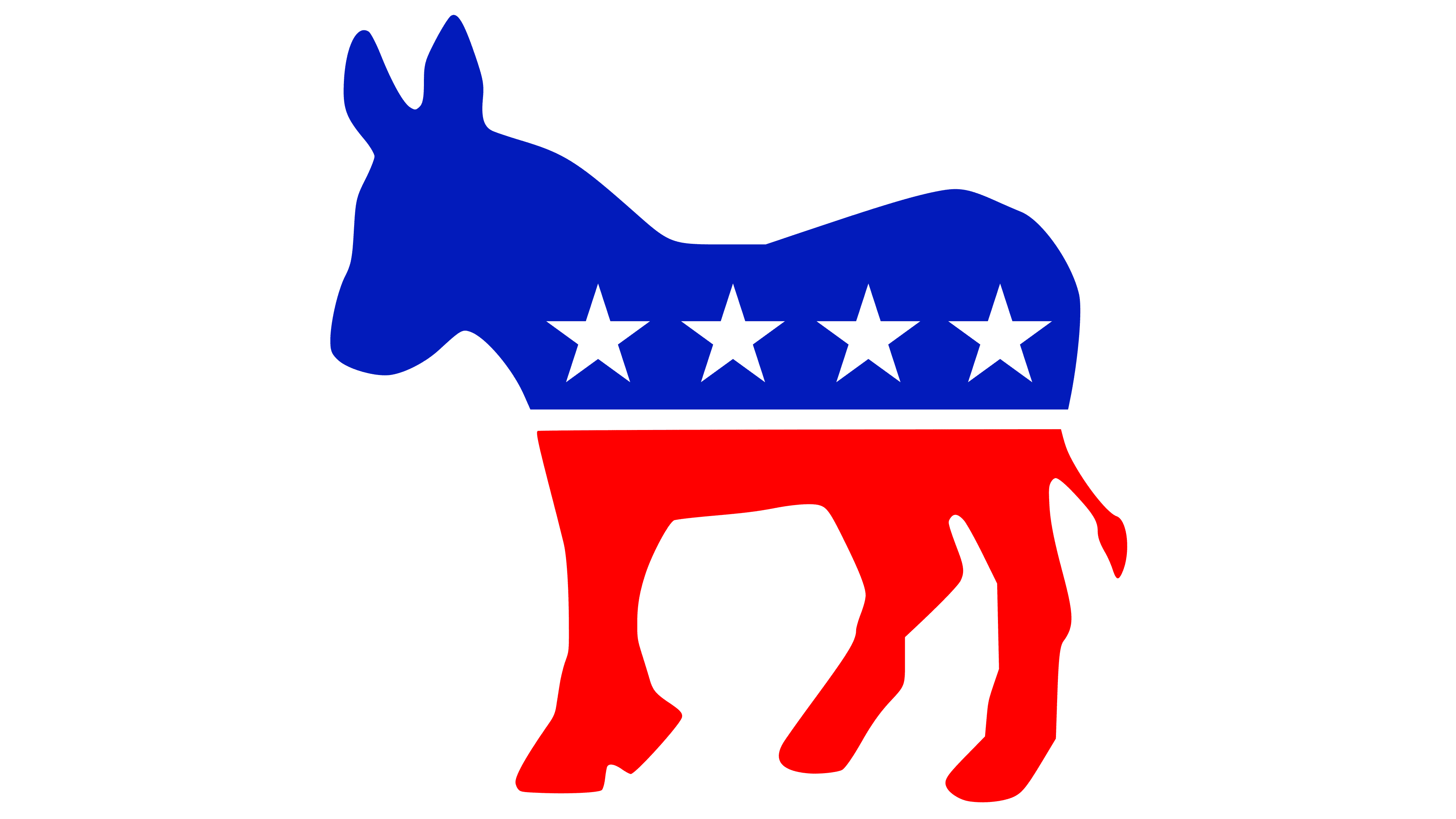
The Democratic Party’s logo features the unofficial symbol of a donkey. It is depicted as an abstract figure with an easily recognizable characteristic silhouette. The top half of the emblem is painted in blue cobalt, and the bottom half in red. A thin white stripe separates them. The upper part also has four stars, representing the American flag and symbolizing patriotism. This emblem is still in use.
2010 – today
Since the donkey is the Democrats’ unofficial mascot, designers did not include it in the new logo. They proposed a neutral option with “D” surrounded by a ring the same width as the letter’s lines. The glyph is uppercase, bold, and grotesque, formed by a single continuous strip. The icon looks like a classic rondel with an accentuated center in this form.
Font and Colors
The Democratic Party emblem’s text is represented by a single typographic element, the uppercase “D.” The letter is block-style, massive, and sans-serif. The logo’s palette is two-colored: red, blue, and white, borrowed from the U.S. national flag. These colors emphasize the party’s patriotism and close connection with the United States of America.