


 UNESCO Logo PNG
The UNESCO logo is built on strict symmetry and restraint, emphasizing the organization’s official status. The ancient temple symbolizes knowledge, culture, and world heritage. The inscription and abbreviation reflect the institution’s mission: safeguarding peace and preserving cultural assets.
UNESCO’s origins trace back to November 1942, when Allied education ministers met in London during World War II. Governments in exile and partners such as the UK, US, and China discussed long-term cooperation in education and culture, arguing that peace required intellectual and moral unity. The idea took shape in the office of British minister Rab Butler.
From 1 to November 16, 1945, delegates from 44 states gathered in London. On November 16, 37 countries signed the UNESCO Constitution. It came into force on November 4, 1946, and the first General Conference was held in Paris later that year, where Julian Huxley became Director-General.
Early work focused on rebuilding schools, libraries, and museums in postwar Europe, alongside literacy campaigns. As newly independent states joined in the 1950s–1960s, attention shifted toward education systems and training in developing regions. In contrast, agencies such as UNICEF and the World Health Organization concentrated on direct aid.
In the 1960s, UNESCO led an international effort to relocate Nubian monuments threatened by the Aswan High Dam, including Abu Simbel. The campaign, supported by over 50 countries, led to the 1972 World Heritage Convention and the creation of the World Heritage List.
In the 1980s, proposals for a new global information order triggered conflict. The US withdrew in 1984, followed by the UK and Singapore, cutting major funding. The UK returned in 1997, while the US and Singapore rejoined in 2003 and 2007.
In 2011, UNESCO admitted Palestine, prompting the US to suspend payments. It withdrew in 2019 and rejoined in 2023. By the mid-2020s, the World Heritage List included over 1,100 sites across 167 countries, and since 2003, it has also covered intangible cultural heritage.
Meaning and History
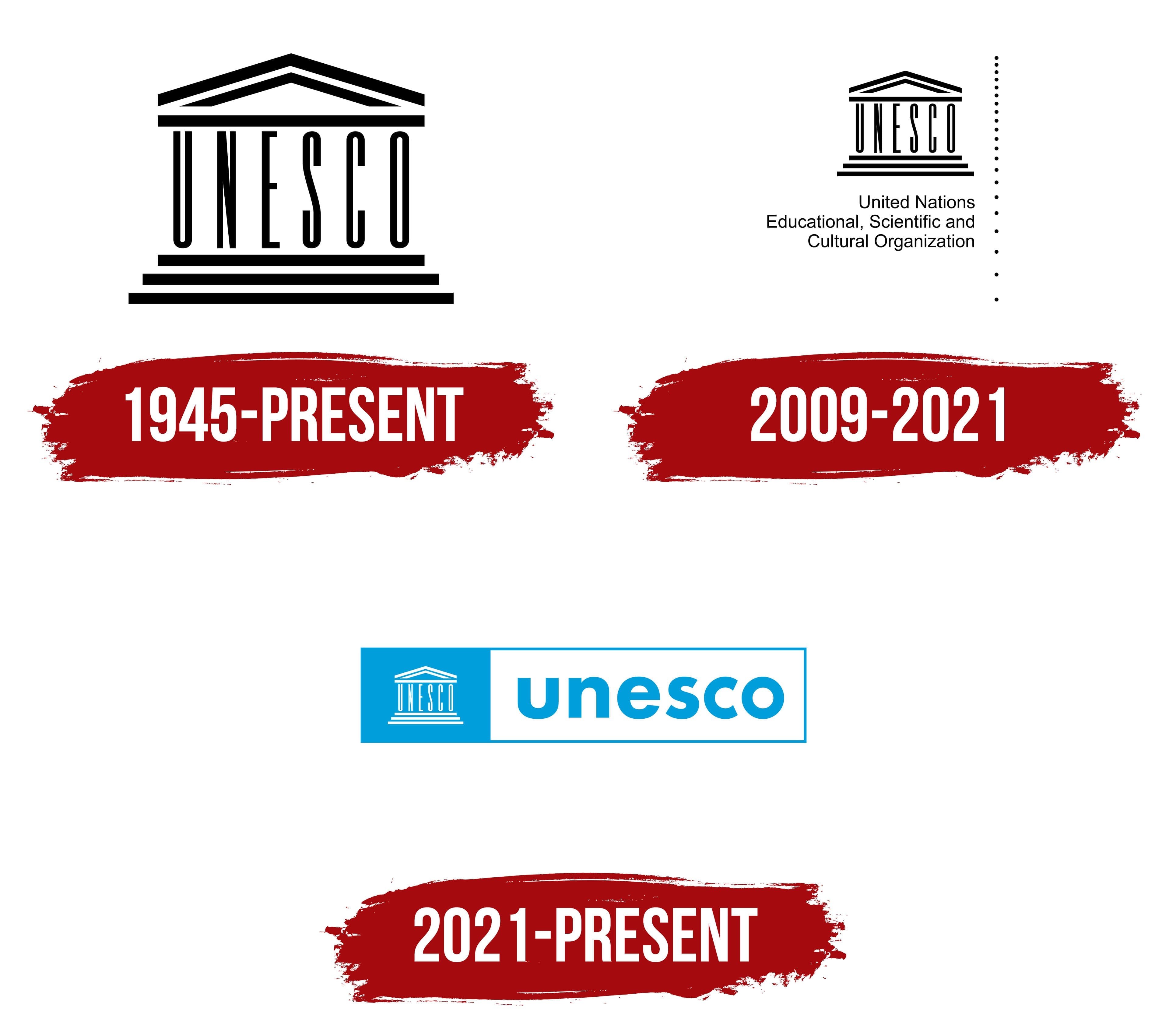
The UNESCO emblem is a stylized name composed of the initials of the United Nations Educational, Scientific, and Cultural Organization. The acronym and the full name are used in the most recognizable logo structure. It symbolizes the organization as a bastion of peace, ready to support good endeavors and humanity’s vanishing heritage.
What is UNESCO?
It is a specialized agency within the UN. It was founded in 1945 to address cultural, scientific, and educational issues. The headquarters is located in the capital of France.
1945 – today

The UNESCO logo symbolizes cultural and scientific education. Its image resembles a classical ancient Greek temple. The organization’s name “UNESCO” is rendered as six thin vertical columns in a restrained typeface similar to Futura Condensed. The letters are narrow and tall, forming a structure that visually mimics the supporting pillars of an ancient building.
The upper part of the mark is crowned with a triangular roof formed by two converging lines, conveying a sense of light perspective. Beneath them runs a horizontal band that marks the boundary between the architectural pediment and the lettering. The overall composition evokes the monumentality of ancient temples, which have long symbolized human achievement and enduring knowledge.
The base consists of three horizontal steps placed one after another and widening toward the bottom. The evenly spaced lines resemble a pedestal. Together with the letter columns and the roof, they create a unified image of an ancient structure that visually conveys a stable foundation for education, culture, and science.
The logo is rendered in monochrome. Its simple execution and rich meaning make the UNESCO logo a symbol of its global mission: preserving and disseminating knowledge, culture, and science.
2009 – 2021
In 2009, UNESCO adopted an expanded logo that emphasized its official status and brought the elements under a single structure. To the already familiar symbol, in which the letters of the name form an ancient temple with a triangular roof, the organization added its full English name: “United Nations Educational, Scientific and Cultural Organization.” The inscription is set in a simple typeface and placed beneath the building image in three neat lines.
On the right, a vertical row of small, identical black dots closes the composition. They run straight across the entire logo from top to bottom.
The entire structure represents the organization as a house of education, culture, and science, drawing on ancient imagery and reinforcing its mission in the realm of knowledge.
2021 – today
In the new version, the UNESCO logo looks different, although the symbol within it has remained unchanged since the organization’s founding in 1945. The entire mark is placed within a horizontal rectangle outlined by a thin, bright blue line.
The interior space is divided into two blocks. The left square is filled with the same bright blue and contains a simplified building symbol with letter columns and a pediment. The architectural silhouette remains the same, preserving its main proportions and shapes.
The right side of the composition features the organization name in lowercase sans-serif letters. The typeface is rounded and blue, resembling modern grotesques such as Nunito or Google Sans.
The composition is monochrome and flat. Pairing the historical symbol with a modern typeface highlights a balance between tradition and contemporary presentation. The organization demonstrates continuity by recalling its enduring mission in science, education, and culture.
Font and Colors

The emblem’s color palette consists of blue-gray, black, green, white, and brown. The palette choice depends on the purpose of use and the emblem’s location. The same applies to the full inscription at the bottom: depending on the document type, it may be placed on the steps, beneath them, or as a column.

Like the organization it represents, the logo’s concept is incredibly important. The emblem symbolizes the fight against discrimination in education and research on national cultures, and the promotion of a common human heritage. It also denotes assistance in addressing problems in the social sciences, information, geology, oceanography, and environmental protection.