


 Estée Lauder Logo PNG
The Estée Lauder logo features an elegant, refined style. The interlacing lines form a monogram that conveys luxury and lightness. The style highlights the brand’s premium character and its connection to beauty and fragrance.
Estée Lauder’s story began before the company existed. Born Josephine Esther Mentzer in Queens, she learned skincare from her uncle John Schotz, a dermatologist who mixed creams and lotions. As a teenager, she helped produce and sell them, meeting clients directly in salons and beach clubs.
In 1946, Estée and Joseph Lauder registered Estée Lauder Cosmetics in New York. The initial range included four products. She built the business through in-person demonstrations and introduced the “gift with purchase” tactic. In 1948, the brand secured a key order from Saks Fifth Avenue.
A turning point came in 1953 with Youth Dew, a bath oil that functioned as perfume. The product reshaped consumer behavior and drove rapid growth. In 1960, the brand entered Harrods in London, marking the start of international expansion.
In 1964, Aramis launched as a premium men’s line. In 1968, Vogue editor Carol Phillips founded Clinique as a fragrance-free dermatological brand. Prescriptives followed in 1979, and products reached the Soviet Union in 1981.
Origins was introduced in 1990. The company went public in 1995 while remaining family-controlled. The decade included acquisitions such as M·A·C Cosmetics, Bobbi Brown, Aveda, and La Mer, followed later by Jo Malone London, Too Faced, Dr. Jart+, and Tom Ford Fashion.
Estée Lauder died in 2004. By then, the company operated in over 130 countries. Leadership passed to Leonard Lauder and later to William Lauder. In 2024, revenue reached $15.6 billion, amid slowing sales in China, prompting the “Beauty Reimagined” program in 2025.
Meaning and History
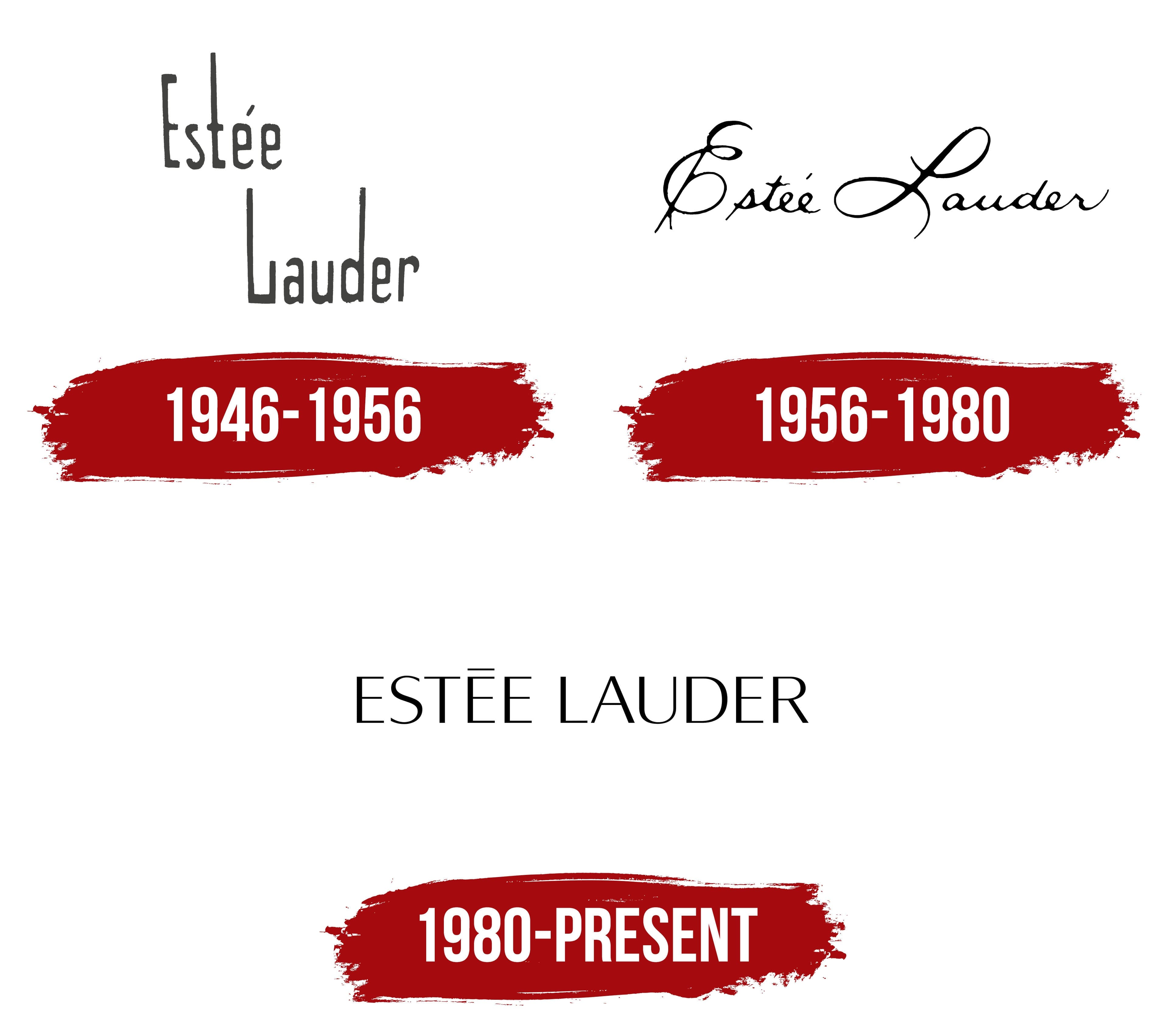
The owner created the company logo herself. The general style has remained almost unchanged. Any adjustments were minor and did not fundamentally affect the design. Overall, the logo has had three minor updates.
What is Estée Lauder?
It is a multi-brand manufacturer of decorative cosmetics, fragrances, skin, and hair care products. Founded in the U.S. in 1946, the company initially sold only face creams. Today, it is considered a beauty industry leader, owning brands such as La Mer, Bobbi Brown, and Clinique. Their products are known for their innovative formulas, as Estée Lauder invests millions of dollars in developing new technologies.
1946 – 1956

The early Estée Lauder logo dates to the brand’s 1946 founding in the United States. The lettering conveys the era’s aesthetic and overall mood.
The inscription is arranged on two levels. Some letters are elongated. The initial letters “E” and “L” are tall and extend upward, creating a visual accent and giving the wordmark an elegant appearance, while the letters “t” and “d” add extra refinement to the overall look.
The upper line, “Estée,” shifts slightly left, while the lower word, “Lauder,” sits further to the right. This logo marks an early stage in the brand’s journey, when the company was first establishing itself in the cosmetics market. The lettering conveys an atmosphere of craftsmanship and careful attention to detail that characterized Estée Lauder from its earliest years.
1956 – 1980
The evolution of Estée Lauder’s identity in the new logo highlights the brand’s individual character through an elegant imitation of the founder’s handwritten signature. At first glance, it is clear that this is a cosmetics brand where handwork and attention to nuance are inseparable from the Estée Lauder name.
The lettering is executed in a calligraphic script that resembles smooth pen strokes. All letters connect into a single flowing line except for the capital letter, with no breaks, forming a cohesive, harmonious rendering of the name. In the first word, “Estée,” the letter “E” is capitalized. In the second part, “Lauder,” the main emphasis is also on the capital letter “L,” which begins with a curve that forms a large loop.
The script’s overall style evokes old handwritten correspondence in ink. The logo preserves the living energy of hand movement, demonstrating the brand’s connection to craftsmanship and refined beauty.
1980 – today

In its current form, the Estée Lauder logo reflects the company’s modern style with restraint and precision. The name ESTĒE LAUDER is set in all caps on a single line. The typeface is neo-grotesque, with thin strokes and slight weight variations. It is stylistically similar to Didot and Optima.
A distinguishing feature is the unusual treatment of the letter “Ē.” A horizontal bar appears above it, parallel to the letter’s top edge. This nonstandard diacritical mark lightens the wordmark.
The entire inscription appears balanced and unobtrusive. It effectively conveys Estée Lauder’s pursuit of purity, restraint, and refined elegance.
Emblem
There is a brand symbol. It consists of the outlines of the capital letters “E” and “L,” drawn by hand with graceful, rounded strokes. The letters intertwine to form a stylized signature. It resembles a monogram enclosed within a thin-framed square. Outwardly, it is a simple mark of strict geometric form, yet inside it is intricate, composed of several intersecting lines that express the aristocratic grace of the company’s founder.
Font and Colors

The brand and company logos still differ. The first uses a simpler font, without serifs or decorative end elements, which dominate the opening symbolism. Curved lines of varying widths form a complex monogram. Thanks to the concise design, the emblem is much easier to interpret.

The color palette is not monotonous either. Thus, monochromatic options include white letters and edging on a black background and frame. Dark blue and its greenish-blue variation (slightly darker than emerald) are also used. The brand owner herself invented this shade, so it’s called Lauder Blue.