FCA Logo PNG
The designers who created the FCA logo incorporated the organization’s name into it. It is presented in two versions: full and abbreviated. The abbreviation appears on the left side and is partially inscribed in a parallelogram. The phrase “FINANCIAL CONDUCT AUTHORITY” is in the right part of the emblem and occupies three lines.
The UK Financial Conduct Authority dates back to 1985, when the Securities and Investments Board, or SIB, was created. At the time, financial services were overseen by separate bodies for different sectors. In 1997, the UK Treasury began creating a single financial regulator: the Financial Services Authority (FSA). The Financial Services and Markets Act 2000 gave it legal powers, and on December 1, 2001, the FSA formally began work.
The unified model reflected a broader regulatory shift, also evident in bodies such as the US Securities and Exchange Commission, founded in 1934, and Germany’s BaFin, founded in 2002. The 2008 financial crisis damaged the FSA’s standing after major bank failures. Its reputation was further weakened by the PPI mis-selling scandal and the LIBOR manipulation scandal, in which major banks falsified benchmark rates for their own benefit.
In June 2010, the government announced that the FSA would be abolished. The Financial Services Act 2012 created the legal basis for the change. On April 1, 2013, the FSA was replaced by the Financial Conduct Authority and the Prudential Regulation Authority. FCA took responsibility for market conduct and consumer protection, while the PRA oversaw major banks, insurers, and investment firms.
FCA is independent of government and funded by fees from the financial industry. It later imposed major penalties, including £87.5 million against RBS in 2013, £226.8 million against Deutsche Bank in 2015, and £1.1 billion across five banks for foreign exchange misconduct. It launched Project Innovate and the regulatory sandbox for fintech testing. In 2020, Nikhil Rathi replaced Andrew Bailey as chief executive, introduced Consumer Duty, led listing reforms, and was reappointed in 2025 until September 2030.
Meaning and History

The Financial Conduct Authority, better known as FCA, uses both versions of its name in the logo. Its first wordmark appeared in 2013, when the Financial Services Act 2012 came into force, signaling the abolition of the Financial Services Authority and the creation of a new UK financial control system. The designers played with the three letters of the abbreviation, presenting them in different colors within negative space. Later, they changed the emblem’s structure, making it more minimalist. The design work involved separating the inscriptions and removing a common base.
What is FCA?
FCA is the Financial Conduct Authority. It is an independent UK government body that oversees financial institutions. It was formed in 2013 and replaced its predecessor, the Financial Services Authority. It regulates mutual aid societies, banking firms, and independent financial consultants.
2013 – 2017
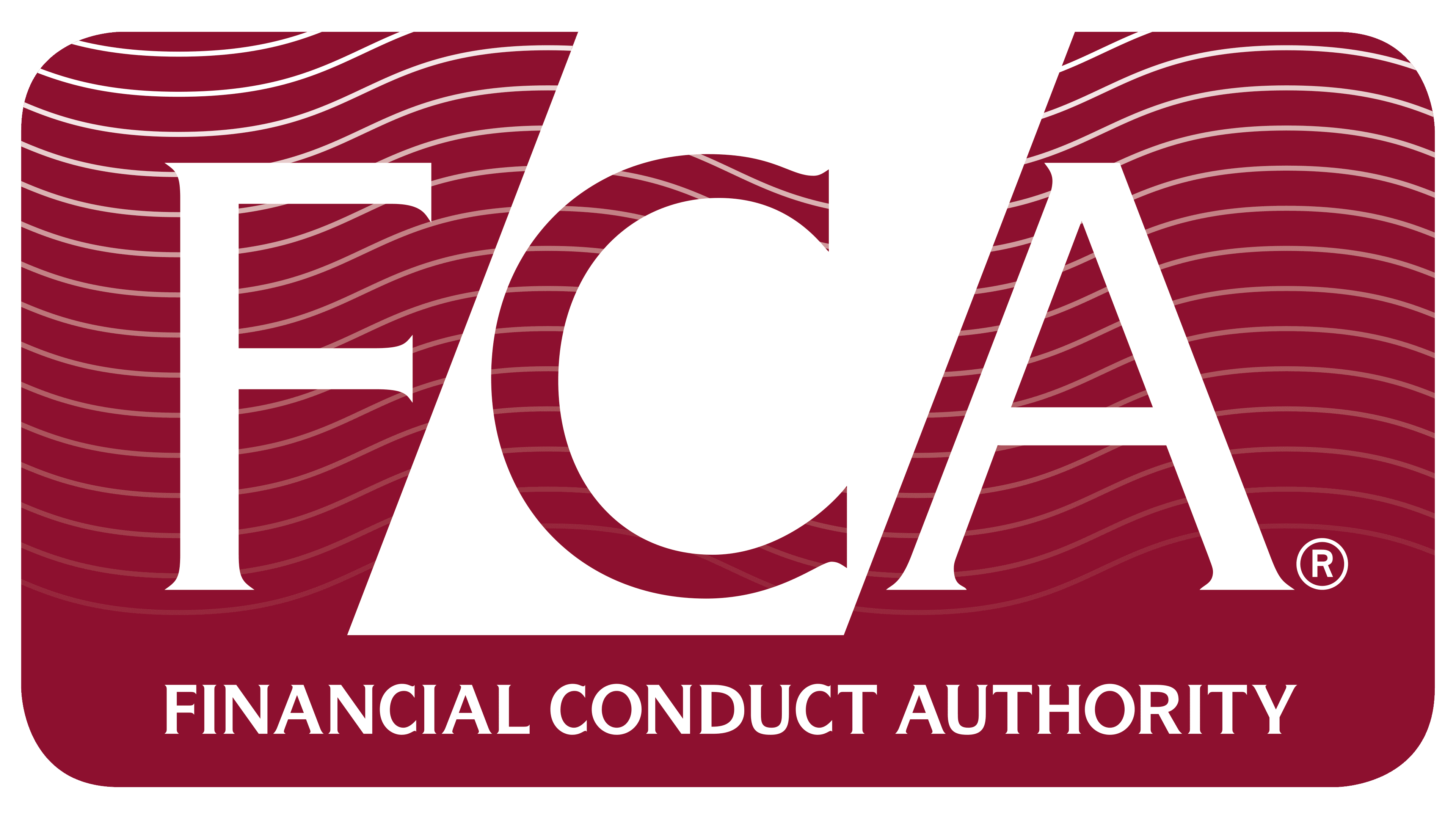
The first logo took the form of a bank card: a horizontally oriented rectangle with rounded corners. The designers chose this association because the FCA has regulated banks, credit unions, and independent financial consultants since its inception. However, the emblem’s base wasn’t solid: the top half lacked a center. In its place was a white, parallelogram-shaped depression. All the remaining space was painted in a burgundy gradient with many light, wavy horizontal lines.
At the top was the abbreviation “FCA.” The white “F” and “A” filled the free space on the sides, while the burgundy “C” with a striped pattern sat in the middle, with a missing section at the base. Below the large letters, the phrase “FINANCIAL SERVICES AUTHORITY” was written in small font. All the glyphs were uppercase and had short, sharp serifs.
2017 – today
In 2017, advertising giant Saatchi & Saatchi developed the regulator’s current logo and was paid 57,600 for the full range of services. After the redesign, which was timed to coincide with the move to new offices in Stratford, the common base disappeared. The letters “FCA” sat on the left, with two of them (“F” and “A”) now in purple on a blank white background, while the middle “C” was painted white and set inside a purple parallelogram.
The cuts at the ends of the horizontal strokes of “F” and the slant of the left diagonal of “A” are parallel to the quadrilateral’s sides, creating visual harmony. The organization’s full name appears to the right of the abbreviation and is set in three left-aligned lines. The bold sans-serif font looks imposing and solid.
The geometric symmetry and clear shapes align with the organization’s essence. After all, it should convey correctness, structure, consistency, reliability, and incorruptibility. At the same time, the emblem is disproportionate: the white letter “C” inside the purple parallelogram stands out from the overall picture. This demonstrates the Financial Conduct Authority’s innovation and modernity.
Font and Colors
When creating the new logo for FCA, the designers at Saatchi & Saatchi started with the idea that the words “FINANCIAL CONDUCT AUTHORITY” should be highly visible, clear, and legible. Therefore, they used a bold sans-serif font for the inscription, similar to Durotype’s Aspira Wide Bold. Notably, the standalone letter “F” in the abbreviation is cut at the ends, parallel to the adjacent sides of the parallelogram. The wordmark’s main colors are white and purple.