


 Fendi Logo PNG
The emblem’s symbols contain diversity and harmony. The Fendi logo is stylish and perfectly balanced, as is the image created by the company’s accessories. The company offers a full range of products for a flawless toilet.
Meaning and History
The Fendi fashion house is named after the spouses of its founders, Adele Fendi and Edoardo Fendi. Adele opened his first store in 1918, but the company’s official founding date was 1925 when the young entrepreneur married Edoardo. Later, all their children joined the business, including five daughters who saved it after World War II. Together, they restored Fendi’s status as a prestigious manufacturer.
They would have failed without Karl Lagerfeld. He was first hired to modernize a fur line, but in 1962, the German designer signed a lifetime contract and became Creative Director, laying the foundation for the new brand. He completely changed the collections’ style, transforming rough, heavy clothes into sophisticated, flowing outfits. In addition, the “king of fashion” influenced Fendi’s image. Lagerfeld designed the famous Double F, believing that the emblem is the core of any globally recognized brand.
The monogrammed symbol once adorned most Fendi products. It was on clasps, straps, bracelets, and the inner lining of bags. It was used on black-and-tobacco jacquard fabric. The letter emblem became especially popular in the 1980s. However, with the onset of the new millennium, it faded into the background: it was completely replaced by the logo with the inscription “FENDI.” The Double F received a second life in 2018. After a revival, the iconic sign retained the spirit of the original but took on a modified form and was downgraded to a secondary symbol.
What is Fendi?
Fendi is a fashion house based in Rome, owned by the conglomerate LVMH Moët Hennessy Louis Vuitton. It was named after its founders, who opened a shop selling fur and leather goods in 1925. Since then, the company has repeatedly returned to leather and fur products, creating exclusive collections using expensive materials. Today, it produces accessories, clothing, footwear, and perfumes, upholding the principles of luxury and innovation.
1925 – 1965

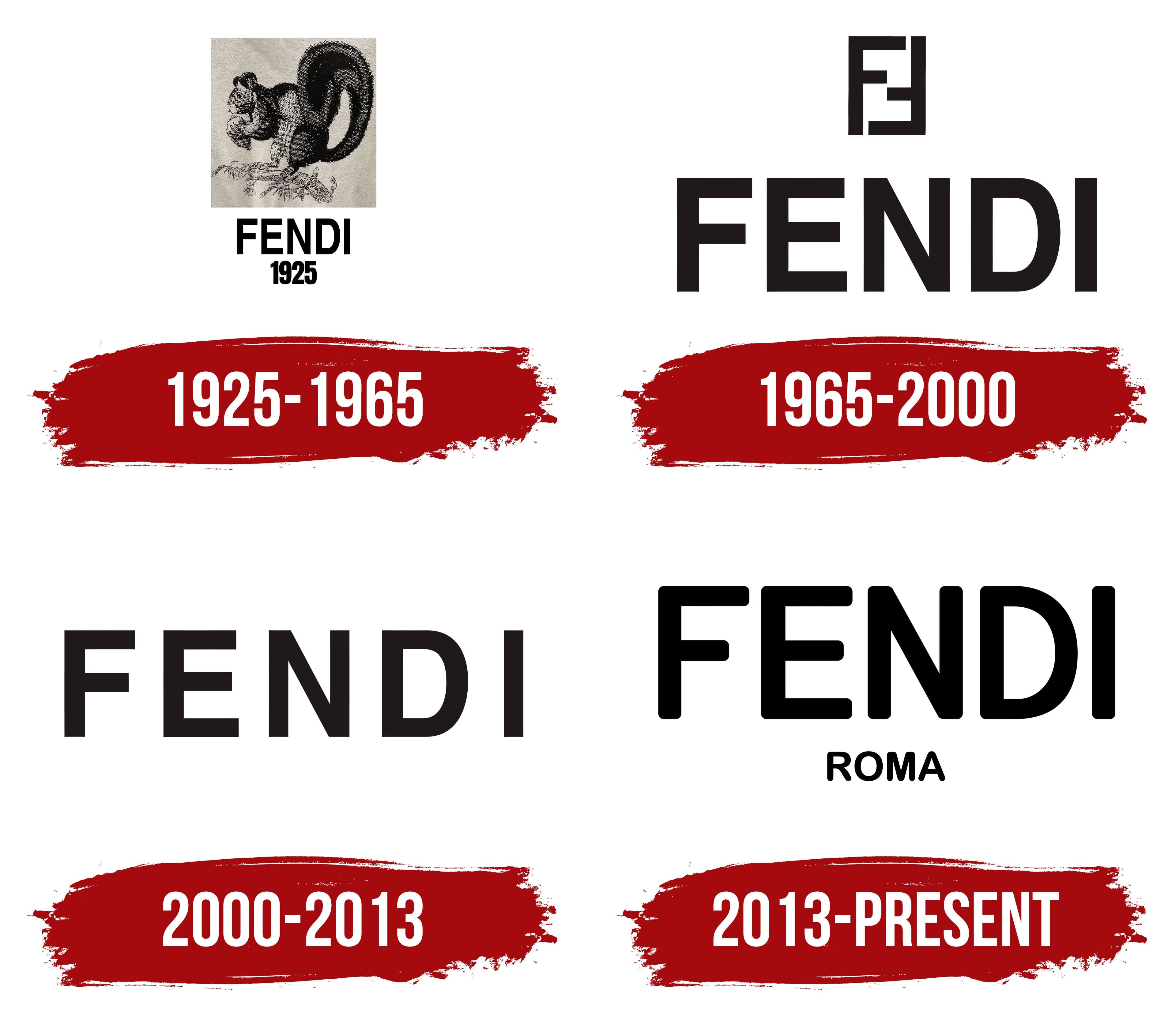
The badge, consisting of the two letters “F,” appeared only after Karl Lagerfeld’s arrival. Before that, the company’s mascot was a squirrel who gnawed a nut while sitting on a tree branch. The illustration sat inside a light-yellow square, and the space below it held the company’s name and founding year. The lettering “FENDI 1925” was blue-green.
The squirrel image was no accident. Edoardo compared his wife to this animal because she was constantly working. So, the brand’s debut logo symbolized the Fendi family.
1965 – 2000

In the early 1960s. Karl Lagerfeld created the iconic double FF badge known as the inverted Zucca. Later, the Parisian designer admitted in an interview that it took only three seconds. The inspiration came from the first meeting with the Fendi sisters, who made Karl Lagerfeld the brand’s artistic director. The designer never imagined how famous the result of his lightning-fast creativity would become.
In 1965, the company also began using a minimalist wordmark featuring the single word “FENDI” instead of the squirrel logo. The short lettering used bold, sans-serif capital letters, with strokes of uniform thickness. The Double F symbol sat above it.
2000 – 2013

The inverted Zucca became incredibly popular, peaking in the mid-1980s. But by the early 1990s, people stopped wearing clothing with emblems because they were considered in bad taste. Therefore, the fashion house abandoned its iconic “FF” monogram, retaining only the stylish lettering. The shapes and proportions of the signs have not changed.
2013 – today

In 2013, the designers updated the logo text for the first time. They rounded the edges of the letters so no corners were left. The word “ROMA” is in the same font as the one at the bottom. It denotes the city where the company was founded. This version of the identity is very similar to the first sign in 1925. At least the developers tried to draw parallels between them.
In the distant past, Fendi had a monogrammed emblem of two Fs. One letter (on the left) stood upright, and the other (on the right) was inverted, forming a rectangular shape. This symbol represented the core of Karl Lagerfeld’s concept, summed up in the phrase “Fun Furs.” According to another version, the two “F”s came from the company’s founders: Adele Fendi and Edoardo Fendi.
The company used its iconic sign to decorate everything – from clothes to accessories. But he exhausted himself when minimalism came into fashion, and global manufacturers abandoned their obsessive desire to cover dresses, T-shirts, and bags with their logos. In line with current trends, Fendi has removed the Double F from its main logo.
Font and Colors

The company name has always been written in capital letters using a bold sans-serif typeface. Previously, the fashion house favored Helvetica Bold. Linotype Foundry published this grotesque in 1983. The typographers who developed it adhered to simplicity, purity, and minimalism, which perfectly complemented the Fendi aesthetic. In 2013, designers chose a custom typeface for the wordmark with rounded ends, similar to Sommet Rounded.

The main logo is black (# 000000), although Fendi branding guidelines also allow white lettering on dark backgrounds. This combination (black plus white) symbolizes elegance and excellence. Another valid color is yellow (# FDDB00). According to official documents, the company name and surrounding space can be painted white. The palette choice depends on the visual context, as the Fendi brand must always create contrast.