 FIFA World Cup Logo PNG
The FIFA World Cup logo conveys the tournament’s global status and significance. Its visual design emphasizes the unity of different countries and cultures at the largest international sporting event.
The tournament’s history began with the founding of FIFA in Paris in 1904. Jules Rimet, who became president in 1921, pushed for an international competition independent of the Olympic Games. The first World Cup was held in Uruguay in 1930. The hosts defeated Argentina in the final at Estadio Centenario, and the main trophy later carried Rimet’s name.
The competition stopped during World War II, with the 1942 and 1946 editions canceled. It returned in Brazil in 1950, where Uruguay defeated the hosts at the Maracanã in the match remembered as the Maracanazo. Brazil then became the dominant national team of the next two decades, winning in 1958, 1962 and 1970. Pelé emerged as the era’s leading figure, and Brazil kept the Jules Rimet Trophy after its third title.
A new trophy was introduced in 1974, when West Germany beat the Netherlands in the final. Argentina won in 1986 behind Diego Maradona, whose quarterfinal against England produced the “Hand of God” goal and his famous solo run. The tournament expanded to 32 teams in 1998. In 2010, South Africa became the first African host, and Spain won the title.
Russia hosted in 2018, while Qatar staged the 2022 edition in winter, forcing major European leagues to alter their calendars. Argentina beat France on penalties in the final, giving Lionel Messi the last major trophy missing from his career. In 2026, the tournament will expand to 48 teams and be staged across the United States, Canada and Mexico.
Meaning and History
What is FIFA World Cup?
It is the world’s premier international soccer tournament for national teams, held every four years, attracting huge global audiences. Qualifying rounds start several years in advance, and the final tournament lasts about one month. The winner receives a famous gold trophy, and the tournament’s best player receives a separate award. Host countries showcase their culture, traditions, and sports facilities.
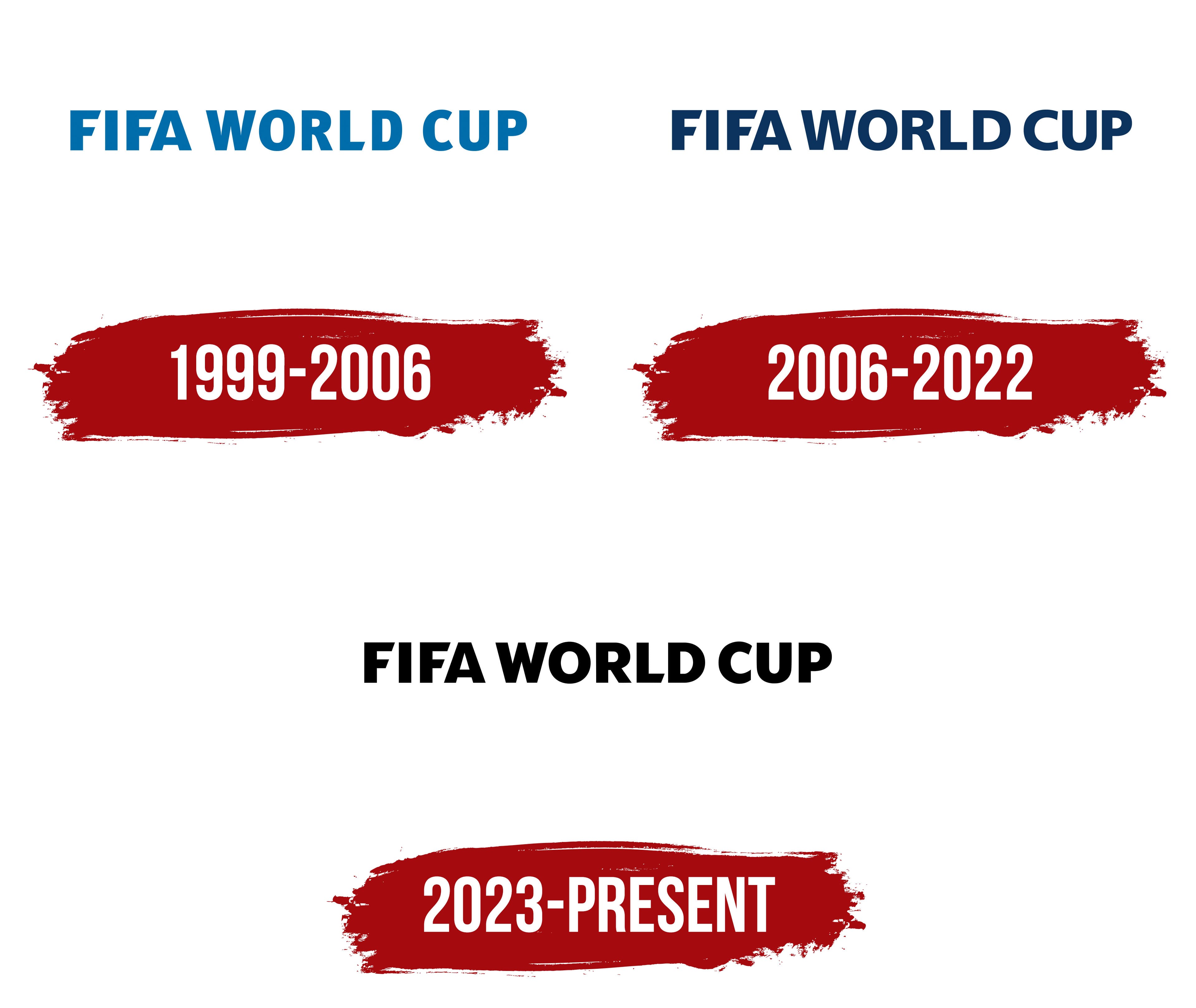
1999 – 2006
This was FIFA’s first attempt to create a unified visual identity for the tournament that was not tied to a specific host country or individual championships. Before this period, each host nation had its unique symbolism, such as Mexico 1986 or the USA 1994. By the late 1990s, however, FIFA saw the need for a permanent corporate mark to be used between competitions.
The logo introduced in 1999 consisted solely of the text “FIFA WORLD CUP,” set in a strict sans-serif typeface. All letters were uppercase, with uniform stroke thickness and geometrically precise proportions. The glyphs were characterized by straight forms and wide letter spacing, creating an impression of solidity and formality.
The rich blue color palette was chosen as FIFA’s official color to symbolize unity, reliability, trust, and the international scale of the event. The shade was associated with courage and the pursuit of victory.
The logo served as neutral, universal branding between individual World Cups. It appeared on FIFA corporate documents, official flags, promotional materials, television graphics, and federation events. Its first widespread use came during preparations for the 2002 tournament in South Korea and Japan. However, that event had its own separate logo.
The specific type designer is unknown, but in the late 1990s, FIFA collaborated closely with major European agencies, including Interbrand and Studio Dumbar. It is quite possible that they were responsible for the design.
2006 – 2022
The next update to the logo was an evolution of the previous identity, expressing FIFA’s goal of even greater brand unity in the era of digital media. Unlike the 1999–2006 version, the new design retained the typographic foundation but introduced updated lettering and a deeper color palette.
The words “FIFA WORLD CUP” were set in uppercase letters using a bold sans-serif typeface. In the first part of the inscription, the word “FIFA” featured a font almost identical to the previous version, retaining the characteristic slanted cuts on the horizontal strokes of the letter “F.” The second part, “WORLD CUP,” used a different typeface similar to Frutiger Cyrillic 75 Black. Compared to the earlier version, the letters became slightly narrower with reduced spacing, increasing visual compactness and improving legibility in digital formats.
The color palette shifted toward a richer dark blue. This tone emphasized the organization’s prestige, authority, and stability, while visually marking a new stage in the brand’s development. It also unified various FIFA competitions under one style, including the Women’s World Cup and the eSports World Cup.
2023 – today
The FIFA World Cup logo, introduced in 2022, reflects the organization’s renewed approach to minimalism and digital adaptability. Compared to the previous version, the design was simplified to its maximum extent, with an emphasis on the text.
The words “FIFA WORLD CUP” are set in solid black and written in uppercase letters. The typeface is a wide, bold sans serif with clean, geometrically precise shapes and consistent stroke thickness. The style is closely related to the custom FIFA Display typeface, developed as part of the organization’s global visual system update, which was presented ahead of the World Cup in Qatar. Minimal letter spacing gives the design compactness and ensures maximum legibility in all conditions, from smartphone screens to billboards.
The use of black emphasizes the brand’s official status, authority, and international standing, allowing the logo to integrate seamlessly into any background composition. Abandoning the blue palette traditionally associated with FIFA was a step toward universality and neutrality, making the mark adaptable to a wide range of media and cultural contexts.
The design was created by the international branding agency Works in London in collaboration with FIFA’s in-house design team. The visual approach aimed to create a unified, recognizable, and highly functional style for all divisions of the organization, encompassing digital projects and women’s and youth tournaments.