


 March Madness Logo PNG
The March Madness logo, used by the television broadcast, fully aligns with the emblem of the NCAA Division I men’s basketball tournament, an annual elimination tournament to determine the best team. They share the same concept, expressed in traditional elements, and a deep idea conveyed in a classic design.
March Madness began in Illinois, before the phrase became tied to the NCAA. In 1939, Henry V. Porter of the Illinois High School Association used it in an essay for Illinois Interscholastic, describing the state high school basketball tournament, which had grown from a 1908 event into a major competition with more than 900 schools.
The NCAA tournament started independently in the same year. Ohio State coach Harold Olsen helped create the first national college basketball championship, with eight teams. On March 27, 1939, Oregon defeated Ohio State 46-33. At the time, the National Invitation Tournament, founded in 1938, was still the more prestigious college event.
The NCAA field expanded slowly, reaching 16 teams in 1951, 32 in 1975 and 64 in 1985. Television changed the event’s status. In 1982, CBS took over from NBC, and Brent Musburger began using “March Madness” on air during a tournament filled with upsets. That same year, North Carolina freshman Michael Jordan hit the winning shot against Georgetown in the final.
The phrase later became a legal asset. IHSA, Intersport and the NCAA fought over rights before forming March Madness LLC in 2000. In 2010, the NCAA bought out Intersport’s IHSA license for $17.2 million. The field grew to 68 teams in 2011, with CBS and Turner Broadcasting sharing coverage. “One Shining Moment” became part of the Final Four in 1987, and in 2022, the NCAA extended March Madness branding to the women’s Division I tournament.
Meaning and History
The project began with the risk that leading U.S. television studios would lose the rights to broadcast men’s basketball tournaments. ESPN tried to outpace everyone to become the sole media owner for future game broadcasts. However, the NCAA renegotiated its contract with CBS and Turner Sports (later, this division transitioned to Warner Bros. Discovery, as its parent studio WarnerMedia was acquired). This initiated the era of two March Madness brands with the same name and identical emblems, sports, and television. This way, they demonstrate their close interconnection.
What is March Madness?
March Madness is a television broadcast that has been in existence since 2011, airing matches held in the NCAA Division I men’s basketball tournaments. It covers everything happening on the sports field, as the sole officially permitted media outlet. The competitions are conducted with the support of CBS Sports and Warner Bros. Discovery Sports and broadcast in the USA on channels like truTV, TBS, TNT, and CBS.
2011 – 2014
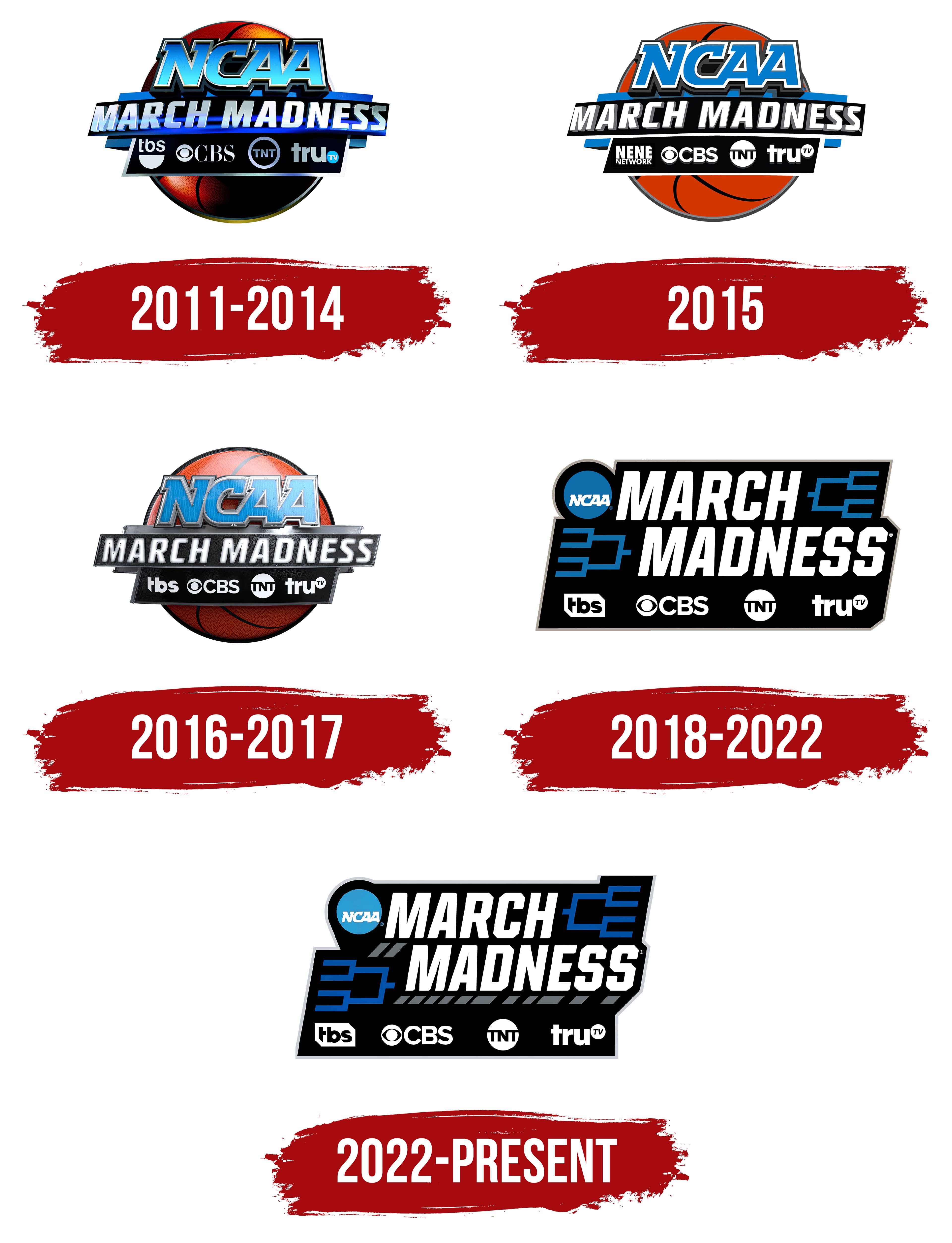
The key element of the logo is a basketball. It “holds” all other details, acting as a thematic background. The gradient is distributed such that the ball’s top side is light, and the bottom is dark. In the foreground, inscriptions are divided into three lines. The first is reserved for the single word “NCAA.” It’s slanted, continuous, extra bold, and provided with serifs veering left. All letters are colored blue and framed in silver. The second line is the longest, containing the brand name “March Madness.” This part is executed in bold grotesque with white-blue glyphs. In the bottom row, on a black rectangle, are the logos of channels broadcasting the basketball tournaments: TBS, CBS, TNT, and truTV.
2015
The old structure of the March Madness logo is completely preserved, but the style has become simpler for easier viewing across different devices. The gradient and color depth are things of the past. Now, precise, uniform colors reign without shade changes: yellow, light blue, black, gray, and white.
2016 – 2017
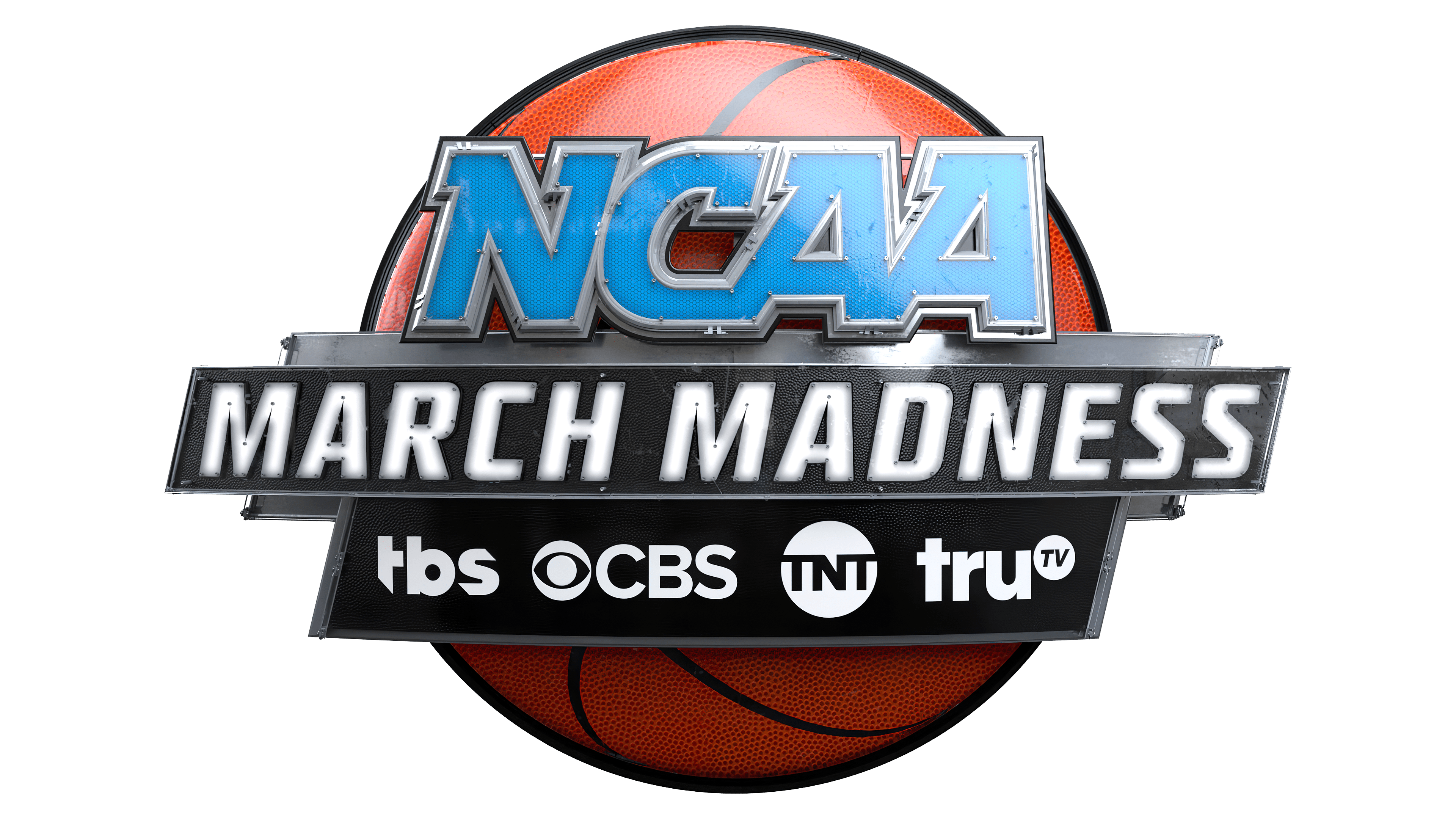
The designers changed the yellow color to brick red and added a gradient that creates a bright reflection on the basketball. They also toned down the color intensity of the black background with inscriptions, resulting in a muted black color with a pastel shade. The top line again appears three-dimensional due to glare on the last two letters of “NCAA.” The gray shadows in the middle row moved from the outer side of the glyphs to the inside, meaning they previously formed half-frames but now look like dust at the edge of the signs. The emblem also featured black and silver dots and a chrome plaque behind the phrase “March Madness.”
2018 – 2022

The redesign of the March Madness logo resulted in a complete change of the familiar format. Almost all traditional elements disappeared from the emblem, and the remaining ones were relocated. For example, the name of the sports broadcast occupies not one but two lines. The inscription is now as large as possible, bold, and chopped. A slight right slant is retained. The word “NCAA” was recolored to white and reduced, placed in a small blue circle at the top left. The background became entirely black. The channel logos also changed.
2022 – today
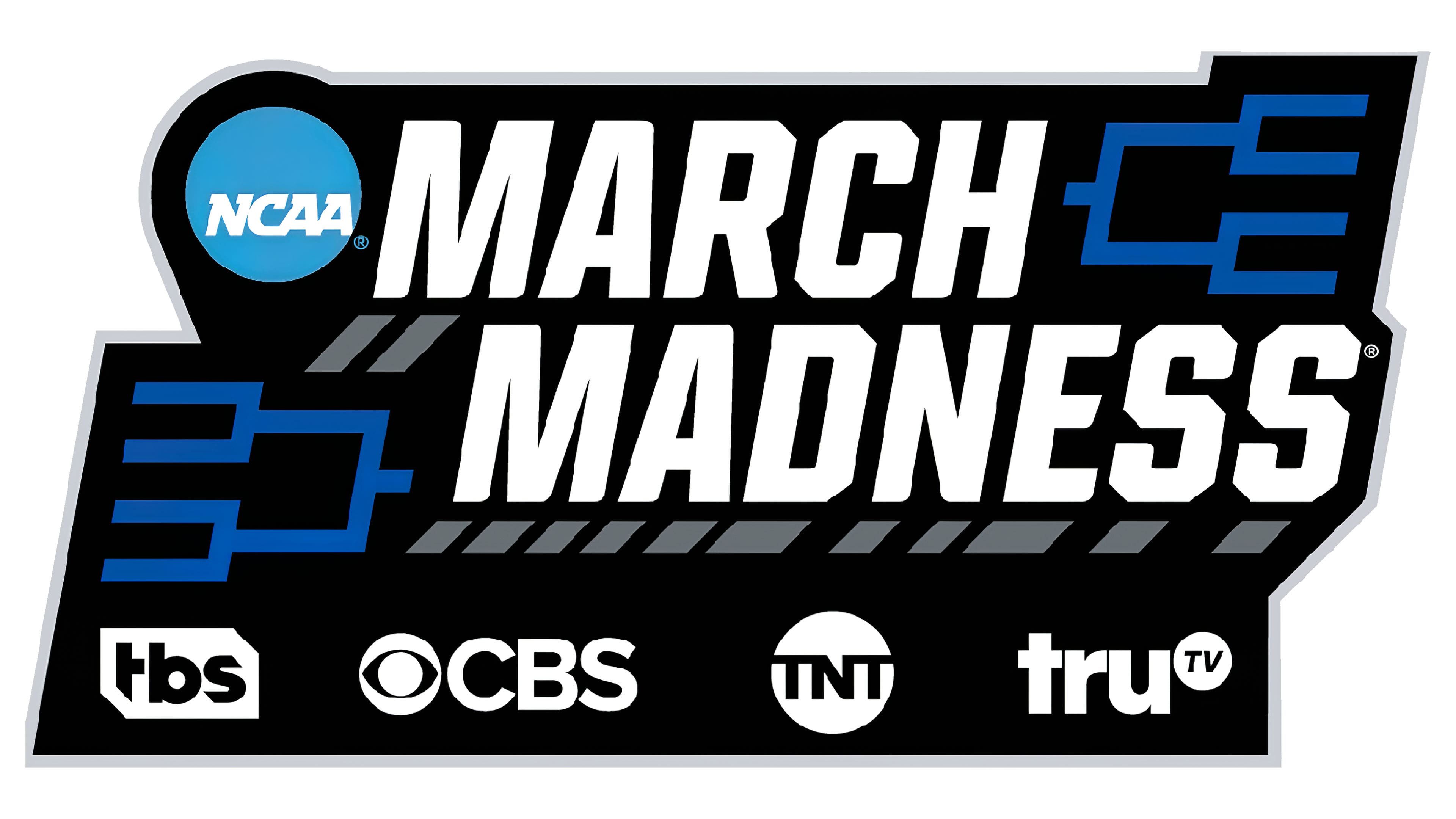
This version of the logo is almost identical to the previous one, except for two minor details: the colors and the shape of the catches. The background geometric shape turned coal-black and received a previously trimmed corner at the bottom right. Designers added volume to the inscription using gray parallelograms that form short shadows under the letters.
Font and Colors

The inscription in the March Madness logo is done in a custom font developed by Joe Bosack & Co. specifically for the NCAA. It’s called NCAA Legacy. Its geometric letters with numerous cut corners look strict yet dynamic. The closest substitutes are Garamond and Arial Black.
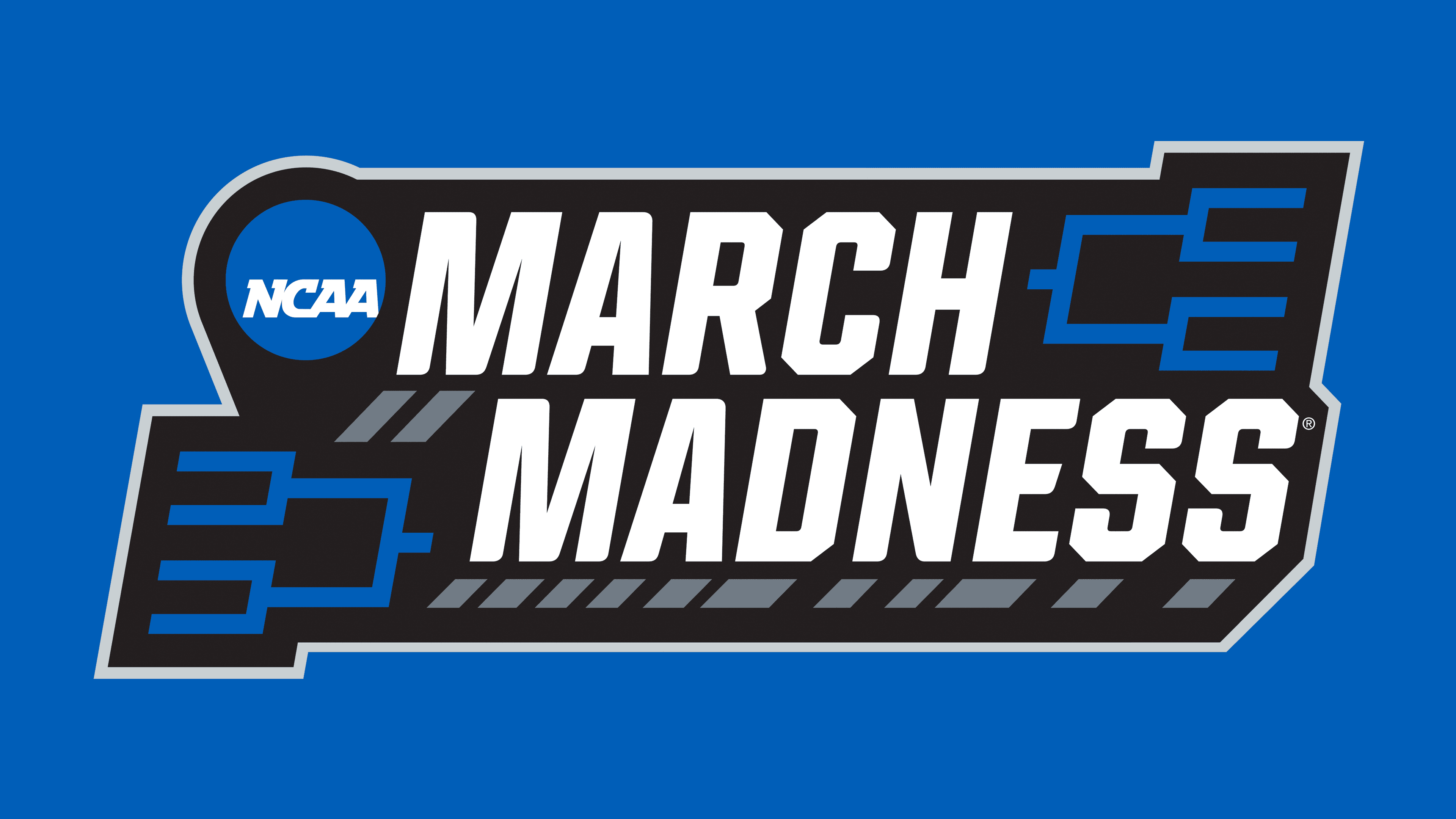
The color palette of the television broadcast emblem is restrained, with no bold tones, despite the presence of red. It is closer to a brick shade. There are also yellow and blue in light and dark variants, as well as white, gray, and black.