


 Fnatic Logo PNG
Fnatic’s logo symbolizes unity and teamwork. The emblem demonstrates the power of collective effort when each player’s strengths are used to their full potential. This way, participants come together to form an invincible super-warrior.
Fnatic was founded in London on July 23, 2004, by Sam Mathews and his mother, Anne. The name came from “fanatic,” matching the founders’ early approach to esports, then still far from a mature industry. The start was funded from personal money, and one well-known story says Mathews sold his car to send players to a tournament in Las Vegas. The first focus was Counter-Strike, Europe’s main competitive discipline at the time.
By 2005, Fnatic had reached the EPS final. In December 2006, its Counter-Strike roster led by Patrik “cArn” Sättermon won the CPL Winter Championship, and the organization received a Team of the Year award. Fnatic then expanded beyond shooters, adding World of Warcraft in 2006 and later teams in Quake, Painkiller, and other games. From 2008 to 2009, it competed as FnaticMSI under an MSI sponsorship.
In March 2011, Fnatic entered League of Legends by buying the myRevenge roster. A few months later, the team won the first League of Legends World Championship, defeating All Authority in the final. In “CS:GO”, Fnatic built another peak with Olof “Olofmeister” Kajbjer, winning DreamHack Winter 2013, ESL One Katowice 2015, and ESL One Cologne 2016.
After retiring as a player, cArn joined management in 2012 as chief gaming officer. Wouter Sleijffers became CEO in 2015, while Mathews moved to the role of chairman. Fnatic Gear launched in 2018 with mice, keyboards, headsets, and pads. That same year, the League of Legends team reached the World Championship final before losing to Invictus Gaming. Rivalry with G2 Esports shaped Europe in 2018 and 2019. By 2022, Forbes valued Fnatic at $260 million, and in 2024 Mathews noted 49 world championship qualifications across six major games.
Meaning and History
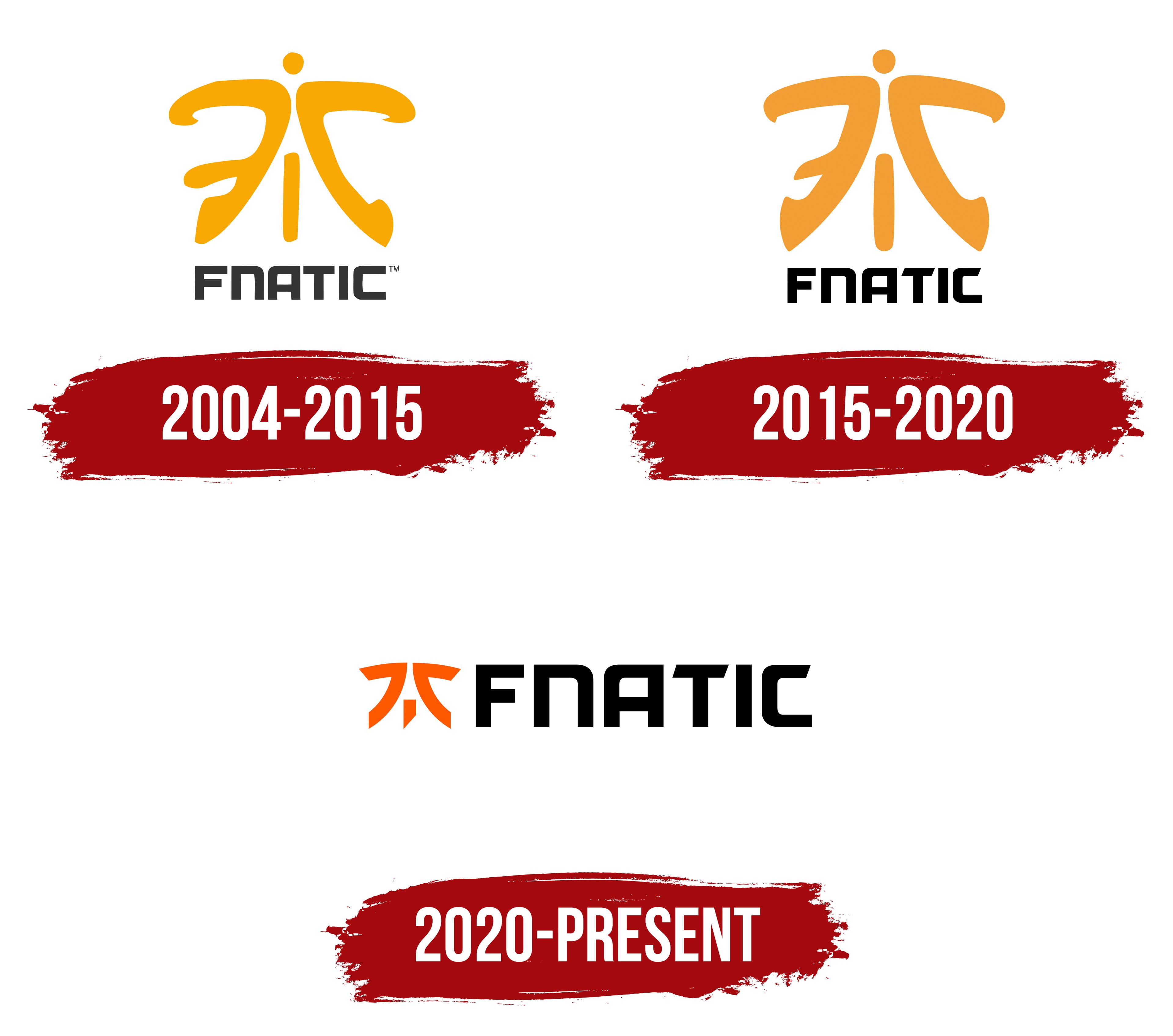
Despite several rebranding efforts, the emblem’s core elements remain consistent: a schematic representation and the name in black capital letters. This consistency shows that over 20 years, the company’s primary mission and objectives have remained the same: to unite strong players and participate in professional, fair competitions. The organization seems to have crafted its glyph of strength that encapsulates its essence. Thus, there’s no need to change it.
What is Fnatic?
An esports organization that has won over $15 million in tournaments and competitions and has consistently ranked in the top 5 of its category for 15 years. They are one of the founding members of G7 Teams. They own the esports store Bunkr and produce their lines of gear and sportswear.
2004 – 2015

At the top of the emblem is an orange composition reminiscent of Chinese glyphs. The schematic representation appears to be:
- A rebus in which the name is encoded. The same lines serve as glyphs for different letters. The result is an image in which the letters of the inscription overlap. This design symbolizes stationary movement, since esports are competitions where players remain seated. It also signifies unity. The players’ strength lies in teamwork. Each member contributes their unique abilities to form a powerful team. This theory is further reinforced by orange, a color of communication and collaboration.
- A figure of an esports athlete. Overlaying the images of letters on each other creates a superhero, a ninja warrior proficient in martial arts. Hence, the drawing resembles a Chinese character.
- A bird. According to some interpretations, the emblem features a phoenix as a symbol of the ability to accept defeat, rise from the ashes, and start anew. This approach has enabled the organization to thrive for 20 years and consistently rise to the top.
- A butterfly symbolizes the butterfly effect on the future. Even minor events in the present impact humanity’s future. It’s a symbol of inspiration and passion for the game. The main reason Mathews founded Fnatic was the desire to compete not just once a week but every day.
Below the drawing is an inscription spanning the image’s width. The letters seem to form a foundation or ground beneath one’s feet. The square shape of the symbols further hints at teamwork.
2015 – 2020

In 2013, Anne Mathews, Sam’s mother, became the executive director. She had a significant influence on Fnatic’s development. By 2015, the hue of the emblem shifted from light orange to a darker shade, and the glyphs of the “hieroglyph” were made bolder, signifying the company’s decade-long experience. The organization had the most successful Counter-Strike team, winning eight titles.
2020 – today
In 2019, the company raised $19 million for restructuring and expansion, aiming to cover Asian and North American regions and increase the staff from 150 to 1,000.
The new logo, reflecting the company’s ambitious plans, is more abstract. The figure consists of strict geometric lines with sharp edges reminiscent of a samurai sword.
The changes indicate a transformation from a young, energetic entity into an experienced organization and a formidable opponent on the battlefield. Beyond expansion, the organization plans to bolster its warriors with specialized nutrition, new psychological programs, and physical training, making them stronger competitors.
Font and Colors
Orange and black are the two main colors in Fnatic’s palette. Orange represents teamwork and communication, embodying a team with a friendly and warm atmosphere. It signifies competitions and tournament activities that involve close human interactions. The black color symbolizes the players’ power, invincibility, and self-confidence.
The font resembles a transformed Sporty Pro Bold. Square letters with rounded lines and sharp ends speak to strength, agility, and dominance on the battlefield.