 Freemason Logo PNG
It is not known for certain who created the Freemason logo. The symbol system of this movement began to develop in the late 16th century when societies of free masons, the predecessors of Freemasonry, emerged. Since they were builders, the emblem includes the main attributes of medieval architects: the compass and the square.
Freemasonry has no single documented starting point. Its earliest known text, the Halliwell Manuscript, or Regius Poem, is dated between 1390 and 1425. It traces the craft of masons to Euclid in Egypt and to England under King Athelstan. The movement is generally linked to medieval stonemason guilds, where handshakes, passwords, and initiation rites helped confirm skill and membership.
In Scotland, the records of Aitchison’s Haven Lodge from January 9, 1599, show an early institutional form. In 1646, Elias Ashmole recorded his initiation at Warrington, the first documented case of an English speculative Mason. On June 24, 1717, four London lodges met at the Goose and Gridiron tavern near St Paul’s Cathedral. They formed the Grand Lodge, with Anthony Sayer as its first Grand Master.
In 1723, James Anderson published The Constitutions of the Free-Masons for the Grand Lodge, which set out the history, rules, and hymns. The Grand Lodge of Ireland followed in 1725, and the Grand Lodge of Scotland in 1736. In America, the first lodge appeared in Philadelphia in 1730, with Benjamin Franklin among its founders. St John’s Lodge in Boston was chartered by the Grand Lodge of England in 1732.
English Freemasonry split in 1751, when rival lodges formed the “Ancients” at the Turk’s Head tavern, opposing the “Moderns.” Groups such as the Bavarian Illuminati, founded by Adam Weishaupt in 1776, competed for educated elites. On December 27, 1813, the two English Grand Lodges united as the United Grand Lodge of England, led by the Duke of Sussex. Its tricentenary was marked in 2017 at London’s Royal Albert Hall.
Meaning and History
Freemasonry originated from the guilds of stonemasons, that is, those who built sculptures, buildings, and other stone structures. The modern brotherhood dates back to the end of the 13th century, when its symbol system also originated, which has hardly changed over time. Traditional signs reflect the moral principles that Masons adhere to. Most of the symbolism relates to stonemasons, including the ashlar, gavel, level, and plumb. However, the most famous Freemason logo is the square and compass. These are the main attributes of a medieval architect. They are often used in various Masonic rituals.
The square is depicted at the bottom and is shaped like the letter “V” with a right angle. The open compass is located above the square and intersects its two sides at their ends. Together, they form a kind of diamond, inside which, in English-speaking countries, there is often a large black letter “G.” It is believed to stand for the word “God,” as all members of the movement must necessarily believe in the so-called Great Architect of the Universe. According to another version, “G” stands for “Geometry,” since stonemasons’ work was based on this science in the past, and the concept of Freemasonry is now built upon it.
What is Freemasonry?
Freemasonry is a transnational organization about which little is known. It is far removed from religion and politics, and its participants maintain anonymity and use a complex system of passwords and signs to distinguish themselves from the uninitiated. Most Masonic lodges have specific functions, most often related to charity. The main goals of Freemasonry are the unification of humanity and moral self-improvement.
Freemason symbols have deep meanings that correspond to the fraternity’s global goals: to unite humanity and to improve oneself morally. It is believed that the compass outlines the Mason and allows him to stay within the boundaries of society, while the square helps to restrain oneself, one’s needs, desires, and actions.
Font and Colors
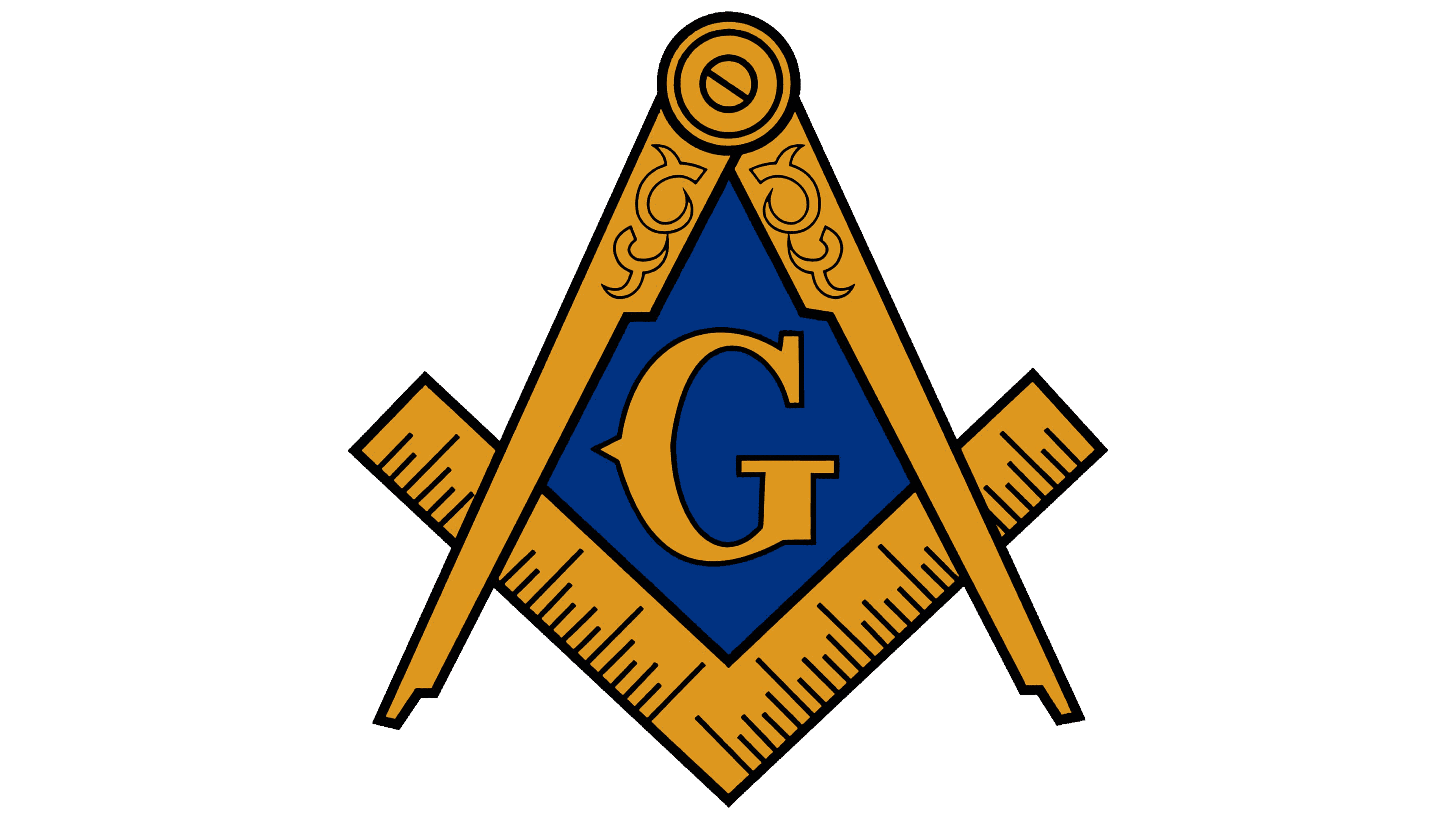
Since the Freemasons do not have dogmas, there are no strict rules defining the appearance of their symbols. However, the letter “G” in the logo is most often depicted in a bold geometric font with large serifs and rounded corners. The black “G” is usually surrounded by white instruments with black outlines.