


 The Hartford Logo PNG
The Hartford logo symbolizes reliability and trust. The deer image represents strength, stability, and protection, creating a sense of support and steadiness. Through the emblem, the company conveys its readiness to support clients with insurance matters and provide security.
Hartford, founded in 1810 in Hartford, Connecticut, is one of America’s most respected insurance institutions. The Hartford Fire Insurance Company was the brainchild of several prominent local businesspeople who sought to fulfill the community’s insurance needs.
As the late 19th century drew to a close, Hartford realized it needed to diversify and expand its offerings beyond its foundational fire insurance products. A significant transformation occurred in 1968 with the merger with ITT Corporation, which led to a name change to ITT-Hartford. However, in 1995, the company returned to its roots, renaming itself The Hartford Financial Services Group to better reflect its core insurance business.
The Hartford Company’s more than two-century journey has been monumental. It has solidified its reputation as a dominant player in the United States property and casualty insurance industry. Hartford offers a range of services for clients, from individuals and businesses to large organizations.
Today, this well-respected Fortune 500 organization is based in Hartford, Connecticut, and employs over 19,000 people. While the company primarily utilizes independent agents and brokers for distribution, it also works directly with clients. Notably, Hartford has partnered with AARP, serving as the preferred insurance provider for its members for a quarter century.
Meaning and History
What is The Hartford?
It is a major insurance company in the United States serving individual customers, small businesses, and the corporate sector. Its portfolio includes auto insurance, home insurance, property and liability coverage, and employer programs.
1810 – 1861

The Hartford takes its name from Hartford, Connecticut, where the Hartford Fire Insurance Company was founded in 1810. The original name identified both its home city and its focus on fire insurance. Early wordmarks featured the full name in serif lettering.
The name was later shortened to The Hartford, and a stag crossing a stream conveyed the connection to the city. The image illustrated the two parts of the English name Hartford. A “hart” is an adult male deer, and a “ford” is a shallow place where a stream can be crossed. Together, the animal and the stream formed a visual representation of the name.
1861 – 1867
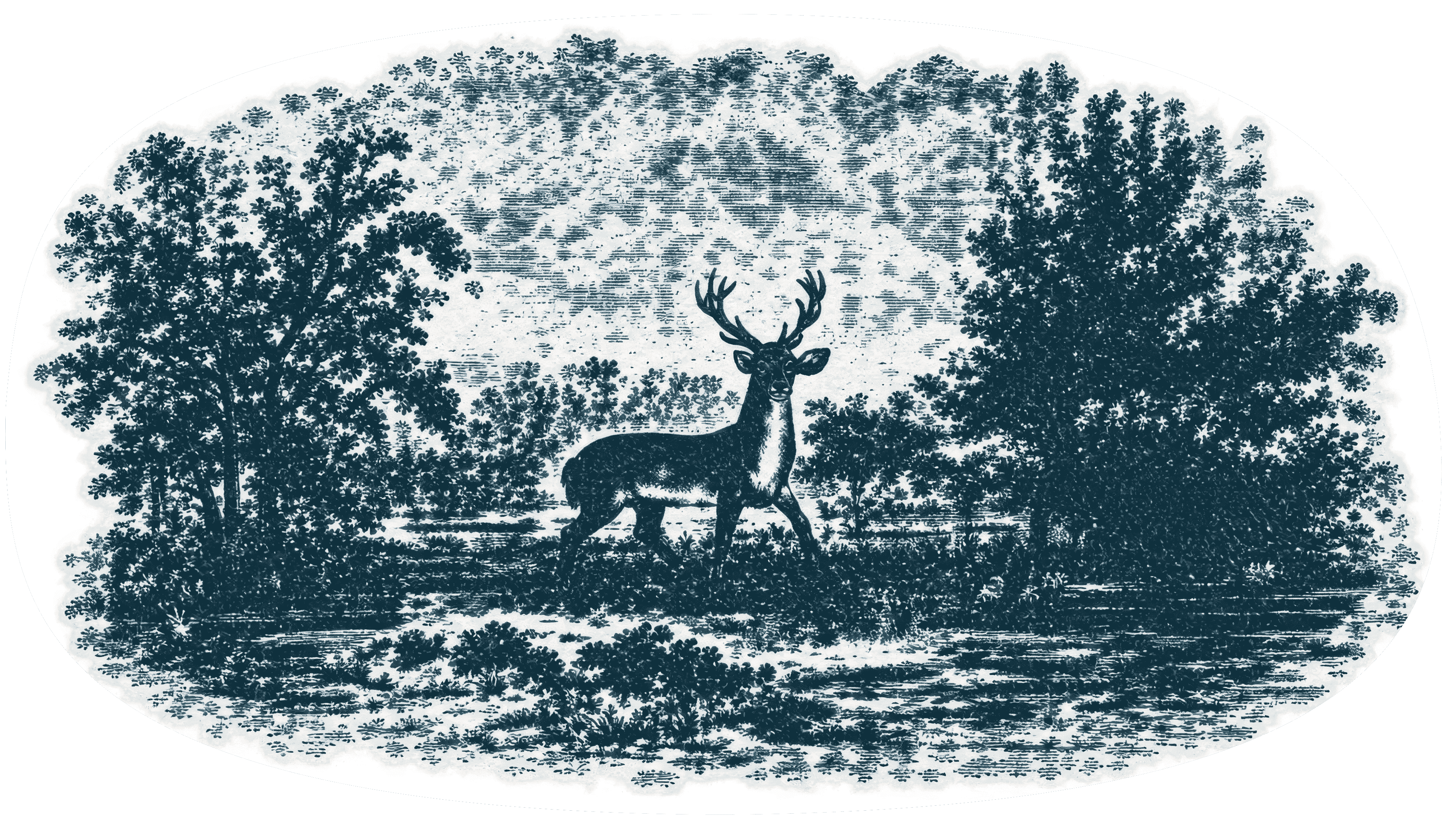
An early example of The Hartford’s stag emblem survives on an insurance policy issued to Abraham Lincoln in 1861 to protect his Illinois home. The emblem resembled a small engraving of a stream and trees. The animal stood in the center, occupying only part of the scene. Together, the stag and the ford represented the insurer’s name. Dark tree canopies framed the image, while horizontal strokes indicated the water’s surface.
A more elaborate version paired the circular scene with two shields. Stars and stripes on one referenced the American flag, while three grapevines on the other represented Connecticut. An oak garland intertwined with a ribbon bearing the Latin motto “Flammis quae correpta ruunt renovare conamur.” It promised to restore what fire had destroyed, connecting the emblem to the insurance company’s obligations.
“Incorporated 1810” appeared above the image, identifying the year the company was established. Below it, “Charter Perpetual” indicated that its charter had no expiration date.
1867 – 1875
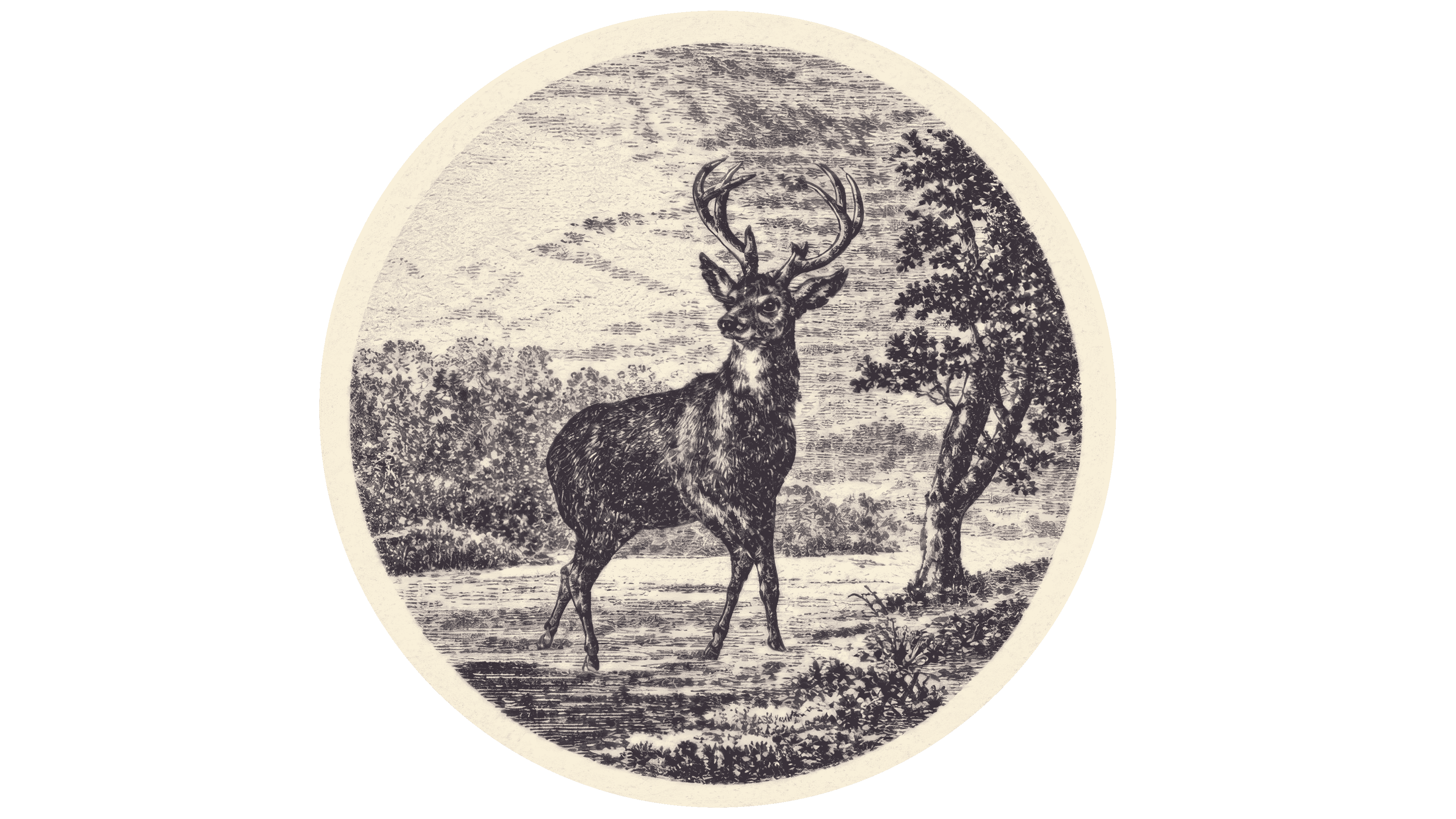
In 1867, The Hartford enlarged the stag and enclosed the scene in a circular frame. The animal appears in three-quarter view, with its head raised. Trees and the stream bank remained in the background.
1875 – 1886
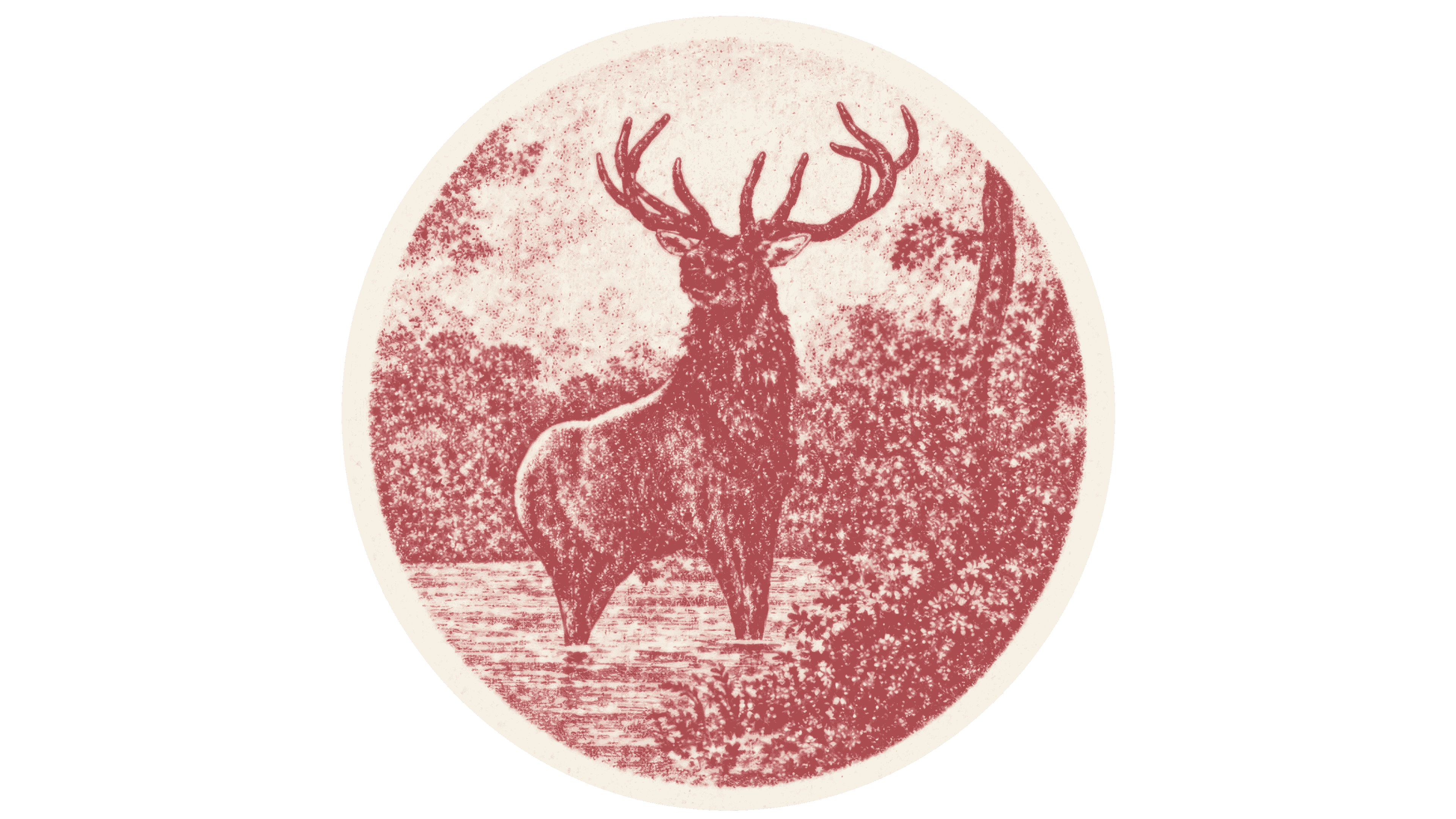
Red appeared in The Hartford’s circular emblem in 1875. The stag’s antlers, head, and chest were drawn in greater detail, setting its silhouette apart from the densely hatched background.
Edwin Landseer’s 1851 painting The Monarch of the Glen served as the basis for the next stag depiction. The painting shows the animal standing on elevated ground among mountains, its head held high.
1886 – 1890
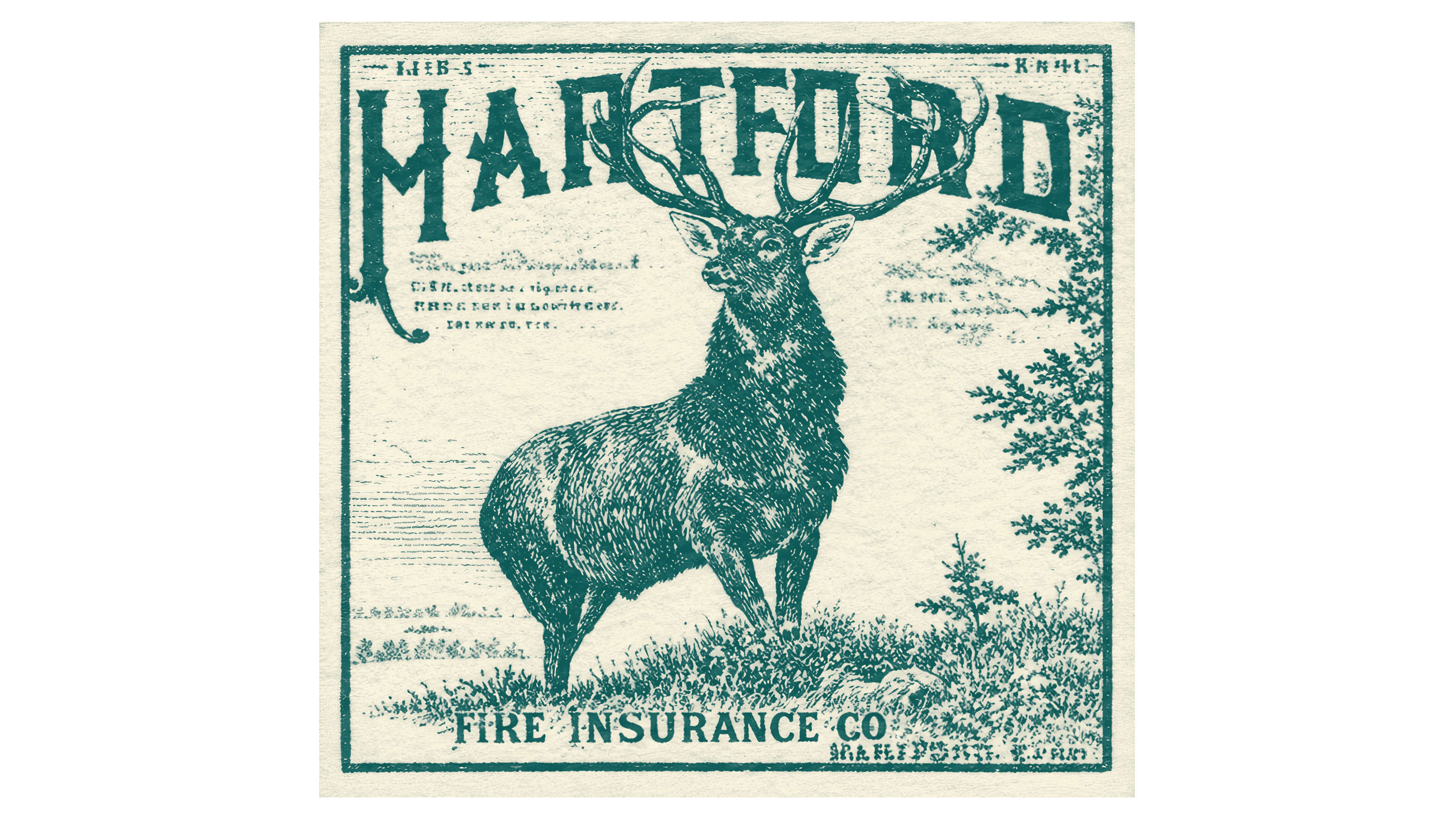
In the 1886 emblem, the insurance company’s name surrounded the stag. Large, decorative HARTFORD lettering formed the top of a rectangular frame, with FIRE INSURANCE CO. completing it below. The tall letters at the top featured serifs and elongated terminals. The illustration was printed in blue-green.
By 1890, the stag had been enlarged relative to its surroundings. Mountain outlines, vegetation, and a patch of ground remained, preserving the connection to the original painting.
1890 – 1971

In subsequent versions, the full name Hartford Fire Insurance Company appeared on a separate line beneath a detailed image of a red deer stag. The name used horizontally extended serif lettering that combined uppercase and lowercase letters. Its design resembled Garamond or Baskerville.
The illustration retained the style of an old engraving. The stag stood with its head turned slightly, large antlers with numerous points rising above it. Detailed musculature and fur, accurate anatomy, and gradual transitions between light and shadow gave the animal a realistic appearance.
A mountain range with snow-covered peaks and shaded slopes stretched behind the figure. Different shades of gray conveyed the mountains’ distance. The image and text were printed in a single color. The monochrome treatment reinforced the company’s established image, suggesting financial dependability and a serious commitment to insurance.
1971 – 1997

The shift from an engraving to a black silhouette changed the balance between the name and image in The Hartford’s logo. The lettering took up most of the space, while the stag became smaller. A 1970 design used the name ITT HARTFORD. In September 1971, the company introduced a logo designed by Sandgren Murtha Lubliner, with a large THE HARTFORD wordmark on the left and a small stag on the right.
The shortened name used a modified version of Optima. The uppercase block lettering was taller and more substantial than the adjacent emblem. Black unified the two components and gave the design a restrained, established appearance, supporting the image of a dependable insurer with a long history.
The stag retained its raised, turned head and large, branching antlers. Its body faced right. The mountains, trees, and tonal shading were removed, while a few strokes of grass beneath its feet indicated the ground. A solid, flat fill replaced the detailed rendering of fur and musculature. The animal’s pose and the shape of its antlers maintained the connection to earlier images.
1997 – 2009

Color returned to The Hartford’s branding in the mid-1990s. The 1997 version paired a burgundy-red stag with the company name in dark gray on two lines. THE appeared above HARTFORD, with enlarged initial letters “T” and “H.” Elongated letterforms with thin serifs gave the wordmark an elegant appearance.
The animal stood to the right of THE, above the end of HARTFORD. Its earlier pose and branching antlers remained, while light hatching was added to the body. This conveyed the texture of the fur and the body’s volume, making the image more realistic. Beneath its feet ran a horizontal burgundy-red strip with an irregular edge representing grass.
2009 – 2025

For its bicentennial in 2010, The Hartford highlighted its long relationships with customers and sought to make its communications more personal. CoreBrand developed the identity update. The project, featured in Tenet Partners’ portfolio, drew on research into how customers, brokers, and agents perceived the brand. The phrase “Trusted 200 Years” conveyed the anniversary theme.
The commemorative emblem emphasized the number 200 through its size, placing the anniversary wording to the left of the burgundy stag. The figure rose above a rectangular background with blue bands suggesting distant hills and sky. THE HARTFORD appeared below in heavy sans-serif capitals.
The 2013 version retained the burgundy animal and blue rectangle but removed the anniversary wording. The company name appeared on the left in two lines, with THE above HARTFORD. The geometric sans-serif letters were rendered in a dark red close to the stag’s color. Their restrained forms sat alongside the detailed animal illustration.
The stag on the right retained its earlier profile pose, with its body facing right and its head raised. Its large antlers, with finely drawn branches, extended above the background panel along with its head. Light strokes across the body conveyed fur and physical contours. A sloping red strip beneath its feet represented the ground and connected the figure to the emblem’s base.
Transitions between several shades of blue within the rectangle conveyed depth between the stag in the foreground and the natural setting behind it. The traditional animal image maintained a connection to the company’s history, while burgundy red reinforced its established appearance.
2025 – today

The Hartford’s update, introduced on February 6, 2025, was intended to adapt its historic emblem for small screens and digital notifications. The company sought to preserve its brand heritage, adapt the identity to current market conditions, and convey the insurer’s strength and dependability with fewer details. The unveiling took place at the New York Stock Exchange to mark the 30th anniversary of its listing. The holding company changed its name from The Hartford Financial Services Group, Inc. to The Hartford Insurance Group, Inc., retaining the shorter brand name.
Pentagram developed the identity under Luke Hayman’s direction, with contributions from Michael Bierut. The company also worked with the agency Solve. The stag, its symbol for over a century, remained the emblem’s basis. Still, a black silhouette replaced the detailed illustration. The blue field and hatching were removed. A few white cutouts suggested texture and volume, while the sloping base beneath the animal’s feet remained. The antlers became thicker, with smoother curves.
The change in the animal’s orientation sparked discussion about the update. The stag’s body faces left, while its head turns right. Its previously relaxed pose gave way to an alert stance, suggesting an animal watching over and protecting its herd. In the horizontal logo, the figure appears before the name. Another version places it above the lettering. The all-capital THE HARTFORD was replaced with the mixed-case The Hartford.
The custom typeface Trust Hartford was developed from Trust, designed by Jeremy Mickel of MCKL Type. The original typeface drew on lettering found on American coins. Individual letters and numerals were adjusted for the insurer. Burgundy maintained a connection to the earlier identity and, together with black, formed the core color scheme. Fuchsia was introduced as a bright accent, complemented by white and warm gray.
The stag’s antlers retained 12 points, six on each side. The number 12 was repeated in secondary emblems, with 12 circles surrounding an “H” monogram and a separate design featuring the date 1810. The version bearing the founding year used an engraved style, connecting the new typography to the company’s early printed imagery.