


 Hooey Logo PNG
The unique Hooey logo represents extreme sports culture, which the brand’s founder associates with rodeo, drawing a parallel between them in clothing. Their styles are almost identical, making it easy for the company to appeal to surfers conquering powerful waves and cowboys taming fierce bulls. And it all comes down to the hat.
Hooey was founded in Texas in 2007 by Joey Turlington, a professional rodeo rider who knew the culture from inside. The name came from a rodeo term for the knot used to secure a calf’s legs during tie-down roping, giving the brand a direct link to the sport from its first day.
The first product was a baseball cap, but Turlington found a clear gap in the Western market. While Wrangler dominated jeans, shirts, and workwear for ranch life and rodeo, Hooey offered caps with bold prints, Western references, and a younger streetwear tone. Early sales grew through rodeo events, where riders and fans saw the caps in use rather than through conventional advertising.
Professional rodeo sponsorship became a key part of the brand’s rise. Hooey worked with athletes affiliated with the Professional Rodeo Cowboys Association, leveraging their visibility at competitions to build trust with fans. As demand grew, the company moved beyond caps into T-shirts, hoodies, shirts, jeans, jackets, belts, bags, and later women’s and children’s lines.
The company based itself in Spring Branch, Texas, near San Antonio, keeping close to the rodeo world it represented. Hooey did not try to replace older Western brands such as Wrangler; it occupied a different space based on identity, graphics, and community. Social media, including Instagram, helped extend its reach beyond rodeo crowds, turning the label into a broader Western lifestyle brand.
Meaning and History
This company began with love and curiosity. Its creator wondered whether it could unite two extreme cultures to showcase their kinship. As a result, wide-brimmed hats suitable for both surfers and cowboys appeared. After their success, the product range expanded: now, on every pair of shorts, jeans, T-shirts, hoodies, baseball caps, and trousers, there’s a unique trademark, a sideways “H” in a hat with raised “arms.”
The owner, well-versed in both extreme activities, named the brand. He chose a popular term for authenticity among cowboys, skateboarders, and surfers. Thus, the active sports-style brand celebrates Western culture, adapting it for the mass consumer. The slang word “hooey” has several meanings. One of them is “half-hitch,” used by surfers when tying up before starting. The second relates to common exclamations used by bull riders in the arena. So, it’s a widely used term, dating back to 1872, the year of the first rodeo.
What is Hooey?
Hooey is an American brand that emerged in Spring Branch, Texas, out of a love for extreme sports. Its founder, Joey Austin, wanted to unite two cultures: surfing and cowboy. After a trip to the coast, he noticed an inseparable bond between them and decided to share it with the world. Thus, his famous hat was created, starting the line of clothing for men and women. The brand was launched in 2009.
2009 – today
The Hooey logo is a graphic-textual combination featuring both an image and text. The first element is a round icon with an “H” in the center. The letter is anthropomorphic, as it resembles a cowboy with raised arms when rotated. Its legs are spread wide, and on its head is a hat, where this brand began. Designers elongated the side strokes to make the glyph resemble a human figure. The bold stripes reach the circle’s edge and merge with the thin frame. The headwear is drawn with a single continuous line, reminiscent of a surfer’s rope, used by athletes to tie their leg to the board, and a chasing whip used by riders to tame bulls.
To the right of the round symbol is the brand name. It is very large and almost matches the adjacent icon’s height. The inscription is in massive, uppercase letters. All lines are wide, making the inter-letter spaces narrow. Despite its boldness, the word is easily readable due to its high color contrast: black glyphs stand out well against a white background. The absence of serifs enhances clarity.
Font and Colors
The brand’s logo is designed in a bold geometric typeface, with letters that appear confident, stable, and precise. Clean, straight lines form a strict, undecorated text, giving the visual style a solid, contemporary appearance. Comparable typefaces include Colin Samuels Bold and Knockout No. 72 Full Cruiserweight.
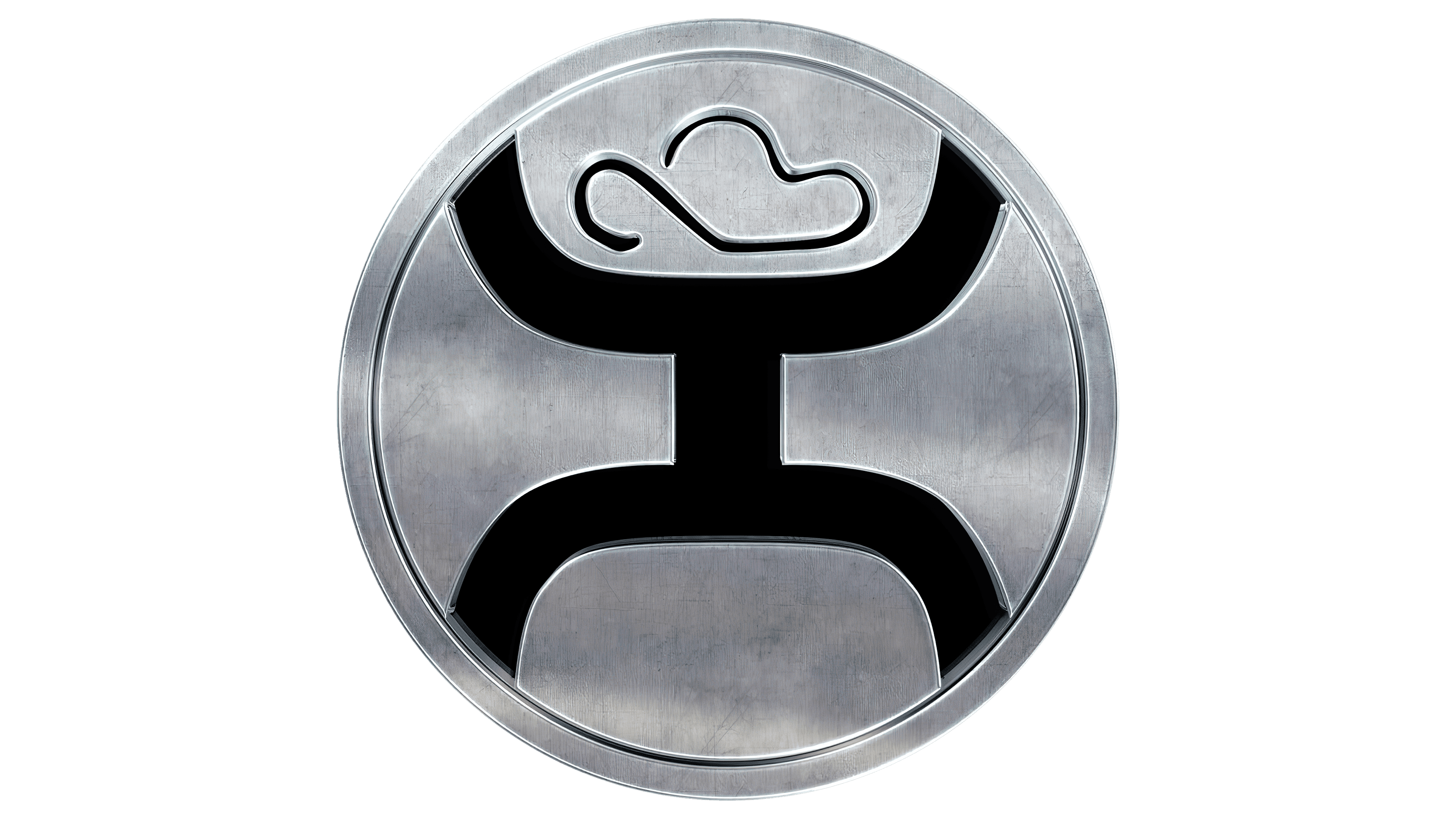
The primary colors used in the design are classic black and contrasting white, reinforcing the brand’s minimal and disciplined aesthetic. At times, the brand also incorporates bold color combinations such as red, white, and blue in clothing prints inspired by American symbolism. The logo’s color choices support a restrained visual identity that complements everyday essentials and more expressive, design-forward pieces.