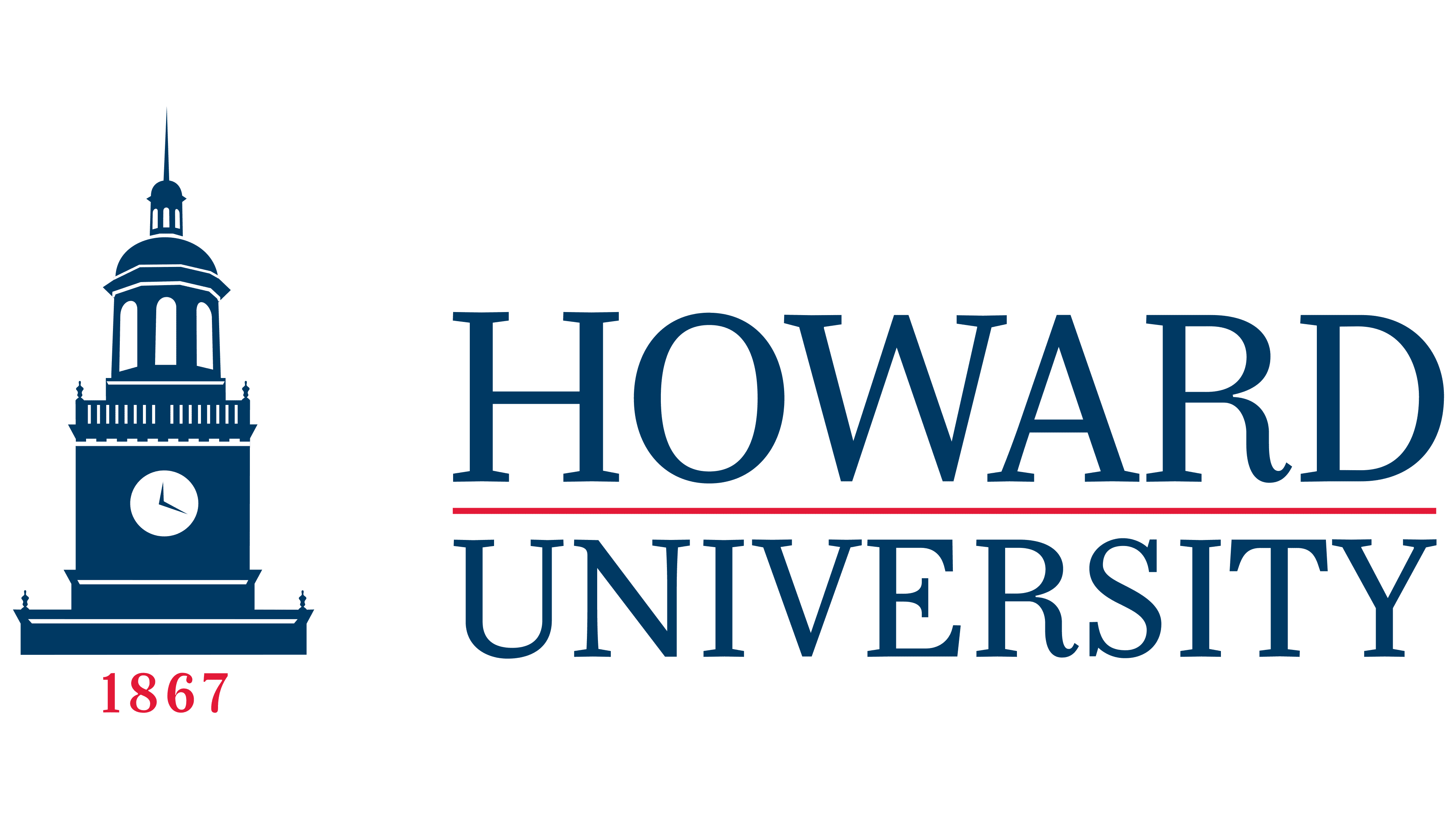
 Howard University Logo PNG
Howard University’s logo was chosen with the motto “Truth and Service.” As a result, it is strict, businesslike, and serious. The main emblem features the main building with a clock and a rotunda on top. The historic structure is rendered in blue and white colors. The administrative seal features a shield with an open book and also echoes the slogan.
Howard University began in December 1866, when Congregationalists met at Henry B. Brewster’s home in Washington, D.C., to plan a seminary for Black ministers and teachers. Within weeks, the idea expanded into a full university. On March 2, 1867, the U.S. Congress granted its charter and named it after General Oliver Otis Howard, head of the Freedmen’s Bureau and one of its first trustees.
The university opened without restrictions on race, sex, or religion. In 1868, medical and preparatory departments were created, and the medical school formally opened on November 5. In spring 1869, the law school admitted its first students under John Mercer Langston’s leadership. By 1872, Howard had helped educate 150,000 formerly enslaved people.
For its first sixty years, Howard had white presidents. In 1926, Mordecai Wyatt Johnson became the university’s first Black president and led the university for 34 years. Under him, enrollment reached 6,000 students, the budget rose to $8 million, and the number of buildings more than doubled. Howard Law became a civil-rights center under Charles Hamilton Houston, who trained Thurgood Marshall before the legal strategy behind Brown v. Board of Education in 1954.
Howard’s faculty and alumni included Carter G. Woodson, Alain Locke, Ralph Bunche, Zora Neale Hurston, Charles Drew, Toni Morrison, Roberta Flack, and Kamala Harris. In 1942 and 1943, students organized early sit-ins in Washington. Fisk University and Morehouse College remained historic peers in Black higher education. Howard later opened the National Human Genome Center. Today, Howard Bison teams compete in NCAA Division I through the Mid-Eastern Athletic Conference.
Meaning and History

From the beginning, HU positioned itself as a non-sectarian university, open to representatives of all races, which is why many African-American students study there. However, the original plan was to make it a seminary for training clergy. Yet, just weeks before the launch, the project was expanded to include a university and was revised. As a result, the university was formed, including several humanities and medical colleges. The US Congress officially established it in the spring of 1867.
What is Howard University?
Howard University is a private higher education institution registered in Washington, D.C. General Oliver Otis Howard established it, after whom it is named. The university was founded in 1867. It offers more than 120 educational programs. The university is accredited at R2.
1867 – today

The university’s identity is tied to Oliver Otis Howard, a general, Civil War hero, and head of the Freedmen’s Bureau. He founded Howard University, inspired it, and was its first president from 1869 to 1874. The main logo features the iconic HU building on campus. The Founders Library was later added to the National Register of Historic Places. As a result, it has become important to the entire area, not just to university representatives.
The academic logo of Howard University combines its roots with modernity. The university’s architectural landmark, Founders Library, represents the past. The building is a listed historical monument. The logo depicts the upper part with two domes of different sizes and a tall spire. Below (in the square segment) are clocks. The clocks and windows are painted white. At the bottom, a horizontal rectangular platform has decorative elements at the edges. The text indicates the university’s founding year, 1867. The university’s name is typed in uppercase serif font. The first word is larger than the second. A thin stripe runs between them.
The Seal

The seal of Howard University is classically round. It features a rondel with an accentuated center: a rectangular shield in the colors of the American flag is depicted within it. Small stars appear at the top on a dark blue field, and red stripes appear at the bottom on white space. At the very heart of the shield is a symbol of wisdom and knowledge: a book. It is inscribed with the phrase “Deo et Reipublicae.” Surrounding it is the Latin phrase “Veritas et Utilitas,” divided into three fragments, with each word flanked by single dots on both sides. Next is a chain of small dots. Then, in a wide ring, the university’s name and location are indicated. The composition is completed by a twisted rope running in a circle. The seal’s palette is based on the colors of the US national flag: red, blue, and white.
Howard University’s visual identity is businesslike and practical, matching its activities. Everything in it is subordinate to the canons of truth, knowledge, and justice, which the two slogans on the seal emphasize. The university’s historical roots are not forgotten either. They are represented by the library, whose building is included on the list of architecturally significant objects.
Font and Colors

The basic font in the emblems of Howard University is called Serif12 Beta. It is a typeface with small serifs. If a sans-serif font is required, Eau Sans Book is used. Dark blue, red, and gray are part of the official university palette. White serves as the background.