


 Penn State University Logo PNG
The university’s logo reflects a flexible education system that adapts to the market’s needs. The university produces specialists with varied training. The Penn State University logo embodies graduates’ pride and dignity.
The Pennsylvania State University began in 1855 as the Farmers’ High School of Pennsylvania after Governor James Pollock approved its charter. Center County residents donated land for the campus, and the first students arrived in 1859 at an unfinished stone building. Under President Evan Pugh, the school combined academics with mandatory student labor.
In 1862, the institution became the Agricultural College of Pennsylvania and soon secured federal support through the Morrill Land-Grant Act. Renamed Pennsylvania State College in 1874, the school struggled with low enrollment before expanding into engineering, research, and graduate education during the 20th century. By 1953, under Milton Eisenhower, Dwight D. Eisenhower’s brother, the institution officially became The Pennsylvania State University. Expansion accelerated with new research facilities and a medical center funded through trusts linked to Milton S. Hershey.
Football became central to Penn State’s identity after coach Joe Paterno took control of the program in 1966. The university won national championships in 1982 and 1986 and later joined the Big Ten Conference in 1993. Beaver Stadium expanded repeatedly during Paterno’s tenure, eventually becoming one of the largest stadiums in the United States.
The university’s reputation changed dramatically in 2011 after former assistant coach Jerry Sandusky was arrested on child sexual abuse charges. Investigations showed that senior university officials had known of the allegations years earlier but had not informed the police. Joe Paterno was dismissed in November 2011, and the NCAA imposed sanctions, including a $60 million fine and the temporary removal of Penn State’s victories from 1998 to 2011.
Meaning and History
Today, Penn State is one of the four major universities that have become administrative centers. Its branches span the state and cover several fields of study, including agriculture, astronautics and marine science, medicine, law, and more. You can major in any of the 160 majors. Annual enrollment at the central campus in University Park approaches 47,000, making it one of the largest. Overall, it has almost 98,000 students.
In addition, the university has its own sports department, Penn State Nittany Lions, which receives excellent sponsorship support. With increased attention and continued funding, club members have achieved great results. Teams are in the Big Ten Conference, and members have earned 54 Olympic medals.

Penn State is one of 15 universities in the United States that play Division I FBS soccer and hockey. The other two sports are in other conferences because the Big Ten does not sponsor them. They are the Eastern Intercollegiate Volleyball Association (EIVA) men’s volleyball team and the College Hockey America (CHA) women’s hockey team. Some fencers compete as independents.
Each entity has a logo that reflects its individuality. Shared elements and a color palette link the logos and emphasize unity. University-wide symbols represent official seals with historical motifs. Educational units use a shield emblem with a mascot. The sports club emblem features the Nittany Lion (in this case, there are three).
What is Penn State University?
Penn State is a large public research institution with 24 campuses across Pennsylvania, with its flagship campus in University Park. The university has 12 colleges offering over 275 majors, including popular programs in business, engineering, agriculture, and earth sciences. The main campus spans 8,000 acres and includes the nation’s largest student center, modern athletic facilities, and advanced research divisions. The Nittany Lions represent its athletic heritage, especially in football, with countless loyal fans gathering at the renowned Beaver Stadium. The university is also known for its unique THON program, the world’s largest student-run charity event, and an active student community with over 1,000 organizations.
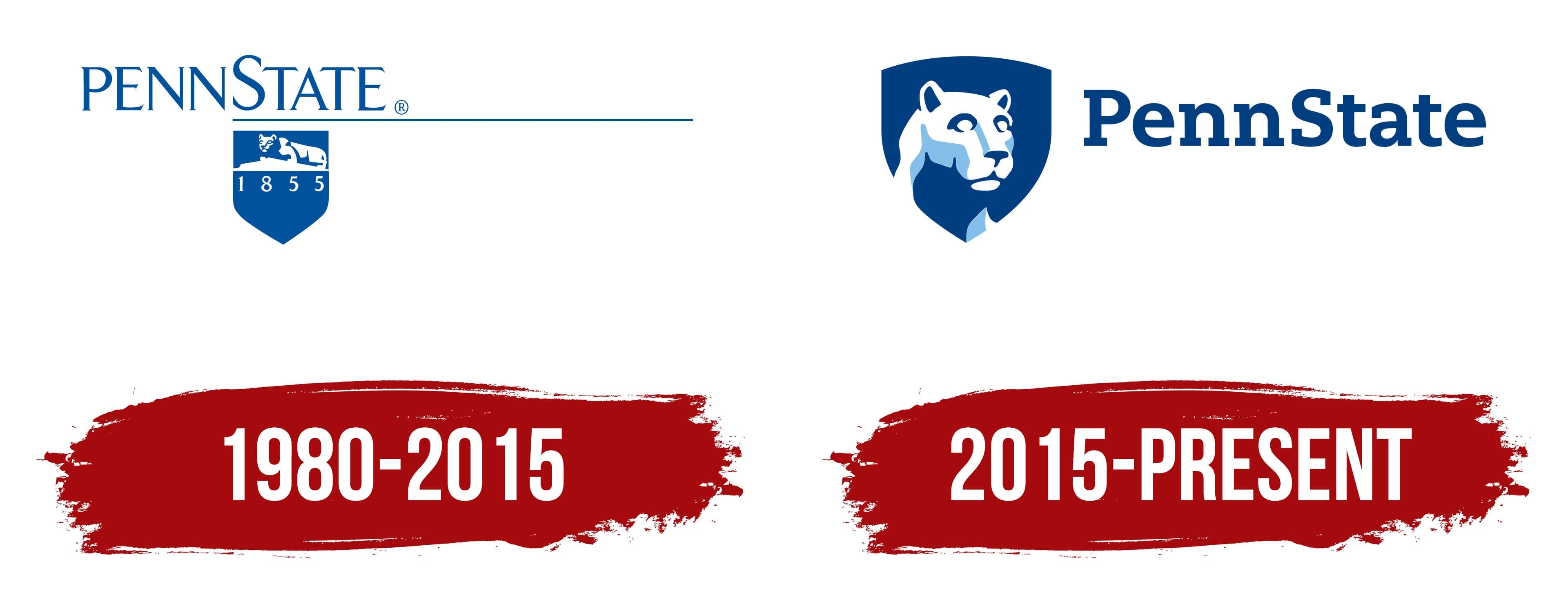
the 1980s – 2015

The emblem is a shield depicting an eastern cougar. She is behind a small hill, hiding from an attack. Its squat posture evidences this: the Nittany Lions are pressed to the ground, expressing wariness. In the center is a horizontal line marking the date of PSU’s appearance: widely spaced numbers “1”, “8”, “5”, “5”. Above the shield is a long, thin strip stretching far to the right. Above it is the name of the educational institution written in capital letters with the accent “C.”
2015 – today

The modern logo’s elements remain the same but are slightly reorganized. The designers rounded the shield’s corners and made the top part convex. They redrew the eastern puma, using only its head, which now fills the entire space. The developers changed the inscription to a serif font. At the same time, they shifted it to the right, slightly away from the icon. The authors of the updated version removed the horizontal stripe.
This is a sign from the flag of the state of Pennsylvania. It is a round seal based on the classic rondel. The center features a shaped frame divided into three sectors, denoting the main directions of this administrative territory. The upper one shows a ship (maritime department), the middle one a plow (agricultural and technical), and the lower one three sheaves of wheat (agricultural crop production). To the right and left are two horses.
On the frame sits a bald eagle – the symbol of the United States; below him, an ear of corn with leaves and an olive branch with fruit. A red ribbon with the Latin maxim “VIRTUE LIBERTY AND INDEPENDENCE” is stretched over the curved elements with a fork at the ends. A wide band around it bears the institution’s full name and the year of its foundation, in double-edged white and black.
Font and Colors

The University of Pennsylvania seal features elements of the Pennsylvania state flag and includes only the state symbols: a sailing ship, sheaves of wheat, a plow, corn, an olive tree, a bald eagle, and horses. The remaining visual identification signs feature a single image: the Nittany Lion, which became the university’s mascot in the 1980s.
Penn State guidelines recommend the Serifa and Avenir fonts for print products. The emblems use a modified and adapted version of the Gf Special 151 font and another closely related font, Impact.
The university and its athletic teams have always used several shades of white and blue as their brand palette.
FAQ
What is the Penn State logo?
Penn State’s logo is the eastern cougar, representing an extinct species of large feline. The animal is depicted in negative space on a five-sided shield. The university’s name appears to the right of the cougar’s head, and the cougar has white pupils.
Can I use the Penn State logo?
No personal use of the Penn State logo is prohibited, as is its use as a designation for student organizations. You must clear this with the university administration in advance by sending a request to licensing@psu.edu.
Who owns Penn State University?
In the 1970s, Penn State University became a state-owned university. Thus, it is now owned by the Commonwealth System of Higher Education.
What is Penn State University known for?
Penn State University has high admission standards and very strong competition for each seat. The university is also known for its large student population, with more than 100,000 students enrolled yearly.