


 J Crew Logo PNG
The J.Crew logo reflects the clothing style produced by the American company. It looks just as simple and unpretentious, but there is a hint of nobility and sophistication. With this emblem, the brand wants to demonstrate its love for contrasts.
J.Crew traces its roots to 1947, when Mitchell Cinader and Saul Charles founded Popular Merchandise, Inc. in New Jersey. Under the Popular Club Plan name, the company sold low-cost women’s clothing through home demonstrations, a direct-sales model close to Avon’s neighborhood catalog system.
By the early 1980s, Mitchell’s son Arthur Cinader was leading the business. Inspired by L.L. Bean, Lands’ End, and Talbots, he launched the first J.Crew catalog in January 1983. The brand aimed for a Ralph Lauren coastal look at a lower price, positioned between luxury fashion and mass retailers such as The Limited. Emily Cinader joined the company and became president in 1986.
Sales grew by 25 to 30 percent a year, rising from $3 million to more than $100 million within five years. In 1985, the company introduced the budget catalog Clifford & Wills, while former executives later created the rival catalog Tweeds. J.Crew opened its first store in Manhattan’s South Street Seaport in 1989, entered Canada in 1991, and expanded into Japan in 1993.
Texas Pacific Group bought control in 1997, and Clifford & Wills was sold to Spiegel in 2000. In 2003, former Gap chief Mickey Drexler became CEO and pushed J.Crew toward higher-quality fabrics and a more premium image. The company acquired Madewell rights in 2004, went public in 2006, and became private again in a 2010 deal with Leonard Green & Partners. Falling mall traffic, debt, and competition led to Chapter 11 bankruptcy on May 4, 2020. J.Crew exited in September 2020 under Libby Wadle, with ownership tied to Anchorage Capital Group and Leonard Green & Partners.
Meaning and History
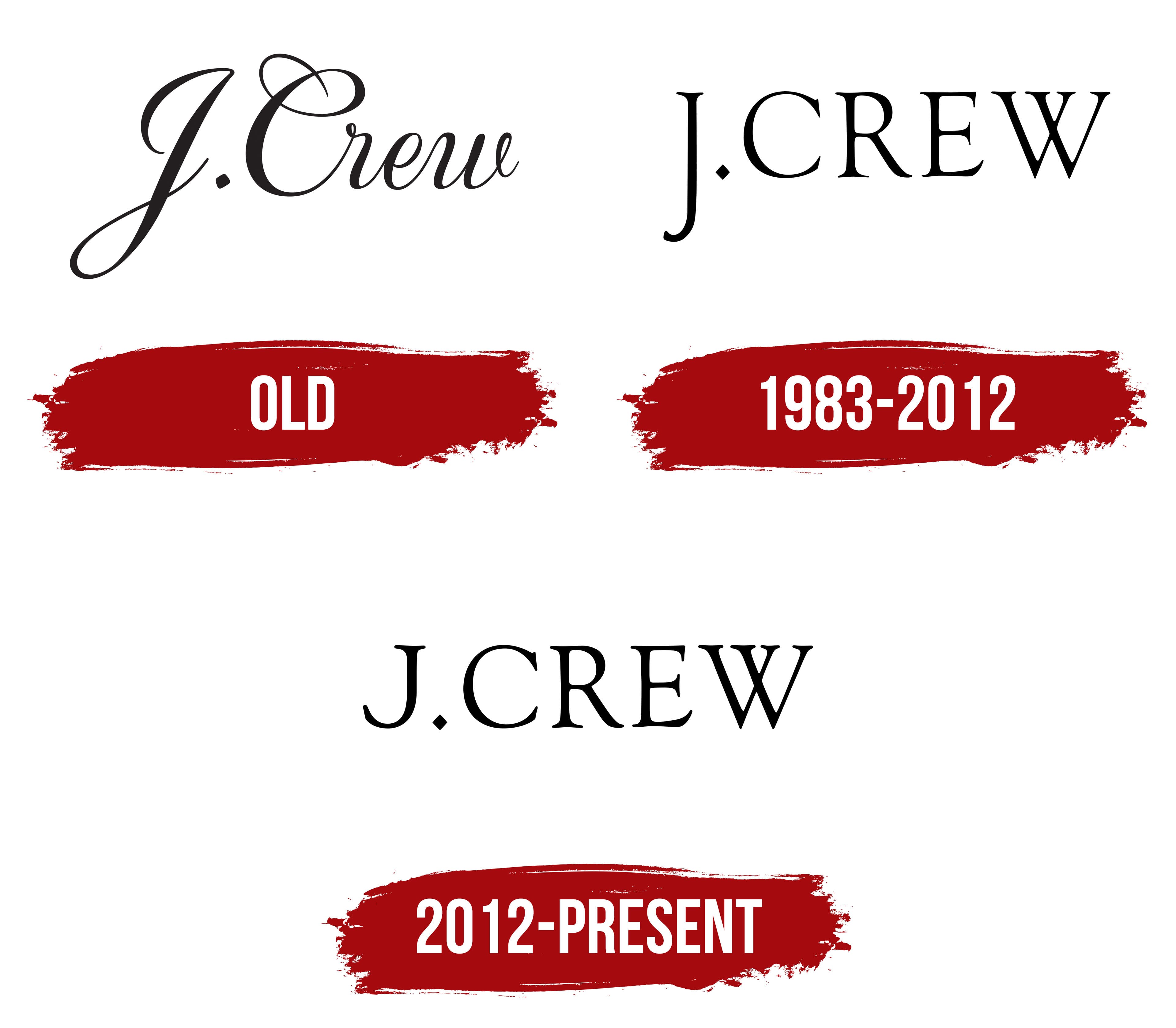
The “J. Crew” inscription has been used in the logo only since 1983, as the company was previously known as Popular Merchandise, Inc. Planning to rename the fashion brand, Mitchell Cinader initially wanted to name it after the lawyer Sir Edward Coke, but then changed his mind and chose the word “Crew.” It is associated with high society and students of elite universities, in short, those whose style the clothing manufacturer tries to emulate. The letter “J.” is, in turn, connected to the J. Press factory, which became a fashion authority for Yale University and the entire Ivy League. Cinader invented a legend that J. Crew was a haberdasher at Princeton to create an intriguing image.
An emblem on the 1980s and 1990s labels sometimes featured a full-length man holding an oar. The vintage wordmark contained the brand name in an ornate handwritten font. Then the style became more formal: a straightforward serif replaced an elegant cursive. The next redesign was almost imperceptible, as only the first letter “J” was changed. Internet users noticed the discrepancy in 2011, though some brand fans discovered that the new “J” version appeared in earlier catalogs.
What is J Crew?
J. Crew is an American retailer of accessories, shoes, and clothing. It offers fashionable items for children, men, and women in its more than 450 physical stores and on its website. The main service area is the United States. The company was founded in 1947 and was known as Popular Merchandise, Inc. until 1983. For the first few decades, it was owned by the Cinader family, and as of 2023, its shares are owned by two investment firms: Leonard Green & Partners and Anchorage Capital Group.
Before 1983
The vintage J. Crew emblem features the brand name in a connected, elegant handwritten font. Designers imitate calligraphic handwriting, characterized by rounded lines, loops, swirls, and contrasting stroke thickness. The emblem’s sophisticated style and black-and-white palette convey the company’s uniqueness.
1983 – 2012
In this logo, the “J. Crew” inscription is in an elegant font with pointed serifs. It has several similar counterparts: Goudy Oldstyle FS Regular, Goudy Serial Regular, and Sorts Mill Goudy Regular. The letter “J” appears lowercase as its tail descends below the line. The dot after “J” is diamond-shaped.
In 2003, Mickey Drexler, who had dedicated his life to the fashion industry, became the CEO of J. Crew. He completely changed the company’s concept to save it from impending bankruptcy. By his order, the emblem stopped being depicted on clothing, as Drexler believed that buyers of high-priced items would not want to wear brand advertising.
2012 – today
The company subtly updated its logo in a careful and almost unnoticeable way. The main change involved the first letter, which was capitalized and resized to match the other characters’ height. This adjustment made the text appear more unified, cleaner, and calmer.
Following the update, the typeface became slightly denser, with letters appearing more stable and compact. Although proportions were subtly modified, the logo retained its recognizability and overall identity. The brand’s image remains relatable, reflecting an attention to small yet meaningful details.
Font and Colors
The J. Crew logo is designed in a thin serif typeface that conveys elegance and refined taste. The letters appear delicate and precise, reminiscent of classic fonts such as Goudy Oldstyle FS or Sorts Mill Goudy. This choice gives the inscription a natural and harmonious appearance, expressing a sense of understated sophistication.
The use of black reinforces the brand’s formal and elegant image. The versatility of the color helps highlight the clothing’s style, which appeals to a broad range of age groups. J. Crew focuses on a balance of comfort and elegance, and the logo’s design effectively reflects this approach.