


 JMU Logo (James Madison University Logo) PNG
The JMU logo symbolizes the vast opportunities the institution offers. The emblem shows that every student within the university’s walls is safe, and their rights and uniqueness are respected.
James Madison University began on February 29, 1908, when the Virginia legislature approved a new teacher-training school for women in Harrisonburg. State senator George B. Keezell of Rockingham County pushed for the site, and the school opened in September 1909 as the State Normal and Industrial School for Women at Harrisonburg. The first class had 209 students and 15 teachers, with 20 women graduating in 1911.
Under the first president, Julian Ashby Burruss, the early campus took shape, and six buildings were built. In 1916, the school gained the right to award bachelor’s degrees. Samuel Page Duke became president in 1919 and led the institution for thirty years. Enrollment rose from 300 to nearly 1,400, and nine new buildings were added.
In 1924, the school became the State Teachers College at Harrisonburg. In 1938, it was renamed Madison College in honor of James Madison. Men entered regular daytime classes in 1946. Under J. Tyler Miller, who became president in 1949, the campus grew by 240 acres, 19 major buildings were built, and liberal arts joined teacher education. In 1954, the college received the authority to grant master’s degrees.
Virginia formally approved coeducation in 1966, and Shiri Darcus became the first Black student that year. Ronald E. Carrier became president in 1971, raising enrollment from 4,000 to 14,000 and adding over 20 major buildings. On March 22, 1977, Governor Mills Godwin signed the law making Madison College James Madison University effective on July 1. In 1994, JMU gained doctoral authority, won its first NCAA title in field hockey, and saw the Marching Royal Dukes receive the Sudler Trophy.
Meaning and History
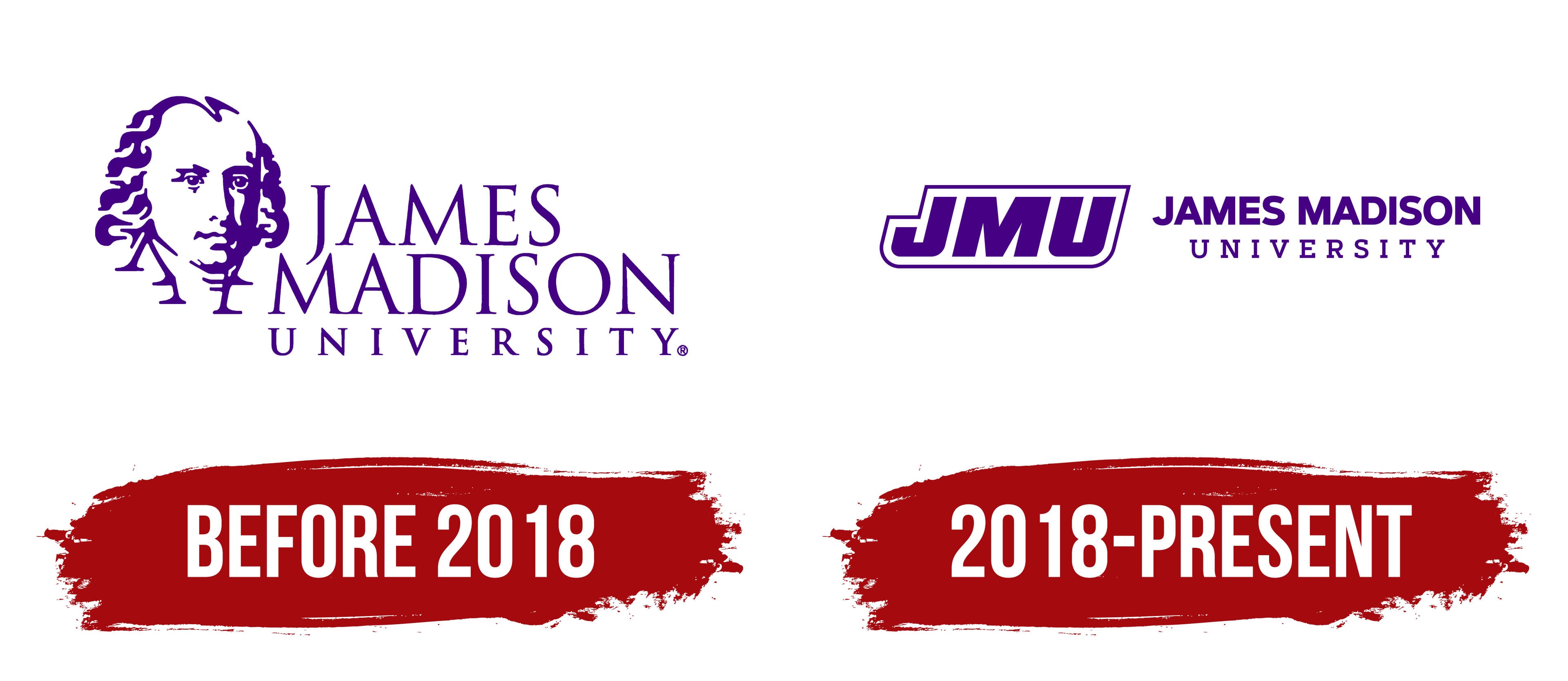
Despite its extensive history, the JMU logo appeared relatively recently and has remained consistent. Due to frequent name changes, previous visual symbols were unrelated to the university.
The educational institution was named after the fourth President of America, who lived long before the founding of the Normal and Industrial School (1751-1836) and had no connection to it. The name was chosen for several reasons.
James Madison was born in Virginia, near Harrisonburg, where the university is located. In his political career, he served in the Virginia House of Delegates and later became president. Therefore, the name was chosen after one of America’s prominent figures who lived near the university.
Madison became famous for his amendments to the U.S. Constitution. He proposed a system of governance consisting of three branches of power and a bicameral legislative body, which still operates in the country. However, the Bill of Rights is the most important contribution to the president’s immortalization at JMU. Most of its provisions were proposed by the politician. This document protects freedom of religion and speech, the right to bear arms, the right to housing, and much more.
Harrisonburg is a city that attracts many immigrants. Dutch Mennonites, who practiced a religion different from the majority (18th century), found refuge here, and formerly enslaved Black people in 1865 who practiced Baptism and other religions. The inhabitants of this city are so diverse that they speak 55 languages. Even the city’s name was given in honor of the son of an English settler who built the first house here. Harrisonburg is considered an independent city where the observance of its residents’ rights and freedoms is very important. They have always welcomed people seeking a new homeland in America. Therefore, James Madison holds great significance in this area. In 1938, when the college was founded, it was named after the president.
What is JMU?
The university, located in the American city of Harrisonburg, ranks second among the best educational institutions in the southern United States. It offers 62 undergraduate majors and programs for graduate and doctoral degrees. It is characterized by affordable tuition and tolerance.
before 2018

The JMU logo showcases the educational institution’s connection with James Madison. The portrait of the fourth President of the United States is rendered in an old-fashioned style, with detailed facial features. It has a strict and minimalist design, typical of many symbols dedicated to historical US figures. The artists used negative space to make the lines expressive. James Madison’s image symbolizes the high quality of education and commitment to the values the politician relied on when creating the Constitution.
The university’s full name is written on the right side and divided into three lines. The bottom word is significantly smaller than the top two, but all are set in the same serif font, similar to Adobe Trajan Pro 3 Semi Bold. Interestingly, you can also see a semblance of serifs in James Madison’s portrait: they are in the collar area. This balances the image with the adjacent text. All elements of the logo are either purple or white.
2018 – today

The James Madison University emblem is quite simple. It consists of the highlighted abbreviation of the name, followed by the full name. The symbol’s simplicity is partly due to the university’s extensive legacy. Since its founding, the university has expanded from two buildings to an impressive infrastructure that includes sports facilities, parks, educational and entertainment centers, dormitories, and more. JMU has its newspaper, sports teams, 350 clubs, ten groups uniting students by race or beliefs, and over 30 fraternities. Reflecting all this in the university’s visual symbol was not easy. Therefore, the emblem focused on the name.
The abbreviation’s main significance is outlined in purple on a white background, following its shape. This background demonstrates that, in addition to regular education, the university offers a wide range of activities, providing ample opportunities for students’ development. It also indicates the scale of the campus. Students do not need to leave the university’s territory to visit all the places and participate in clubs. Each day brings something new, as the outline suggests, which seems to map the campus.
The outline also serves as a symbol of protection. Inside JMU is an atmosphere of acceptance, respect, and safety. Therefore, students of any nationality, race, or religion can count on everyone’s support and equal rights.
The slight forward tilt of the letters symbolizes movement and the pursuit of development. The university’s primary focus is research, so the learning process here never stops.
The Seal
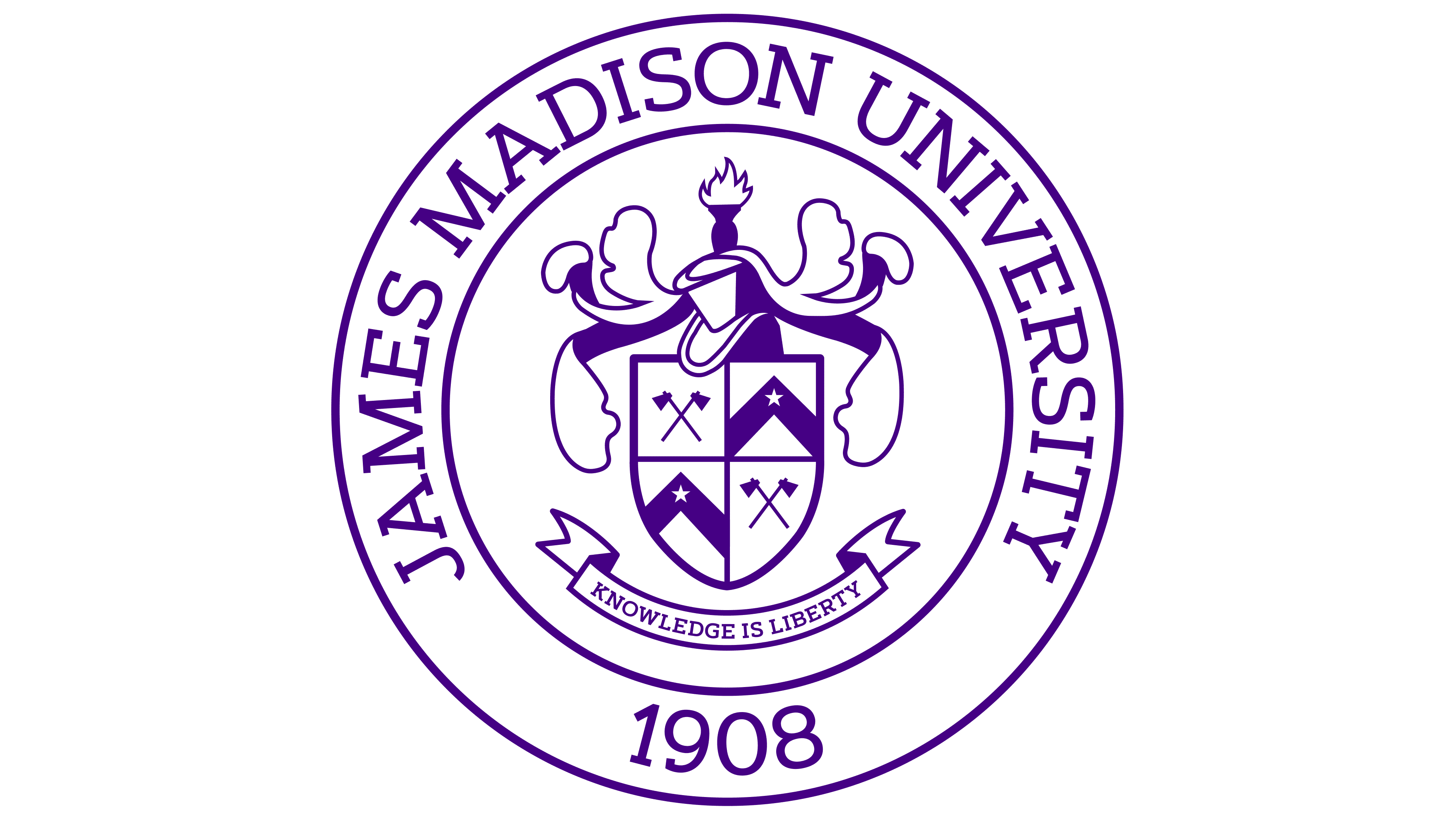
The university’s seal is designed in a uniform style with the logo. University professor Horace Burr developed it. The double border indicates the protection of students’ rights. The institution’s name and the founding year of the first women’s school, which later evolved into JMU, are placed in the first circle.
Inside is the coat of arms of the Madison family, after whom the university was named. The coat of arms is English and features a helmet and shield with axes and chevrons inside. For JMU, the image was slightly modified. The original knight’s hand, with an axe at the top, was replaced by a torch, symbolizing the light of knowledge that the university shares with its students.
The inscription below the coat of arms on a heraldic ribbon is “knowledge and freedom.” The signature reflects the institution’s priorities and President James Madison’s personal emphasis on education, freedom, and equality.
The modern version of the seal appeared in 1975, just before the college became a university. Before that, a version was designed in 1908 for women’s schools. The inner shield was divided into four parts with inscriptions: state, literature, industry, and home, with corresponding images for each word.
Font and Colors

The main colors of the emblem and seal are white and purple.
- Purple symbolizes knowledge, freedom, prosperity, and well-being. It represents extraordinary and gifted people. In the logo, purple reflects students’ creativity, artistry, and talent development.
- White denotes development and a new chapter in life upon entering the university.

The logo uses three font types: the first for the abbreviation in bold italic, the second for the institution’s name (Artegra Sans Black), and the third, a thin serif font reminiscent of typewriter text, for the word “university” (Artegra Slab SemiBold).