 Khan Academy Logo PNG
Although the Khan Academy logo looks quite simple, it reflects the ideas of development, growth, and self-improvement, which are fundamental to the brand’s concept. Thus, the emblem is fully adapted to the educational organization’s goals, symbolizing a passion for knowledge and inspiring new students to join the video lessons.
Khan Academy began in 2004, when Salman Khan, an MIT and Harvard Business School graduate working at a Boston hedge fund, started tutoring his cousin Nadia in math by phone and Yahoo Doodle. Other relatives soon joined, and in 2006 he began recording short lessons for YouTube from a home closet, using screen capture, voiceover, and a digital board.
The videos quickly reached viewers outside the family. Khan kept working as an analyst until 2009, when he left the hedge fund and committed to the project full time. Khan Academy had been registered in 2008 as a nonprofit with 501(c)(3) status. Still, early survival depended on personal savings and a major donation from Ann Doerr.
In 2010, the organization received $2 million from Google through Project 10100 and $1.5 million from the Bill and Melinda Gates Foundation. Shantanu Sinha, Khan’s MIT friend, became president and COO. The first office opened that year, and the platform added math exercises and progress badges. Unlike Coursera, built around paid university certificates, and Duolingo, focused on language learning, Khan Academy kept a free-access model funded by donations.
In 2015, the College Board made Khan Academy the official free SAT preparation partner and later extended the role to Advanced Placement in 2017. Khan Lab School opened in 2014 in Mountain View. In 2023, Khanmigo launched on GPT-4 as an AI tutor, followed by essay help, Microsoft-backed teacher tools in 2024, and Google-linked AI literacy work with Gemini in 2026.
Meaning and History
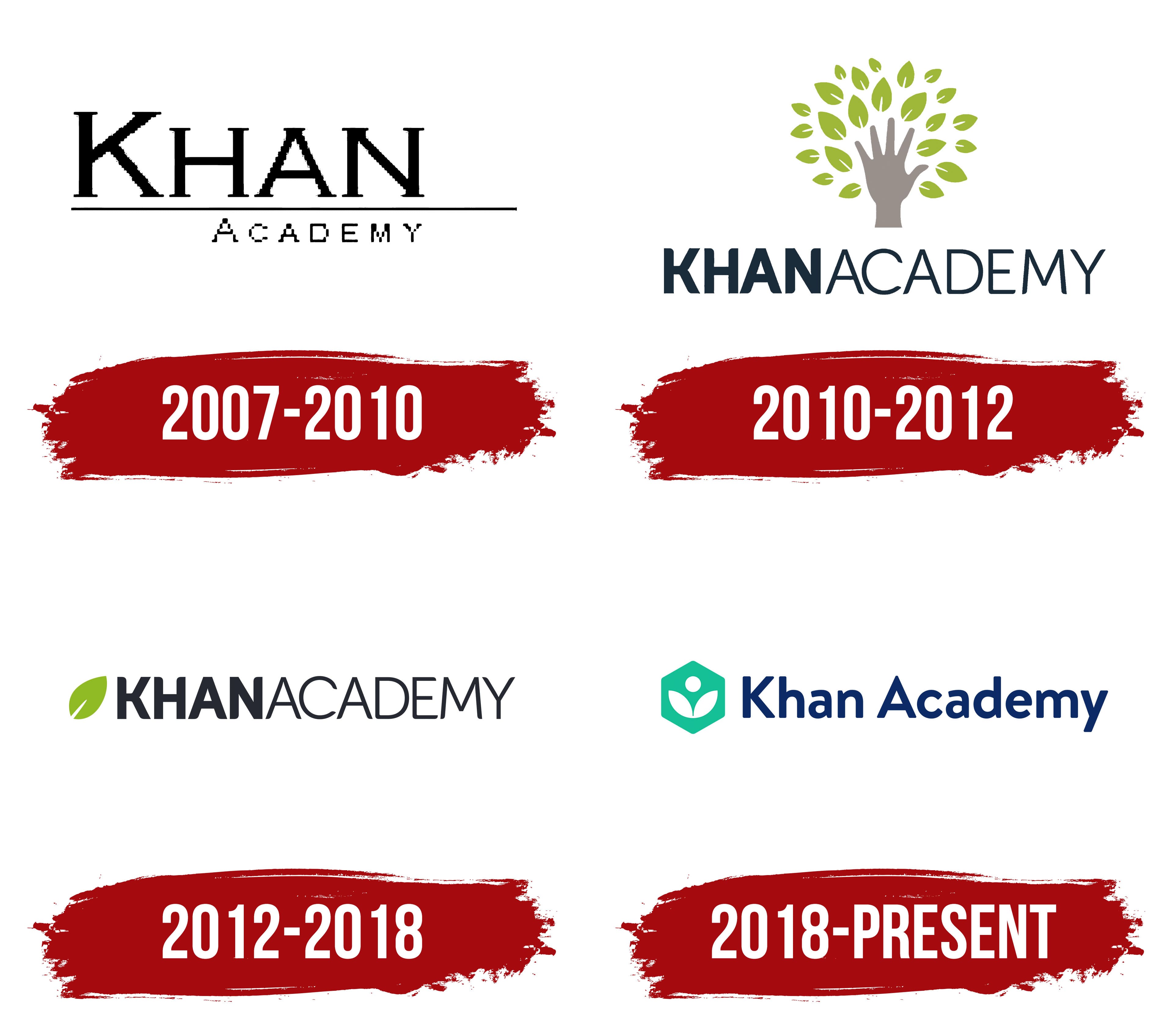
Khan Academy positions itself as an organization that helps with growth and development; most of its emblems feature a plant theme. It all started with a metaphorical symbol of knowledge – a tree resembling a palm with leaves. Then, it was decided to remove many small details, including the hand itself, and leave only one green leaf. It is still associated with knowledge, but unlike a full tree, it scaled much better. In 2018, designers again modified the logo, depicting a stylized book opened, with a student reading it. This graphic sign symbolizes a passion for learning.
What is Khan Academy?
Khan Academy is an organization created by American Salman Amin Khan to make education accessible to all. It offers students free video lessons and teachers a variety of tools and practical exercises. All materials are originally released in English, but volunteers translate them into other world languages. The content covers many fields from the sciences to the humanities, from mathematics to art history. However, the lessons do not replace comprehensive education but are only a useful supplement. The organization does not profit from its activities.
2007 – 2010

The old Khan Academy logo differs from the others in that it lacks plant motifs. It contains only the name of the educational organization, divided into two levels, with a thin horizontal line drawn between them. The first word is much larger than the second, but both are written in uppercase letters. A serif monospaced font is used for the top line. It creates balance, although the emblem’s details introduce enough imbalance. For example, the line passing through the inscription is shortened on the left and asymmetrically extended on the right.
2010 – 2012
Although this logo is no longer in use, it is still associated with Khan Academy. Its main element is a tree, a gray hand from which small green leaves grow. The wrist and palm act as the trunk, while the splayed fingers serve as branches. Unofficially, this is known as the Tree of Knowledge, also known as the Bodhi Tree. It is believed that sitting under its canopy, Buddha achieved enlightenment. Similarly, educational organizations offer people the opportunity to learn and discover many new things to achieve success in the future.
The drawing, which looks like a hand tossing up leaves, is placed above the black inscription “KHAN ACADEMY.” The space between the words is as narrow as the spacing between letters, visually separating the two parts of the text only by font: “KHAN” is much bolder than “ACADEMY.” But the style of the glyphs is the same everywhere: designers chose a geometric grotesque with balanced forms.
2012 – 2018

In 2012, the organization made a green leaf its main symbol, now used in the logo instead of the hand-tree. Its color represents a student in the first stage of acquiring knowledge. The brand name is on the right side and has a familiar design, with the words written together and differing only in the boldness of the letters.
2018 – today
The educational organization underwent a rebrand to mark its rapid growth, as it expanded its range of educational programs, added new content types, and began creating useful tools for students and teachers. It needed a universal emblem, one without many small details and easily scalable in digital space. Thus, a symbol consisting of simple geometric figures appeared.
At its core is a turquoise hexagon. It was chosen for its shape, often found in nature (e.g., bee combs), art, and the mathematical sciences, and is essentially a “building block.” Inside, in the white negative space, is a circle placed above two connected leaves. The drawing can be interpreted as a diligent student bent over an open book. It is also a stylized plant, a symbol of growth, development, and prospects. The name “Khan Academy” is on the right and is dark blue. Now, the space between the two words is wide enough, and both parts of the inscription have the same boldness, making the logo look cohesive.
Font and Colors

The brand’s logo uses a variant of the Museo Sans font. It is also roughly similar to Brandon Text Office Bold by HVD Fonts. As for the color palette, it includes two proprietary shades: Khan Blue (#0A2A66) for the inscription and Teal (#148F96) for the hexagon. These are complemented by white negative space, forming a plant pattern.