


 McDonald’s Logo PNG
The McDonald’s logo has become a symbol of the global fast-food industry. It unites millions of people worldwide while remaining familiar to everyone. The sign has transcended countries and cultures, becoming a symbol of a place where people always know what to expect.
McDonald’s is a well-known fast-food restaurant chain. It operates on a franchise system. The brothers Maurice and Richard McDonald founded the company in 1940. Its career began in San Bernardino, California.
In 1940, Richard and Maurice McDonald opened their first restaurant, McDonald’s Bar-B-Q, in San Bernardino, California. It was initially a BBQ restaurant. In 1948, they developed a fast-food service model, a major advance for the food industry.
In 1954, Ray Kroc, who sold milkshake mixers, recognized McDonald’s growing popularity and decided to partner with the McDonald brothers. He opened his own McDonald’s in Des Plaines, Illinois, in 1955, when the famous golden arches first appeared.
Kroc had big dreams for McDonald’s. By 1961, he had purchased the company from the brothers for $2.7 million and began opening additional McDonald’s locations across the U.S. and Canada. McDonald’s began serving food abroad in 1967, opening its first international stores in Canada and Puerto Rico. In the 1970s and 1980s, McDonald’s expanded into Europe, Asia, and South America, with its first UK restaurant opening in 1974.
By the 1990s, McDonald’s was a global brand with over 11,000 restaurants, including a dedicated vegetarian menu introduced in 1996 in India.
However, the 2000s brought health and environmental challenges. McDonald’s responded by adding healthier menu options and enhancing its sustainability efforts.
The 2010s brought technological innovation and adaptation to customer needs, with new features such as self-service kiosks, mobile ordering, and delivery.
Today, McDonald’s is the world’s largest fast-food chain, with over 38,000 locations in more than 100 countries. From its beginnings as a BBQ joint to a global fast-food empire, McDonald’s story shows its innovation and adaptability.
Meaning and History
The McDonald’s empire began in the mid-20th century. The McDonald brothers founded the restaurant in 1940. Its menu had only 20 items, including hamburgers, fries, and Coca-Cola.
Seeing high demand, they decided to create and implement a fast customer-service system. They created a kitchen where people could work quickly to serve customers more efficiently. This reduced customer service time, enabling faster operations and higher sales of lower-priced dishes. For instance, burgers were priced at $0.15, half the competitors’ price. As the business evolved, the brothers opened the first McDonald’s restaurant, featuring the golden arches that are now the restaurant’s logo. These arches crossed the restaurant, but they weren’t connected, unlike in the restaurant’s logo. After several franchise attempts, Ray Kroc joined the company and expanded it worldwide.
As the company expanded, it adopted marketing strategies. Initially, it used the famous clown, Ronald McDonald, who later became a symbol of the company. In the 1970s, the idea of implementing a “Drive-Thru” feature emerged and proved highly successful. A few years later, McDonald’s launched the Happy Meal. The idea of “happy boxes” was a massive hit, as children worldwide eagerly awaited receiving a toy with their favorite food. By the end of the 20th century, McDonald’s had introduced the “McCafé” concept, offering breakfast, and in Israel, even opened a kosher restaurant. The opening of a McDonald’s in Moscow is hard to ignore.
In 2000, the slogan “I’m Lovin’ It” was coined and became an enduring guidepost for the brand. With this slogan, McDonald’s is not just advertising its food; it embodies the joyful spirit felt across its franchises worldwide. Remember, this is not just a name but an entire era, with a long, well-studied history that has established the company as an empire.
Although the company was officially founded in 1955, its roots date back 15 years. This hamburger, fries, and Coca-Cola empire began in the mid-20th century. The restaurant opened in 1940 beside a gas station with only three menu items. Thus began the era of minimal menus, reliable self-service, and affordable food.
Over time, the project evolved into a franchise, expanding the business model. Ray Kroc bought the franchise in 1954 and later acquired the rights to the catering enterprise in 1961, making this possible. As a result, McDonald’s operations began in April 1955.
Under the new owner, the system became more active and entered a rapid phase of development, as Kroc was knowledgeable about marketing. He suggested transforming the company’s logo, which later became a recognizable worldwide brand. Moreover, the owner did not abandon the original image; instead, he used it to his advantage. But before becoming a recognizable emblem, it underwent several transformations.
It’s impossible to identify a single emblem that the company still uses today. All logos have the right to exist and are used on McDonald’s products in one situation or another.
What is McDonald’s?
It is an American company that owns an international fast-food restaurant chain of the same name. It emerged in 1940 as a simple kiosk selling hamburgers. Fifteen years later, Raymond Albert Kroc turned the corporation into a franchise, took full control, and expanded McDonald’s presence worldwide. The chain now comprises over 386,000 restaurants.
1940 – 1948
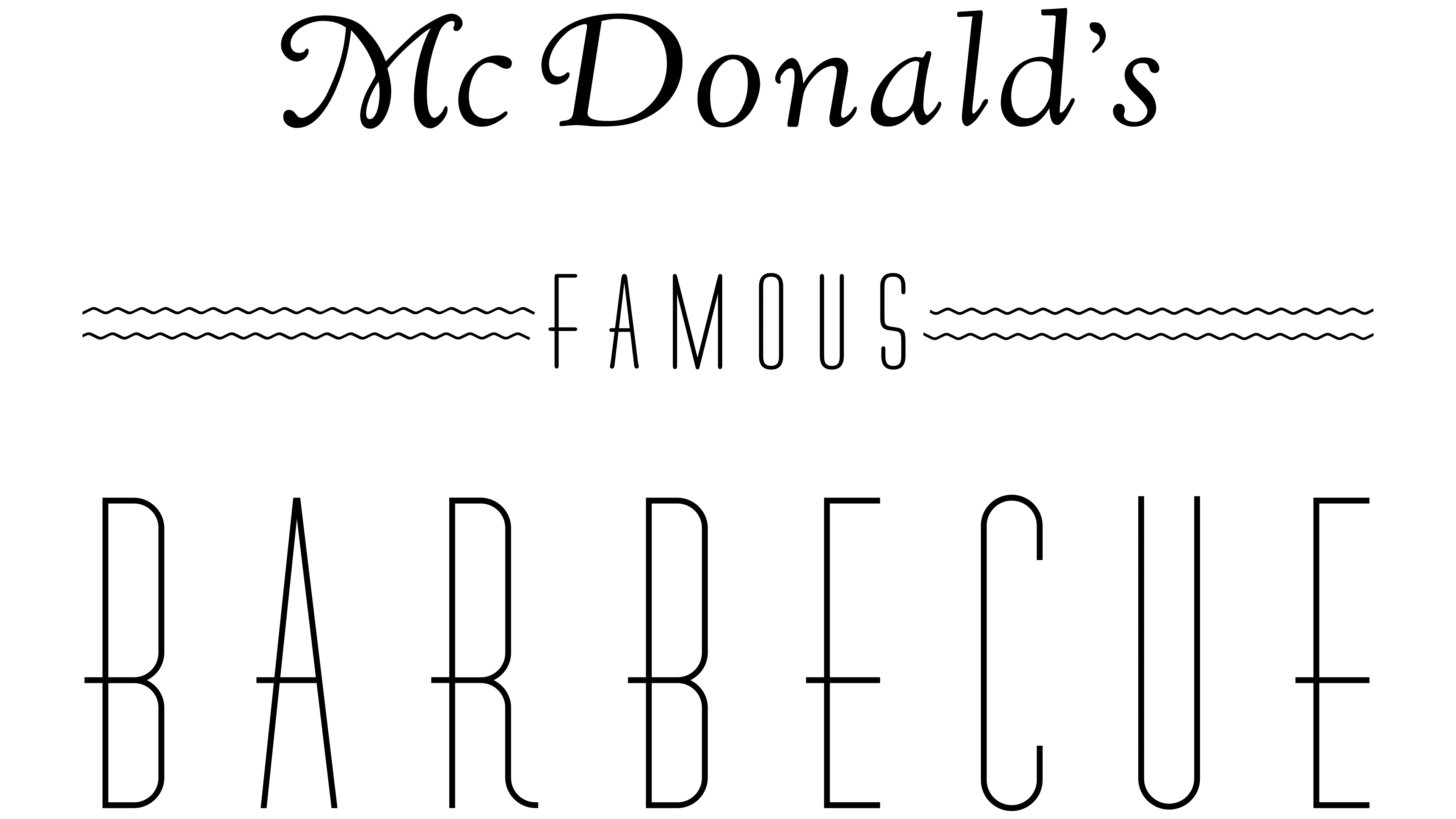
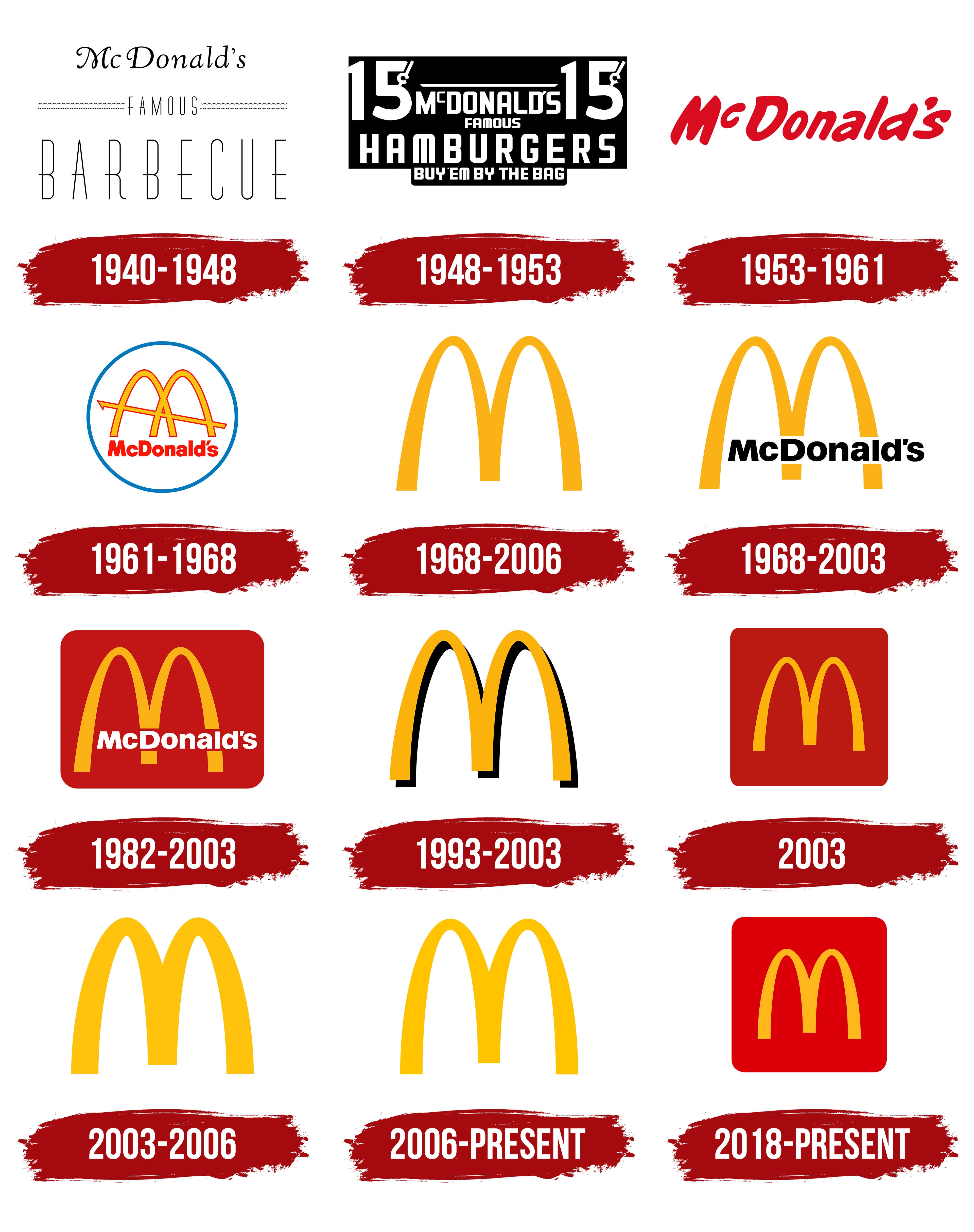
On May 15, 1940, in San Bernardino, brothers Richard and Maurice McDonald opened their first restaurant, specializing in barbecue. They started small, with no plans to scale, and operated under the name McDonald’s Famous Barbecue. The restaurant’s exterior was restrained, built around a black-and-white color scheme, without bright accents or symbols that later became part of the brand.
The sign consisted of three textual levels. The top featured the name McDonald’s, set in the handwritten Kennerley Italic typeface. Smooth strokes, curved endings, and thin lines created a handcrafted feel.
At the center of the composition was the word FAMOUS. It was set in the elongated Huxley Vertical typeface. Wavy lines on both sides visually suggested the heat and smoke of grilling meat.
The lower level featured the word BARBECUE, executed in the same Huxley Vertical typeface. Tall, narrow uppercase letters reinforced the product’s focus and logically completed the sign composition. The combination of decorative lines and strict typography formed the atmosphere of American roadside restaurants of the time.
The first McDonald’s logo reflected the chain’s early history. During this period, barbecue defined the restaurant’s identity, and the McDonald brothers were seen as owners of a local California restaurant that had not yet achieved the status or symbolism of a global corporation.
1948 – 1953

By the end of 1948, McDonald’s had entered a new stage of development. This followed a radical menu overhaul and a shift to hamburgers as the core product. The name changed to McDonald’s Famous Hamburgers, and the sign was updated to reflect the new format and its focus on a mass audience.
While the previous version used black lettering on a light background, the new design inverted the palette. The sign became a typographic billboard, scaled for reading from the road. On both sides of the main inscription, the price 15¢ was clearly visible to pedestrians and drivers approaching the restaurant.
The number 15 appeared large and heavy, with the cent symbol placed alongside it. At the center of the composition, the name McDonald’s appeared in a sans-serif typeface. The letterforms were simple and utilitarian, with a thin horizontal line above the word to draw attention to the restaurant name.
Below it was the word FAMOUS. It appeared more compact, playing a secondary role in the sign’s structure. The main emphasis fell on the word HAMBURGERS. The wide letters featured rounded corners and dense strokes.
The lower part of the composition was complemented by a rectangular plaque with the text BUY EM BY THE BAG. The lettering was set in a compact sans-serif typeface, and the panel’s rounded corners fit naturally into the overall design.
1953 – 1961

By 1953, the McDonald brothers concluded the restaurant needed a short, clear name. After earlier longer names, they settled on the concise McDonald’s, marking a new stage in the chain’s development. At the same time, they updated the sign and later adopted it as the official logo when the corporation was incorporated on April 15, 1955.
The new visual image felt freer and livelier. Strict outlines gave way to a slanted inscription, creating the impression of handwritten lettering. The name McDonald’s was rendered in red, with letters resembling brush strokes. Rounded forms and gentle curves created an open, friendly atmosphere.
As early as 1961, the emblem was replaced, yet the mark continued to appear in selected advertising materials until the late 1960s. In 2021, the historic lettering unexpectedly returned in Japan on vintage packaging released to mark the fiftieth anniversary of the chain’s local division. The corporation’s Chicago headquarters also uses a similar version, recalling the brand’s early formation.
This logo appeared just before Ray Kroc became involved in the company’s development. The mark signaled the shift from a local family business to future large-scale expansion, marking a new chapter in McDonald’s history.
1961 – 1968

On September 13, 1961, McDonald’s, already under Ray Kroc’s management, registered a new logo. At the time, no one anticipated the yellow arches would become the chain’s visual identity for decades. Jim Schindler, head of engineering, created the image and proposed a form that has since become a fixture of the American urban landscape.
The mark consisted of two connected golden arches forming the letter M. Red outlined the arch lines. A diagonal yellow stripe, outlined in the same way, ran across both shapes and ended in a sharp point on the left. The entire composition was placed within a light-blue ring that formed a circular frame.
Below the symbol, the name McDonald’s appeared. The wordmark used a sans-serif typeface with tightly spaced letters and rounded shapes. The typography felt heavy and complemented the arches.
The chain first used the new symbol at a Phoenix restaurant, then rolled it out to other locations. The arches featured a diagonal crossing and interlaced central sections, distinguishing the early version from later interpretations. The chain’s oldest operating restaurant in Downey, which opened in 1953, still uses this version.
Although the official mark was updated in 1968, some locations continued to use the early version of the Golden Arches as a visual reference to the company’s history and the period when the chain began to expand internationally.
1968 – 2006

In the fall of 1968, McDonald’s introduced a new mark and began using it publicly. The date October 21 is recorded in an internal company report. That’s when the final version of the arches appeared, ready for trademark registration.
The logo featured two elongated yellow arches. At the bottom, they connected to form the letter M. The shapes were symmetrical, with rounded tops. A single color was used. The simple geometry made the image easy to remember and visible from a long distance.
Paul Schrage led this version, overseeing the shaping of the company’s visual image. His version of the arches matches the form considered canonical today. The logo was registered on November 18, 1968, and the mark was officially adopted as the chain’s emblem.
The new form entered the restaurant visual environment and became a clear symbol of fast food. The yellow letter M began to be used on its own, without text or explanation. Since the late 1960s, Schrage’s arches have remained a key element of McDonald’s image, retaining their original proportions and form.
1968 – 2003

In 1968, McDonald’s introduced another version of the symbol, combining the arches with the brand name into a single composition. Paul Schrage created the concept. McDonald’s used this version for many years on packaging, in advertising, and on restaurant signage.
In this execution, the golden arches took on a different structure. The right side of the form was opened, leaving space for the McDonald’s wordmark. The name was placed horizontally and ran through the arches, partially overlapping their lower area.
The wordmark used a bold sans-serif typeface. The letters M and D were larger than the rest, while the remaining characters appeared more compact. The color scheme used yellow and black.
This logo version was used for almost two decades. Until 1987, it appeared on most of the chain’s packaging and advertising materials. The mark remained on restaurant facades until 2006, when exterior updates began under the Forever Young campaign. Today, the version with the overlaid text is rare and is perceived as a reference to the classic stage of McDonald’s history, which can still be seen at select restaurants worldwide.
1982 – 2003

In 1982, McDonald’s introduced an updated version of the mark to convey a softer, more universal feel. McDonald’s used the 1968 version as the base and added new elements.
The key change was a red rectangle with rounded corners. Inside it, the golden arches and the McDonald’s wordmark were placed. The text color was changed from black to white. The red background enhanced the yellow symbol’s visual presence, while the white lettering improved legibility and stood out clearly against the surface.
After the next version was released in 2003, the 1982 variant gradually disappeared from packaging. Until 2004, it remained the primary mark for most of the chain’s products. In Indonesia, the symbol appeared on certain packaging until 2010. Today, this emblem still appears at several restaurants that have not updated their exteriors.
1993 – 2003

In the mid-1990s, McDonald’s changed the mark’s familiar appearance. In the main version, they removed the wordmark and added a shadow to the golden arches. The company had already used a similar approach in 1990 for the McKids children’s line. The arches without text appeared in 1993 and became more widespread after the 1995 packaging update.
The symbol remained based on two symmetrical yellow arches forming the letter M. The added shadow gave the mark volume and made the image feel more contemporary.
McDonald’s used the shadowed version alongside the 1982 logo for nearly 10 years, and it remained in circulation until 2003. In some countries and for certain product categories, McDonald’s used this variant until 2010.
2003
In the spring of 2003, McDonald’s briefly returned to the visual mood of the 1980s, but without any text. In May, a version of the mark appeared with a golden arch on a red background with rounded corners. The brand name was removed. The arch’s proportions remained familiar, and the red rectangle retained a rich, uniform color.
The company used the mark exclusively in advertising materials. It appeared in television commercials and print advertising. Its use was short, lasting only a few months. By September, the company began a large-scale visual update and discontinued the May version.
2003 – 2006

In the summer of 2003, McDonald’s announced the launch of the “I’m lovin’ it” campaign and unveiled an updated version of the golden arches emblem. McDonald’s officially presented it on September 2. The campaign started in Germany and was launched in the United States on September 21, 2003. The German agency Heye and Partner developed the mark. The arches retained their familiar curve and yellow color.
The main changes affected proportions. The lines became thicker and visually heavier. The mark consisted only of the arches, with no background or panels. In the brand identity, the typeface Neue Helvetica 75 Bold was introduced in advertising materials and other applications.
2006 – today

On September 28, 2006, McDonald’s announced a large-scale restaurant update called Forever Young. At the same time, it redesigned the logo. The company retained a single letter M composed of two yellow arches.
The symbol looked lighter than before. The arches lost their excessive thickness, and the outlines became thinner and softer. The heavy form was replaced by a neat, restrained figure without background or text.
The typefaces were also updated. From 2006 to 2014, Akzidenz Grotesk Bold was used. It was later replaced by Lovin’ Sans, which remained current until 2018. Both typefaces were part of the broader cycle of visual updates and were used in restaurant design, navigation, and advertising materials.
2018 – today
In October 2018, McDonald’s introduced a new version of the mark called Token. The launch coincided with the transition to the Speedee typeface, named after an early brand character. It replaced Lovin’ Sans, which had been used since 2014. Until 2020, the mark on packaging and in advertising was used on its own, without a slogan.
The emblem featured a golden arch on a red square background. The color combination relied on the standard brand palette. The yellow arch lines remained thin, preserving the familiar silhouette established in mass perception.
In 2020, during the COVID-19 pandemic, a temporary version of the mark appeared. The arches were separated, increasing the distance between them. The brand used this approach as a visual gesture to reinforce social distancing and customer care. The version circulated in the media and was discussed in public.
In the same year, the slogan “I’m lovin’ it” returned to the brand’s advertising, appearing in a Super Bowl LIV commercial.
Font and Colors
The golden arches symbolize the wealth you can gain by joining the company and also represent protection and safety.
The letter “M” has been part of the restaurant’s logo since its inception. Initially, it was doubled, a nod to the two McDonald brothers who founded McDonald’s. In the late 1960s, the icon was modified, giving it a clear arch shape connected in the form of the letter “M” with thickening at the ends.
The brand’s color palette consists of yellow, red, and green. According to the creators, red attracts attention and stimulates appetite. Yellow symbolizes joy, a lifted mood, robust health, and friendliness. Green, introduced in 2007, symbolizes a commitment to sustainable development and stability.
Why are McDonald’s colors red and yellow? Red attracts attention and triggers hunger. Yellow, on the other hand, evokes feelings of joy and friendship. Undoubtedly, red and yellow create high contrast, making people more likely to eat at McDonald’s because these colors subconsciously prompt consumers to do so.
The dark green color, introduced in 2007, symbolizes a commitment to sustainability. Note that logos in Europe are predominantly green. However, the logo’s background color periodically changes.
This is how a small fast-food restaurant transformed into an empire and expanded worldwide, eventually becoming a large company. This logo is one of the most recognizable globally and is impossible to confuse with any other. Behind its golden arches lies an entire era. The letter “M” has delighted children and adults for years.
FAQ
What is the slogan of the McDonald’s logo?
The slogan “I’m Lovin’ It” isn’t just catchy; it’s central to its identity. Introduced in 2003, it quickly gained popularity worldwide. This slogan was transformative, aiming to strengthen customer loyalty by highlighting the joy and satisfaction of dining at McDonald’s. “I’m Lovin’ It” stands out due to its simplicity and universal appeal. It promotes a positive outlook that resonates with people globally. McDonald’s has used this slogan extensively across advertising channels, including TV commercials, billboards, and online platforms, often accompanied by memorable music.
This slogan complements McDonald’s iconic “Golden Arches” logo, a globally recognized symbol. These arches symbolize McDonald’s tradition of offering quick, tasty meals. Together, this slogan and logo capture McDonald’s essence, contributing to its dominance in the fast-food industry and broad appeal.
What does the McDonald’s symbol represent?
The McDonald’s logo, a golden “M” on a red background, represents more than a restaurant sign. It’s a globally recognized symbol. The “M” shape is intentionally reminiscent of a mother’s breasts, a concept design expert Louis Cheskin proposed. He believed the design would subconsciously evoke comfort and care, making McDonald’s feel welcoming to everyone.
The golden arches design is simple and bright, making it easy for potential customers to notice. This distinctiveness sets it apart from numerous fast-food competitors. The gold choice suggests quality food, while the red background captures attention and stimulates appetite. As McDonald’s expanded globally, its logo came to symbolize American fast food worldwide. It assures customers of consistent quality and quick service across all locations.
How many McDonald’s are in the world?
By the end of 2018, McDonald’s had 37,855 restaurants in 120 countries, establishing itself as a leading fast-food chain. Around 68 million people choose McDonald’s for their meals daily, highlighting its widespread appeal.
With over 210,000 employees worldwide, McDonald’s plays a significant role in the job market, providing a variety of positions that support many individuals and their families. McDonald’s continuous growth underscores its commitment to meeting customer preferences with fast, delicious, and affordable meals wherever they are.
Why is the McDonald’s logo so successful?
The McDonald’s logo, with its golden arches, is incredibly famous and brings joy to people worldwide. It’s not just about quick service, delicious meals, and joyful times; it connects with us emotionally and brings back fond memories whenever we see it.
Its simplicity is another reason it works so well. The “M” is styled to be easy to spot from afar, whether on a sign or on packaging, and to be instantly recognized as McDonald’s. The color scheme is eye-catching. The bright gold on a red background is hard to miss, whether in a bustling city, on a highway, or in an advertisement. Its memorability is key to its success. Its distinctive look ensures it stays in your mind. This works for McDonald’s because it makes you think of them the next time you decide where to eat.
The logo succeeds because it connects emotionally, is simple and recognizable, stands out visually, and is memorable. These qualities make the golden arches more than a symbol; they’re a crucial part of the brand’s identity, helping it remain a favorite worldwide.
What is the McDonald’s symbol?
The McDonald’s golden arches are well-known worldwide and symbolize the fast-food chain. These bright yellow arches form an “M” for McDonald’s, combining simplicity with impact. The idea for the arches came from the first McDonald’s restaurant in Phoenix to offer franchises. Architect Stanley Clark Meston designed it, embedding the “M” in the building’s structure and making the restaurant easy to spot at first glance. Over time, the golden arches’ meaning evolved. Some think they evoke feelings of a mother’s care and comfort, broadening the logo’s appeal.
Why did McDonald’s choose its logo?
In 1961, Ray Kroc took over McDonald’s and needed a new logo to represent the company’s identity. He wanted a simple yet striking design to make McDonald’s more visible among fast-food chains. He tasked Fred Turner, the company’s president, with creating this new logo. Turner selected Jim Schindler, a construction manager with a flair for design and architectural knowledge, for this critical task.
Schindler drew inspiration from the arches that prominently feature in McDonald’s restaurant buildings. Schindler aimed to transform these arches into a prominent logo. His decision was ingenious. Schindler morphed the architectural arches into an “M” shape, creating a logo instantly recognizable as McDonald’s and a globally recognized symbol. This new Golden Arches logo transformed McDonald’s.
What does the McDonald’s logo symbolize?
The McDonald’s logo, famous for its eye-catching red and yellow, carries significant meaning for the brand. It features a large “M” made of golden arches, with strong visual appeal and strong brand recognition.
The red logo represents passion for food and its dynamic nature. Red is often associated with the food industry because it can make people feel hungrier, which fits McDonald’s status as a major fast-food player. The red background underscores McDonald’s commitment to delivering tasty, satisfying meals.
The yellow color used for the “M” evokes sunshine, warmth, and joy. It positions McDonald’s as a welcoming, friendly spot for enjoyable gatherings. This shade of yellow evokes the famous, crispy, golden fries, linking the logo to the delicious food they offer.
Does the McDonald’s logo depict a breast?
Jim Schindler, the head of McDonald’s construction department, created the famous “Golden Arches” logo, inspired by the arches on the company’s restaurant buildings. He turned these arches into an “M” for McDonald’s, aiming for a standout design.
As the logo became well known, some people began to see it differently. For example, a few thought the arches resembled a woman’s breast. This interpretation led them to consider changing the logo. However, psychologist Louis Cheskin advised against it. He argued that the resemblance might subconsciously reassure customers and make them feel nourished, potentially leading to a more positive view. Cheskin suggested these feelings could connect customers to the brand emotionally and psychologically. McDonald’s decided to keep the logo, as Cheskin recommended.
What do McDonald’s golden arches symbolize?
McDonald’s golden arches are recognized worldwide and directly associated with the fast-food chain. At a glance, they form the letter “M” for McDonald’s. This globally recognized design connects people to the brand. Some people even see these arches as comforting, akin to a mother caring for her child, given their association with nurturing and feeding.
These arches symbolize stability. Their sturdy, symmetrical appearance makes people feel secure and confident, much as McDonald’s is a reliable fixture in communities worldwide.
They are more than places to eat; they show how McDonald’s has integrated into global culture and illustrate the reach of American capitalism. They represent the McDonald’s brand, convey care and stability, and highlight the company’s role in global culture and capitalism.
Does the McDonald’s logo have a hidden meaning?
With its golden arches, the McDonald’s logo is widely recognized for the “M” it forms. Interestingly, some people see the arches as resembling a woman’s breasts, offering a new perspective. This interpretation links the logo to motherhood and the nurturing, love, and care it represents. As this view gained attention, McDonald’s kept the logo unchanged. They recognized the logo’s ability to evoke comfort and care, like the warmth of a mother’s embrace.
When was the McDonald’s logo created?
In 1962, Jim Schindler, who led McDonald’s construction department, created the first design for what we now know as the “Golden Arches.” He designed an “M” with two arches connected by a diagonal line, making a unique and memorable symbol for McDonald’s.
Following Schindler’s design, other designers refined the logo into its current form. They removed the diagonal line, leaving only the golden arches that form an “M.” This simpler design made the logo one of the most recognizable worldwide and strengthened the brand’s image. The logo has changed slightly over the years, but Schindler’s original concept remains, showcasing his lasting impact on identity.