


 Medtronic Logo PNG
The Medtronic logo features a dark blue wordmark. It used to be inseparable from the emblem, a man rising to his feet, symbolizing the fullness of life. But after a series of rebrandings, these identity elements began to be used separately.
Earl Bakken, an electrical engineering graduate student at the University of Minnesota, and his brother-in-law, Palmer Hermundslie, registered Medtronic in Minneapolis on April 29, 1949. The company began in two railroad cars converted into a garage near Hermundslie’s home. In its first month, it earned eight dollars by repairing medical electrical equipment for hospitals.
That repair work connected Bakken and Hermundslie with doctors at the University Hospitals, including heart surgeon Clarence Walton Lillehei. After a 1957 power outage killed an infant attached to a plug-in pacemaker, Lillehei asked Bakken for a portable version. In less than four weeks, Bakken built the first wearable battery-powered transistor pacemaker, adapted from a Popular Electronics circuit.
In 1960, Wilson Greatbatch and William Chardack developed the first implantable pacemaker. Medtronic licensed the device as the Chardack-Greatbatch pulse generator. The same year, while the company was near bankruptcy, Bakken wrote the company’s mission, centered on patient welfare rather than profit. Revenue reached $10 million in 1968, passed $100 million in 1975, and exceeded $200 million by the late 1970s.
Medtronic expanded internationally in 1969, added a neurological division in 1976, and listed on the New York Stock Exchange in 1977. Later products and acquisitions included the Medtronic Hall heart valve, the PCD defibrillator, Sofamor Danek, Arterial Vascular Engineering, and MiniMed. Rivals included Boston Scientific and Johnson & Johnson units. In 2015, Medtronic bought Covidien for about $42.9 billion and became Medtronic plc in Ireland. Bakken died in 2018, after receiving a Medtronic pacemaker in 2001.
Meaning and History
Now, Medtronic actively uses the wordmark in its name. But the brand’s real fame came not from this inscription but from the symbol featuring a human figure. Its history began in the 1960s, when Earl Bakken, one of the company’s co-founders, commissioned a philosophical painting. The painting depicted a man lying on a table, slowly rising to his feet. The picture showed the movement’s full trajectory, from start to finish. This inspired the iconic Medtronic emblem.
The logo was initially accompanied by the slogan “When life depends on medical technology,” suggesting that medical equipment could lift people, both literally and figuratively. Over time, the company’s identity has evolved. A particularly notable leap in its development came in 2015 when Interbrand employees took on the job.
What is Medtronic?
Medtronic manufactures various medical and diagnostic equipment, including electrocardiac monitors, portable ventilators, insulin pumps, X-ray systems, spinal cord neurostimulators, and more. The company is legally registered in Ireland but is headquartered in Minneapolis, the United States.
Before 2000

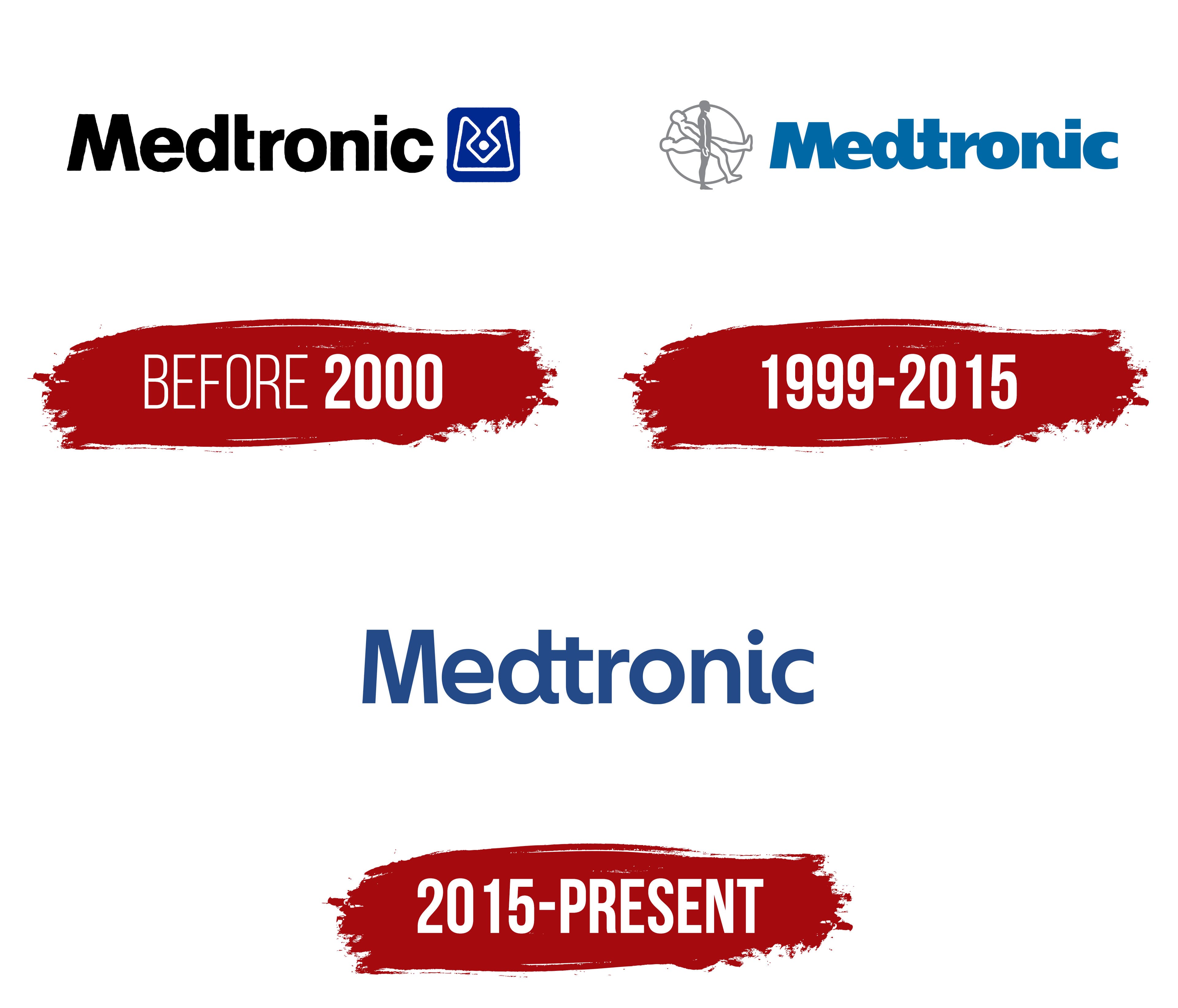
Medtronic was once represented by a logo featuring black lettering in a bold, sans-serif font. To the right of the brand name was a graphic sign, a stylized “M.” It was enclosed in a blue square with rounded corners and consisted of thin white lines. The central part of the pattern formed a rhombus with a dot at its center. The emblem also had a black-and-white version without the blue elements.
1999 – 2015

For a long time, the medical device manufacturer had a logo with the word “Medtronic” in an unusual design. The designers made it blue and used a bold font with lengthened terminal elements on some glyphs. The designers reduced the letter spacing so narrow gaps appeared only between the “t” and “r,” “o” and “n,” “i,” and “c.” All other glyphs were merged. The stylized “M” on the right had disappeared, but a symbol of three human silhouettes in a white circle appeared on the left. The closest figure (standing straight) was gray, and the two farther ones (at different angles) had gray outlines but were themselves white. Overall, this icon resembled a dial with people in place of the hands.
2015 – today

Medtronic’s next transformation came courtesy of the Interbrand Health office. Designers completely changed the company’s visual identity, presenting it not just as a seller of medical devices but as a universal health care provider. The rebranding followed the acquisition of Covidien, which shifted the business strategy. As a result, the main Medtronic logo was shortened to dark blue lettering, which was more legible than the previous version. Now there are sufficient width intervals between all letters except “d” and “t.” In addition, the glyphs no longer look flattened.
Font and colors

The company’s most famous emblem is an image of a man standing. In the original version, the figure rose from the table, but after the symbol was finalized, it changed. The 2021 redesign left a single silhouette in a ring with blue, blue, and purple gradient bands. This graphic sign promises to help people find fullness in life.

The medical technology manufacturer originally used a bold sans-serif font in its logos. Despite multiple changes, it remains balanced in shape. In the current version, the glyphs feature both smooth roundings and sharp corners, giving the lettering a dynamic feel. The Medtronic wordmark is painted in its signature navy blue.