


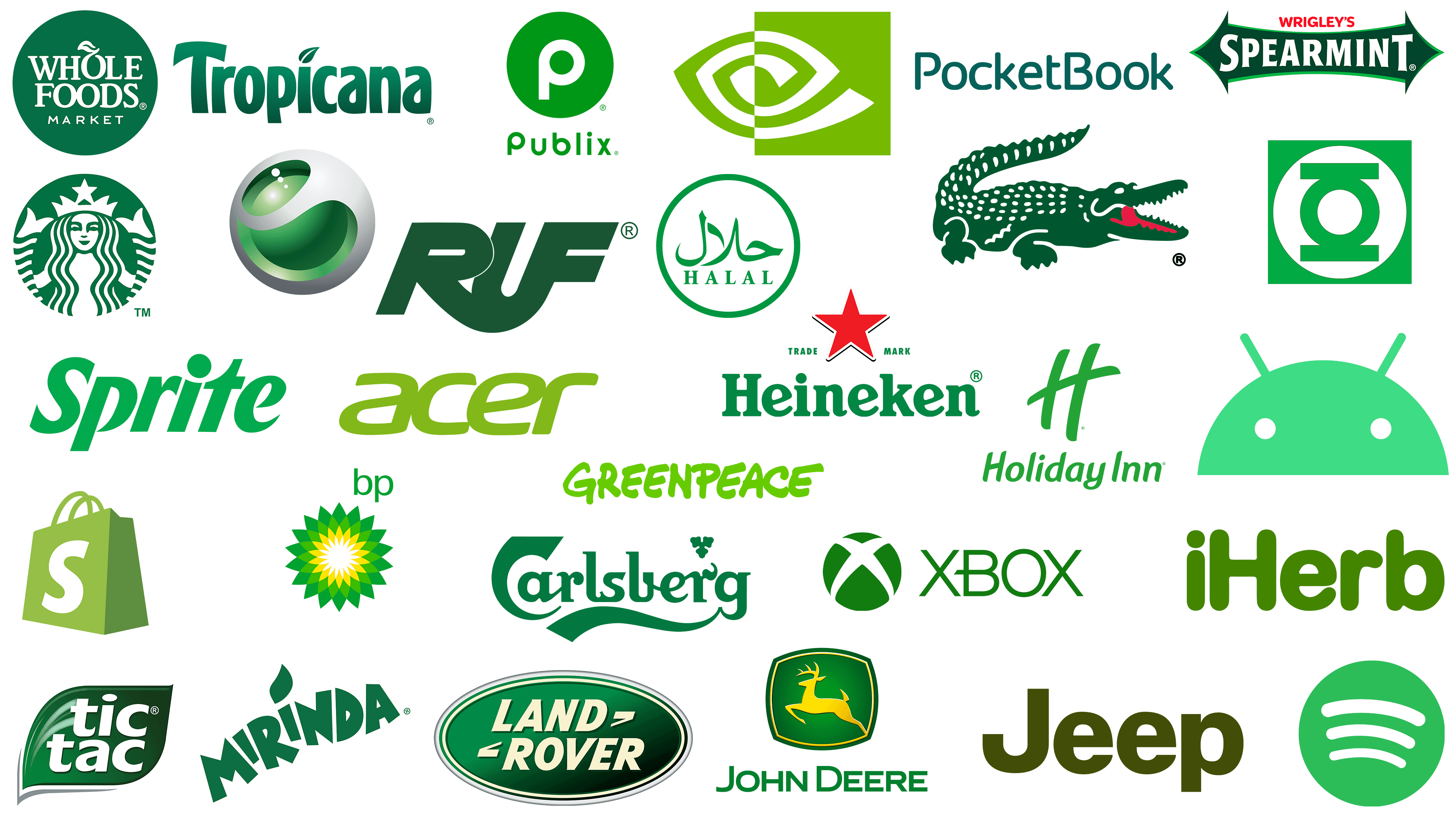
The color green has many meanings. It symbolizes life, rebirth, nature, growth, profit, prosperity, progress, and money. Companies across most industries use these meanings. So, we can be sure green is one of modern consumers’ favorite colors. After all, brands that have adopted it as part of their visual identity are popular worldwide. This means that they are noticed, respected, and trusted.
We have collected the most interesting and famous green logos. They are played with all shades of color, from neon-light green to mysterious emerald. Each company has its motive. By exploring their concepts, we will try to trace the relationship between the emblem and the trademark’s purpose. We are sure we will find it. After all, organizations, manufacturers, and world-class brands invest in identity for self-realization for a reason. It’s like advertising: the more accurate it is, the more profitable it is.
Here is a list of green logos arranged in order of increasing complexity. This arrangement makes it easier to understand the meaning of the green color and the semantic support it has from the surrounding elements.
iHerb

Our “pantheon” opens with an online platform that sells vitamins, supplements, and organic and natural products. So it’s no surprise she chose green. It emphasizes its line of business, connects with nature, and promotes the concept of a natural habitat. The simple icon consists of the web resource’s name in its original spelling, with the lowercase letter “i” first. This is followed by the capital letter “N.” All letters are dark green, grotesque, and rounded. The lowercase “b” is the same height as the uppercase letters, keeping the lettering visually balanced.
Acer

The Acer logo is also green. It’s a light green shade in the pastel spectrum: rich in color but slightly muted. The lettering is smooth and lowercase, which adds to its practicality. The glyphs are slightly italicized and elongated, creating a sense of dynamism and emphasizing progressiveness. In addition, the letters are interconnected: each successive character relates closely to the previous one. Particularly interesting is the connection between “a” and “c,” which are literally “attached” to each other’s sides. Here, green indicates the company’s aspiration for continuous development and improvement.
Jeep

Jeep, an automobile company, also has a logo that reads, “There is no simpler.” It contains only one inscription: the name. It is typed in a sans-serif font with narrow character spacing. The text color is khaki (also called swamp). This shade of green is most commonly associated with heavy machinery and military uniforms. As a result, the emblem feels brutal yet balanced, emphasizing that the brand’s cars are durable, reliable, and practical.
PocketBook

The manufacturer of electronic books, PocketBook, chose a simple logo: it consists only of text. Thin letters are rounded at the ends, looking elegant yet strict. The letters “P” and “B” are capitalized, with a space between them; the rest of the characters are lowercase in the classic spelling. The letter “t” is missing from the left side of the crossbar. The emblem’s color is emerald, a blend of green and blue. It is also called aquamarine. This combination harmonizes the wordmark and embodies the yearning for creativity, the emergence of knowledge, and the manifestation of wisdom.
Sprite

The Sprite logo’s color palette is inspired by its lime-and-lemon recipe. The brand’s emblem was originally yellow, but in its modern interpretation, it became green, the color of spring grass. The simplicity of the symbolism is explained by the need to accurately represent the product and fit it on a small label. Therefore, the letters are set in bold italics. There are no serifs, but there are dots at the ends and many right angles.
Greenpeace

The Greenpeace logo clearly illustrates this idea of integrity in tasks, concepts, and identity. Green represents ecology, nature, organic products, and the unity between man and the Earth. A special font was developed for the emblem, with bold, uneven letters that looked as if they were written with a marker on a white sheet. Each glyph differs from the others: no two letters “E” are the same. The lettering is uppercase and light green.
RUF

German car manufacturer RUF has a bold, progressive logo. The visual identity is based on a stylized inscription, transformed from regular text into a graphic element. The designers found common lines and connected all the letters into a single “construction.” Thus, they have interlocking sides: “R” smoothly passes into “F,” and between them lies a portion of “U.” They are painted dark green, which emphasizes the car company’s business qualities and seriousness.
Android

The Android logo is green, with no gradient or glare. The logo shows only a solid half circle. It is distinguished from standard geometric shapes by two small white dots. These are the “robot’s” eyes. In the upper part, two small antennas are positioned diagonally opposite each other. This image generally denotes an unearthly creature, an alien, or, as it is also called, a green man. Hence the choice of color. The palette is calm, non-aggressive, soft, and light, reflecting the operating system’s friendliness, which has become the most popular among smartphone and tablet owners.
Spotify

The streaming service Spotify chose a simple, graphic logo. It represents a green ball with three diagonal semi-arcs. “Half-arcs” because the lines only vaguely resemble arcs: they’re more like diagonal strokes with slightly dropped edges. They are waves that broadcast music for music lovers. The upper stripe is bold; the lower one is thin. The background circle is a moderate shade of light green. Three white arcs are visible on it.
Shopify

The Shopify logo is concise. It depicts a paper bag with handles, like the ones supermarkets give to customers. It is one of the most iconic symbols in stores, so the online platform is widely recognized. The online shopping service lets users select and buy what they need in minutes from more than 1.5 million outlets. The calm green color contributes to this: it inspires trust and confidence. The package’s handles and front are light, while the left side is dark to indicate the side wall. In the center of the bag is a single white “S”.
Lacoste

The Lacoste logo features a toothy crocodile, the brand’s mascot. As expected, it is a very saturated, dark green. It is supplemented with two colors for greater expressiveness: white (eyes, crest dots) and red (mouth, tongue). This contrast gives the animal a sense of realism, confidence, and seriousness. The alligator is turned to the right. It has massive paws and a curved tail.
Carlsberg

The Carlsberg logo is another medium-sized visual identity mark. It represents the brewing company and consists of its name. The green color was chosen because the foamy beverage is bottled in green glass, darkened to prevent sunlight from degrading its contents. This shade evokes professionalism and perfection. The inscription is written in a calligraphic hand, with letters arranged vertically. The letters “C” and “g” have wide, ribbon-like stripes, and the upper “r” is depicted as a leaf. Above it are three connected hop cones.
Tropicana

The green color scheme suits a juice and fruit drink producer. That is why the Tropicana logo is green with a subtle gradient: the lower part of the letters is darker than the upper part. The shade of the inscription matches tropical tree leaves, where active photosynthesis occurs under excess sunlight. To confirm, the emblem is a leaf that replaces the dot above the lowercase “i.” The cap of the capital letter “T” is similar: it repeats the pointed leaf outline.
Mirinda

The Mirinda logo is also dark green and has a leaf above the letter “i.” It differs only in the lettering style. Here, the font is uppercase, geometric, and non-standard. The letters differ, with dots and uneven ends, so they look like they’re “jumping.” The juice brand’s name is set on a diagonal.
Land Rover

The Land Rover SUV brand uses a green, classic logo. It’s a horizontal oval with a triple border of white, green, and silver. The middle is also green with a gradient from light to dark. The brand name is centered in the medallion and set in uppercase geometric type. The letters are italicized, with tiny serifs as pointed extensions. Triangular hyphens mark the end of the first line and the beginning of the second.
Sony Ericsson

The Sony Ericsson logo’s complexity lies in its use of several shades of green to form three-dimensional spots. Properly selected shadows and highlights make them look like hollows in a gray ball. Moreover, in the center, another ball appears smaller and entirely green. Bright, saturated colors suit a cell phone manufacturer. Overall, the emblem looks futuristic.
Holiday Inn

Despite its two elements, the Holiday Inn emblem is simple. The inscription is thin and grotesque, with diagonally cut, pointed ends on almost all letters (except the “o”). The glyphs are straight, flowing, and rounded. Above the brand name is a single letter “H.” It is made in the same style as the main text but with an elongated crossbar. As a result, the mark appears to be a pound sign (#). The color is spring green, i.e., bright and juicy.
NVIDIA

NVIDIA, a developer of graphics programs, chose an abstract logo. The rich light green pairs well with neutral white, and the spiral line ties the two colors together. The left has green stripes on a white background, and the right has white stripes on a green background. The stylized figure also resembles an eye, echoing the theme of the American company’s work. The absence of a name lends the emblem mystery and originality.
Green Lantern

The Green Lantern emblem is associated with a fictional superhero first introduced in a DC Comics comic book in the 1940s. Since then, it has evolved into a media franchise, including a sequel movie. The character’s signature color is, naturally, green. The emblem features a square background with a white circle and a stylized lamp inside. It is also green and features a wide ring between two short lines. The abstract geometric shapes represent the eternal fire in the hearts of those who strive for justice, fight for truth, and have brave hearts.
Halal

The green in the Halal logo is classic: moderately bright, fresh, and rich, reminiscent of the first spring leaves. It symbolizes Islamic culture, so most Eastern companies use it in their symbols. The emblem consists of a green ring and a white circle; inside, it features Arabic and English inscriptions. The font is uppercase, sans-serif. The emblems are flat, with clear corners and thin crossbars. In contrast, the Arabic letters are rounded. They are made with smooth and soft strokes.
Whole Foods

Like many other brands offering natural and organic products, Whole Foods has adopted a natural logo. The supermarket chain’s emblem is a muted green circle. It contains the full name in three lines. The first line features an apple replacing the letter “o.” A cutting and a leaf complement it. In the second line, two neighboring “o” letters are played with. The letters are tightly connected. The third is the word “Market”. This inscription is typed in a thin sans-serif font. All the others have classical serifs. The text is white.
Starbucks

The Starbucks logo is more complex because it depicts a mermaid. The pattern covers almost the entire background circle and consists of smooth, wide lines that form an unusual image for a fast-food chain. The dark emerald color suggests long hair, a friendly face, thin arms, a shapely body, and a massive crown with a star. Also present is the semblance of a forked mermaid tail on both sides. This color combination represents confidence and determination. Thanks to him, the company is actively expanding and opening new establishments.
Tic Tac

This brand’s visual style is well known worldwide, as it specializes in releasing small candies in a variety of flavors. Originally, the dragees were minty, so the Tic Tac logo features a small green leaf with white, two-tier lettering. The lettering is lowercase, with wide, rounded letters. The letters “t” and “c” have pointed ends. The leaf is arranged diagonally and is also pointed. It also has short, light strokes and a shaped gray shadow at the bottom. There is also a black outline. These details give the logo a dynamic, three-dimensional, and realistic feel.
Wrigley’s Spearmint

The iconic Wrigley’s Spearmint logo has white, red, and two shades of green. It consists of multidirectional arrows formed on the base of an elongated rectangle. The geometric figure is arranged horizontally and is flanked by sharp triangles. The center contains the second part of the brand name. It is typed in uppercase with large letters “S” and “T.” All glyphs have elongated dots. The first half of the name is colored red and typed in sans-serif capital letters. The banner’s main color is dark green. It is outlined in a thin, light green.
Heineken

Heineken chose a complex logo as it is one of the most famous beer producers in Europe and needed a decent identity:
- The brand settled on green, a color commonly used for beer bottles.
- It presented itself as a premium brand by using a big star.
- He captured all of this succinctly in the emblem.
The largest element is the green-colored lettering. The beer’s name is in lowercase letters (except for the “N”). The letters are wide and grotesque. The “n” has a curved right foot, and the “e” has a diagonal center crossbar. At the top is a red five-pointed star with black shadows, giving it a sense of volume. The sides read “Trade” and “Brand”. These inscriptions are capitalized.
Xbox

The Xbox logo directly reflects the developer’s concept of the console it shares its name with. It is made in a light and bright palette of the green spectrum. White is also present. This neutral color perfectly complements the main shade and balances it. The first is a ball formed from four triangles of different shapes. They are combined as if divided by two wide diagonal strips. So the designers created a stylized “X”. On the right side is the brand name. It is also green in color and made with thin lines. The letters have no serifs, and “B” has an elongated middle stroke. It extends beyond the glyph’s borders and is cut at a slight angle.
Publix

A dusty dark green is used in the logo of Publix, an American company with an extensive nationwide network of stores. It also specializes in financial services, event management, and real estate. Its emblem is a circle that unites all its interests. In the center is a single letter “P.” It is colored white and is shaped like a ring road with siding. Below is the company name. It is typed mostly in lowercase green letters. Moreover, “p” and “b” are rounded and repeated. The letter “u” also uses a round geometric font.
BP

The BP logo is the most complex green visual identity mark. In addition to green and white, it also contains yellow. This is explained by the nature of the company’s activities: it provides a wide range of gas and oil services. As a result, its sign resembles a flower made of many geometric petals. They look like elongated rhombuses with sharp tops. But the green isn’t one color; it is two. The first row is dark green, and the second is light green. At the center is a sun-like figure with long rays. It also uses the similarity between the letters “p” and “b”. The abbreviation “BP” (for British Petroleum) is in the upper-right corner.
John Deere

The John Deere logo emphasizes the American agricultural machinery manufacturer’s high professionalism. It is a multi-structured visual identity mark. It contains a pictogram consisting of a geometric figure with four convex faces. It also has two frames: an inner yellow frame and an outer green frame. The central space is painted in a gradient green: lighter in the middle than at the edges. A running deer is depicted in this background. It captures the moment of a jump, echoing the concept of a specialized equipment manufacturer. The graceful animal’s silhouette is positioned on the left, facing left.