


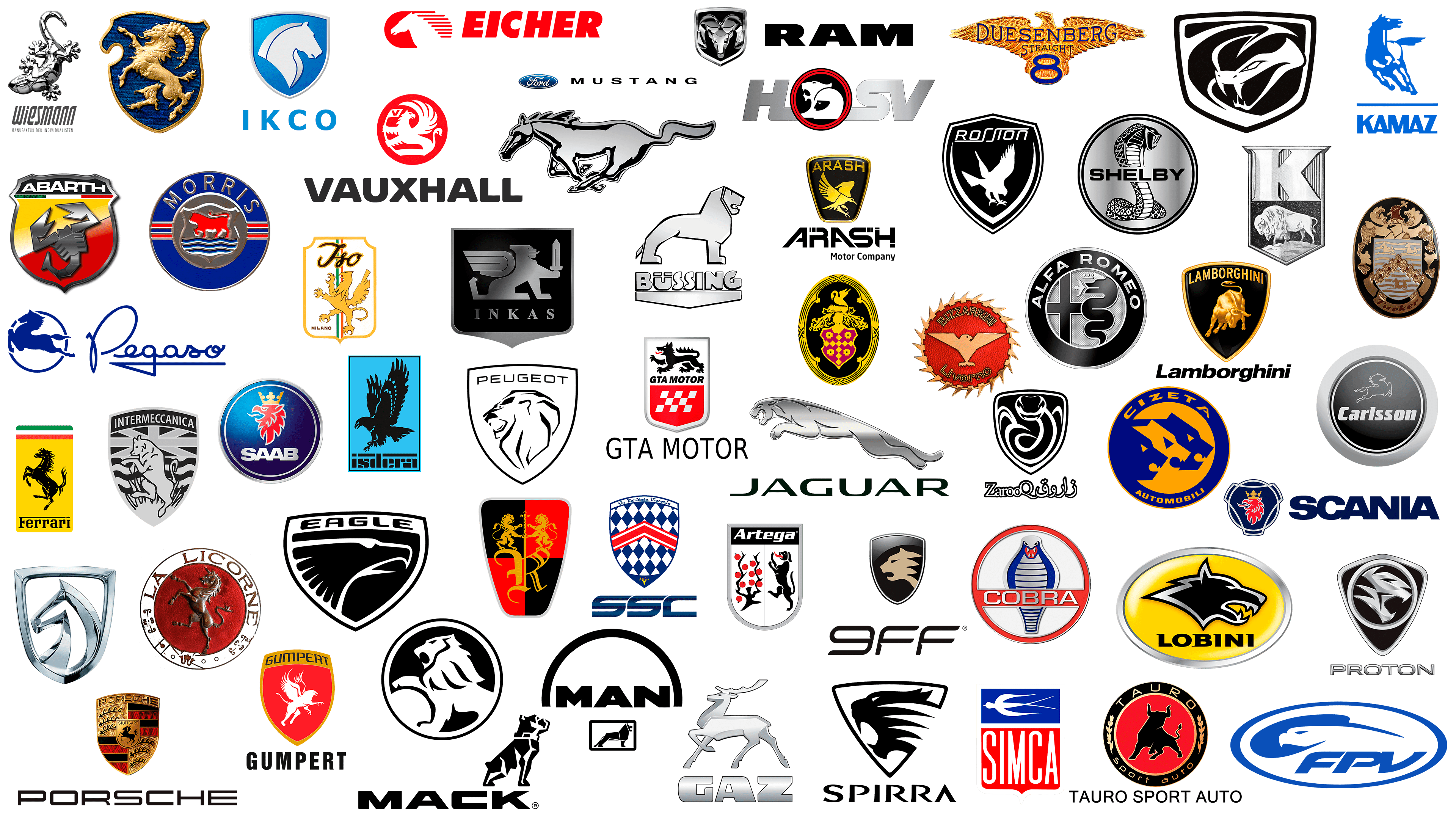
The earliest references to transmitting meaningful information to descendants date back to the Paleolithic era, when people recorded history in cave paintings. This is how mankind separated from the animal world, while retaining an invisible connection to it. This later led to the emergence of heraldry, as coats of arms and logos sought to convey traits that characterize a clan, country, or company. For example, most automobile brands incorporate animal motifs into their distinctive marks, which often have a historical or symbolic basis.
Each animal symbolizes a specific quality or combination that is unique to it. Therefore, the brand’s logo is appropriate and embodies the product’s virtues. Companies that produce exclusive cars with a distinctive character, such as Porsche, Ferrari, and Lamborghini, occupy a special place in this niche of visual identification. Many suggest privilege, which affects their price.
Car logos with a Horse
The horse is a strong, unwavering animal, so its image is one of the most popular in logo design. Regardless of cultural differences and people’s religion, its symbolism remains unchanged, denoting strength, beauty, freedom, and grace. Sometimes, the primordial elements fire, wind, and water are also mentioned in this sense. Thus, no matter how you interpret this symbol, it still implies activity and movement.
Therefore, you can specify the style and elegance of individual design elements or the overall composition. Emphasize the desire to win, highlighting its genuine strength and speed, complemented by the fluidity of its forms. This reflects part of the plot, reinforcing its spirit of freedom and irrepressible character. The horse’s multifaceted meaning lets you visualize it in different spheres and directions.
Pegaso
Pegaso is a Spanish company that produced engines, tractors, trucks, and automobile equipment from 1946 to 1990. The company did not produce two identical models, as it considered customers’ wishes when manufacturing each body. In 1990, Enasa acquired the brand, and it ceased to exist in 1994.
The logo emblem is a monochrome image of a mythological flying creature that fully reflects the brand’s name. The execution is original, with the silhouette’s clear contours highlighted by the round frame. The emblem symbolizes decisive actions, freedom, and speed. The badge embodies a strong fighting spirit and highlights the company’s key strengths.
Ferrari

The Italian automobile concern, founded in 1947 in Maranello, produces sports and racing cars. It began with the Scuderia Ferrari racing team, established in 1929, which has won 15 world championships and about 16 constructors’ championships. Formula 1 racing has brought the brand its greatest success.
The logo’s main element is a galloping horse, set against a monochrome palette. It originally stood as a memorial to the pilot Francesco Baracca. It symbolizes speed, rawness, and power, hallmarks of Ferrari cars.
Baojun
In 2010, the Chinese company Baojun was founded to produce low-cost automotive products as an alternative to Buick and Chevrolet. A sharp increase in sales in the first years of production suggests an acceptable balance of price and quality, driving the brand’s expansion and the growth of its dealer network.
The visual identity features a horse’s head turned to one side, set within a shield. The composition looks quite realistic, conveying the spirit of freedom and nobility that this animal symbolizes. The brevity of the detail speaks to conservatism and emphasizes the brand’s cars’ availability. The gradient color palette evokes silver reflecting light, lending the brand an air of aristocracy.
Porsche
In 1931, Ferdinand Porsche founded a company in Stuttgart to produce sports and off-road cars. During World War II, the company developed several heavy tank projects that later formed the basis for the Panzerjäger Elefant. Today, the company’s products are renowned for their high performance and quality.
The Porsche logo combines elements from the coats of arms of Württemberg and Stuttgart, featuring a blazoned horse at the center. Thus, the company chose to pay tribute to Germany’s history and the city where its headquarters are located. The emblem became a symbol of luxury and high status, helping the brand gain worldwide recognition. Shades of yellow and red, combined with black outlines, symbolize privilege and reflect the country’s flag colors.
Kamaz
Since 1969, KAMAZ has produced diesel engines, trucks, and buses. Its main production facilities are located in Naberezhnye Chelny. The plant has been completed in 19 countries, including the USA, Japan, and Canada. Over its 10-year history, the plant has fully justified the investment.
The emblem depicts an argamak steppe horse galloping across the fields, characterized by devotion, intelligence, and agility. It symbolizes speed and great strength, directly reflecting the products’ basic qualities. At the same time, it expresses the company’s desire to grow and expand. The logo is crafted in a minimalist, monochrome style that conveys beauty and nobility. The lines lack sharp transitions, suggesting a friendly, cooperative nature.
Corre La Licorne

Founded in 1901 in Levallois-Perret (France). It developed and produced automotive equipment until 1947, producing 33,962 copies. In 1950, the company was closed.
The Corre La Licorne logo is based on the Corre family coat of arms, which depicts a flying unicorn facing left. Thus, the company’s founder emphasized his belonging to this ancient family. Additionally, this symbolizes the products’ power and speed. The color palette is dominated by shades of red, reflecting the company’s rapid development in its field. The emblem, worn as a ring, also conveys independence and a commitment to tradition.
Iran Khadro
Founded in 1962 in Tehran, Iran, the joint-stock company produces buses, transportation components, cars, and trucks. IKCO produces 13 vehicle brands and is the largest manufacturer in North Africa, the Middle East, and Central Asia.
The logo’s main element is a horse’s profile facing right, symbolizing the company’s continued expansion. The mark is placed on a shield, symbolizing reliability, power, and the spirit of freedom. In line with the laconic composition, the volume conveys affordability and a trustworthy approach to customers. This contrast is clearly expressed through the gray-and-blue color palette.
Eicher
Eicher is an Indian manufacturer of commercial vehicles and mid-range motorcycles. It was founded in New Delhi in 1948. It includes a subsidiary, Royal Enfield Motors, which manufactures motorcycles exclusively. Eicher has invested in customized designs, guides, and maps.
The visual identification is a horizontally arranged red oval. The background features a horse profile facing left, its mane rippling in the wind. The logo symbolizes dynamic movement, speed, freedom, and vigor. Its color palette reflects courage, passion, and stability, emphasizing a responsible approach to solving tasks.
Ford Mustang
The Ford Motor Company has produced automobiles since 1964. Its active advertising promotion is considered one of the most successful in the history of the automobile industry. Unification was achieved by developing mechanical units and using parts from inexpensive models.
The Ford Mustang trademark features a galloping horse to the left, reflecting the American spirit and power that the iconic car embodies. The emblem is dominated by flowing lines, emphasized by sharp transitions at the head, tail, and hooves. This emphasis highlights the model’s wild temperament and speed. The monochromatic, laconic design signals conservatism, an integral part of the model range.
Carlsson
Tuning studio Carlsson Autotechnik is renowned worldwide for its Mercedes-Benz modifications. It was founded in 1989 in Merzig by brothers Andreas and Rolf Hartge. The company is also known for its wide range of alloy wheels.
In the company’s visual style, the main element is the silhouette of a running horse, conveying dynamic growth as it overcomes emerging difficulties. Worn as a ring, the emblem symbolizes the company’s integrity and independence. The color scheme emphasizes the products’ association with the elite car segment. Below the horse emblem, the atelier name appears in uppercase in ITC’s Crillee Bold Italic typeface, with no special modifications. The text features flowing lines that convey a friendly relationship.
Car logos with Griffin
A griffin has the body of a lion, an eagle’s head, wings, and clawed paws. In legends, he was portrayed as a guardian of secret knowledge or treasure. He symbolizes strength and vigilance, representing dominance on the ground and in the air. Often, he appears as a fully realized mythological creature, so his identity is clear. It can be an abstraction, a combination of disparate elements, or a detailed image. It can also be enough to sketch the silhouette, emphasizing the presence of a legendary character if the title mentions him.
Gumpert
Roland Gumpert, former CEO of Audi, founded his luxury sports car company in Denkendorf in 2004. In 2008, the Apollo Sports creation debuted, breaking speed records set by models such as the Pagani Zonda and Bugatti Veyron. However, the firm went bankrupt in 2013.
Gumpert’s visual style includes a shield-shaped emblem with a griffin on its surface. The background color palette is burgundy red, highlighted by a golden frame that symbolizes the product’s sophistication. The mythological creature is a powerful heraldic symbol that reflects elegance. Its varying shades of light gray make it seem alive, adding dynamism and strength to the composition.
Saab
Founded in 1937, the company produced military aircraft, so the second letter stands for “Aeroplane.” The company’s greatest fame came from the single-seat fighter, the Viggen 37, which showcased its best work. In 1949, production shifted to passenger cars, as the abbreviation reflects.
SAAB borrowed its brand logo from Scania after their union was dissolved. It depicts a crowned red griffin’s head in profile, facing left. This emphasizes the machinery’s power and vigilance. Below, in a silver gradient fill, is the SAAB company name. Rings surround the entire design, symbolizing the company’s independence and autonomy.
ISO
From 1939 to 1974, the Italian company produced automobiles, motorcycles, and scooters at its Bresso facility. The most successful model was the Grifo GL 365, which reached over 255 km/h. However, despite these efforts, the company was forced to close in 1974 because of bankruptcy.
The ISO emblem is presented as a rectangular white shield framed in gold, with a bottom protrusion and cutouts in the upper corners. In the center, a galloping griffin looks left. This emphasizes a serious approach to solving project tasks and symbolizes vigilance and perseverance. Behind the creature, vertical lines of national colors rise, and above it, the word “Iso” appears in dark gray cursive with a golden border. The composition evokes associations with wealth and luxury.
Vauxhall

Today, Vauxhall is a division of Stellantis, a British automobile company. Since 1857, it has developed and sold steam engines. However, the company later shifted into the automotive industry and, in the mid-20th century, began cooperating with the German manufacturer Opel. Subsequently, Vauxhall used the brand name to sell Opel and Holden products in the UK.
The visual identification is a circle containing a griffin. He holds a flag in his right paw, on which the letter “V” is engraved. Its torso faces right, and its head faces left. This symbolizes the company’s appreciation for its past, which enables it to continue developing. The emblem appears laconic, but all its elements combine to convey nobility and confidence in the future. The red-and-grey color palette only emphasizes these qualities.
Scania

Founded in 1891, the Swedish company originally manufactured bicycles and carts. In 1920, it shifted to motor vehicles, including automobiles, trucks, and buses, for commercial and industrial applications. Since 1968, it has partnered with SAAB, which helped it gain popularity among heavy-truck users.
The Scania logo dates back to 1984, when the crowned griffin from Skåne County’s coat of arms became a distinctive brand element. It implies courage, strength, speed, and attention to detail. Modern technology enabled a simpler visual representation of the brand, enhancing its perception and making it more memorable. The circle outlining the logo’s base and extending beyond it symbolizes a willingness to cooperate.
Car logos with an Eagle
The eagle often appears in company logos or on national coats of arms, as it symbolizes power and strength in heraldry. Many see it as a messenger of the sun, a divine messenger, and a symbol of immortal life, freedom, or courage. In two-headed versions, he is seen as the victor over evil. During the birth of Christianity, he became the personification of the cross.
Today, the heavenly king emphasizes pride, recklessness, and serious intent. Regardless of the execution style, whether a detailed profile or a light outline, it will still impress and attract attention. Placed inside the shield, the regal predator still symbolizes freedom. In some cases, you can even skip clear boundaries.
Eagle
An American company division, Chrysler owned the Eagle from 1988 to 1999; headquartered in Auburn Hills, it was created from the AMC facility with the prospect of mass-producing passenger cars. Legal issues later led to the trademark being abolished.
The Eagle logo is a shield-shaped triangle with two curved sides. At its center is the contour of an eagle’s head, facing right, combining clarity with smooth lines. The image symbolizes strength, speed, and aspirations for development. Above the sign, the unit’s name appears in lowercase letters, giving the image a sense of originality. The emblem’s color palette consists of light and dark shades of gray, creating a matte silver finish.
FPV
The FPV brand was a division of Ford Motor Company Australia from 2002 until it was discontinued in 2014. During its existence, it developed a line of premium vehicles based on the Falcon model under its logo, and it proved successful with consumers.
The company’s visual identity features two monochromatic color palettes: blue and dark gray. The emblem features an oval outline of variable thickness, with a centered, left-facing eagle profile. Clear, sharp lines of the eyes and beak emphasize its aggressiveness and danger. This symbolizes the impetuosity the cars produce. Below the sign, the text “FPV” is in italicized Snasm Heavy Italic, with slight modifications.
Isdera
A privately owned German automotive products company founded in 1969 in Hildesheim, it produces luxury sports cars in limited quantities. A team of specialists assembles each model by hand, and each car is individually designed for a particular customer, so production takes up to six months.
The Isdera logo appears as a vertically oriented sky-blue rectangle with a black outline. A monochrome image of a flying eagle spreading its wings against a black background conveys a serious approach to producing unique automotive products. Despite its brevity, the emblem is powerful, with every line speaking volumes. The company name is set in a non-standard bold font at the bottom of the emblem.
Car logos with a Lion
The lion has long been one of heraldry’s most iconic symbols. Historically, it has personified strength, courage, bravery, valor, and dignity, and is known as the king of beasts. Its frequent use in various symbols has given each pose its own name. The most common visual image is presented in profile, emphasizing its majesty. A natural-born leader can inspire not only fear but also respect. He is often associated with the sun, suggesting nobility and superior physical qualities.
Today, many brands use this animal’s image in their logos. In the automotive industry, it denotes leadership qualities backed by courage and strength.
INKAS
Canadian private security corporation INKAS was founded in 1995 in Toronto. One of its categories is designing and manufacturing armored vehicles. In 2015, the company opened its first exhibition center, expanding its products nationwide and across the continent.
The logo is a shield with a winged lion in profile, symbolizing a vigilant guardian protecting the vehicle’s owner. In its front paw, it holds a sword raised toward the sky, indicating seriousness, endurance, and self-confidence. Below, the text “INKAS” appears with increased letter spacing. The composition is angular and laconic, in a monochromatic light gray shade. As a result, the emblem looks more formidable.
MAN AG
The European concern, founded in 1758, is now a subsidiary of Traton SE. The company primarily develops and produces heavy commercial vehicles.
The MAN logo features a horizontal rectangular outline. It symbolizes stability backed by many years of experience. The figure features a laconic silhouette of a lion facing right, denoting courage and strength. Various angular elements create a collective image, giving the emblem a sense of massiveness. The company name balances the overall impression, set above the image in the usual bold font with small additions. The color palette resembles that of chrome-plated metal, combining traditional and modern trends in the overall composition.
Holden

The Holden company was founded in Melbourne, Australia, in 1856. Initially, it produced saddles and related accessories. By the end of the 1900s, however, the company had converted its production facilities to make automotive equipment. The firm remained independent until the 1930s, when General Motors assumed management control.
The 2016 logo redesign features a simplified color scheme with light gray tones and a black outline, creating a metallic sheen. The emblem is a circle containing a grinning lion, holding its front right paw on a rounded stone block. It symbolizes steadfastness, strength, ferocity, and confidence in one’s actions. The image’s simplicity adds elegance to the brand and makes it easier to visualize. The logo’s rounded, smooth lines convey a friendly, professional character.
Peugeot
Founded in 1810 in Paris, France, Peugeot is one of the country’s largest automobile manufacturers. In 1975, the company became the majority owner of Citroën. At the end of 2007, the company ranked second among European car producers.
The image of a lion standing on its hind legs and looking left has become Peugeot’s main distinctive feature. This shows the powerful qualities of the company’s products. It also emphasizes confidence and stability, which are integral to its models. The image’s iconicity adds visual individuality and clarity by removing unnecessary elements from the composition. Under the emblem, the brand name appears in a thin font, adding elegance. The gradient fill in the figure’s gray shades creates a three-dimensional effect, making the logo feel fresher and more modern.
Bussing

Since 1903, the German company Büssing has been developing buses and trucks on a par with other, more established companies. This has brought it fame in Europe. However, in 1971, the brand ceased production and was subsequently declared closed.
The company logo is minimalist and modern, featuring light gray tones with black edging. The emblem features a lion in profile, symbolizing courage and the company’s continued growth and development. The simplified color palette gives the image a more conservative, serious feel. Under the sign, the company’s unique inscription appears in bold. A rectangular shape with one side resembling a downward-pointing arrow emphasizes it. This speaks of Büssing’s solid foundation and long history.
Roewe
The Chinese manufacturer headquartered in Shanghai founded the automobile brand in 2006. Roewe initially developed its cars using technology acquired from BMW’s now-closed MG Rover division. Subsequent attempts to buy a controlling stake were unsuccessful.
The logo features a shield with rounded corners, divided into four parts. It features a black-and-dark-red checkerboard pattern. It fully reflects the company’s name. Translated from Chinese, it sounds like “glorious power”. However, according to SAIC representatives, the word was recycled from German and translated as “Lion.” The logo features a gradient gold hue in the upper half of the rendering, with the lion standing on its hind legs and facing the viewer. This symbolizes the power, determination, and aristocratic nature of its products.
Proton
Proton is Malaysia’s largest automobile manufacturer. Mahathir Mohamad founded it in 1985. Initially, the models were modernized Mitsubishi models. However, in 1996, it acquired a controlling stake in Lotus Cars. The division then engaged several companies to develop and manufacture original equipment.
The visual appearance is gray and black, creating a polished metal effect. The shape resembles a triangular shield with rounded corners, representing quality and safety. A circle inside a tiger’s head in the background symbolizes the product’s speed and power. The emblem uses straight lines and sharp angles to convey wildness and nobility. Above the sign, the inscription “Proton” emphasizes the technique’s individuality.
Car logos with a Wolf
North American Indian tribes associated the wolf with fearless, strong warriors who could stand alone against adversity and protect weaker comrades. Thus, the animal symbolizes a free spirit, altruism, independence, and a sacrificial nature. For this reason, automobile companies that use the wolf as their main symbol imply independence from other enterprises in their development. However, despite these advantages, the wolf is rarely used as an emblem. This is because the predator’s intimidating grin symbolizes a formidable character and unruly temperament.
This sign can not only capture the automobile brand’s influence but also imprint its mark on engineering and design developments, allowing it to reflect the proud animal’s characteristic features in the products’ exteriors. The trademark features pointed elements that symbolize speed and increased power.
Lobini
Lobini has developed and manufactured Brazilian sports cars since 1999. Its products use technologies that meet or exceed international quality standards for vehicles in the same category. The company gained fame with a single H1 model known for its enhanced performance.
The brand logo features a yellow oval with a metal border and a wolf’s head facing right. This emphasizes the car’s power. The evil grin is menacing, and the silver contour emphasizes the unique style. Below the main element, the company name appears in serif letters, conveying the company’s attitude toward sport and symbolizing speed. Laconic execution gives the composition confidence and rigor.
Spania GTA
Since 2010, Spania GTA has been producing sports cars in limited numbers. However, GTA Motor controls it. The company gained popularity by competing in various racing leagues, where it introduced its first models.
The company’s visual style features an elegant, traditional coat of arms on a shield, with safety as its top priority. In the background are two elements. At the top of the coat of arms, a black wolf silhouette signifies impetuosity and indomitable character. The lower part, filled with a dark red hue, features a white checkered flag, hinting at crossing the finish line. This symbolizes the power and superiority of the products produced. The company name is centered, separating the two areas.
Car logos with a Ram
Aries symbolizes fire, vitality, courage, and power. Its image suggests purposeful, persistent, and impulsive action. Twisted horns are associated with security and wisdom. Because visual identification is universal across production, the image can emphasize one meaning or another.
The animal’s most recognizable elements are its horns, silhouette, and head. Regardless of the execution style, the sign can convey the right mood and highlight specific details. For example, the image of crossing animals conveys the company’s qualities of unwavering, decisive resolve. If a logo includes text, combining pictorial elements with letters is appropriate and supports the intended association. Today, the brand’s design adopts a minimalist aesthetic, simplifying the overall image and making it more memorable.
RAM
RAM, an automotive brand, is a Dodge offshoot and has specialized in full-size pickup trucks since 1981. The main production facilities are located in Mexico and the United States. In 2008, Dodge introduced the fourth generation of the RAM, specifically the full-size trucks.
The logo, featuring a ram’s head on a shield background, was originally used as Dodge’s trademark. The animal symbolizes dominance on the highway and reflects the power, safety, and reliability of the cars produced. The color palette features shades of gray in harmony with black, creating a polished silver effect. Thus, the composition emphasizes a conservative approach and an aristocratic tone.
Car logos with Deer
Among car emblems featuring animal silhouettes, stylized and faithfully copied deer figures are common. This beautiful, proud animal has always attracted attention in heraldry across time and cultures. Here, the question isn’t just about noble beauty. A well-chosen totem is believed to reward its owner with the best qualities and protect them through its symbolism. In turn, placing a deer on an automobile conveys a slightly different attitude toward the latter, directly transferred from the living, historical prototype chosen for the logo.
In this case, the mark does not simply cover the automobile’s make. It leaves an appropriate imprint on the work of designers and constructors, seeking to reflect the noble beast’s features in the unit’s characteristics and appearance. At the same time, designers and constructors themselves sometimes fail to notice this influence, acting on a deeply subconscious level. That is why most brands with a deer emblem have correct, noble outlines, with greater controllability and high starting speeds, as if repeating their totem’s main features.
GAZ
One automobile brand whose logo has featured a deer since its inception is the Russian automaker GAZ, founded in 1932. It is a world-renowned manufacturer of cars, trucks, vans, engines, and components. Today, it is considered a major component of the Basic Element industrial group, headquartered in Nizhny Novgorod.
The famous “running deer” emblem has changed over time. Some elements have been removed, bringing the deer to the foreground and making it the main accent. Its 1949 design has gained volume, clearer contours, and more dynamic lines. The chrome effect makes the sign particularly attractive. Created on a black background, this effect makes the stag more realistic and expressive.
SSC
Among the automobile brands that use a deer in their logo is SSC, an American manufacturer of exclusive cars founded in Washington, DC, in 1999. It earned fame by developing high-tech, high-speed hypercars. The vehicle’s design and shape were inspired by both the brand’s noble animal silhouette and the beauty of modern fighter jets.
The brand logo features a stylized deer, a noble animal. Its stylized head, crowned with beautiful, branching antlers, adorns the triangular, pointed heraldic shield at the base. Rendered in gold on a dark blue background, it stands out clearly in any armorial position. It is an auspicious symbol associated with the Sun, light, purity, and the permanence of renewal. Its branching horns symbolize the brand’s success and a direct link to the Tree of Life, which brings success and victory.
Car logos with a Dog
The dog also fits among the accepted elements of automotive heraldic logos. It is rarely seen in a car’s emblem. It is designed to shape the brand’s psychological perception and endow it with the properties and characteristics the chosen animal embodies. She finds her place where she can demonstrate her main characteristic: impeccable service. A dog is an ideal choice for car branding because it embodies fidelity, devotion, and unconditional service.
However, with so many dog breeds available, designers have many opportunities to reflect their ideas, demonstrate the required characteristics, and focus on the desired features and properties. A bulldog (Mack) or a hound (Lincoln) has accompanied “their” cars for many years on long journeys along the world’s roads. They reflect a model’s key features, creating a clear impression of the car or the brand and ensuring easy recognition and a unique visual identity.
Artega
Klaus Dieter Frers founded the car manufacturing company in 2006. The brand’s headquarters are located in Delbrück (Germany). The company was established to produce sports cars that incorporate many modern technological advancements. However, the company realized only one of its ideas: the Artega GT, which combined its most advanced technology. In 2012, the brand ceased to exist, leaving a significant mark on automotive history.
The Artega logo has remained in the memory of many car enthusiasts as one of the originals in its execution. Representing a heraldic shield divided into several segments, it features a stylized dog with a fiery red tongue on the right. The character stands on its hind legs, threatening any opponent. The symbol shows constant readiness to fight for what it has conquered and for the position and success it has achieved. However, this did not save the company from closure.
Mack
Mack is one of the world’s leading truck producers. Starting in 1900 as the Mack Brothers Company, the brand gained fame for pioneering steam engines. Later, the Greensboro-based company built specialty vehicles, buses, and trolleybuses, then expanded into truck production. In 2020, Volvo acquired the brand.
The brand’s well-deserved prominence before World War I was reflected in its adoption of the bulldog as the logo, a symbol of Great Britain. The figure was not limited to the logo. The shiny dog, crowned at the center of the brand’s car hood, symbolizes the British’s steadfastness, perseverance, and resolve in the struggle to achieve their goals. The power and strength radiating from the animal figure were inherent in every vehicle the brand produced throughout its existence.
Car logos with the Jaguar and the Leopard
Logos that incorporate images of various animals possess exceptional appeal and effectively reflect key brand features. This is because such an emblem creates associations that directly reflect the animal’s strengths. Humans are inherently drawn to many animal traits. This makes them especially popular in heraldry and logo design because they convey power and are often associated with beauty and grace. The most common images are beautiful felines, such as leopards or jaguars.
However, they require careful handling and application, as the image cannot be displayed optimally if used incorrectly. Emphasizing the leopard’s aggressive, self-centered side would suit a logo for a formidable, powerful automotive product. The jaguar suits more streamlined forms and emphasizes the gracefulness of a particular type of machinery. In addition, these animals’ image is shaped by two key characteristics they offer car manufacturers: speed and power. First, these influence the use of predatory felines as an emblem.
Spirra
Oullim is a South Korean automobile manufacturer founded in 1997 in Gyeonggi Province. It disbanded in 2007 and was taken over by Proto Motors, which produced the only sports model with a turbo V6 engine, the Oullim Spirra, from 2008 to 2017. At the end of 2017, the firm closed and announced its disbandment.
The logo features a triangular outline with rounded corners, reminiscent of a shield. It represents protection for the driver and signals the product’s quality. The figure’s background features the head of a snarling jaguar, rendered in a laconic style. The animal in the emblem symbolizes confidence, speed, and determination, which indicates the car’s involvement in the sports class. The entire composition is rendered in a monochrome black palette, giving the image a conservative, serious feel.
HSV
A subsidiary of Holden Group, founded as a brand in 1987. The primary focus is developing and producing high-performance automotive products. Over time, the company has modified some of General Motors’ automotive equipment.
The HSV logo features a solid black background and a double red outline. This suggests self-sufficiency in production and independence in key design decisions. In the background, a jaguar’s head is shown against a black backdrop, while in the foreground, a man wearing a racing helmet is depicted. The logo’s main color is white. Its elements symbolize power, speed, and racing, reflecting the brand’s position in the luxury car category.
Cizeta
The automobile company Cizeta was founded in 1988 in Modena (Italy). It was named after the only hand-built car it produced, the Cizeta-Moroder V16T, it was named. Its design later became the basis for the Lamborghini Diablo. The company produced eleven cars during its existence.
The brand’s logo is a circular blue shape, outlined in yellow. At its center, a rounded area in the border color holds three jaguar heads facing right. The design’s brevity and the interplay of two colors, with each jaguar set against the other’s background, create the impression that they are competing yet remain calm and purposeful. At the same time, the angular lines and austere appearance convey the product’s seriousness and power. In creating the logo, the manufacturer sought to highlight the technique’s primary qualities. Modena’s flag, where the first production was established, also informed the color scheme.
9ff
Tuning Studio 9ff was founded in 2001 in Germany and modifies standard Porsche cars into certified racing equipment. It also sells finished cars and spare-parts kits. The company gained fame for a model that exceeded 400 km/h.
The brand is visually laconic and easy to remember. It features a heraldic shield with rounded corners and a light border, drawing attention to the lion’s share of the image. It features a silhouette of a leopard’s head, looking left with a predatory, imperious expression that emphasizes strength, speed, and formidable character. The emblem’s color palette conveys the brand’s extravagance and aristocracy, featuring light and dark shades of gray, dark gold, and black.
Jaguar
Jaguar is a multinational company with production lines worldwide. Founded in 1922, it is headquartered in Coventry, UK. Initially, its factories produced motorized wagons and then cars. In 1975, the company underwent nationalization. Today, Tata Motors, part of the Jaguar Land Rover group, controls the company.
The brand’s visual identity is represented by the jaguar, an animal that embodies strength, power, and elegance. It is depicted mid-leap, implying the vehicles’ impetuosity and performance. The color scheme uses dark and light shades of gray to create the illusion of volume, giving the figure a metallic quality. The beast’s smooth lines lend the emblem a sense of mobility and vitality. The logo has become an exemplar of quality and style that, thanks to its brevity, remains current.
Car logos with a Bird
Images of terrestrial fauna often inspire many in the automotive industry. The desire to display, in their heraldry or other visual identification, the features that characterize their best aspects, to a greater or lesser extent, leads to animal imagery. This is how companies showcase their products’ merits and the principles they follow.
Birds play a distinct role in modern advertising, symbolizing a happy, peaceful, and free life. They also inspire the further spiritual development of enterprises that want to emphasize their individuality and align with the trends of a given period. Many automotive brands have used the image of a celestial animal to describe the benefits of their technology, including Rossion and Arash.
Arash
Arash Motors, founded in the UK in 1999, primarily develops and produces luxury sports cars. The company’s first model was the Farboud GT, which embodied avant-garde design and improved aerodynamics.
The eagle image defines the brand’s logo. Despite the laconic execution, the eyes and body curves are well detailed. The image looks natural and haphazard. In the emblem, the bird symbolizes speed, boundless energy, and mastery over its element, reflecting the products’ character. Its formidable appearance and fighting stance suggest coherence and effectiveness in unforeseen situations. The animal is placed at the bottom of the black shield with a gold border, symbolizing safety and style.
Packard
The American brand Packard produced luxury cars in Detroit (USA) from 1899 to 1958. Initially, the vehicles’ design prioritized quality over quantity, making them prohibitively expensive to produce at scale. During World War I, the company produced aircraft engines and chassis parts for armored vehicles.
Packard’s visual style features a vertically arranged black oval with a wide golden frame, emphasizing the company’s independence and friendliness. At the center, a red heraldic shield features luxurious decorations against a background. A knight’s helmet crowns it, with branches extending from it; at their base, a graceful swan with outstretched wings and a bowed head. The bird speaks to the aerodynamics, speed, and beauty inherent in the brand’s cars, all in this detailed splendor. The emblem’s symbolism suggests high society, and the gold-toned coat of arms confirms it.
Rossion
Founded in the early 2000s in Florida (USA), the company produces sports cars. The Noble M400 served as the basis for the flagship Rossion Q1. The company strives to enhance the speed and dynamic performance of its creations while prioritizing handling, a crucial criterion for sports cars.
To convey the efficiency and power of its vehicles, the company chose an eagle as the logo’s main element, set against a heraldic shield background. The black-and-gray color scheme emphasizes the composition’s uniqueness, highlighting notes of conservatism and elitism. A bird of prey on the emblem spreads its wings, ready to pounce, symbolizing the desire for further development. Above it, the brand name appears in large, rounded letters. The letter “S,” in the center of the text, features a special addition: strokes that extend above and below the word.
Bizzarrini
The Italian company Bizzarrini is renowned for its bespoke sports cars, each crafted to the owner’s specifications. Talented engineer Giotto Bizzarrini founded the company in 1964, after beginning his career as a teacher. After five years, the company discontinued equipment production, and the 1990 revival did not generate sufficient interest.
The logo features a small bird resembling a sparrow, rendered in a laconic style. This is how the manufacturer denoted the high power, speed, and aerodynamic parameters of its creations. The image sits on a circular background with a border of golden claws, reminiscent of a circular saw disk. The golden-and-red color scheme adds volume and an air of aristocracy, positioning the brand alongside companies such as Lamborghini and Ferrari. In the ring, the company name appears above and below the bird in thin, dark letters with golden edges.
Duesenberg
The American company Duesenberg is known for its luxury racing cars, produced in Auburn (USA) from 1913 to 1937. Despite its short existence, the company demonstrated its technique in various races. During the First World War, they produced Bugatti U-16 aircraft engines under the license issued by Colonel Bolling.
The Duesenberg logo features a large golden eagle with outstretched wings, reminiscent of German symbols. Its three-dimensional, detailed structure gives the emblem vitality and a sense of mobility. The torso and head create the image of a noble, strong animal ruling in its element. The company name appears on the two wings, and the figure eight appears on the tail. The dark blue execution strongly contrasts with the background, drawing the viewer’s attention to the brand’s text.
Simca
In 1934, an automobile manufacturing company was founded in France under the leadership of Henry-Theodore Pigozzi. In 1935, the company acquired a factory in Nanterre from the bankrupt company Donnet to support mass vehicle production. In 1970, Chrysler acquired the shares, and the brand was subsequently discontinued.
The brand’s visual style is a rectangular shield with a small protrusion at the bottom and rounded lower corners. Thus, it emphasized the importance of ensuring the safety of the company’s cars. The color palette is represented by three shades: white, blue, and red, which are reminiscent of the colors of the French flag and evoke a sense of national belonging. In the upper third of the shield, set against a clear sky, a swallow is striving upward, symbolizing development, speed, and grace, which form the basis of the brand’s technology design. The company name sits at the bottom of the heraldic element.
Car logos with Snakes
Since ancient times, the snake has carried deep meaning, representing strength, health, and wisdom. Many also believed it could attract success, wealth, and good fortune into the owner’s life. The animal is characterized by independence, elegance, and beauty, allowing you to fully express the product’s inherent design qualities. However, it must be done correctly so people immediately understand the company’s primary direction at a glance.
For these reasons, many automotive brands, such as Alfa Romeo and Ford Mustang Shelby, use this element to make their logos stand out. This enables interesting, creative solutions that align with current trends.
AC Cobra
Founded in 1961, this British car company is one of the oldest independent UK-based companies. It specializes in producing small-scale sports equipment. The brand’s models earned fame through their extensive sporting history. However, in 2004, the brand was declared closed.
The logo is a red ring, connected near the center by a line in the same palette. The stripe features the brand name in a regular lowercase font with wide letter spacing. The figure’s outer and inner borders have a silver tint. The emblem conveys the company’s independence and self-sufficiency. The main element of the composition occupies the central position in visual identification: the frontal image of a cobra, denoting revival and further development. The color palette includes red, gray, and blue, giving the sign energy and a fresh look.
Mustang Shelby
The Shelby Mustang was first introduced in 1964. It was developed in collaboration with Shelby American and, as a prototype, was a less powerful version of the Ford Mustang. This car is still being produced today. However, its design has lost its connection to the classic versions of the technique from that period.
The brand’s emblem is a stylized cobra, curled on its back but ready to strike anyone who disturbs it. This creates a formidable, aggressive, and powerful image that fully reflects the nature of the equipment produced. The image is competently and powerfully drawn, as shown by the scales, which range from diamond-shaped figures with a dot at the tail to squares on the head. The color scheme uses black, light gray, and dark gray tones, and the gradient fill creates a three-dimensional effect. This emphasizes the car owner’s affiliation with the conservative luxury class and conveys a prestigious image.
Alfa Romeo
The Alfa Romeo company dates back to 1910 in Italy. It acquired its final name in 1915, when Nicola Romeo took the helm. Each stage of the company’s development brought its own successes, and participation in racing competitions such as “Formula 1” only added to its fame. The team used an innovative approach to exterior and interior design, helping the brand lead its category.
The final logo was designed digitally in a concise, slightly futuristic style, enhancing its presentation and refreshing the existing image. The color palette retained Biscione’s green-crowned serpent, the blue circle enclosing the emblems, and the red cross. The line dividing the left and right into two halves was removed. At the same time, the white-and-blue background was replaced with a silver structure. This expanded the coils and reduced their number in the serpent, causing it to unite with the cross that denotes Milan’s coat of arms. Beyond flexibility, the mythical animal symbolizes the movement, agility, and strength characteristic of Alfa Romeo cars.
Zarooq Motors
Based in Dubai, UAE, Zarooq Motors develops and manufactures high-performance automotive products. It holds a leading position in producing body and running gear parts and directly participates in mass-producing sports cars.
The snake was chosen as the main element of the brand logo for a reason. The company’s name symbolizes a species known for its rapid movement and desert habitat in the UAE, a key distinguishing feature of the products. The cold-blooded animal sits within a triangular shield with a silver border and rounded corners. The image uses a laconic style, with alternating light gray and black lines that make up the composition’s entire color palette. The emblem emphasizes the brand’s luxury and privilege, highlighting its high-class attitude.
Dodge Viper

The Dodge Viper is a key model in the sports category. The American company Dodge, controlled by Chrysler, produces it. The first generation of this brand’s two-seater cars was introduced in 1992. From 1997 to 2008, this technique was frequently employed in racing tournaments, achieving notable success.
The brand’s emblem is a wide five-pointed shield with rounded corners and a light border. A laconically executed yet extensive image of the head and part of the snake’s body is in the background. It is distinguished by a stern look and an open mouth, which indicates its readiness to deliver a fatal blow. The animal’s body has sections of varying thickness, creating a brushing effect. This symbolizes the vehicle’s impetuosity and power, like a snake rushing from start to finish. The color scheme uses monochrome shades of light gray and black, emphasizing the brand’s seriousness and cost.
Car logos with a Bull
The bull personifies unbending character, invincible strength, perseverance, self-sacrifice, and boundless power. Car manufacturers try to incorporate these traits into their logos. A vivid example of successful branding is Lamborghini, which used the image of a bull in its visual identity.
When creating an emblem based on this animal, don’t use a framework that limits its power and strength. If you still need to set boundaries, choose dimensions that don’t diminish the noble animal. Most often, businesses limit themselves to combinations of red, black, and yellow, emphasizing the animal’s courage and fury.
Kaiser
The American company Kaiser, founded in 1945 in Michigan (USA), originally intended to produce convertibles and sedans. The production site was a long-term leased plant, Willow Run, owned by Ford Motor Company. In 1953, the brand ceased to exist when it merged with Willys-Overland.
The official logo is a pentagonal heraldic shield with elongated top serifs, signifying reliability and steadfastness. Visually, it was divided horizontally into two components. On the striped background in the upper half, a massive, smooth letter “K” with a dark border is displayed, denoting the company’s name. In the lower part of the shield, a silver buffalo stands atop a hill against a night-sky background. It conveys security, determination, and confidence. This animal symbolizes calm strength. At the same time, the color scheme uses shades of gray, creating an unsurpassed composition.
Lamborghini
The Italian company Lamborghini is one of the most famous European car manufacturers. It is famous for the quality and elegance of its sports cars. Ferruccio Lamborghini founded it in 1963 in Sant’Agata Bolognese. Today, the German Volkswagen Group controls the brand.
The last logo redesign, developed in 1998 and based on the 1972 logo, was digitized. It is a black, three-pointed shield with a gold border, featuring rounded corners and slightly convex sides. In its center is a powerful zodiacal animal, symbolizing strength, resilience, and stability. Taurus is rendered in golden shades, which give it mobility and vitality. Above it hangs the letter component, set in bold capital font to emphasize the brand’s uniqueness and privilege.
Tauro Sport Auto

The Spanish company Tauro Sport Auto, founded in 2010 in Valladolid, produces elite sports equipment. Spanish businessmen created the brand in partnership with a British production company. Today, the company is mass-distributing its trademark worldwide.
The visual identity features a red circle framed by a wide black border and separated by a thin gold ring. The company name is bordered in black at the top and bottom, with willow branches around the edges. The text is set in a thin, serif font with sharp corners, conveying friendliness and openness. At the center of the emblem is a black silhouette of an angry bull, poised to rush into battle at any moment. The composition reflects the key characteristics of the developed products: high power, quality, and reliability. The logo’s laconic design enhances its memorability and aligns with modern trends.
Car logos with Gecko, Scorpion, and other animals
Among the automotive-themed emblems, you can find many representatives of exotic fauna. They have long attracted human attention and, with particular zeal, have appeared in mythology and heraldry, carrying that passion into automobile branding. Attributing supernatural properties to exotic animals and insects stemmed from a lack of understanding of how nature can create unusual forms and survive in challenging conditions. Humans have long sought to adopt these properties or assign them to protective heraldry, making such creatures totems.
This attitude has been reflected in the formation of automobile brands. Reptiles and amphibians often became symbols of wisdom and good fortune. The Italian company Abarth included lizards, turtles, and scorpions in its bestiary, and the German luxury Wiesmann features geckos and iguanas. Even British Gordon-Keeble felt it needed a tortoise silhouette to signal stability and reliability. This is only a small part of the group that currently represents automakers’ interests.
Tucker
Founded in 1946 by engineer Preston Thomas Tucker, the Tucker Corporation is an automobile company headquartered in Chicago, USA. The company was engaged in development only until World War II. After the war ended, unable to invest in new products, the brand continued pre-war production, which led to its collapse in 1951. Throughout its existence, the brand has created the American dream: a beautiful, affordable car.
A special mark in history was left by the “Blue Dream” Torpedo model, whose hood depicted the hippocampus, a mythical fish-horse. It served as a mount for nereids, known for their beauty and grace. These characteristics prompted the automaker to choose this mythical animal, also considered the king of fish. This significant origin and ownership of the symbol reflected the brand’s main equipment features.
Cisitalia

Italian businessman and motorsports enthusiast Piero Dusio opened a workshop in Turin in 1946, which would eventually grow into a full-fledged automobile production company. The company developed and assembled racing cars. The name was part of the Compagnia Industriale Sportiva Italia, a business conglomerate. The brand became famous thanks to the Cisitalia 202 GT model. The company has existed since 1963.
The Cisitalia logo was peculiar. It included a coat of arms featuring a golden-horned goat standing on its hind legs and threatening enemies with its front legs. This creature from European mythology represents pride and reflects the desire to develop and use the latest scientific achievements. Yale is depicted on Yale University’s official flag.
Abarth
In 1949, Harold Wester founded Abarth in Turin, Italy, to manufacture automobile mufflers and exhaust systems. In the early 1950s, the company began to develop sports cars based on Fiat models. The subcompact Abarth 850 TC became particularly famous. In 1971, the company released its last car under this brand. However, Fiat has revived the brand since 2007.
Throughout the brand’s existence, a scorpion mascot has accompanied it: a scorpion symbol on the inner surface of the coat of arms that serves as the brand’s emblem. Its diagonally divided inner field uses the company’s corporate colors: bright yellow (top) and red (bottom). The top segment features a scorpion in a fighting pose, with its upper body visible. This signals to the brand’s enemies that it is always ready to defend itself. The logo carries strong symbolic meaning for a growing business that leverages the latest technological advancements, as Abarth does.
Morris Motors Limited
Morris Motors Limited, a privately owned manufacturing company, is known for its automobiles, which accounted for 42% of the British car industry in 1926. Founded in 1912, the company adopted its current name in 1919 and used it as a trademark until it closed in 1984. The company was headquartered in Cowley, Oxford, Oxfordshire, and Longbridge, England.
The brand’s original logo featured a leopard or lion in motion. The choice of this heraldic animal was influenced by the place’s heraldry and the mythical animal’s characteristics. Its majestic grace, characteristic of the king of beasts, speaks to the brand’s greatness and dignity, and to its desire not only to live up to the chosen image but also to hold fast to any position it has achieved.
Intermeccanica
The Italian automotive brand Intermeccanica was founded in 1959 in Turin by Frank Reisner as a manufacturer of tuning kits. The brand changed locations during its operation, moving first to the USA and then to Canada. Starting with Formula Junior single-seater models, the brand progressed to the small Intermeccanica series, then to the Puch.
The founder’s passion for heraldry strongly influenced the brand’s logo. When he chose the heraldic shield as his trademark, he settled on a lion in a protective pose on two hind legs. In this way, the brand confirmed its commitment to protecting its own interests and the interests of the equipment owners it served, ensuring safety. As a strong, proud animal, the king of beasts, it was the best way to demonstrate the brand’s advantages and characteristics.
Wiesmann

The German automobile manufacturer Wiesmann, founded in 1988 by brothers Martin and Friedhelm Wiesmann in Dülmen, Germany, is known for its high-quality, hand-built convertibles. The brand is best known for the MF 30 roadster, a classic open-top two-seater, and the enclosed two-seater GT MF 4. In 2014, the company ceased to exist.
Nevertheless, the brand left its mark on automotive history, and its silver-metallic gecko is now known worldwide. Choosing this reptile for the brand’s logo reflected its philosophy of creating cars that “hold on to the road,” even at high speeds. This ability to adhere firmly to surfaces made the gecko reflect the best characteristics of a premium-segment car brand.