


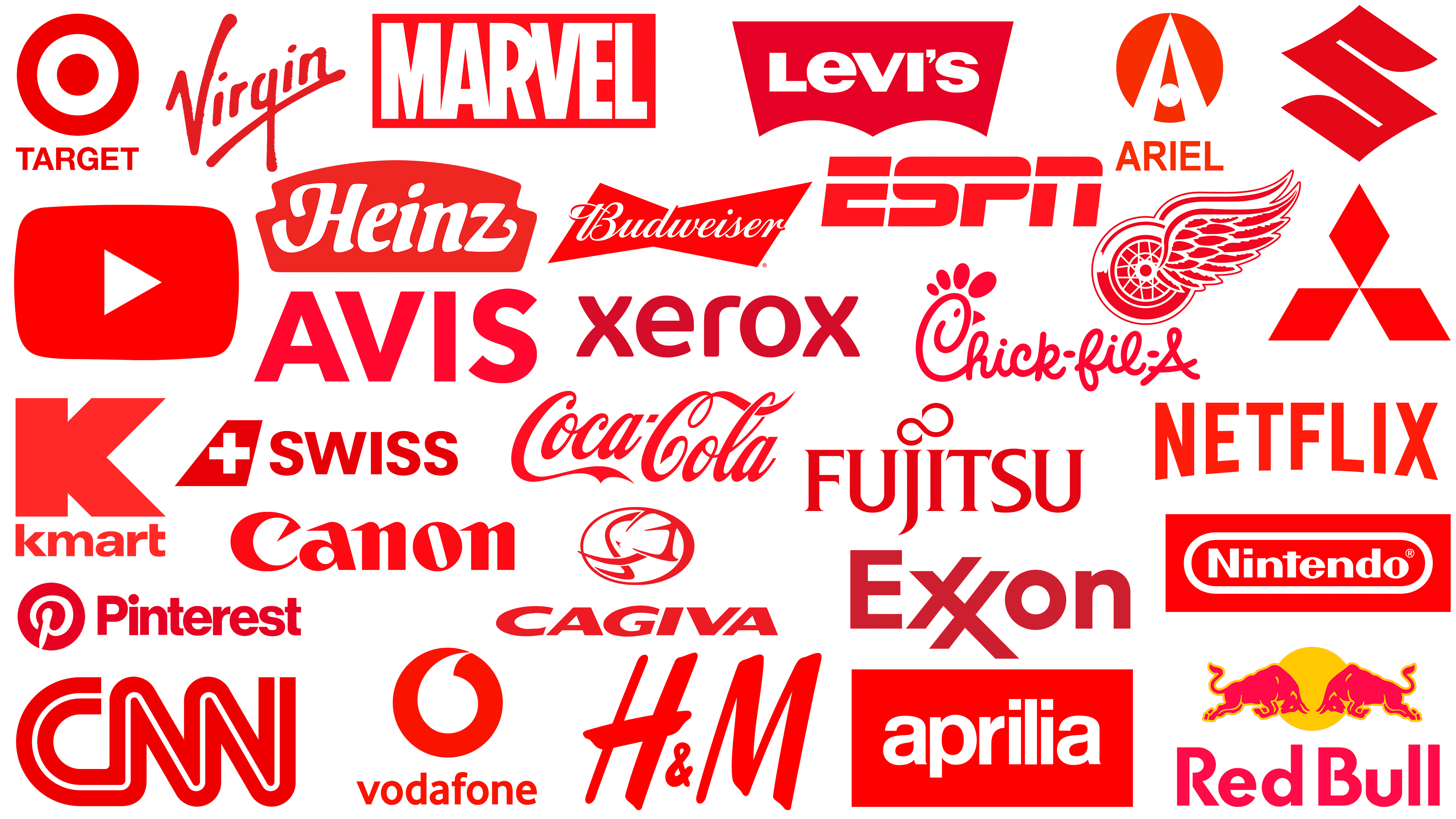
Colorimetry is the science of colors. It studies hue changes, measures their intensity, and determines their effects on humans. As a result, color plays a key role in logos. It shapes how the emblem is perceived, how many customers it can attract, and what impression it leaves. This approach pushes companies to refine their style, fix flaws, and adjust their tone, since the right color is key to success.
As a result, we see many logo variants today. With their help, brands fight for popularity, recognition, and demand. Of course, the catchiest color in the palette is red. Eyes are instantly drawn to it. But how did you make it neither aggressive nor unattractive? This helps company owners enhance their reputation and increase their revenue. What is the secret here? Let’s figure it out!
We have selected the emblems of the most famous brands whose visual identities are based on the red spectrum. White mostly complements it; as a neutral background, it creates calm and dispels danger. This combination demonstrates determination, confidence, passion, and strength. Here are the top 30 companies associated with the color red. We have arranged the logos from simple to complex.
Suzuki
Suzuki’s logo couldn’t be simpler. It is based on a single letter from the brand’s name. The stylized letter “S” is painted in a deep, rich shade of red. It looks elegant and unusual, with Asian roots: the symbol resembles a hieroglyph. The ends are pointed, and the radial lines curve. This makes it resemble the roofs of Japanese pagodas. This combination of color and shape evokes peace, tranquility, and confidence. Additionally, the emblem showcases a progressive mindset and a willingness to adopt technological innovations that transcend conventional norms. This manufacturer also chose red because it echoes the Japanese flag.
Mitsubishi

The Mitsubishi emblem reflects Japanese laconicism and is also rendered in red. The automaker demonstrated its love for the motherland and its superiority over competitors, as this color represents innovation, leadership, and technological challenge. The pointed badge is formed by three rhombuses connected at their center points. The result is a geometric figure resembling a flower with delicate, petal-like features. In the negative space between them, white triangles are visible. This element was named Mitsubishi Diamond. This combination makes the corporate badge look elegant and modern.
YouTube

This is a simple corporate identity. Moreover, it is practical because it includes a play button for audio or video content. Indeed, the international online resource YouTube has chosen a thematic logo that explains its color scheme. The Play button traditionally features a white triangle. This element was already in use before virtual media players appeared on remote controls, tape recorder keys, and DVD players, among others. The designers combined it with a red horizontal rectangle. This color conveys activity, dynamism, and beginnings. The background figure’s sides are slightly curved, and the corners are rounded, giving the logo a friendly appearance.
Detroit Red Wings

The Detroit Red Wings’ emblem embodies the confidence, energy, and determination of a hockey team, which the red color represents. The NHL team’s visual style is dynamic because the circle represents movement. In this case, the wings add even more dynamism. One of them is shown in full. The feathers are drawn in detail, with smooth curves ending in sharp points. The second wing is located behind the first, so only the upper fragment with a wavy stripe is visible. The wheel is large, with luminous highlights and spokes. The white color harmonizes perfectly with the red, emphasizing the concept of continuity of movement.
H&M

Swedish fashion house H&M chose a laconic logo: two capital letters connected by an ampersand. Everything is executed in a dark shade of red. It streamlines the lettering and brings austerity, making the emblem colorful but understated. Beyond confidence and flashiness, this palette symbolizes beauty, given the brand’s association with the fashion industry. The letters “H” and “M” are oblique, capitalized, and grotesque. They consist of lines of varying widths, giving them a dynamic, unusual feel. The feet at the ends are rounded, so the glyphs have no sharp elements. The ampersand is miniaturized and not centered; it sits at the bottom. It is also colored red.
CNN

The CNN logo’s color palette strongly affects the audience, as it symbolizes the relevance and importance of the news this media giant reports. The channel’s bright red icon appears powerful and stable, conveying confidence in what is happening. The emblem’s text is in double capital letters, separated by a thin white stripe. At the same time, the large and small glyphs are almost identical. The only difference is that the inner glyphs have pointed feet, and the outer ones are rounded. The inscription is continuous, with two unbroken bands, so the letters flow seamlessly into one another. A thin white line in the center gives them an airy, light feel.
Avis

The Avis logo is simple in both shape and color. It uses a dark crimson shade that is calmer than the others. This perspective reflects the service’s demand, as it involves car rental. This visual instills confidence in potential customers considering a rental. The emblem’s design is laconic: it consists only of letters in the same style. No images are present. The letters are flat, vertical, and classically styled. The inscription is written in bold, grotesque type. Color, in this case, serves as the sole decorative element, as the emblem has no other options.
Xerox

This is the world leader in printing and scanning a wide range of materials. Therefore, Xerox chose a conceptual logo that reflects its business. The direction of the work is conveyed through smooth lines, the curves of the legs, and smooth strokes. The designers reflected the versatility and flexibility of copiers that can scan and print documents, images, books, and photographs. The text logo is a soft, non-aggressive, eye-catching red. The smooth contours of the sans-serif glyphs give it a softness. The wide inter-character intervals visually balance the massive letters.
Exxon
Exxon, the largest international oil and gas company, has a text-red logo. A double “x plays the role of graphics in it: both letters have one common leg. Because of this, there is a slight bevel reminiscent of the typographical hash “#” (hash). All lines of the icon end in a diagonal slice at both the top and bottom. Other symbols are not connected and are spaced apart. The corporate style uses a light but saturated red. It conveys power, strength, and energy, reflecting the essence of business and the oil-and-gas industry.
AirAsia

The Malaysian airline’s emblem is red and white. Despite its apparent simplicity, the AirAsia emblem has a complex structure. This is evident in the letter “i.” Both lowercase letters are rendered non-standard: they lack a flat cut and instead feature an arc-shaped depression reminiscent of a smile. This design emphasizes the air carrier’s goodwill, hospitality, and friendliness, despite the catchy palette, because the red used is the brightest shade: scarlet. In addition, the right side of the letter “r” is also replaced by a bold dot, making it look like an atypical “i.” The remaining symbols are classic and are in lowercase. They have smooth curves and proportional rounding, so they don’t break from the usual style, letting you better see the characteristic features of neighboring letters.
Canon

The world leader in camera and lens production has a very simple emblem. It consists only of its name, written in dark red, which signifies the company’s authority, leadership, and high capabilities. The inscription uses bold lowercase letters and keeps the characters small. The exception is the first letter: it is typed in capital letters. All glyphs (except one) have needle serifs pointing to the left. The letter “o” is slanted in the same direction. Overall, the Canon logo surprises with a harmonious mix of smooth, rounded shapes and sharp corners. The red color plays a significant role; it attracts attention and helps smooth out the dissonance.
Netflix

The Netflix logo is scarlet. It is a light, bright shade of red, reminiscent of blood. It fits the minimalist design because the emblem of the American entertainment film company shows only the name. It is focused on developers and offers a variant that lets the number of letters be adjusted. As a result, the letters are lower in the middle and higher on the sides, adding dynamic movement.
The expansion occurs only along the word’s lower border. The upper part is flat and horizontal. The text uses uppercase, condensed, bold glyphs. The wide inter-character spacing makes the lettering look light and balanced.
ESPN

Red color best conveys dynamics and energy. This explains the American cable channel’s choice to broadcast sports and extreme sports. The inscription on the ESPN logo is simple, single, and made in a non-standard font. It features massive slash glyphs connected like a racetrack. Each glyph has a white stripe at the top that divides it into two halves.
This stripe runs through, as it is open on both sides. The letters have a slight rightward slope. The emblem’s color is bright and saturated.
Virgin

The Virgin’s emblem resembles a personal signature. This image is essential for the company, as it operates across many sectors of the economy. With a handwritten signature, she can more easily demonstrate her personality and show customers her focus on close contact. The red color helps bring the idea to life. It has made this brand’s emblem one of the world’s most recognizable. The text is arranged diagonally and composed of smooth, emphasized lines. The letters are lowercase (except for the “V”) and are in a grotesque style. The first glyph has a side stroke. The letter “q” has an elongated stem.
Fujitsu

In this case, the red in the emblem reflects patriotism. Fujitsu chose an emblem in the colors of Japan’s national flag: white and red. The name reflects the company’s role as a manufacturer of a wide range of electronic devices. It is set in a custom serif font, tiny but clear. In contrast, the inner lines are rounded. This is especially noticeable in the letters “U” and “S.” The rest of the glyphs are right-angled. All letters transition smoothly into the serifs. The dots above the letters “j” and “i” are connected. Designers stylized them as two combined circles so they resemble ∞ , the classical infinity sign. All characters are uppercase, except for the lowercase “j” and “i,” which are simply enlarged.
Coca Cola

The Coca-Cola brand has a simple logo. It contains nothing but text based on the name. The lettering is done in hand-drawn cursive calligraphy. It also contains vignette elements: swirls, curved lines, and wavy ribbon-like stripes. The initial “C” in the first word extends lower, and in the second, it extends higher. The rest of the letters are lowercase and rounded. The hyphen is short: it is shown as a parallelogram. The sign is so tiny that it is lost against the large elements in the background. Here, red conveys passion, energy, love, and confidence.
Motorola
Passion and progress- that’s what red represents in the Motorola emblem, as the company was among the first to enter the cell phone industry. The emblem’s main element is the capital letter “M,” formed by two identical arrows. They meet in the center and have elongated side legs, clearly reminiscent of the first letter of the American telecommunications company’s name. The upper part of the glyph forms a sharp triangle, and the lower part features two arc-shaped elements. The single symbol is located in the center of a solid circle. Thus, the red color reinforces the idea of an innovative approach and provides comprehensive coverage in all directions. As a result, the right combination of geometry and palette was a prime example of successful visual identification.
Chick-fil-A

Fast food restaurant chain Chick-fil-A uses a simple yet thematic logo for its chicken dishes. The designers harmoniously combined the brand name with a chicken image. To do this, the designers stylized the first letter by adding a crest, beard, beak, and eye. To match the natural color of the chicken scallop, they chose a red with a slight crimson tint. The emblem consists entirely of an inscription in a careless handwritten style. Here, the glyphs are not oblique but straight, with bold, smooth lines. Each part of the name is connected to the other; there are no gaps between the letters, and they are closely connected.
Marvel
Red, chosen as the emblem color of the famous media franchise, conveys a powerful energy charge. The color is bright, saturated, and catchy, so the Marvel emblem quickly catches the eye. However, on other icons, the letters are red, and only the background is white. The white lettering breaks out of the negative space like a curly element. Although the text is printed, it consists of closely spaced glyphs. “M,” “A,” and “R” touch at the bottom, while “R,” “V,” and “E” touch at the top. The exception is “L”: it stands apart from the other glyphs. For the word “Marvel,” the designers chose a geometric solid sans-serif font. The background is a horizontal rectangle.
Aprilia

This Italian brand’s visual style is another vivid example of the red square-and-white-lettering combination. However, the shade here is a lighter scarlet. This palette is characteristic of Italians, who are emotional and love the unusual. The logo’s catchy color is balanced by a minimalist design and a restrained font. The text is written in classic lowercase block letters. They are neat, and the contrast makes them appear perfectly white. The inscription’s peculiarity is the squares above the letter “i” instead of the usual dots. Additionally, both signs are aligned to the same height, with the letter “L” between them.
Levi’s

The red color in the Levi’s logo appeared in the mid-20th century. Since then, it has remained a constant presence in the iconic denim brand’s identity. True, several color adjustments followed, and the red became a dark crimson. At the same time, the company name isn’t quite rectangular: two curved bends at the bottom make the background look like an open book. The glyphs are also white. They are thick, squat, and wide. The distance between the letters is minimal: the characters almost touch, but this is because there are no serifs. Typographically interesting is the original combination of the lowercase “e” with the uppercase letter: it is so large that the font difference is not immediately noticeable.
Heinz

The sauce manufacturer couldn’t choose another visual style: the Heinz emblem is red because it matches the color of the tomatoes that form the basis of its products. The emblem is arc-shaped at the top and flat at the bottom. Its base is a trapezoid with “steps” on the sides. The trademark name is white and set in italics. The letters are slightly wavy and lowercase, except for the first one. The “H” has both ends elongated, and the “z” has the lower part elongated.
Budweiser

The famous beer brand also uses a red background in its logo. However, the Budweiser logo remains distinct from other companies’ visual identification marks, notably in its shape. It resembles a bow tie. Straight lines and right angles emphasize its geometricity. The centered name is white, italic, and set in a handwriting-style font. The letters are calligraphic, connected, and uniform in height and width. At the narrowest point is the letter “d,” while the “B” and “r” extend beyond the borders of the figure.
Nintendo

The Nintendo logo indicates the company’s roots, as red is the color of the Japanese flag. This hue also conveys excitement, passion, joy, and energy, as the brand is associated with the gaming and entertainment industry. Its badge is a dazzling, bright scarlet. It represents a rectangle stretched horizontally. A bold white stripe forms an oval in the center. At its center, on a red background, is a white inscription naming the console manufacturer. The letters are grotesque and flat. Almost all are rounded except the “N,” “i,” and “t.”

The online platform Pinterest uses a red-and-white emblem. The emblem consists of two components: the pin and the name. The site’s personalized pin is a solid red circle with a white “P” in the background. It has a curved shape with a large cap and flowing lines. The stem ends at the circle’s edge and tapers to a point, giving the glyph a pin-like appearance. On the right is the text, set in red. The text is printed in a strictly vertical, grotesque, lowercase font, except for the first word.
Swiss International Air Lines

The Swiss International Air Lines logo is also in red and white. It is a complex visual image, as it consists of two components. The first is a figure resembling an airplane’s tail, keel, and rudder. Its lower and upper borders are horizontal, and its sides are diagonal. In the background, a flat cross from the Swiss national flag appears. The inscription is bold, chopped, and capitalized. Like the icon, it is colored in rich red.
Adobe Acrobat

An encrypted inscription characterizes the Adobe Acrobat logo. In addition to the catchy red color, it contains the letter “A.” It is stylized as a Möbius loop, an infinity ribbon with smooth transitions between its sides. The glyph also forms a triangle with bent ends, set at a slight leftward angle. The lines are white and medium-thick, standing out against the light-colored, rounded-corner square. This icon serves as a logo, a mobile app icon, and a representation of the site. Here, the red-and-white scale symbolizes innovation and energy.
Target

The American department store chain Target has an abstract logo. At first glance, the sign seems non-thematic, but it is; it directly relates to commerce and sales. The emblem features a target design with a solid center circle and a wide outer ring. Between them is a white stripe of equal width. The emblem suggests that every purchase hits the target. Below, the company name appears in thin sans-serif letters. Partial rounding is only possible for “R” and “G”.
Vodafone
Vodafone, a cellular operator, chose a red logo because it is instantly recognizable among competitors and highly eye-catching. On a red-orange background, a thick white comma is placed. Below is the text part. It is the company name, typed in lowercase letters. The bright red letters are rounded, giving them a streamlined appearance. The exception is the letter “v,” which has straight lines and angles.
Kmart

The block letter “K” in dark carmine is the Kmart logo’s primary characteristic. This color attracts buyers’ attention and sets a serious mood, as the department store chain in the United States offers a vast range of goods. The emblem consists of two parts: a capital letter and text. It is located below and is set in lowercase. All characters (except the first) are rounded. At the “t,” the left side of the crossbar is cut off, allowing designers to optimally position the neighboring “r.”
Ariel

The Ariel logo takes an opposite approach to red: it is not dark but bright, close to the shade of a carrot. With it, the race car manufacturer makes a loud statement. Its visual identification is a circle with a non-standard letter “A” inside. It consists of two superimposed triangles: a small red one and a large white one. They have sharp tops and rounded legs. The large dot replaces the crossbar. Below the graphic icon is text. It contains the brand name in the same color as the background circle. All glyphs are uppercase, chopped.
Red Bull

The Red Bull energy drink brand has chosen a logo that matches its name. Here, red signifies strength, energy, and power. That is why its logo shows two red bulls fighting against a rising-sun background. It is depicted as a disk with yellow reflections on the animals’ bodies. This technique accentuates the musculature, highlights contours, and adds tension. The eyes are drawn in the same color. The company name is written at the bottom in a large font. The letters are not serifed, and the curves of the “R” and “B” do not reach the opposite side.
Cagiva

The Cagiva logo is the most complex among other companies’ red logos. It consists of many thin lines forming the image of an elephant. The head is depicted in profile. In it, the ear, forehead, tusks, and trunk can be guessed. For motorcycle manufacturers, this animal embodies strength, so the emblem is red. The central part is set in an oval frame. Below, the company name appears in Italian. It is typed in a grotesque cursive. The letters are large, bold, and capitalized.