


The face mirrors a person’s inner state. Looking at it, we feel either a pleasant disposition or a strong dislike. Therefore, in the era of consumerism, hundreds of thousands of companies compete with it for customers’ attention. Logos play an important role in this, as they convey a lot. Some brands prefer realistic designs; others prefer abstract ones, but both use visuals to attract customers. And imagination has no limits! Some use restrained individuality; others compete with rich graphics and colors.
In any case, physiognomy (the study of facial features and expressions) becomes a key tool for increasing the number of consumers and, with it, income. Companies pay the most attention to this question because a person’s image (especially a happy, satisfied one) inevitably evokes trust in those around them. Then, potential customers become real buyers.
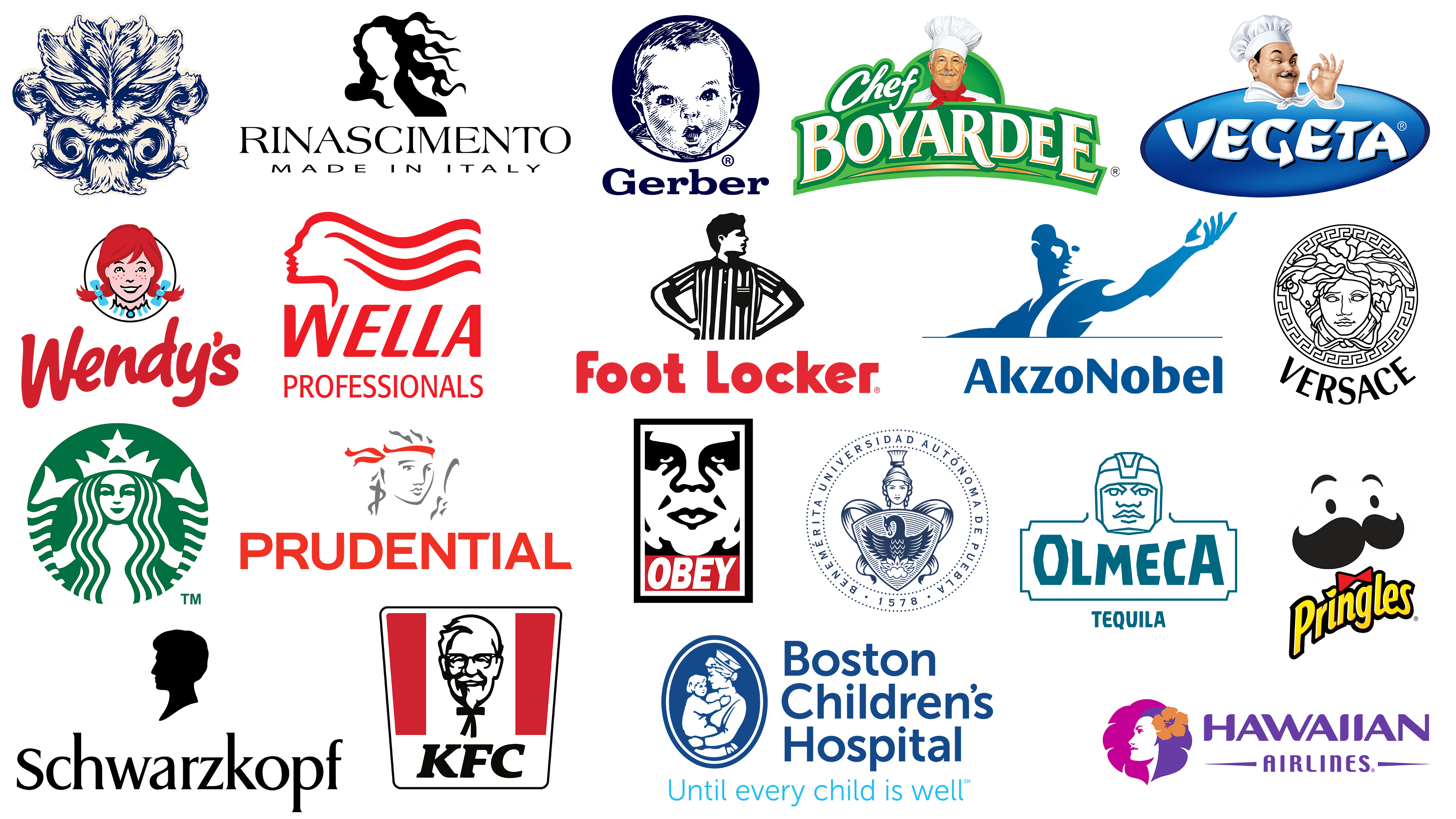
We propose studying this issue by examining face-featuring logos to better understand the underlying marketing mechanism. After all, identity is a decisive factor in the worldwide recognition of firms, organizations, and enterprises. The presented emblems have different colors and styles, but they are united by one thing: a face. The brands are arranged from most to least visually simple.
Boston Children’s Hospital

Boston Children’s Hospital has the most complex logo in terms of the number of elements it contains. It has many details, arranged so it is immediately clear what kind of organization it is and what services it provides. After all, medicine is one of the most relevant areas in the search, selection, and treatment. In some cases, procrastination can become a real tragedy, so the identity is understandable, although complex. The emblem depicts a female health worker holding a young child. The woman’s welcoming face is turned toward the baby, and he, in turn, is holding onto her hands. Both figures are arranged in a vertical medallion with a double border. Next to it is the medical institution’s full name. It is typed in a classic sans-serif font. Below is the slogan, highlighted in blue.
Wella

The American-German hair care product manufacturer also uses a triple symbol as part of its visual identity. The Wella logo has been in use since 1880 and captures the essence of its products. The designers used a female profile with no specific facial features to emphasize hair care. The image is contoured to emphasize the strands. The hair is wavy, fluttering in one direction as if blown by the oncoming air. The face is raised and outlined in shadow, so the emblem seems to depict not one woman but two. The lines are light, relaxed, gliding. The emblem is complemented by a two-line inscription: above, “Wella”; below, “Professionals.” The first word is set in a bold font with smoothed letter corners, and the second uses thin glyphs with strict form.
Rinascimento

Italian clothing brand Rinascimento chose a stylish, minimalist logo associated with the world of high art. Its emblem depicts not just an undetailed woman’s face but also a hint of artistry. The hair’s contour, the head’s turn, and the neck’s slope remind me of the famous figure in Sandro Botticelli’s painting “Birth of Venus.” The image symbolizes beauty, the goddess Venus, as the Romans and Greeks both call her. Below is the company name, set in an elegant antique font. The letters are tall, uppercase, and a combination of thin and wide lines. Next is the phrase “Made in Italy”. By contrast, it is grotesque and low. The logo is in monochrome.
Hawaiian Airlines

The Hawaiian Airlines emblem has three elements and a face, but the style is completely different. The emblem reflects aspiration to new heights, the fullness of life, and its colorfulness and brightness. Artistic boldness and a diverse palette make the emblem modern, unlike the standard symbols of air carriers. The portrait of a young girl is painted in purple and blue, and her hair is transformed into part of a palm leaf against the background on which she is set. The hairstyle is decorated with a large red flower, the symbol of Hawaii. On the right side is a two-tiered inscription. The word “Hawaiian” is large and bold, with diagonal slits and rounded ends, while “Airlines” is narrow, small, and tall, with horizontal stripes on the sides.
Chef Boyardee

The culinary brand Chef Boyardee uses an emblem to represent its products shipped worldwide. The colorful, detailed emblem depicts a chef in a white cap with a red neckband. The face is in profile and looks more like a photograph than a drawing. Behind the man, an archway bears the cursive inscription “Chef” on the left. It is written in cursive, semi-erased script. Below it is the second part of the title, “Boyardee.” This line is large, typewritten, and capitalized, with a red border around each letter that makes it appear three-dimensional. The background is green in two shades.
Olmeca

One of the most famous tequila brands, Olmeca, chose a historical logo. It depicts an Aztec warrior. His face is drawn large, seemingly composed of geometric shapes. All lines are smooth, clear, and even. The head is depicted at full height. The man has a wide nose, large lips, a massive chin, and a tightly fitting helmet. Below is a shaped banner with the alcohol brand’s name. The lettering is in a very bold sans-serif font. The side letters are high, and the center letters are low, so the warrior’s head appears to squeeze the letters “M” and “E.” At the very bottom is the word “Tequila.” Like the other elements, it is turquoise.
BUAP

The Mexican university, Benemérita Universidad Autónoma de Puebla, has an elegant, classically heraldic symbol. All elements of the BUAP logo are arranged within a single circle, resembling a seal. It shows a woman’s head in a monfortino, a traditional Roman helmet. In front of her is a triangular shield with a dragon, cloud, and flames arranged in a semicircle. From behind, wide ribbons protrude to the right and left; they are identical and mirror each other. The background is plain white. The institution’s full name and founding year (1578) encircle the center. The borders are thin and dotted. The logo is colored blue.
AkzoNobel

The famous Dutch manufacturer of paints and varnishes, AkzoNobel, has a monochromatic logo. This is unexpected for a company that deals in paints and supplies them to more than 80 countries worldwide. Its emblem has two parts: a graphic and text. The drawing shows a man waving his arm. He stretches it forward and raises his palm as if to call others to him or point to something important. The figure occupies ¾ of the icon and seems to emerge from negative space, as it is blue on a white background. However, the palette is not uniform; it shifts in a gradient: the fingertips are lightest, and the opposite hand is darker. Below the person is the international firm’s name. It is set in a bold font that mixes lowercase and uppercase characters. The letters “A,” “k,” “N,” “b,” and “l” have semicircular tops. Only “z” retains its corners and sharp protrusions.
Foot Locker

American online sportswear store Foot Locker also has a face in its logo. It depicts a man turning his head to the right and looking straight ahead as if assessing the future. This shows the retailer’s commitment to constant development and improvement. The character is dressed as a judge in a black-and-white striped shirt. This image is ideal for the retail site, as it conveys a focus on sportswear and footwear, highlights them, and tracks current trends. The man stands confidently with his hands on his hips, ready to help anyone who needs it. This approach to identity reflects the e-commerce company’s core concept. Below is the verbal part of the store’s name. It is made in a mixed font with red letters: “F” and “L” are uppercase, and the rest are lowercase. All glyphs are rounded.
Vegeta

Croatian brand Vegeta also has a logo featuring a realistic face. It is also thematic because Podravka, a food company, owns the brand. Under it, various seasonings are produced, and the packages invariably make everyone smile at the cook. The man is drawn half-turned to the viewer. He is wearing a cap and a neckerchief. One eyebrow is raised, and a gracefully curved mustache is visible above his lip. The left hand is shown in a gesture of approval: the thumb and index finger are brought together, and the other fingers are extended, as if the professional recognizes the product’s high quality. The background is two ovals. The inner one is blue with a gradient. The brand name sits on it, set in a custom font. The letters are wide, angular, and chopped. The outer oval is white. It blends perfectly with the lettering and the chef’s cap.
Prudential

This is Great Britain’s most famous financial and insurance organization. It was founded in London in 1848, and has used the name Prudential ever since. Translated from Latin, the name means “prudent, wise, intelligent” – these qualities were originally incorporated into the company’s concept. Therefore, it is unsurprising that Prudential chose the logo featuring a portrait of the woman after whom it is named. The symbol is crafted in an elegant yet modest design, using only two colors: gray and red. The emblem depicts the face of a beautiful girl. She holds a mirror and stares intently into it. The portrait is drawn in contour, as if it were a sketch for an unfinished painting. A red ribbon is visible in her hair, echoing the corporate name below. It is set in capital letters with tight kerning. Some characters even merge, such as “UDENT” and “IAL.” Only “P” and “R” are written separately. All glyphs are smooth and sans serif.
Gerber

Baby food manufacturer Gerber has used a face logo since it opened in 1931. It is now the largest brand whose visual identity is known worldwide, thanks to its line of complementary foods for babies. The Nestlé Corporation owns the brand and still uses the baby-faced icon. Over the years, the emblem, designed by Dorothy Hope Smith (an American artist), has remained almost pristine. Ann Turner Cook took the portrait. It was from her that the image of a carefree child was copied. The face is realistic, with small strokes forming large eyes, raised eyebrows, a slightly ajar mouth, a tiny nose, small ears, and short hair. The child’s shoulders are also visible. Other details are absent. The head is set against a dark circle that nearly fills it. Below is the company name. It is typed in a smooth font with rounded serifs. The first letter is uppercase; the rest are lowercase.
Versace

Versace, the world leader in the fashion industry, has a simple logo. It has only two elements: a round icon and a large headline. The graphic part is a medallion with Medusa’s head. In mythology, this creature made people fall in love with themselves and turned them into its crude “admirers” forever, freezing them with a single look. That’s why the face expresses no emotion; it’s like stone. The empty eye sockets confirm this. The details are similar: cold, smooth, but flawless. Only the haphazardly arranged hair, strands hanging carelessly around the face, creates dissonance. A wide stripe girdles the contour seal, with ancient Greek ornamentation in a single continuous line. At the bottom, the fashion brand’s name appears. It contrasts with the image, consisting of bold letters in a different style. The glyphs are tall, expressive, and readable because of the wide spacing between characters.
Wendy’s

The third-largest American fast-food restaurant chain, Wendy’s, has a friendly and attractive logo. It depicts the daughter of the company’s founder, Melinda-Lou Thomas. The emblem has changed little over the years (the first restaurant opened in the late 60s of the last century). Adjustments have been minimal, so the emblem still features a cheerful girl’s face in almost pristine condition. The colorful badge is a black ring featuring a smiling child. The girl has round eyes, raised eyebrows, a snub nose, bright freckles, and a white-toothed smile. Her red hair is gathered into two pigtails, decorated with blue bows. The collar also attracts attention. Here, it is scalloped and rendered in a black-and-blue palette, but its shape was previously quite different and underwent several changes. Below the portrait, in the italicized handwritten script, is the name of the fast-food restaurant chain. The line is slanted and extends upward. The sans serif letters are unconventional: they appear to have been written fluently by hand with a marker on a piece of paper.
Schwarzkopf

The name translates to “black head,” so the logo reflects it. It suits them thematically, since the company produces scalp and hair care products and is Henkel’s cosmetics division. The man’s head is depicted in profile, turned left. The drawing closely resembles portraits on classic medallions: the facial line flows smoothly into the neck. This age-old sophistication is essential for a skincare brand to show continuity with tradition. The dark pattern is placed on a white background. The company name is also in black. It is set in an elegant font with tiny extensions that end in sharp serifs.
Pringles

The American chip manufacturer is very popular. Therefore, the logo remained unchanged after Pringles’ ownership change because consumers already know it. Until 2012, Procter & Gamble owned the brand; now Kellogg’s Corporation owns it. On the product packaging, an improvised face of a mustachioed man is painted. He also has arched eyebrows, black-dot eyes, and a red bow tie. Below the abstract head is the title. It is diagonal, bright yellow, with a black stroke. Above the letter “i” is a miniature chip. The font is sans-serif, bold, and lowercase.
OBEY

OBEY’s youth clothing brand has a logo designed by its founder, contemporary artist Frank Shepard Fairey. He chose Andre René Roussimoff, a French actor and wrestler better known by his nickname Andre the Giant, for the image on his label. His face has become an integral part of the brand’s logo. It is drawn in black paint on a white background, as if in negative space. The eyes, mouth, temples, nose, and nearby folds are dark; the rest is white. Below him is a red rectangle with the company name typed in grotesque uppercase. All elements are contained within a double rectangular frame.
KFC

The KFC logo is one of the most recognizable visual identifiers of fast-food chains. As in the previous case, it shows the founder’s face. It is Harland Sanders. It is drawn with a black outline, smiling at visitors from the center and framed by two red rectangles. Geometric figures are arranged vertically, and the emblem is shaped like a trapezoidal plastic cup. In the same frame, the brand name is written. It is written in black, italicized capital letters.
Starbucks

Starbucks, a coffeehouse, chose an unusual logo, unlike those of fast-food establishments. However, this didn’t stop it from becoming a popular franchise, as customers easily remembered the white figure in a green circle. The emblem features a mermaid, often associated with water. Her head is decorated with flowing hair and a crown with a five-pointed star. Her face is friendly and smiling.
Whistling Straits

This is a luxury resort in Wisconsin, United States. Its visual identity is that of a fictional character, drawn in thin, dark blue strokes and tinted flesh-colored. The Whistling Straits luxury vacation resort chose its logo from mythology. Because it depicts the god of wind, the lines are flowing, curly, and “moving.” In some places, they resemble a leafy ornament. The designers did their best to make the symbol match the resort’s name.
Goodwill

Telenet

Playmobil

Alibaba
