


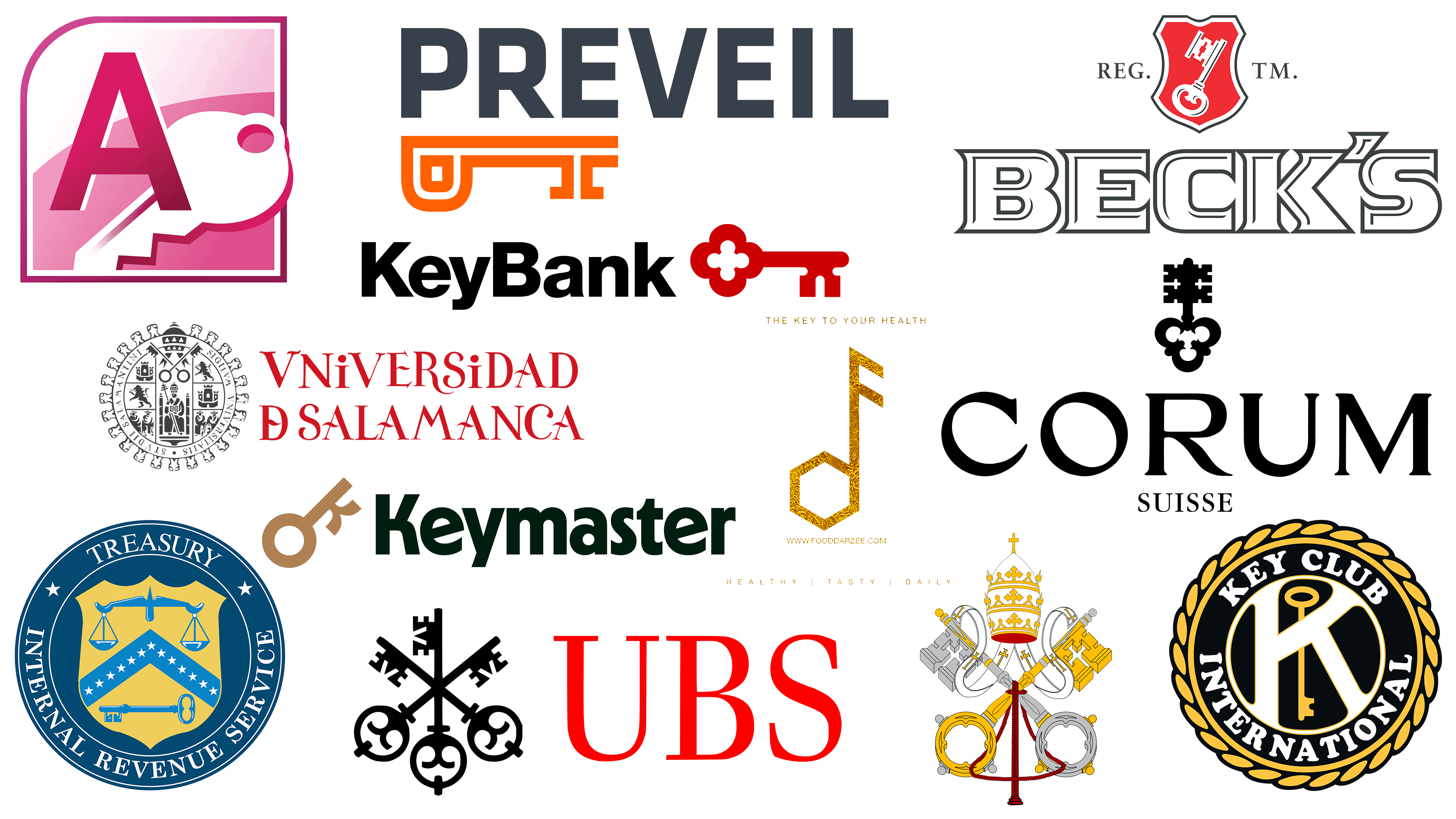
A key grants access to something forbidden, hidden, or unknown. It is an attribute of initiation, a way of gaining knowledge and freedom of action. On the other hand, it not only unlocks but also locks doors. Thus, it also embodies protection, privacy, safety, and security. The two opposite meanings allow the key to be used in the visual language of a wide variety of brands, from institutions of higher education to encryption services for storing information.
In heraldry, this symbol is associated with strength and power. Emblems with images appeared in ancient times, when keepers carried keys to the hidden treasury. In some nobles, they were attached crosswise; in others, they hung vertically. In this form, these attributes are on the family coats of arms. Keys appear on the emblems of cities and fortresses, but here they symbolize security.
In our review, we will examine several uses of keys in emblems and determine which values the same ideogram shares across different companies. In some cases, this sign is intriguing; in others, it prompts deeper historical digging. The brands are presented in random order. So, let’s begin.
KeyBank

KeyBank’s logo features a key for a reason: it reflects the bank’s name. Its meaning is tied to the motto “Achieve Everything”; i.e., the Cleveland-based financial company positions itself as the key to wealth and seeks to convey this through its visual identity. The organization’s name gets a lot of attention: a large black inscription, “KeyBank,” occupies almost two-thirds of the icon, set in a bold sans-serif font. The closest font analog is Sequel Sans Disp Heavy from OGJ Type Design. The key in the image looks very original, primarily because of the flower-shaped ring with four rounded petals. To make the picture stand out against the wordmark’s background, the designers made it a rich red.
Vatican City State

We missed another important meaning of the key religion. It is best seen in the Vatican City State’s logo, as this Italian state is the seat of the head of the Roman Catholic Church. Its coat of arms and flag show two crossed keys: one silver, the other gold. These are the same Claves Regni Caelorum that the Apostle Peter received from Jesus Christ, along with the right to reveal to others the knowledge of how to enter the Kingdom of God at the second coming. The silver key symbolizes the papal authority on earth, and the golden key symbolizes the authority in heaven. Traditionally, the Pope is buried with a symbolic pair of these keys created especially for him. A red triple crown complements the Vatican emblem. Each level of the headdress is dedicated to a particular function of the Pope, who is supposed to be a priest, teacher, and shepherd at the same time. The golden cross atop the headpiece signifies Jesus Christ’s supremacy.
USAL

The University of Salamanca, also known as USAL, is Spain’s oldest institution of higher education. It began as a school attached to a cathedral, then “rose up” and became a university. In 1255, the Pope recognized its new status and authorized it to use the seal. Thus, for USAL, the logo is directly linked to the emblem of the Vatican City State. It also depicts two crossed keys at the top, not in the center. The composition is based on a black-and-white round shield divided into segments. It depicts lions, castles, and a monarch on the throne. The circle is set within a ring with a Latin inscription and is decorated along the outer edge with protruding loopholes in the castle wall. Nearby, in red letters of irregular shape, is written the phrase “UNIVERSIDAD DE SALAMANCA.”
Key Club International

But Key Club International’s logo features only one key, hidden behind a blue “K.” This symbol reflects the name, chosen because the organization’s founders were key members of the student body. The letter “K” is inscribed in a white circle with a blue outline. In a white circular frame is the inscription “KEY CLUB INTERNATIONAL,” where each letter is capitalized in blue. A golden rope runs around the emblem, a common heraldic device that symbolizes connection.
UBS

Three intersecting keys on the emblem of the largest Swiss financial holding company have nothing to do with the symbol of the Vatican. For UBS, the emblem symbolizes reliability, deposit safety, prudence, security, and confidence. When folded, the keys resemble a snowflake, with an original shape featuring many protrusions, curves, and decorative elements. The black figure contrasts in color with the bright red inscription “UBS.” The abbreviation’s font features high contrast and long serifs, making it very similar to FontSite Inc.’s Garamond Modern FS Regular.
IRS

The Internal Revenue Service oversees tax collection in the United States. Since the IRS was created, its logo has been a simplified eagle and scales. But the key appears only on its 1968 seal. This symbol of official authority dates back to ancient times, when rulers began keeping the state treasury under lock and key. It is located inside a yellow coat of arms, on which are also drawn scales (the embodiment of justice) and a chevron with 13 five-pointed white stars. The shield is set within a dark blue circle. Thin white lines around the edge separate the ring, which bears the IRS’s full name in capital letters and the word “TREASURY,” with two stars around the edge.
PreVeil

For software developer PreVeil, the key logo captures the essence of technology. After all, one of the company’s main products is end-to-end encrypted mail, where each user has a cryptographic key, a secret sequence of characters that grants access to personal information. The designers chose not to depict a long string of characters on the emblem; instead, they represented it abstractly as a key to a lock. It consists of two wide orange lines with a white void in the middle. Above it, the brand name appears in large, gray letters. The word “PREVEIL” stands out in a bold geometric sans-serif font, with each glyph visually balanced.
Food Darzee

The manufacturer of health food products positions itself as the key to health, which is impossible without a special diet. Therefore, the designers depicted the Food Darzee logo as graceful, thin, and golden, shaped like a musical note. Its ring is a hexagon with symmetrical edges. The stem points upward and ends in two parallel diagonal lines. The emblem’s texture resembles crumpled foil. Above the key, the Indian food delivery service’s slogan is written in small letters; below it are the official website address and the words “HEALTHY,” “TASTY,” and “DAILY,” separated by short vertical stripes. Without exception, all letters are uppercase, thin, sans-serif.
Microsoft Access

All Microsoft Office products are built on a single scheme. This principle corresponds to the Microsoft Access logo, but here we will consider the older version used from 2010 to 2013. This was the last key emblem, remembered by users for its hot-pink gradient. It was shaped like a square with a cut and a rounded top corner. There was a frame along the edge, and inside, with a small indentation, there was a large dark letter “A.” The background was divided into two color blocks, lighter at the top and darker at the bottom. The key was white, but the designers made it volumetric through light shadows and one-sided contours. This element symbolizes access to information, as the software lets you manage databases.
Corum

For the Swiss watchmaker Corum, the logo is more than just an identity element. It symbolizes high-quality luxury products and signals good style and taste. The key depicted on it is a tribute to the old mechanical watches that were wound with a special small key. The modern crown didn’t exist yet, so this tool was indispensable: without it, the hands would stop, and the device would become useless. The key on the emblem is oriented vertically for a more symmetrical look. Designers shaped it, adding semicircular protrusions and polygonal ornamentation. It gives the impression of opening the door to a magical world where watchmakers’ secrets are kept. The brand name and the word “SUISSE” written under it look no less original. In the first case, the brand uses its own set of glyphs with no analogs; in the second, a contrasting serif font, similar to Gandhi Serif Bold from Librerias Gandhi S.A. de C.V.
Keymaster Games

It’s no surprise that Focus Lab designed a key logo for Keymaster Games. Firstly, this attribute is mentioned in the brand name. Secondly, it symbolizes gaining access to something unexplored, to a notional treasure chest. In this case, various board games open the door to a magical world of entertainment. The round part of the golden key hints at the connection between the people at the game table, and the protruding fragment resembles the letter “K”. On the right, the word “Keymaster” appears in legible Nichrome, set in an expressive, complex font.
Beck’s

The beer brand Beck’s logo features an ancient key, similar to the silver key on the coat of arms and seal of the city of Bremen. This is an attribute of the Apostle Peter, whom Jesus Christ gave the key. The emblem, depicted on the red-figure shield, testifies to the brand’s rich historical heritage, as Beck’s beer dates back to 1873. To the left of the shield are the letters “REG.”; to the right, the letters “TM.”, which should stand for “REGISTERED.” TRADEMARK. And at the very bottom is the name of the product. It is set in a modified Serpentine Sans Serif font, with each letter outlined in uneven black contours that give the word a sense of volume.