


China has appropriated all pandas and given them to other countries only for rent or as a “living gift” with political connotations. There is even a concept called “panda diplomacy”: Chinese authorities give black and polar bears to other countries to build diplomatic relations. At the same time, cubs born abroad must be returned to their homeland.
As China’s national symbol, the panda is associated with kindness, leniency, benevolence, and sincerity. But since it became a rental item, people now see it more as an ornamental animal. Once a zoo attraction drawing thousands of visitors, the bamboo bear has lost its original meaning. Now, it is seen as a cute, clumsy “exhibit” that children enjoy.
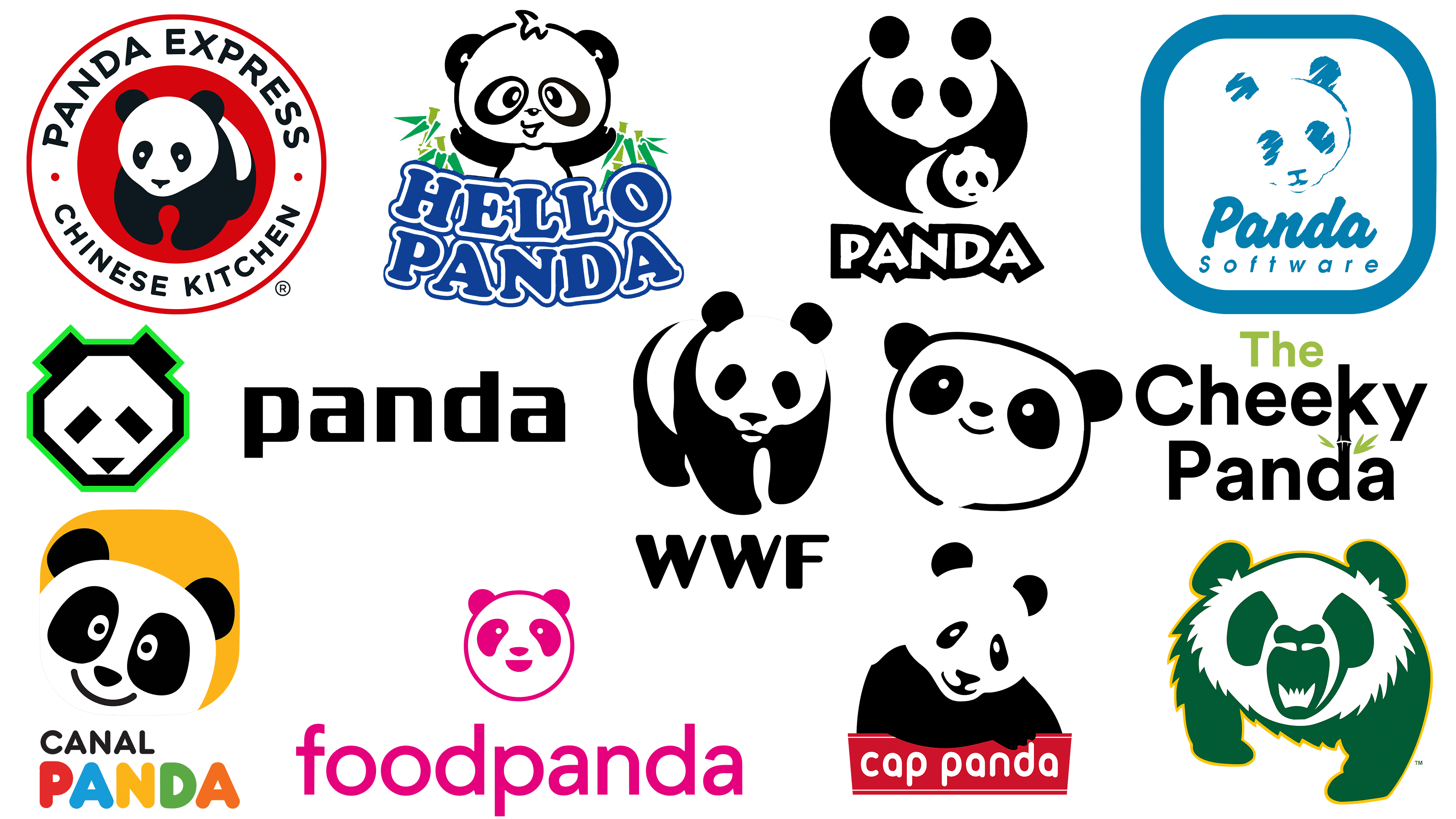
Despite the PRC’s appropriation of these unique animals, no one prevents various foreign companies from using panda emblems. They are depicted as cute and serious, defenseless and dangerous; it all depends on the meaning invested in the brand’s logo. In this selection, we show the clearest contrasts between images.
WWF

The artists who created WWF’s panda logo believed the panda was an endangered species in need of protection. But black-and-white bears are no longer endangered. Chinese authorities have recognized this and increased the population by expanding bamboo forests. However, the World Wildlife Fund has retained its iconic symbol because, without it, the conservation organization would be perceived very differently. With this change, the brand identity would be lost.
The animal in the logo is partially depicted using negative space. Black paws, ears, nose, and eye spots are visible, while the white body and head are formed by negative space. The panda looks depersonalized, as the designers wanted to show it disappearing from the face of the Earth so people can see its defenselessness. Underneath the image is the dark lettering “WWF.” It is in a bold sans-serif font. The rounded edges of the letters create a sense of safety and trust.
Hello Panda

The Hello Panda company produces tiny cookies with crispy shells and sweet cream filling. They depict funny, sporty pandas kicking a soccer ball, shooting an arrow, or playing hockey. Therefore, for Hello Panda, the emblem featuring the same cartoon character is integral to the identity. The animal on the emblem looks as friendly as possible to attract customers, especially children. Artists slightly changed the proportions to make the panda anthropomorphic. To do this, they enlarged the head, shortened the torso, and expanded the eye spots. They also made the white iris unnaturally wide and added black pupils for extra contrast.
The brand’s mascot towers above the two-tiered “HELLO PANDA” lettering, which is slightly curved into a smile. The bubble font and a nice shade of blue match the overall playful style. Bamboo sticks are drawn to the left and right of the animal, and a large red spot serves as the background for all elements.
The Cheeky Panda

Biodegradable wipes, toilet paper, and towels are the backbone of The Cheeky Panda range. And because they are made from bamboo waste, the designers created “The Cheeky Panda” logo with an image of the plant. The letters “k” and “d” connect on a single vertical line and are stylized as a bamboo stem with two green leaves, made possible by splitting the brand name across several lines. The lettering is predominantly black, and only the article “The” at the top is colored in a delicate light green.
The panda appeared in the company’s corporate identity only because it eats bamboo. This is the best association the brand developers could come up with. The emblem depicts a two-dimensional animal head: one black stripe in the form of an uneven, open ring, semicircular ears, a dot for a nose, a smiling arc, and white eyes with large spots around them. The minimalist style and the panda’s friendly look are pleasing, as the designers intended.
FoodPanda

For the FoodPanda brand, the logo is a bold self-expression. It is bright in the literal sense because its parts, the drawing and the inscription, are painted a rich fuchsia. However, the base of the panda’s head is white, as it is in nature. Guided by minimalist principles, the designers created a geometrically accurate composition of circles and semicircles. The drawing is symmetrical: the right side mirrors the left. But why the panda? The food delivery platform chose this symbol because it seemed cute and memorable. Given the club bamboo bear’s clumsiness and slowness, the designers likely focused only on its appearance; to reduce its tenderness, the logo creators used a strict, bold sans-serif font for the inscription.
Panda Global

Panda Global’s online platform has an emblem reminiscent of Cubist-style art, but in a modern interpretation. The entertainment service’s icon consists of various geometric figures, none of which are circles. The head is a white octagon with a dark outline; the ears and eyes are black rectangles, and the nose is a triangle. A thin, light green stripe outlines the figure’s perimeter. The Panda Global website design uses the same green accents. Obviously, they should be associated with plants, namely bamboo, which pandas eat. The lettering next to it also looks futuristic. The designers used a geometric grotesque with rectangular intra-letter breaks and shortened vertical lines at the letters “p” and “d.”
Chengdu Research Base of Giant Panda

The Chengdu Research Base of Giant Panda logo lives up to its name and purpose. After all, this organization preserves rare animals and breeds them in captivity, creating favorable conditions for them. Therefore, the non-profit research center’s symbol is not just a panda, but a mother with a cub. The adult is depicted with two large ovals (black and white) for the torso and head, two small ovals (eyes), and two circles (ears). She holds a cube in her hands, made of the same geometric shapes but in different sizes. At the bottom, the word “PANDA” appears in a specially designed, spiky, jumping font. Some of the strokes resemble bamboo sticks. For visual harmony, all the letters are white, with wide black outlines.
Cap Panda

For the Indonesian brand Cap Panda, the black-and-white bear logo simply aims to attract customers’ attention. This animal was chosen only because most people find it cute. Of course, the creators sought to evoke a connection to nature because the drinks contain jelly made from various herbs, primarily basil. But none of the ingredients are plants the panda is usually associated with.
A black-and-white bear sits with its head bowed and one paw resting on a red plaque bearing the brand name. The white, lowercase, rounded font evokes a sense of subliminal trust. The animal also looks friendly because it smiles in a welcoming way. To make it look friendlier, the artists made the eyes white instead of black.
Alberta Pandas

The Alberta Pandas logo is not as cute as the other brands on this list. Instead, it is filled with fury, as the University of Alberta sports teams needed to show their fighting spirit and drive to win. The emblem proves that appearances can be deceiving. After all, pandas, which look like the epitome of gentleness, are not plush toys. Like many other animals, they have sharp claws and powerful fangs. They also become aggressive when they sense danger.
To depict the bamboo bear in motion, the artists made its right paw longer and larger than the left. This makes the right side of the body appear pushed forward, as if the panda is trying to look more imposing. The dark spots around the eyes look like war paint. The mouth is wide open, showing a row of long teeth. The fur isn’t smooth; it bristles in all directions with sharp, needle-like spikes. It uses dark green instead of the typical black, and the emblem is outlined with a gold stripe.
Panda Express

It’s not surprising that the Panda Express logo and name are associated with China’s national animal, as the chain is Asian. Although it is based in the United States, its menu features popular Chinese dishes. Therefore, the panda image is justified. The black-and-white bear is inside a red circle, which is set within a wide white ring with text. At the top is the brand name, and at the bottom is the phrase “CHINESE KITCHEN.” Both parts use the same font, but only the first half of the inscription has single horizontal serifs.
Panda Antivirus

The creators of Panda Antivirus chose a suitable logo for the program: a black-and-white bear. But the emblem shown here belongs to Panda Security SL, the developer of the antivirus program. This is an older symbol because the company’s former name, Panda Software, appears in a square frame with rounded corners. In the same place, slightly higher, an animal head appears. The drawing is simplified and slightly blurred, as if someone had hastily drawn it with blue chalk on a blackboard. The first word is written in bold italics, the second in small italics.
Canal Panda

For Canal Panda, the logo is a tool of self-expression. After all, this TV channel, broadcasting on the Iberian Peninsula, is aimed at preschoolers. Almost all of its programs are designed for children, with a few for teenagers. So, the cartoon character fits into this concept. A smiling panda’s head peeks out from the corner of a rounded orange square. The word “CHANNEL” is written in gray, with “PANDA” underneath. The second half of the name is in bubble font, with bright, multicolored letters: red “C,” blue “A,” yellow “N,” green “A,” and orange “L.”