 NAU Logo (Northern Arizona University Logo) PNG
The academic logo of NAU (Northern Arizona University) features authentic elements that signify its connection to the locality. The simple image reflects pride in the region and the institution, conveying the aspiration to transform it into a successful brand and to make it desirable to most prospective students.
Northern Arizona University began in the late 19th century, when Arizona was still a territory and needed teachers to expand its public schools. Local figures in Flagstaff, including merchant George Babbitt and the Riordan brothers, pushed to turn a former reform school building into a teacher-training institution. The town’s case grew stronger after Lowell Observatory opened in 1894.
In February 1899, lawyer E. E. Ellingsworth drafted the bill introduced by Henry Ashurst. It passed on March 4 and was signed by Governor Oakes Murphy on March 11. On September 11, 1899, the Northern Arizona Normal School opened with 23 students, two teachers, and two Webster’s International Dictionaries. It became the third higher-education institution in the territory, after the University of Arizona in Tucson and the normal school in Tempe, now Arizona State University.
The first class graduated in 1901, when four women received teaching certificates. In 1925, the school gained the right to award bachelor’s degrees in education, and in 1929 it became Arizona State Teachers College at Flagstaff. During the Great Depression, President Grady Gammage used campus jobs, including a dairy, kitchen, and dining hall, to help students stay enrolled. In 1939, Ida Mae Fredericks became the first Hopi person to earn a U.S. college degree.
After World War II and the V-12 Navy College Training Program, the college broadened again. It was renamed Arizona State College at Flagstaff in 1945, Arizona State College in 1958, and Northern Arizona University in 1966. Doctoral degrees followed in 1968, with the first graduates in 1973. Later milestones included statewide campuses in the 1990s, the 2006 Pledge Program, and a competency-based online degree model in 2013.
Meaning and History

Initially, it was the Northern Arizona Normal School. This format lasted from 1899 to 1925. Then it became a middle-level educational institution named ASTC (Northern Arizona State Teachers College). Further development of the college led to its elevation to university status. Naturally, at each stage of its formation, it had a distinct seal used for official purposes, stamped on documents. Some of its features have been retained, highlighting the historical connection to the distant past. It features the image of a miner with a pickaxe and shovel, and a mountain range with the sun rising above it. Overall, the mountain silhouette is the fundamental element of the university’s identity, always present in its emblems.
What is NAU (Northern Arizona University)?
NAU (Northern Arizona University) is an R2 category institution consisting of seven academic colleges and several educational centers throughout Arizona. The main administration is in Flagstaff. The higher education institution also has its own sports department, the NAU Lumberjacks, which participates in the Big Sky Conference and plays in NCAA Division I.
before 2018

The NAU logo from this period comprises graphics and text that are distinctly separated. Though not connected, they form a cohesive composition that fits well into the university’s concept. The emblem features the university’s full name, occupying three levels and aligned to the left. The longest line is at the top, with the word “Northern.” The next two are shortened due to a miniature shield on the right.
A coniferous tree (presumably a pine) is depicted with widely spaced and uplifted branches. It symbolizes the lumberjacks the region is known for, after which the university’s sports teams are named. Below is a mountain depicted as a triangle. The letters in the first and second rows are bold, and in the third, they are thin. They are unified by having straight edges and a lack of serifs. All glyphs are uppercase. This logo was introduced in 2005 and created in collaboration with Lipman Hearne.
2018 – today
The key feature of the NAU logo is its textual design. The inscription now contains graphic elements camouflaged as the crossbar in the center of “A.” This is a two-peaked mountain, colored yellow to stand out distinctly against the dark blue background. The emblem is visually connected to the university’s sports department symbol in this form.
After the logo’s modernization, it gained a sense of solidity and seriousness without affecting the glyphs’ airiness, thanks to the wide spacing between characters and lines. Interestingly, in this version, there are not three but four lines. The top row is reserved for the abbreviation, which is made massive for this purpose. All the letters there have sharp serifs pointing to the left side. They represent the needles of coniferous trees.
The remaining lines retained the previous font: chopped, angular, and evenly cut tops. The designers have reduced the boldness of the word “Northern” to medium. The boldest glyphs are in the third line. This way, the developers highlighted the name of the state of Arizona. The inscription in the fourth line is made with thin characters.
The Seal
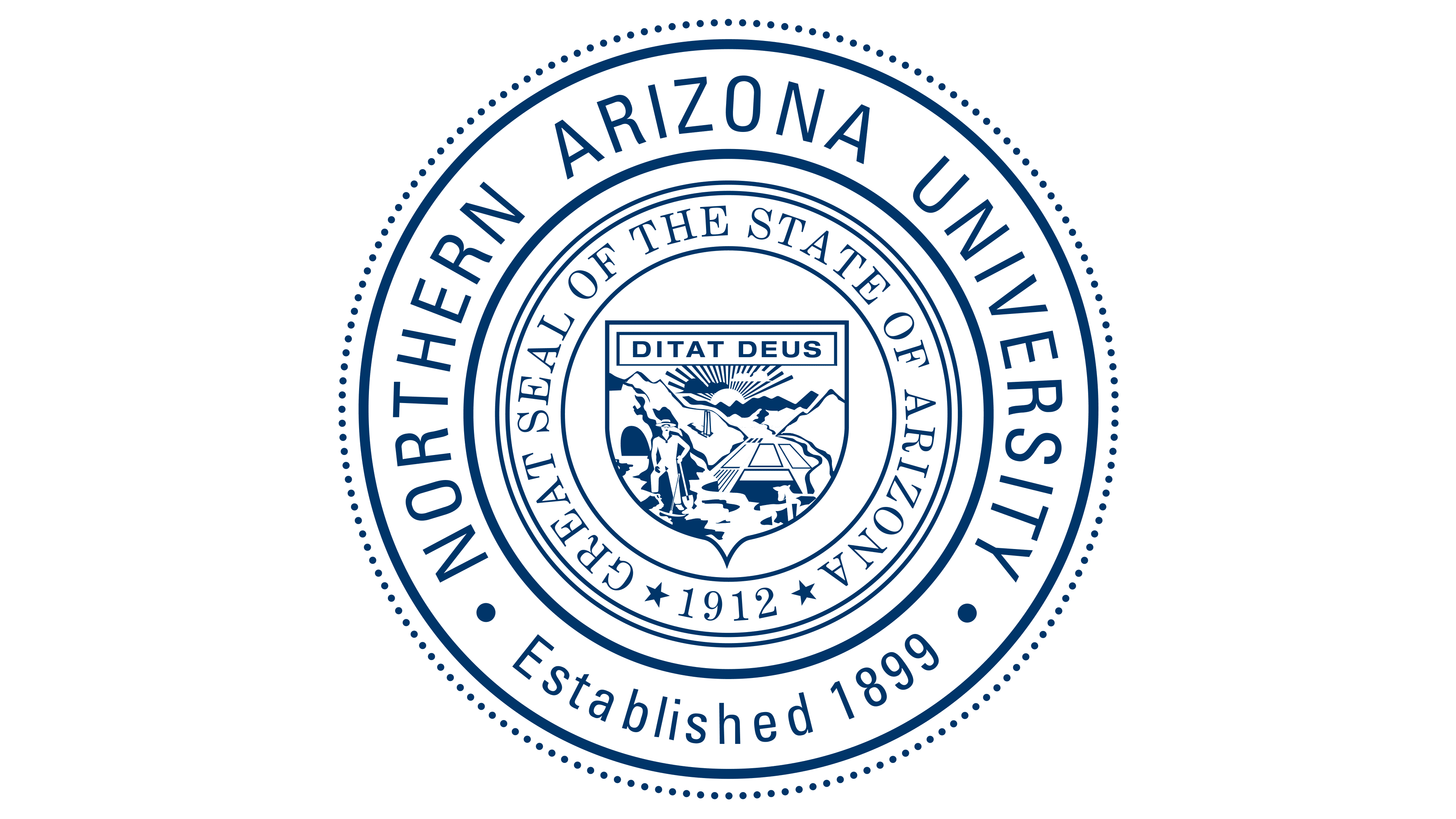
The NAU academic seal looks like a classic rondel with an accentuated center. It features a miner in a hat with a pickaxe and shovel against the backdrop of high peaks, behind which a radiant sun appears as a symbol of light and knowledge. The image is placed in a heraldic shield. In its upper part is the motto “Ditat Deus,” written in Latin. It is placed in a separate rectangle and centered. Next are circles of different sizes: the farther from the center, the larger. The first is the inscription in English, “Great Seal of The State of Arizona,” and the year 1912, separated from the text by two stars. In the widest ring, the university’s full name is typed in a thin sans-serif font.
Font and Colors
The inscriptions are in uppercase. The letters are straight, smooth, and chopped, giving them a perfect geometric shape. Serifs are present only in the abbreviation of the university logo and in the slogan of the academic seal. The brand palette comprises blue (Pantone 282) and gold (Pantone 3514).