


 Nautica Logo PNG
The succinct Nautica logo actually hints at broad horizons and a sea of possibilities. It conveys this directly with a single element, one that’s highly recognizable even to those unfamiliar with the fashion brand.
David Chu founded Nautica; he was born in Taiwan in 1955 and raised in New York after his family opened a Chinese restaurant. He studied at the Fashion Institute of Technology after a professor pushed him from architecture toward clothing design. After a failed export venture in Taiwan, Chu returned to the U.S. He designed jackets inspired by naval pea coats, which were stocked by stores such as Barneys and Bloomingdale’s.
In 1983, at age 28, Chu co-founded Nautica, named after the Latin “nauticus,” meaning “maritime.” The first line had six bright men’s jackets, and first-year revenue reached $700,000, then $2.5 million the next year. In 1984, Harvey Sanders of State-O-Maine acquired control, while Chu remained chief designer.
Sanders and Chu built the brand through selected department stores, including Bloomingdale’s, Nordstrom, and Saks, presenting the clothes as full collections rather than scattered items. The first branded stores opened in New York and Newport Beach in 1987. A women’s line followed in 1988, and sales rose from $28.9 million in 1986 to $75 million in 1989.
In 1994, State-O-Maine became Nautica Enterprises Inc. and signed a watch deal with Timex. By the mid-1990s, Nautica stood beside Tommy Hilfiger and Polo Ralph Lauren in American sportswear, with global sales above $1 billion. VF Corporation bought the company in 2003 for about $600 million after missing the Calvin Klein opportunity. In 2018, VF sold Nautica to Authentic Brands Group, and in 2024, it moved operations to Catalyst Brands.
Meaning and History
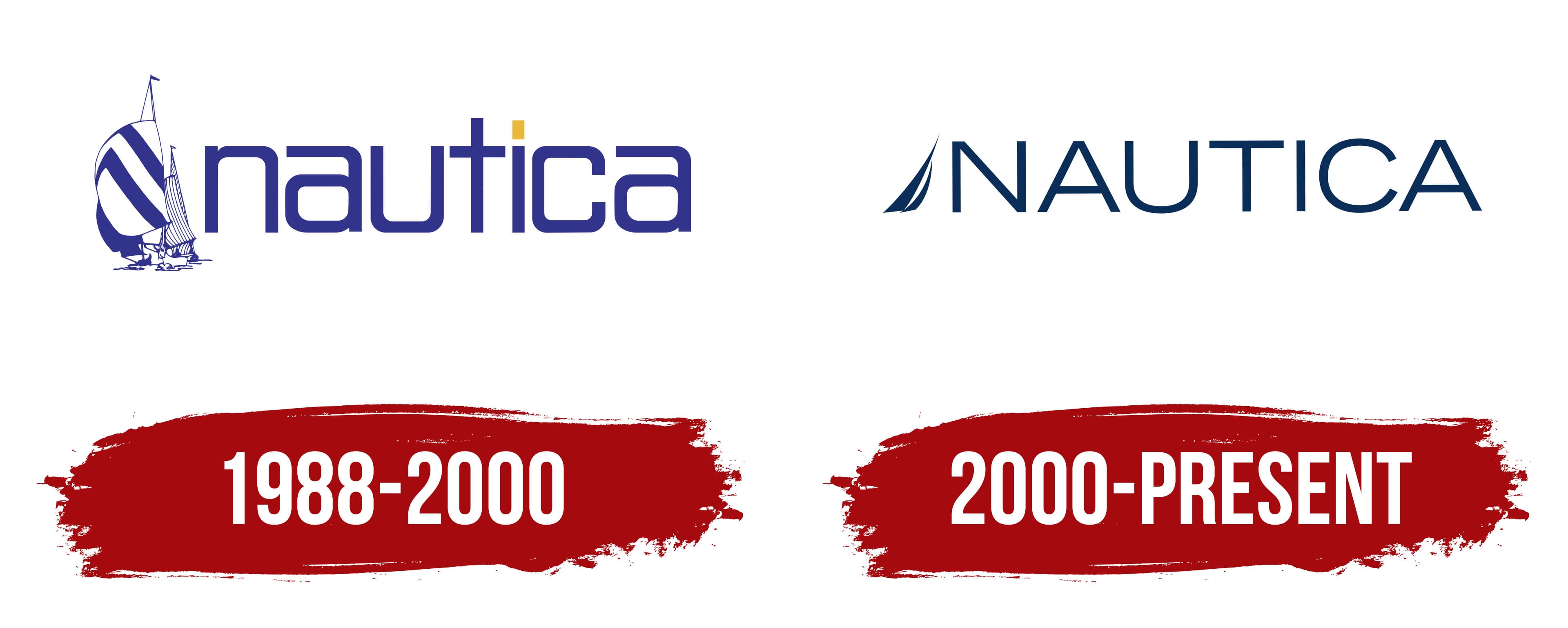
A year after its launch, the brand was acquired by State-O-Maine, a clothing manufacturer. Thanks to its accessible pricing, the newly acquired trademark became so well known that the sewing enterprise renamed itself Nautica. This happened in 1994. VF Corporation then purchased it, which significantly expanded the assortment: the logo featuring a stylized sail now decorates not only clothing but also other products, including perfumes, accessories, and home-use items. Nothing about it could be anything but an allusion to a ship, as the name relates to sailing and water.
What is Nautica?
Nautica is an American sportswear brand for women, men, and children. It also offers perfumes, watches, and various kinds of accessories. All its products fall into the mid-price range. Designer David Chu founded the company in 1983, and ABG (Authentic Brands Group) now owns it. Its headquarters are located in New York City.
1983 – 1988
The brand’s name is derived from Latin: it comes from the word “nauticus,” which has Greek roots and means “naval fleet.” Today, it is also associated with seafaring (in Italy). Therefore, the company’s entire visual identity revolves around a ship, in both the wordmark and the illustration.
1988 – 2000

The Nautica emblem consists of two parts that form an indivisible whole because a common idea unites them. The first is a drawn sign of several ships with tightly inflated sails. In total, there are three sailing vessels: the first has a white-and-blue striped triangular sail, the second is completely blue, and the third is white with thin parallel lines.
On the right side, the company’s name appears in a semi-bold font with large characters. The letters are lowercase, with smooth edges and softly rounded corners, making them seem as if they are cut at the bends. The exceptions are “t” and “i”: one has a classic cross shape, and the other looks like a miniature post with a lantern on top. This association likely comes from a time when sailors ventured out to sea at their own risk; many did not return from the vast waters, and survivors could only navigate by the light of a coastal lighthouse. Why would a clothing manufacturer need this? Probably to emphasize protection against danger, since it sells gear for extreme activities.
2000 – today

Designers moved away from the intimidating Nautica logo and proposed a calmer version with a balanced mix of text and graphics. Now it features two narrow, tall, slightly curved sails. They are directed towards the inscription, which remains on the right. This adds dynamism, creating the impression that the ship is sailing across open water, driven forward by a strong wind. However, the emblem’s font is completely different: first, the letters are uppercase, and second, they are wider. In addition, the glyphs have lost the hint of trimmed and rounded corners. Now “U” and “C” look like brackets; both “A”s have their tops cut off, and “T” and “I” are straight and maximally geometric.
Font and Colors

The Nautica logo inscription is set in a typeface reminiscent of Trade Gothic Extended. The font was created by Jackson Burke in 1948. The letters are wide, smooth, and grotesque, so nothing hinders their representation of freedom of movement across the waves.

This fashion brand’s usual palette is blue, a color that evokes sailing, ships, yachts, and navigation across endless waters. In one version of the visual identity, lilac-blue is used; in another, dark blue symbolizes the unexplored depths of seas and oceans. Yellow harmoniously complements these, representing the life-saving light of a lighthouse.