


 Olympiacos Logo PNG
The emblem’s symbols reflect deep reverence for ancient Greek sports culture. The Olympiacos logo shows a team of hardened, strong fighters who will only win. The elements of the sign symbolize championship cups and titles.
On March 10, 1925, Olympiacos FC was formed in Piraeus by merging two local clubs. Officer Notis Kamperos proposed the name and emblem of a laurel-crowned athlete, while Michalis Manouskos shaped the full title. Red and white defined the identity from the start.
The early squad was built around the Andrianopoulos brothers, who drove rapid success. In 1925 and 1926, Olympiacos won the Piraeus championship. Between 1926 and 1929, the team went unbeaten in 36 matches, earning the nickname “Thrylos”.
In 1930–31, Olympiacos claimed its first Greek national title. During the 1950s, it secured six championships and five consecutive Greek Cups from 1957 to 1961. In 1959, the club made its European debut against AC Milan.
In 1963, Olympiacos won the Balkan Cup, defeating Galatasaray S.K. In 1972–73, it beat Cagliari Calcio in the UEFA Cup, then ended Tottenham Hotspur’s unbeaten European run the following year.
A major transfer came in 1988 with Lajos Détári from Eintracht Frankfurt. Domestic dominance peaked with seven straight titles from 1997 to 2003 and again from 2011 to 2017. In 1998–99, the club reached the Champions League quarter-finals, losing in the final minutes to Juventus FC.
Rivalry with Panathinaikos FC defined Greek football. In 2004, the Karaiskakis Stadium was rebuilt. In May 2024, Olympiacos won the UEFA Europa Conference League, beating ACF Fiorentina 1:0 and claiming its first European trophy.
Meaning and History
One of its founders, Notis Kamperos, created the club’s image. He came up with the current name and designed the emblem, which depicts an Olympic athlete’s profile. The wreath of olive leaves suggests this is not just a participant in the Olympic Games, but a winner, because in ancient times only the most successful athletes were awarded such distinctions.
What is Olympiacos?
Olympiacos is a Greek football club based in Piraeus, Attica. Founded in 1925, it has won numerous titles throughout its history. As of 2023, they have 79 trophies: 47 championship titles, 28 cups, and four super cups.
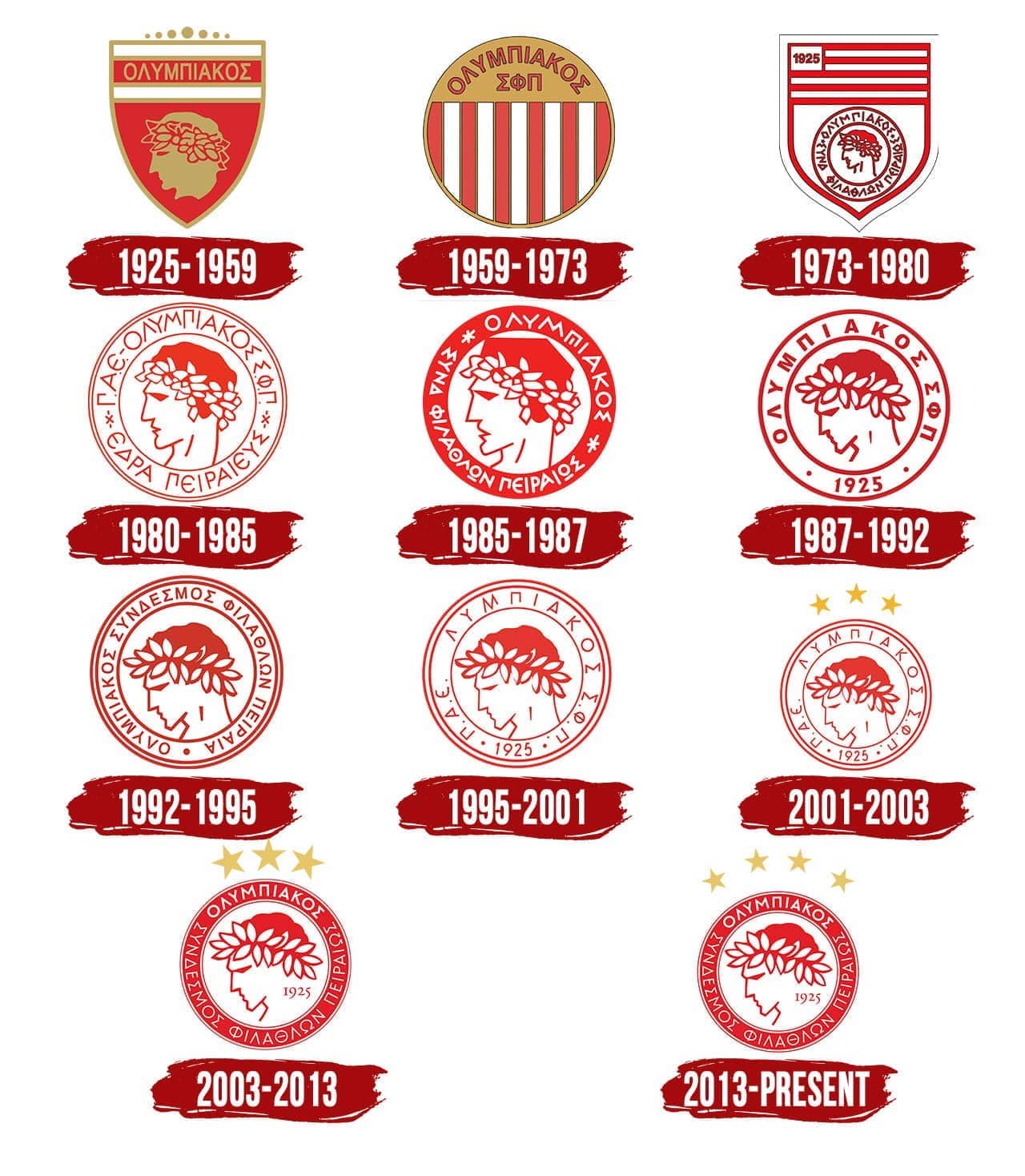
1925 – 1959
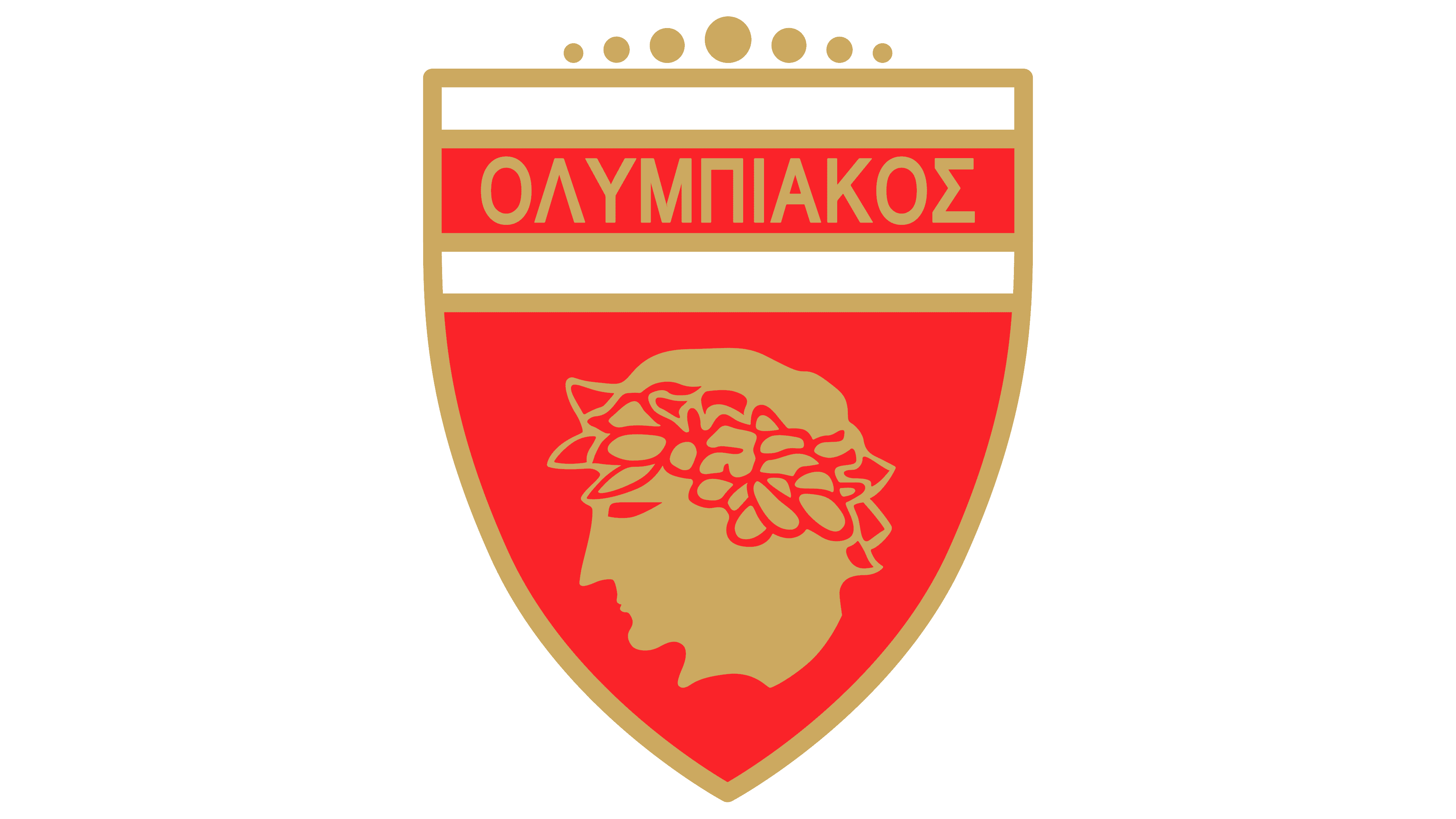
In the first logo, the golden head was located at the bottom of the triangular shield. At the top, in a separate narrow rectangle, was the Greek word “OΛΥΜΠΙΑΚOΣ.” A red background was used for the picture and text.
1959 – 1973
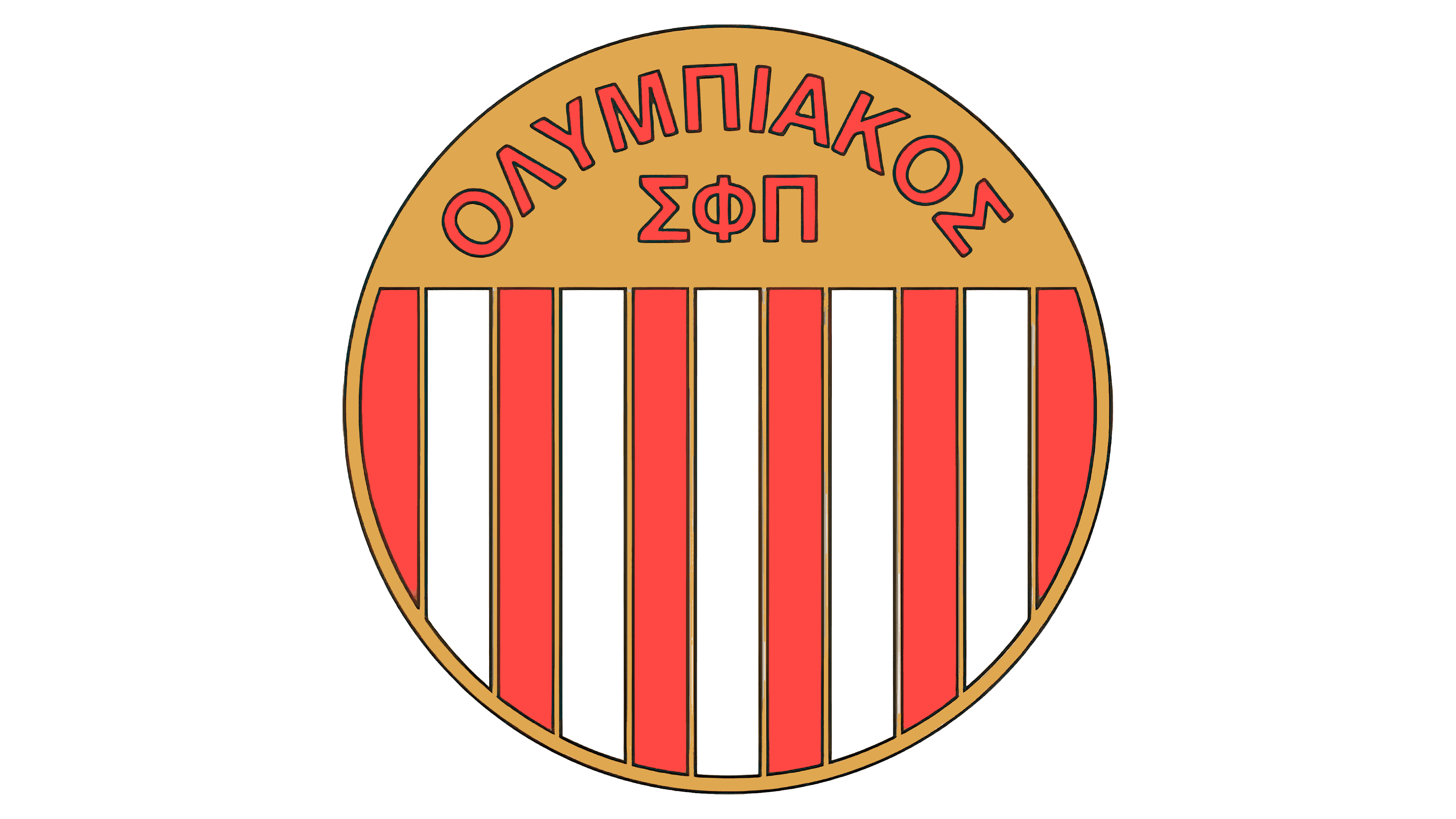
After the redesign, Olympiacos adopted a new emblem that echoed the pattern of the players’ striped uniforms. Most of the circle was occupied by vertical red and white lines. Slightly less space was reserved for the inscription “OΛΥΜΠΙΑΚOΣ ΣΦΠ,” where the last three letters represented the phrase “Σύνδεσμοσ Φιλάθλων Πειραιώσ.”
1973 – 1980
In 1973, another version of the graphic sign with a shield appeared. It had vertical white and red stripes, the year Olympiacos was founded, and a small circle with an athlete’s head and the club’s full name in Greek.
1980 – 1985
The designers have simplified the logo by removing the shield and stripes. This made it possible to bring the circle closer to the profile of an Olympic champion.
1985 – 1987
The ring, once white, is now completely red. The phrase “OΛΥΜΠΙΑΚOΣ ΣΥΝΔΕΣΜΟΣ ΦΙΛΑΘΛΩΝ ΠΕΙΡΑΙΩΣ,” on the contrary, is white. The athlete’s head is enlarged and barely fits in the central circle.
1987 – 1992
The logo designers added the year “1925” and abbreviated the title block to the last three words. The ring is again white and outlined with red lines. The head is centered and seems to hang in space. The Olympian gazes downward.
1992 – 1995
The athlete’s profile shifts toward the circle’s inner edge. A triple red-white-red outline surrounds the ring. The year the club was founded has disappeared, but the full four-word name has returned.
1995 – 2001
The lines used to draw the Olympic champion have become thinner. At the same time, the designers had to shorten the inscription again to fit the number “1925” at the bottom. The ring now shows another version of the Greek name Olympiacos: “Π.Α.Ε. OΛΥΜΠΙΑΚOΣ Σ.Φ.Π.. ”
2001 – 2003
The football club won thirty league titles, so three gold five-pointed stars were added to the emblem.
2003 – 2013

The structure changed further: the head of the Olympian moved to the center, and the number “1925” was placed on the right, under the wreath. This rearrangement made it possible to place the club’s full name within the red ring.
2013 – today
An additional fourth star appeared above the circle in honor of the fortieth league title won in 2013.
Font and Colors
The Olympiacos club crest depicts a man with a Greek profile, a young participant in the Olympic Games. It symbolizes the main ancient Greek values: skill, strength, fighting spirit, and the desire to win. His head wears an olive wreath. This signifies that the athlete has surpassed the competition and taken first place.
The club name on the logo is written in Greek letters. All characters are capitalized and sans serif. The text, olive leaves, center circle, and outer frame are white. The wide ring, Olympiacos’s creation year, and head silhouette are red e21e26). They chose these colors in 1925. They symbolize opposing concepts: white signifies morality and virtue, and red signifies the desire for victory, courage, and passion.