


 Portland Timbers Logo PNG
The three stripes on the “Portland Timbers” logo symbolize the club’s participation in three leagues. The main symbol is the axe, a tribute to the club’s history; at the same time, it’s a stylized representation of the letter T, the initial letter of the second name. The circle symbolizes unity, integrity, and the pursuit of perfection.
The “Portland Timbers” is an American professional soccer club competing in Major League Soccer (MLS) in the league’s Western Conference. Since 2011, the “Timbers” have played their home games at Providence Park. The history of the “Portland Timbers” began in spring 1975, when the original “Timbers” club joined the North American Soccer League. The team disbanded at the end of the 1982 season because player salaries exceeded team revenues. Three years later, the organization reemerged as FC Portland Timbers and formed the Western Soccer Alliance, which later became the Western Soccer League (from 1986).
In 1989, local businessman Art Dixon took control of FC Portland and renamed it “Portland Timbers.” In 1990, the WSL announced a merger agreement with the American Soccer League. The new league was called the American Professional Soccer League, but the team spent only one season there: in 1991. Team owner Art Dixon closed it after losing over $500,000 over two years of ownership.
The team returned in 2001, playing in various leagues, including the USL First Division and the USSF Division 2 Professional League. On March 20, 2009, Major League Soccer commissioner Don Garber announced that Portland would be the eighteenth MLS team. Peregrine Sports, LLC, led by Merritt Paulson, became its owner.
The owner had long aspired to join Major League Soccer, a move that required rebuilding PGE Park. The club kept the same nickname. The name was chosen on March 8, 1975, from over 3,000 entries in an open contest. The word “timbers” is related to the logging that supported Portland’s economy in the 19th century.
Meaning and History
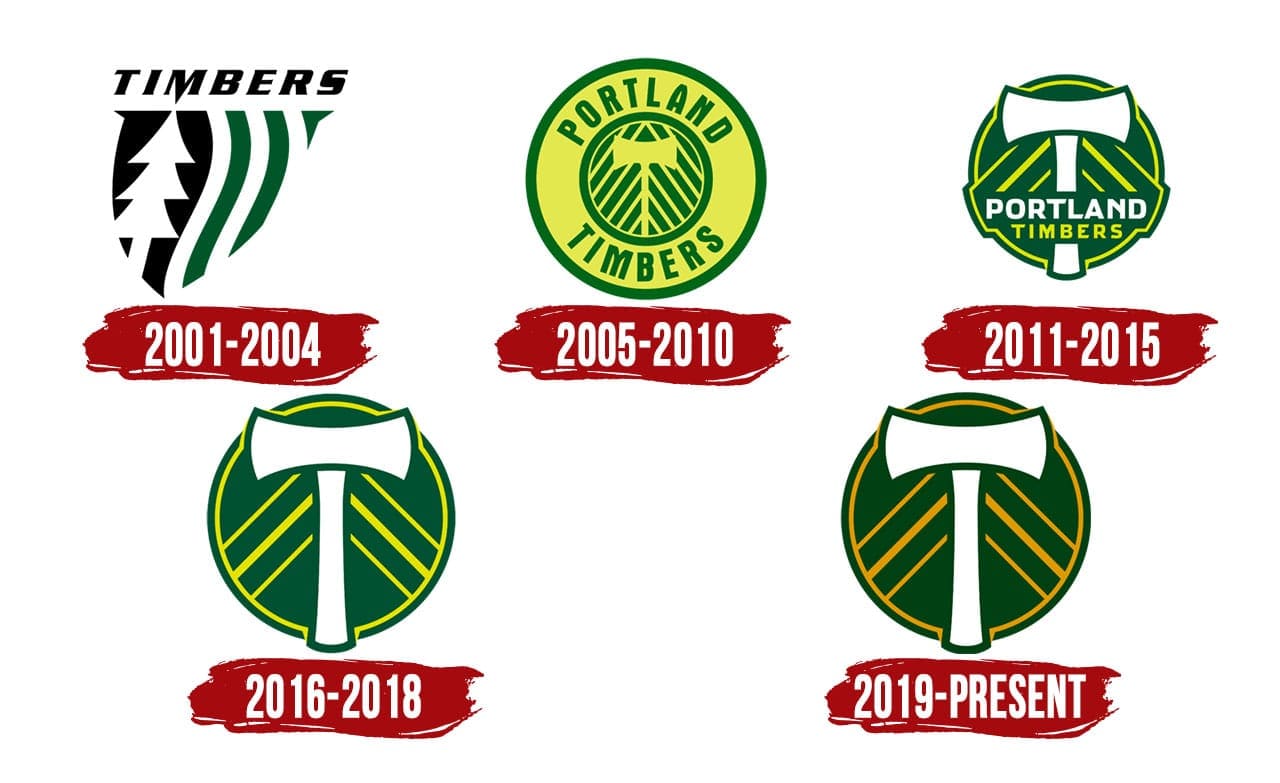
From 1975 to 1982, the NASL team used various logos featuring an axe inside a large circle. After moving to the second tier of the American soccer pyramid in the early 2000s, they introduced a new triangular logo with vertical green stripes and a white pine on a black background. However, it was short-lived: in 2005, the logo returned to its roots.
What is Portland Timbers?
The “Portland Timbers” is an American professional soccer team based in Portland, Oregon. It is a member of the Western Conference and an MLS participant, having served as an expansion franchise since 2011. The club was founded in 2009. Its home stadium is Providence Park. Peregrine Sports manages the club, with Merritt Paulson holding the controlling stake.
2001 – 2004
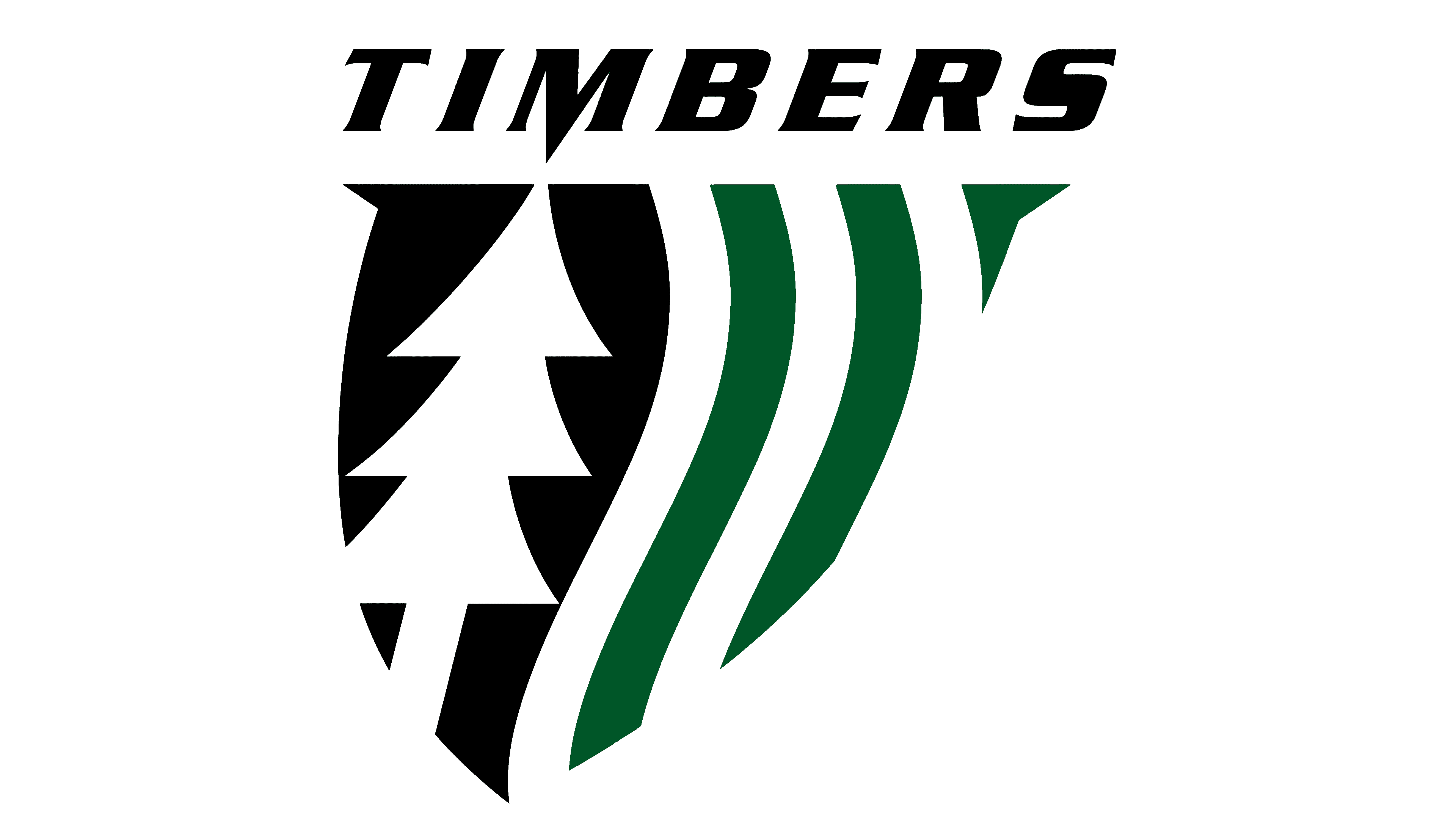
The team entered the second American division with an updated logo. If all the graphic symbols of the “Portland Timbers” had been circular (a classic that persists to this day), the early 2000s were spent experimenting with triangular shapes. As a result, a logo emerged as a heraldic shield with three sharp angles. However, it wasn’t solid; instead, it consisted of disjointed, wavy stripes and elongated geometric figures. On the left side, a pine tree stood on a black background. The right side was white and green. Above the shield was the club’s name, “TIMBERS,” in italics with a uniquely designed letter “M.”
2005 – 2010
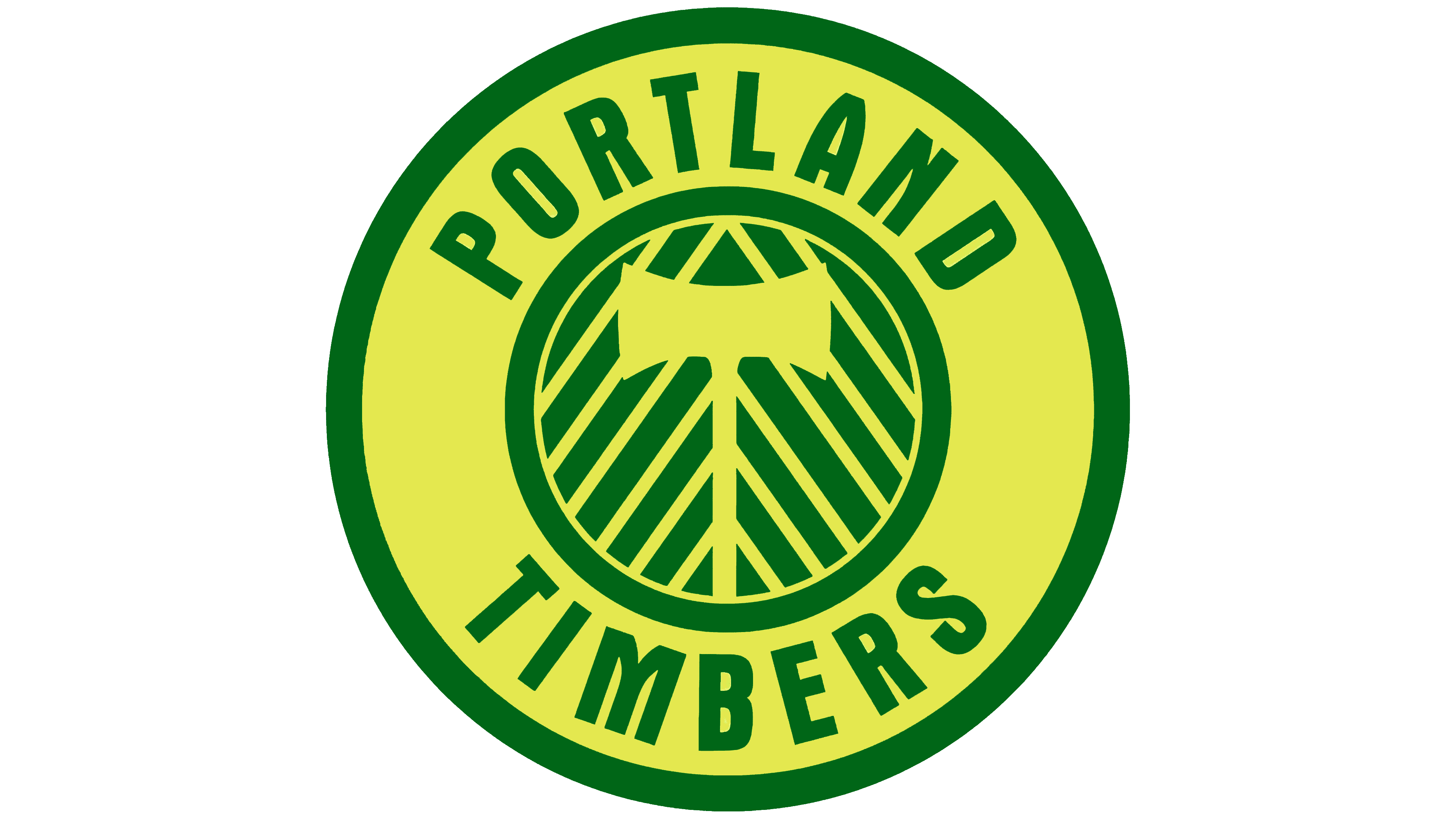
The triangular emblem did not find favor with fans, so they warmly welcomed the new version of the graphic symbol: a circle featuring a double-headed axe. This was an interpretation of one of the old logos of the “Portland Timbers,” used from 1975 to 1982. This marked a return to the roots, albeit in a different color scheme. The circle became pale yellow, and the decorative elements, contours, and inscriptions were muted green.
2011 – 2015
The MLS “Portland Timbers” logo incorporates elements from the former USL “Portland Timbers” emblem. The circular shape symbolizes unity, integrity, and the pursuit of perfection. The white axe pays tribute to the Pacific Northwest’s timber industry, as loggers traditionally used axes to cut trees. The three chevrons resemble a pine.
The axe extends beyond the circle; the lower part of the handle hangs over the club’s nickname, in all caps. The word “Portland” is larger than the word “Timbers.” This references the region. The “Timbers” logo also reflects the team’s colors, ponderosa green and moss green, symbolizing Oregon’s forests.
2016 – 2018
The soccer team updated its logo in 2015 after winning the MLS Cup. Designers removed the inscription from the circle on the “Portland Timbers” logo, leaving only the axis, which resembles the letter “T.” This refers to the word “Timbers.” The diagonal stripes still stretch towards the axis. Their placement changed: they moved lower and became continuous. A series of stripes (three on each side) symbolizes the franchise’s membership in three leagues: NASL, USL, and MLS. The color palette of the current “Portland Timbers” logo matches the previous one.
2019 – today
In 2019, the team underwent another redesign, replacing the yellow stripes with orange. The green color also took on a new shade, seeming warmer. The arrangement of elements, shapes, and proportions remained unchanged.
Font and Colors
Both when the team entered the North American Soccer League and after joining Major League Soccer, the emblems were perfectly round (except during the transitional period from 2001 to 2004). All of them essentially symbolized the same thing. The circle means unity and the pursuit of perfection. The diagonal lines symbolized the forest in Portland and its suburbs; their shape resembled a pine’s pyramidal crown. The axe, another mandatory element of the logo, reminded people of the timber industry that supported the city’s economy for many years.
Apparently, the creators of the “Portland Timbers” emblem decided inscriptions were superfluous and that a simple drawing of a circle and an axe would suffice for the club’s visual identity. They were right: this symbol has long been associated with the Portland club and doesn’t need text.
Designers preserved the emblem’s unique design and experimented only with colors. The last time they updated the palette was in 2019: they used green with a yellow tint for the inner part of the circle and gold (#D69A00) for the other elements.