 Progressive Logo PNG
This is a serious company, so the Progressive logo is serious. Its visual identity is built on the text, which has been played up in several forms. The last logo has an italicized inscription in blue capital letters. It conveys a sense of confidence, reliability, and steady progress.
Progressive was founded on March 10, 1937, in Cleveland, Ohio, by two young lawyers, Joseph Lewis and Jack Green. The company began as Progressive Mutual Insurance Company with only $10,000 in capital. Its first years were difficult. By 1939, the original capital had fallen to $1,500, yet the founders kept the business open.
One early difference was the drive-in claims system. Drivers could bring damaged cars to a claims site, where an agent inspected the vehicle and arranged payment on location. Progressive also introduced installment payments for insurance premiums, making auto coverage more accessible to ordinary American families during a period still shaped by the Great Depression.
After Joseph Lewis died in 1954, his son Peter B. Lewis joined the company. In 1956, Progressive Casualty Insurance Company was created to insure nonstandard drivers, including young drivers, owners of powerful cars, and people with accident records. Large competitors such as State Farm avoided many of these clients, while Progressive used higher premiums and closer risk analysis.
In 1965, Peter Lewis became president and CEO after a leveraged buyout. The company went public on April 15, 1971, and passed $1 billion in premiums in 1987. It later sold policies by phone in 1993, launched a website in 1995, and allowed online insurance purchases in 1997. In 2008, Progressive introduced Snapshot and the advertising figure Flo. In 2016, Tricia Griffith became CEO, and the company later surpassed State Farm and Allstate in written premiums.
Meaning and History
The pioneering approach focuses on the unique selection of client categories and how they interact. The company is the first automobile insurer to allow customers to select and purchase policies online. Later, it was the first to allow smartphone apps and mobile browsers to rate and manage policies. This concept fits perfectly with the insurance innovator’s identity. That’s why all its logos are businesslike and serious.
What is Progressive?
Progressive is the third-largest transportation insurance company in the United States. It provides insurance services to drivers in high-risk categories, such as owners of cars, SUVs, boats, and commercial vehicles. The service has existed since 1937, having been founded by Joseph Lewis and Jack Green.
1937 – 1970
At first, the insurance service searched for its identity: it chose an original niche, which was reflected in its visual identity. In 1956, the company switched to insurance compensation for risk-category drivers and only then finally decided on an emblem.
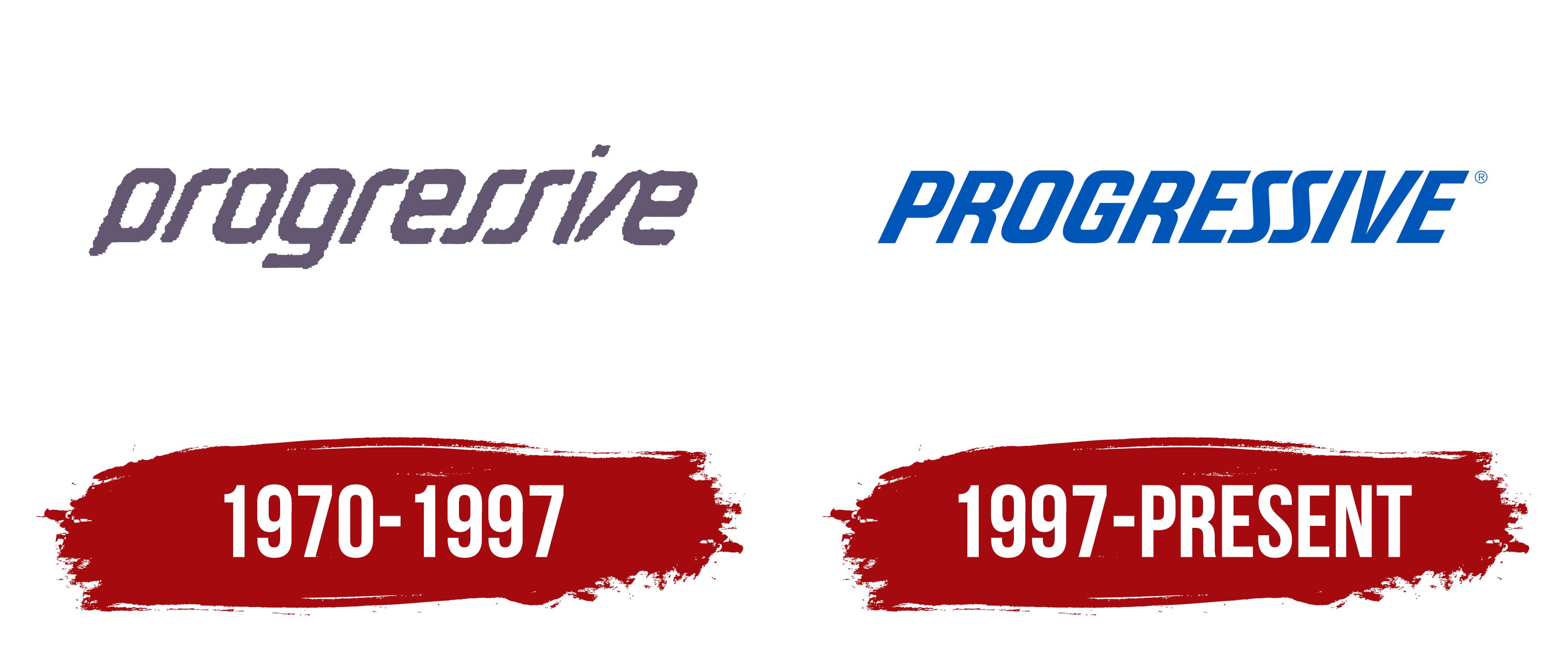
1970 – 1997

The Progressive text mark consisted of a single horizontal inscription. The letters were lowercase, italicized, and bold. In place of the “v” was a pencil, the sharpened end of which was at the bottom, almost in contact with the adjacent “i.” As a result, this juxtaposition created the visual impression of a missing glyph. The logo was gray.
1997 – today
The current Progressive emblem contains the name typed in capital letters. Therefore, all letters are flat, equal, tall, and italic. The rounding at the ends of the glyphs disappeared, and right angles replaced them. At the same time, the designers replaced the gray color with blue.
The insurance company’s visual identity is directly tied to its name. There are two reasons for that. First, Progressive has a text logo. Secondly, the name’s meaning echoes the insurance corporation’s core concept of striving for progress and innovation.
Font and Colors

The inscription is set in a font reminiscent of Gill Sans MT, but it is not identical to it, as it is an individual development created for this project. The modern corporate palette of the leading American insurer consists of the color blue. It is bright, austere, inspiring hope for a positive solution to problems.