 Seattle Sounders FC Logo PNG
The Seattle Sounders football club emblem, executed in a traditional graphic style, features an important city symbol. The emblem’s overall symbolism underscores the close unity among the team, fans, and the city. The color palette reflects the region’s natural features.
The Seattle Sounders FC traces its roots to the NASL team founded in 1974, which was dissolved in 1983 due to financial problems. The name returned in 1994, when a new franchise joined the USL under Scott Oki, a former Microsoft executive.
In 1997, the club moved to the USL First Division. During this period, Paul Allen pushed for entry into the MLS, but the city failed to meet league requirements. Even after building a new stadium, the league rejected the bid as it shifted toward investor-controlled franchises.
In 2002, Adrian Hanauer became the main owner and formed an investment group with Joe Roth, Paul Allen, and Drew Carey. Together, they secured funding for a 30-million-dollar expansion fee. On November 13, 2007, the league approved the bid, and a new team replaced the USL version.
In 2009, the club entered MLS as a successor rather than a direct continuation of the NASL side. Before launch, a public vote in 2008 selected a name. Options included Seattle Alliance, Seattle Republic, and Seattle FC.
Fan resistance forced a reversal. Nearly half of the respondents proposed variants of “Sounders” that reference Puget Sound. The team kept the name, and the rights transferred without conflict.
In 2015, Hanauer became the majority investor, replacing Joe Roth. By 2019, Roth exited, and new partners joined, including a group led by Microsoft executive Terry Myerson.
Meaning and History

The Seattle Sounders football club emblem symbolizes the region’s collective spirit, known for its unique blend of traditions and innovation. The emblem serves as a beacon for casual fans and devoted supporters, representing a team with historical roots and an openness to contemporary influences. The logo emphasizes that Seattle Sounders FC is deeply connected with its community and strives for excellence. The team’s role goes beyond the football field, serving as a symbol complementing the region’s cultural fabric.
One of the main symbols of Seattle Sounders FC is the Space Needle’s pointed form. It’s the city’s main attraction, located in the very center. From its top, you can see the nearby islands, Mount Rainier, and the Cascade Range. Another feature of the tower is its unique Googie architectural style. The emblem creators sought to convey its originality but did so with little detail, depicting only the Space Needle’s general outlines.
What is Seattle Sounders FC?
Seattle Sounders FC is a professional football team from Seattle, Washington, founded in 2007. It entered the league in 2009 as part of the expansion program. The club is a member of MLS’s Western Conference. Adrian Hanauer is the principal owner of the franchise, with minority owners Paul Allen and Drew Carey.
1994 – 2008
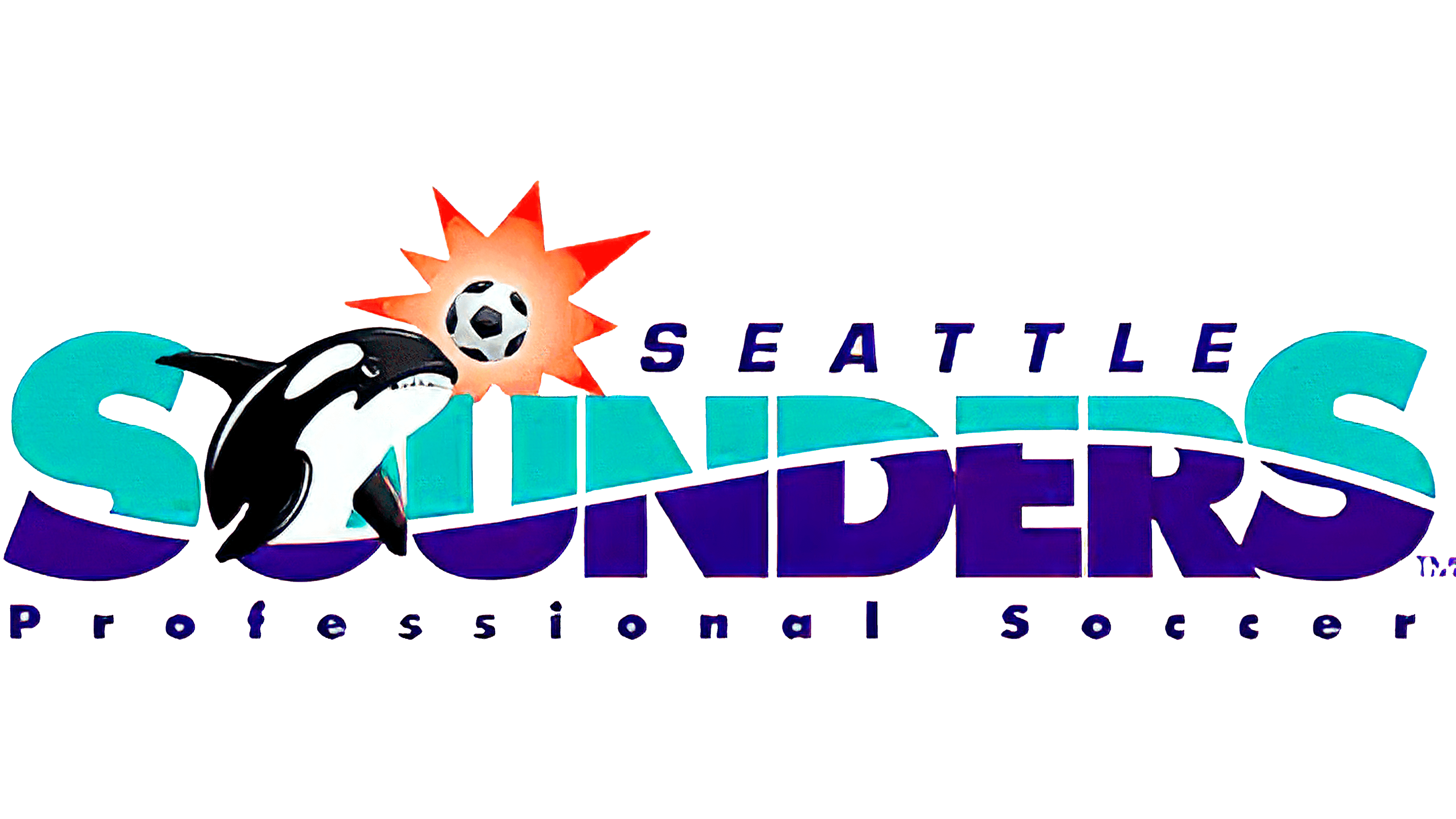
After the club’s return in 1994, the Seattle Sounders logo adopted an original design: the letter “O” was replaced by an orca striking a soccer ball. More precisely, the orca appears to leap from the letter “O” and hit the ball.
The emblem uses a vibrant color scheme dominated by blue and turquoise, suggesting the club’s connection to the ocean and the region’s active marine life. Above the orca’s head is a stylized soccer ball, surrounded by a red-orange burst that adds liveliness and the sport’s excitement.
The orca was chosen as the club’s symbol, reflecting natural strength, energy, and Seattle’s bond with water. The word “Sounders” appears in large, soft, flowing letterforms that convey the club’s character and atmosphere, with a focus on movement and team play. The word “Seattle,” positioned above the main text, is set in a smaller size, neatly completing the overall composition.
Using an orca as a soccer player sets the team apart from other clubs, conveying boldness, energy, and athletic passion. The color palette and line dynamics create an image of a club deeply connected to the city and its natural surroundings.
2009 – 2023
In 2009, the Seattle Sounders logo was changed again as part of the club’s transition to MLS. The presentation occurred on April 7, 2008, at the Space Needle. They chose this place because the famous landmark was once again in focus. The globally recognized symbol of Seattle was drawn within a complex heraldic shield divided into two parts. The combination of elements symbolizes cooperation between the team’s owners, players, city, and fans.
The “Seattle Sounders” logo’s color palette is also symbolic. The blue color (Sounder Blue) symbolizes the water around the city, specifically Puget Sound. Green (Rave Green) represents the Pacific Northwest forests. The dark gray outline signifies the Cascade Range mountains east of Seattle. The words “Seattle Sounders FC” appear in the same color inside a curved white rectangle opposite the “Seattle Sounders” logo.
The font matches the illustration’s style: it looks as futuristic as the famous tower. The first word, “SEATTLE,” is set in a rough, rectangular serif font. Against its background, “SOUNDERS FC” feels less strict: the letter “S” here is smoother and rounder than in the previous case. But some letters (“U,” “D,” “E,” “R,” and “F”) have sharp triangular serifs, with “E” and “F” having them in the middle, not at the ends.
The colors were chosen with their hidden meanings in mind: each shade reflects bodies of water, mountains, and forests. The designers used Cascade Range (#1D252D) for the outlines, Space Needle, Rave Green (#658D1B) for the triangular heraldic shield, and Sounder Blue (#236192) for the pentagonal geometric figure in the background.
2023 – today
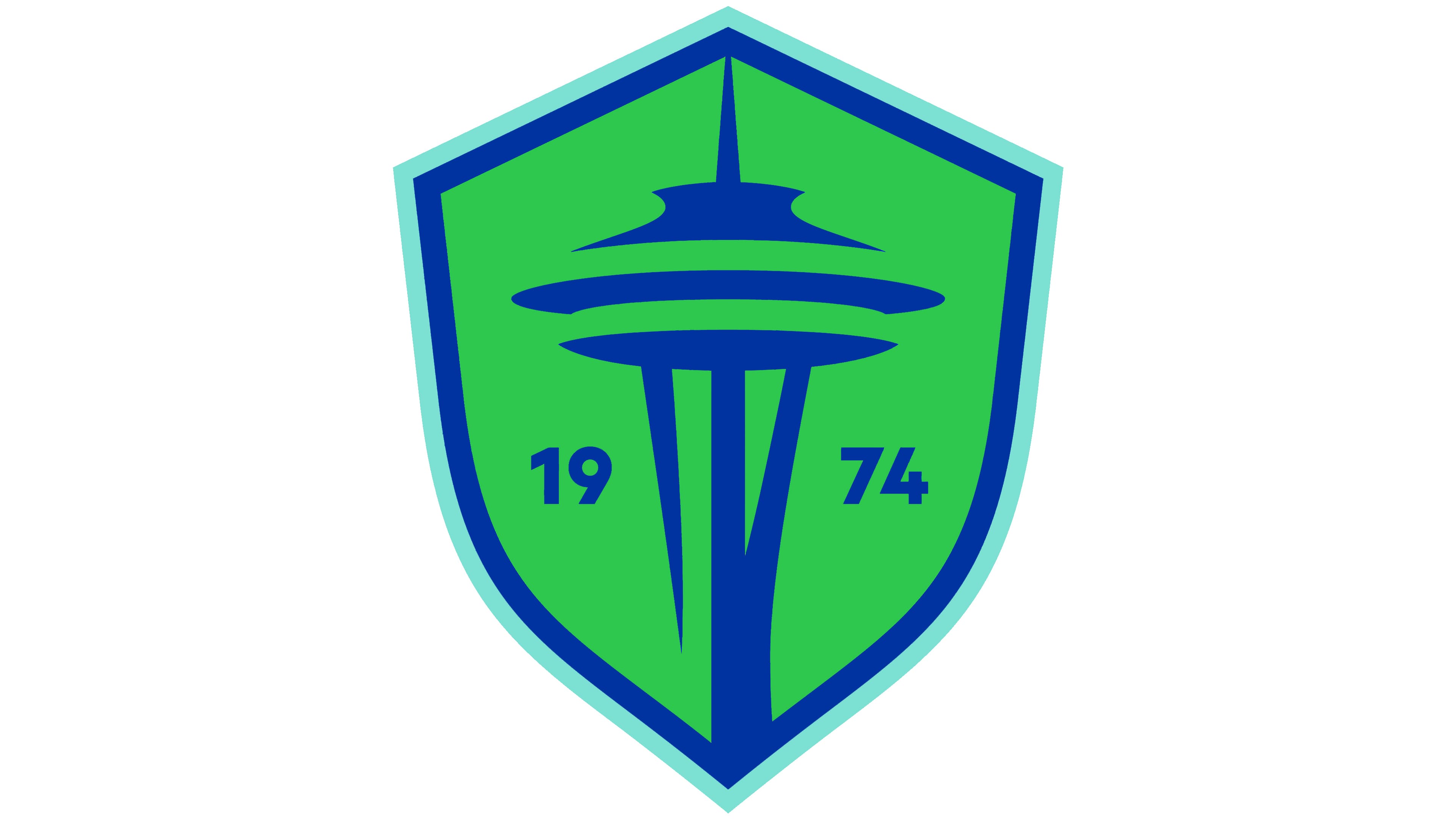
The football club emblem is designed as a shield, conveying strength and reliability. The outer shape is multi-layered, creating depth and volume. At the center is a recognizable regional symbol: the iconic Space Needle, representing local identity and urban tradition.
The tower is depicted schematically, composed of straight and curved lines. The thin, pointed top element reaches upward, reflecting the club’s ambition and pursuit of success and high achievement.
On either side of the tower are the numbers “19” and “74,” indicating the club’s founding year. The symmetry of these elements organizes the composition and adds structure. The font’s geometric style and the numbers’ blue color harmonize with the emblem’s other elements.
Two borders run along the emblem’s outline, guiding the viewer’s eye and emphasizing the design’s key components. The inner blue border highlights the central composition with the tower, while the outer emerald line adds motion and completes the overall look.
The emblem connects the club’s history with its regional identity. The Space Needle’s visual image signifies belonging to a specific place and reflects the city’s atmosphere, where the club originated and continues to grow. The colors and shapes convey the location’s spirit, uniting natural elements with the urban environment.
Font and Colors
The emblem’s color scheme reflects the club’s close connection to the surrounding area. The main shade of green reflects the region’s natural richness, forests, hills, and parklands. The accompanying blue elements reference the city’s proximity to water and the coastline. A vivid emerald line around the outer edge completes the design and adds expressiveness.