 Tylenol Logo PNG
The Tylenol logo symbolizes the simplicity and reliability of a medicine that has become a familiar part of daily life. The brand is recognized as a proven remedy helping relieve pain and discomfort.
The history of the Tylenol brand dates back to 1879, when Robert McNeil acquired a small pharmacy in Philadelphia. The family business gradually expanded, becoming McNeil Laboratories in 1933, and supplying medications to hospitals and pharmacies. In 1955, the company introduced Children’s Tylenol, a pain reliever containing acetaminophen, as an alternative to aspirin-based products.
In 1959, McNeil Laboratories was acquired by Johnson & Johnson. By the 1970s, Tylenol had become the leading pain reliever in the U.S., thanks to successful marketing efforts targeting both physicians and consumers.
On September 29, 1982, the brand’s reputation nearly collapsed due to deliberate cyanide poisonings in Chicago, resulting in seven deaths. Johnson & Johnson recalled all products and introduced tamper-proof packaging, which became an industry standard.
In subsequent years, the brand expanded its product line, introducing innovations such as Tylenol PM and Motrin Dual Action. In 2023, Tylenol became part of Kenvue, a new company spun off from Johnson & Johnson.
Meaning and History
What is Tylenol?
It is a well-known American medication used to reduce fever and relieve pain. Its active ingredient, acetaminophen, is safe for the stomach when used properly. It is available in tablet, capsule, and liquid solution forms, including extended-release options and formulations with additional calming ingredients.
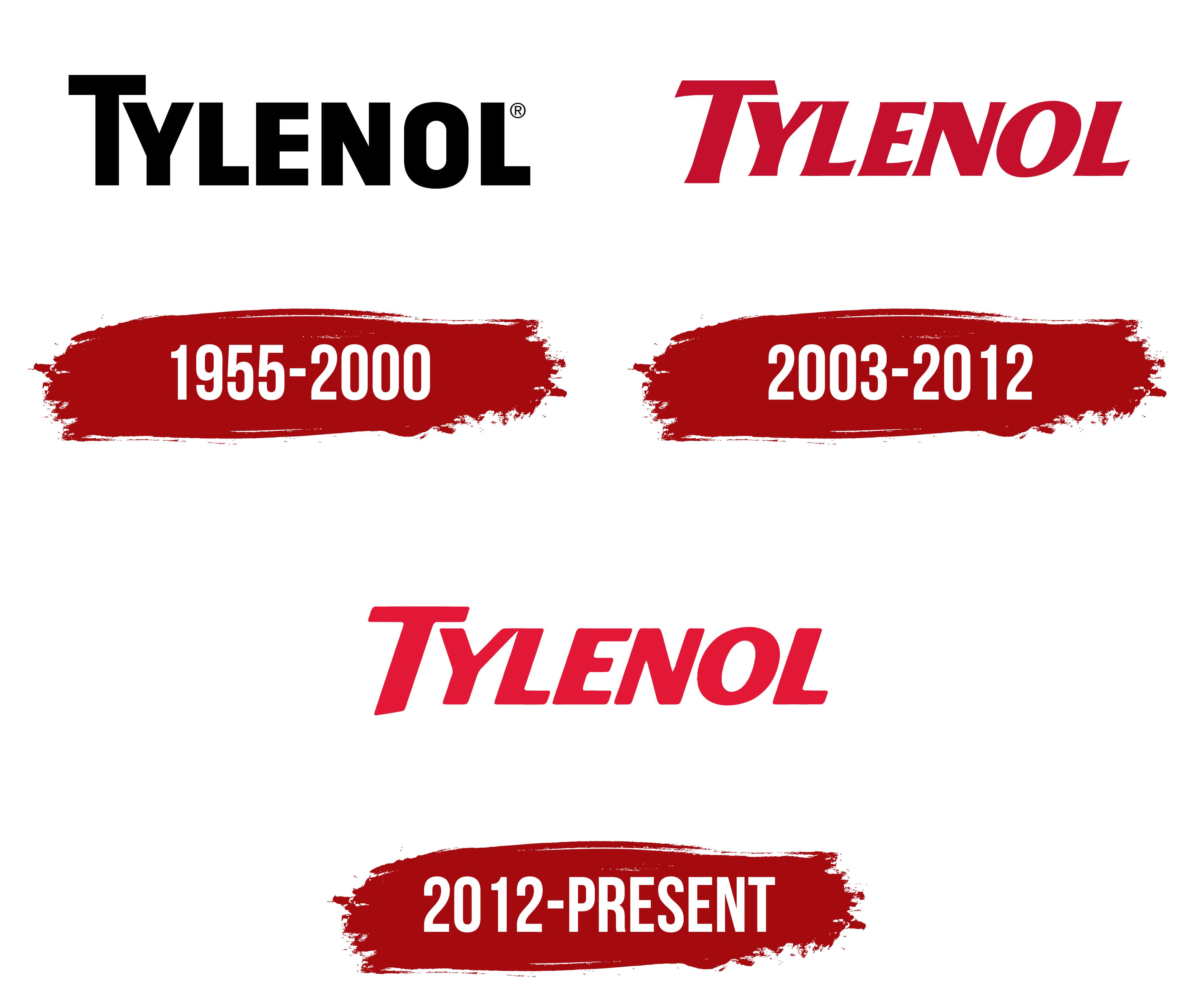
1955 – 2000

The original Tylenol logo debuted in 1955 as part of McNeil Laboratories’ ambitious project to introduce a paracetamol-based analgesic to compete with aspirin. The restrained logo emphasized the medicine’s seriousness and medical nature.
The font closely resembled Helvetica Bold, the standard visual for pharmaceuticals at the time. Helvetica officially appeared in 1957, but the early sans-serif used here closely matched its style and philosophy. Straight lines and proportions conveyed reliability.
Black symbolized precision and simplicity, typical of mid-20th-century medical brands.
This initial design lacked additional elements, clearly positioning the drug as trustworthy. It remained unchanged until the late 20th century, reflecting brand continuity.
2003 – 2012

The 2003 logo redesign reflected a shift in visual identity, developed by the agency Interbrand.
The typeface adopted an italicized, custom look resembling Gill Sans Ultra Bold Italic, conveying a dynamic brand identity. Italics suggested rapid pain relief.
The red shade (Pantone 186 C) was used to maximize emotional intensity. Historically, since the 1950s, red has symbolized trust and reliability, often used on children’s packaging labeled “for hot heads.”
The updated design combined historical color continuity and dynamic form changes, reinforcing Tylenol’s image as a leading pain-relief brand in the U.S.
2012 – today
The updated Tylenol logo looks similar to the previous one, but differs in type and color. In the new image, the brand moved away from heavy letterforms, giving them softer, smoother contours. The red is deeper and brighter, approaching Pantone Red 032 C. The brightness symbolizes the medication’s potency and its pain-relieving action, reinforcing the medical focus and a sense of urgency.
The main emphasis in the name is placed on the first letter “T.” It is larger than the others and highlights the beginning of the word. The contours of all characters became smoother, with a slight rightward slant, and the sans-serif typeface resembles Helvetica Black Oblique with adjusted proportions.
The logo’s overall style became more emotional, reflecting the brand’s human-centered character. The new image emphasizes the product’s openness and modernity, confirming Tylenol’s status as a leading brand in its category.