


 UCLA Logo PNG
The UCLA logo reflects a commitment to growth. It demonstrates the reliable, solid knowledge students gain within the university’s walls. The emblem convinces me that studying at a university builds confidence for the future and opens doors to great career opportunities.
Meaning and History

The Regents of the University of California own the UCLA trademark and all elements of its visual identity. The institution makes money by selling clothing bearing its symbols in the United States and abroad, including Asia, Europe, and the Middle East.
The institution has a seal that is sometimes viewed as an emblem. This distinctive mark dates back to 1884, when the trustees of The University of California decided to create the first corporate seal. Tiffany & Co. developed the jewelry company’s seal, but the original burned in a fire after a severe earthquake in 1906. Two years later, the educational institution again turned to Tiffany & Co. to update the design. Then, they added a book inside the circle, and the five-pointed star moved up.
What is UCLA?
UCLA is one of the world’s most sought-after universities, a prestigious public research center located in the Westwood area of Los Angeles. The Anderson School of Management, David Geffen School of Medicine, and the School of Theater, Film, and Television are just a few of the 109 academic departments offering over 330 programs. The 419-acre campus is in one of Los Angeles’s most prestigious areas, known for its Romanesque architecture and beautiful gardens. The university is distinguished by its academic excellence and rich athletic heritage, with the Bruins having won multiple NCAA national titles.
In 1910, the university began using a seal close to the modern version. Since then, it has remained practically unchanged. When the University of California, Los Angeles appeared, the designers added the word “UCLA” instead of “1868” (the year UC was founded).
The modern logo is the elegant wordmark “UCLA.” The designers retained the font’s general appearance (handwritten italics) but made the letters calligraphic and removed the long strip that underlined the lettering below. They also removed the word “BRUINS” and the golden outline.
The campus also has its logo, the laconic abbreviation “UCLA” in bold italics. This simple sign represents the institution and all of its departments. Keith Bright designed it in 2004.
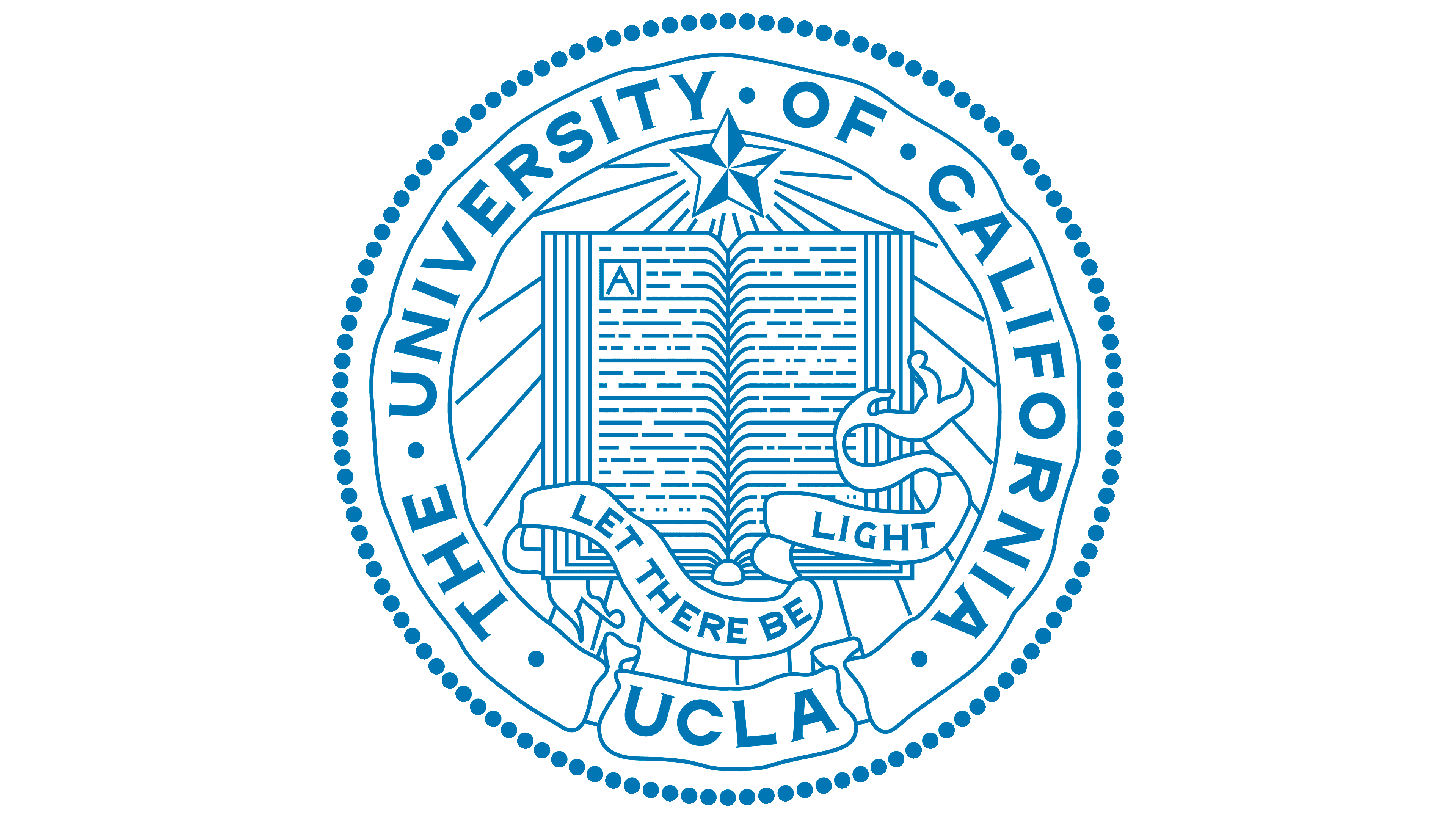
The seal is used primarily for ceremonial purposes and in official documents. Inside it is a book, a traditional symbol of knowledge. She is affably open, as if inviting me to join the world of science. Short dashes on the sheets imitate text. Only the capital “A” in the square is visible, the so-called drop cap. It is enlarged and, in this case, denotes the starting point of the path to wisdom.
Directly above the book is a five-pointed star with irregularly colored sides. Dashed beams radiate from it in all directions. The star symbolizes the source of knowledge, and its light spreads outward. The bottom of the pages is partially covered with a writhing tape with the words “LET THERE BE LIGHT.” UCLA inherited the motto “Fiat Lux” from its ideological predecessor, the University of California.
The book, with its surrounding elements, is enclosed in an uneven ring. This is another inscription tape. It contains the full name of the educational institution, with all words separated by periods. At the bottom of the tape is the abbreviation “UCLA.” The developers replaced the number “1868” with it when they adapted the UC seal for the University of Los Angeles.
The final part of the composition is a ring of many points. It has been used since 1910, when the University of California received its new seal from Tiffany & Co. The UCLA Bruins sports team logo also has a long history, though it has always looked like an inscription; designers have experimented with style and proportions.
UCLA Bruins Logo
The university sponsors 25 teams, including water polo, volleyball, tennis, football, golf, basketball, baseball, and other sports. The teams are nicknamed the Bruins and use Joe Bruin as their bear mascot. Graphic symbols with a common bearish theme are part of their story, but verbal signs have always been the main ones. The branding guide states that the first sports lettering logo appeared in the 1920s, and the modern version was created in 2017.
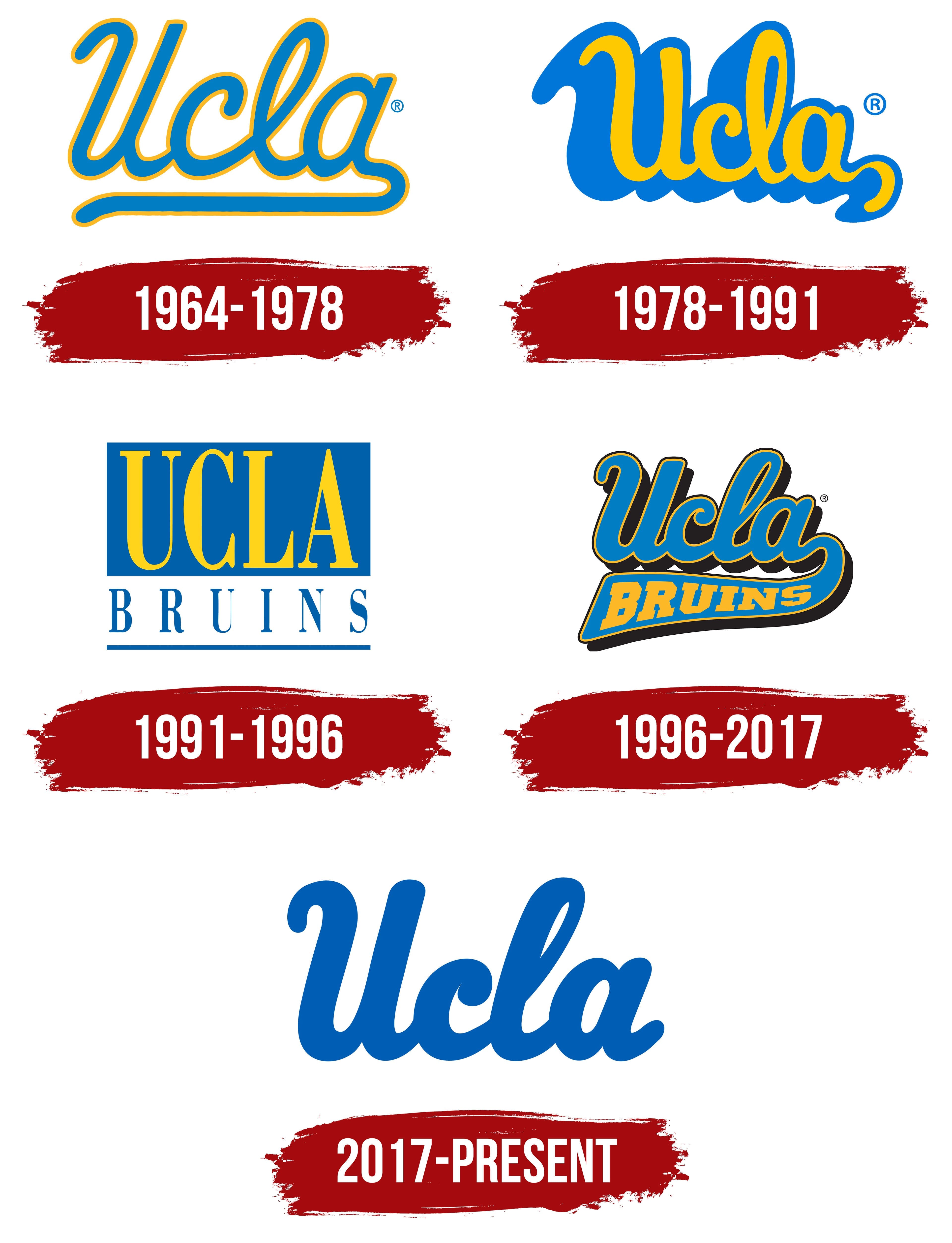
1964 – 1978

Since the mid-1960s, the team has been represented by a badge bearing “UCLA,” with only the first letter capitalized. The retro symbol stood out for its cursive handwriting. A long line stretched from the lowercase “a” to the left, underlining the word. The color palette also attracted attention: the designers made the main part of the logo light blue and drew a thin yellow line around the edges.
1978 – 1991

After completion, the UCLA Bruins sports emblem became even: the designers raised the letters and removed the rightward slope. They also flattened the inscription, making the vertical lines look wider than in the first version. The underscore is gone, replaced by a little hook at the end of the “a.” The colors were mirrored, with the yellow word “UCLA” set against a light-blue background. Moreover, this background roughly replicated the letters’ outlines but was shifted left. This design created a three-dimensional effect.
1991 – 1996

The 1991 version was conventionally divided into two parts: a blue rectangle with the yellow abbreviation “UCLA” inside and the blue word “BRUINS” underlined by a horizontal stripe of the same color. The logo was vertically oriented, with the elements arranged one below the other. The text used a contrast serif typeface, similar to Eurotype Bodoni Condensed. All letters were capitalized.
1996 – 2017
In 1996, the University of California, Los Angeles, changed its sports emblem. The font remains the same as in the modernized version, but the letters have become wider. The bar on the “a” was enlarged to accommodate the yellow word “BRUINS.” The logo creators used a typeface with rectangular serifs to nickname the teams and arranged the symbols from largest to smallest.
2017 – today

The logo was adopted in 2017 and dates back to an early era in the UCLA Bruins’ history. The designers removed the elongated “a” part, the “BRUINS” lettering, the black shadows, and the thin yellow stroke. The remaining words, “Ucla,” were dark blue and slightly transformed. Now, the glyphs are balanced in thickness, and their curves look more elegant than before.
Font and Colors

The words on the university seal are written in two different fonts. For the motto, the designers chose a bold grotesque, and for the educational institution’s name, a typeface with short serifs. The Bruins’ distinctive mark looks very different: it has always used a handwritten, coherent font. In recent years, it has become almost calligraphic. The campus logo features a bold, italic sans serif. Keith Bright, who designed the typography, drew inspiration from the Bauhaus style. He slanted the letters to create dynamic lettering.
All University of California, Los Angeles symbols, including wordmarks and print, share a common color called UCLA Blue (#2774AE). The branding guide also allows black-and-white versions, depending on the background. The sports emblem and seal may contain the Westwood Gold shade (#F2A900).