


 US Army Logo PNG
The US Army logo reflects heroism and service. The emblem demonstrates protection and support for the country in difficult times. A solid foundation and a clear charter make the troops’ victory possible.
The US Army began before the United States formally existed. On June 14, 1775, the Second Continental Congress created the Continental Army from New England militia units around Boston and new volunteer companies from Pennsylvania, Maryland, and Virginia. A day later, George Washington was appointed commander in chief.
Washington inherited a loose militia force, but Congress built civilian control in from the start through oversight. In winter 1778, Prussian officer Friedrich Wilhelm von Steuben trained the troops at Valley Forge and helped turn volunteers into a disciplined army. Victory at Yorktown in 1781, with support from the French fleet, ended the Revolutionary War. The Continental Army was disbanded in 1783, and a small regular army followed in 1784.
For much of the 19th century, the army stayed small in peacetime and expanded during war. The War of 1812 exposed the militia’s weakness. The Mexican-American War of 1846-1848 gave officers such as Ulysses S. Grant and Robert E. Lee valuable experience. The Civil War from 1861 to 1865 became the army’s largest domestic test, with more than 2.8 million men serving in the Union Army and over 620,000 dead on both sides.
The Spanish-American War of 1898 pushed the US onto the world stage. Elihu Root’s reforms created the General Staff and War College. In 1917, General Pershing led about two million soldiers to France. World War II expanded the army to eight million. The 1947 National Security Act created a new structure within the United States Armed Forces. Later came Korea, Vietnam, the all-volunteer force, Desert Storm in 1991, and long campaigns in Afghanistan and Iraq after September 11, 2001.
Meaning and History
The identity of the basic US military force exemplifies resilience, resistance, and loyalty. It has remained unchanged for many years, having survived the Indian Wars, Mexican Incursions, and two World Wars. The only changes concerned the inscriptions: in 1947, the phrase “War Office” was replaced with “Department of the Army,” and the date “1775” was added.
2001 – 2023
The modern emblem was introduced in 2001 and immediately adopted. The professional advertising agency Leo Burnett Worldwide created it. The designer chose understandable and symbolic signs, resulting in a versatile yet concise design. The logo consists of two separate parts, each in a different geometric shape.
A white star with black and yellow edging is located in the center of the black triangle. It has rounded corners, and a yellow edge with a duplicate black strip runs along the entire perimeter. In the horizontal rectangle below, the words “USARMY” are visible. All letters are capital, white, and chopped. “U,” “S,” and “R” have cut corners, giving them a geometric look. The lettering has the same background and border as the star.
2023 – today
Global branding agency Siegel+Gale joined forces with the marketing communications network DDB to transform the US Army brand. The redesigned logo was introduced as part of a recruitment campaign for the armed forces. The clean, fresh design targets modern youth and aims to inspire the current generation to join the Army and protect their nation.
The new emblem consists of a five-pointed star and the dark inscription “U.S. Army.” These elements are no longer enclosed in separate quadrilaterals; they sit side by side to convey openness and unlimited possibilities. The star is outlined in a wide gold contour, leaving the interior empty. The brand name is executed in a strict military-style font – straight, bold, and sans-serif. Massive square dots follow the “U” and “S,” which, in this case, look brutal. Gunpowder ingredients inspire each logo color:
- white – saltpeter;
- gold – sulfur;
- black – charcoal.
However, they are now joined by the so-called “Army Green” – the new official US Army shade permitted for use as a background.
US Army, the SEAL (1775-today)
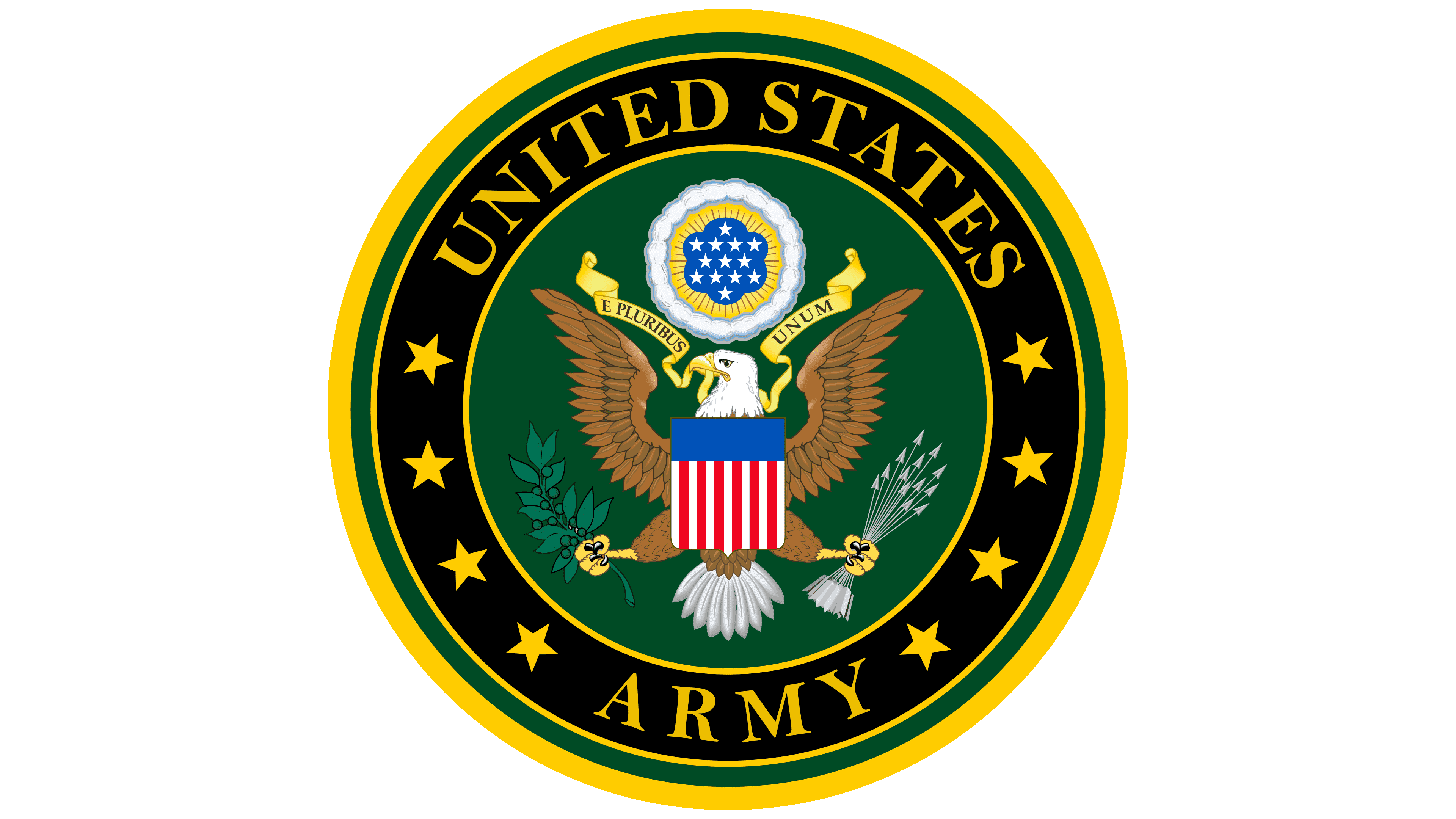
A key mark of the United States military, introduced in 1775, is the classic roundel, whose structure has been preserved for centuries. It consists of a central part surrounded by a circular line and a wide strip bearing an inscription listing the organizations and their founding years. In the middle of the seal is the country’s main historical figure, a national treasure: the bald eagle.
Its head faces left in profile. In the bird’s beak is a long fluttering ribbon of gold with the Latin inscription “E PLURIBUS UNUM.” The wings are wide open, as if showing the breadth of the protected area. Thirteen silver arrows and a laurel branch with leaves and fruit are clamped in the eagle’s powerful paws. Between them is the open tail of the formidable amulet of American lands.
On the bird’s body, below the line of the white head, the state flag is placed. Its wide blue stripe sits at the top, and the narrow white-and-red stripes at the bottom. The stars denoting the states are enclosed in a curly, flower-shaped circle and gathered above the eagle’s head. They sit against a blue background, surrounded by a golden space bordered in white.
All of these elements are underpinned by a green circle outlined in yellow. A wide black stripe follows it, bearing the words “United States” (above) and “Army” (below), separated by eight five-pointed stars, four on each side. Next comes a stroke, consisting of three lines, one thin (inner) and two middle (outer).
Font and Colors
Army symbols consist of the inherent signs of statehood. These are the bald eagle, the personification and mascot of the United States; a laurel branch; silver arrows; a flag; and five-pointed stars. The US Army logo features a single star with double edging and sharp beams.
The inscription uses the Machine Medium typeface. The graphic studio Ronne Bonder & Tom Carnase created it. The closest free font is the NFL Dolphins font.
The emblem’s signature palette matches the official army colors, including black, gold, and white. The logo is complemented by camouflage green.