


 USDA Logo PNG
The modern USDA logo reflects the scope of the organization. It symbolizes a healthy ecological environment and natural resources associated with cleanliness and freshness. In addition, the sign fosters trust and confidence in product safety among consumers.
The USDA was created on 15 May 1862, when Abraham Lincoln signed the law establishing the US Department of Agriculture during the Civil War. Farmers made up more than half of the country’s population, and Lincoln called the agency the “people’s department.” Its first commissioner was Isaac Newton, a Pennsylvania horticulturist and agronomist. The new office started with $80,000, six employees, seed distribution, and practical farm experiments.
In 1862, Lincoln also signed the Homestead Act and the Morrill Land-Grant Act, tying farming to settlement, education, and agricultural science. The department gained cabinet status in 1889 under Norman Coleman. Its food-safety role grew from the Division of Chemistry, led from 1883 by Harvey Wiley, whose research exposed adulteration, unsafe dyes, preservatives, and additives in food.
In 1906, after Upton Sinclair’s The Jungle revealed conditions in Chicago meatpacking plants, Theodore Roosevelt signed the Pure Food and Drugs Act and the Meat Inspection Act. Both were enforced through the Department of Agriculture. In 1930, the Division of Chemistry became the Food and Drug Administration.
During the Great Depression and the Dust Bowl, the USDA became central to farm policy. Under Henry Wallace, the 1933 Agricultural Adjustment Act paid farmers to reduce acreage, while the 1935 Soil Conservation Service responded to erosion across the Great Plains. In 1939, the first federal food-stamp program began in Rochester, was revived in 1961, made permanent in 1964, and renamed SNAP in 2008. In 2002, the USDA later added forest management, research stations, daily meat inspection, and USDA Organic labeling.
Meaning and History
The United States Department of Agriculture has created a system of symbols for its identification, including a logo and an official seal. They were introduced at different times and used for different purposes. For example, if the seal is affixed only to documents, a wordmark with a stylized image of nature can be reproduced across all media, including advertising materials. This is the basis of the unified USDA identity.
The most heavily used USDA symbol is the logo. It was created in 1995. It consists of two parts: a verbal sign and an abstract image of the soil, because the earth is the basis of all agriculture. As for the inscription, it is located at the top and contains only an abbreviation formed from the full name of the United States Department of Agriculture. All four letters are dark blue, uppercase, and have short, sharp serifs. The designers chose a contrasting typeface to create a visual dynamic.
What is USDA?
The United States Department of Agriculture (USDA), a division that controls the production and sale of agricultural products, is responsible for forestry development, the protection of natural resources, and the safety and availability of food for all, and enacts laws regarding commercial farming. Its main program is the Food and Nutrition Service. Predecessor: Agricultural Division.
But the soil landscape shown below has a clear rectangular shape. Although it is not solid, it is composed of geometric shapes of varying lengths and widths, including one large, deformed quadrangle and three tapering stripes. They are all dark green, while the background behind them is white.
Seal
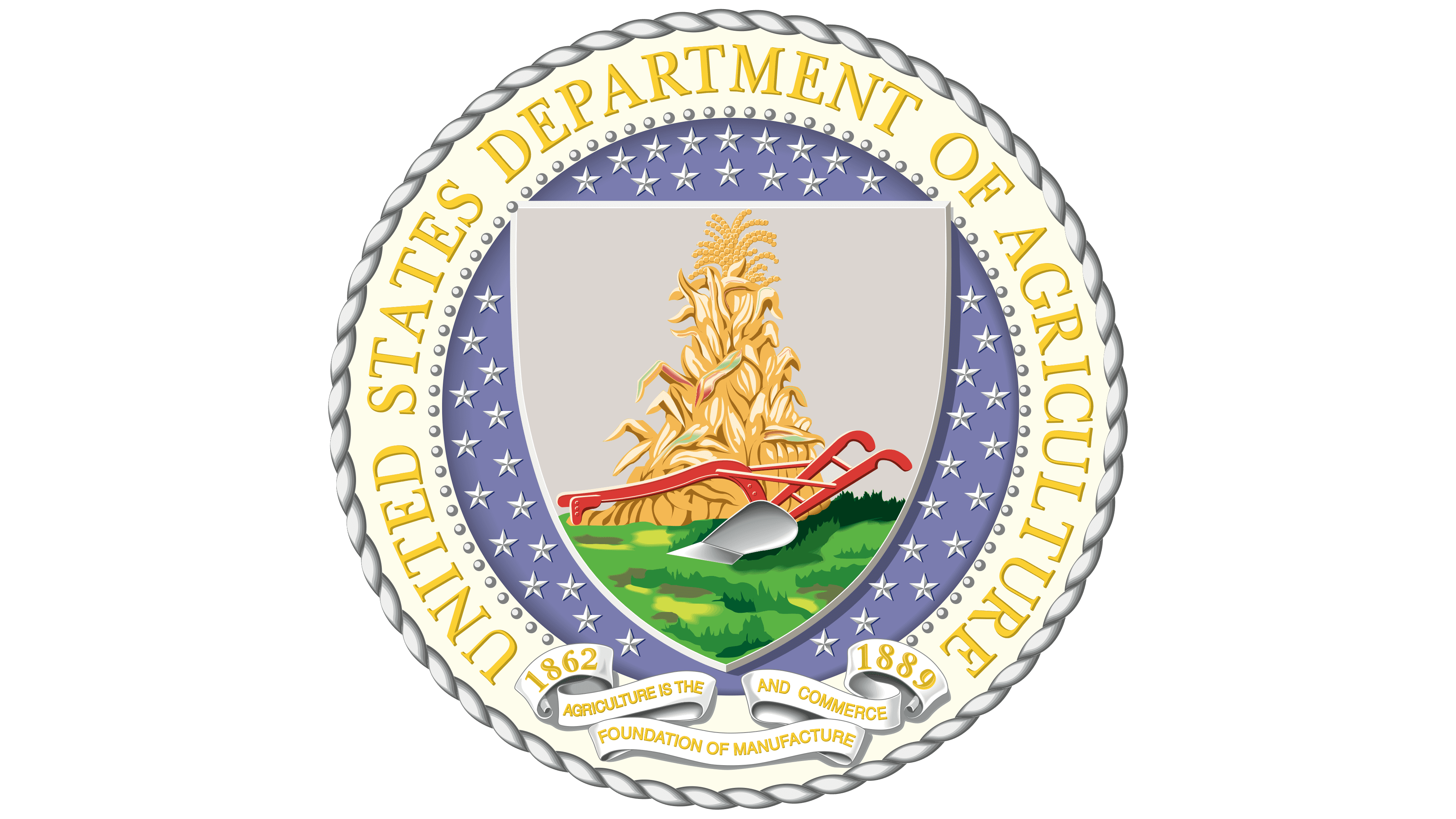
The department’s oldest symbol is the seal, which dates back to 1895. A year before its adoption, the United States Congress passed a law requiring the USDA to have a distinguishing mark. The then Secretary of Agriculture, J. Sterling Morton, was responsible for the identity. As a result, it was on his orders that the drawing proposed by A. H. Baldwin, one of the department’s employees, began to be used as the seal of the United States Department of Agriculture. And Bailey Banks & Biddle, a jewelry retailer, created a seal based on this design to certify documents.
Since then, all USDA legal records have been stamped with a round imprint reading “UNITED STATES DEPARTMENT OF AGRICULTURE.” In the modern version, the phrase is yellow. It is located inside a white ring with a gray twisted rope outline. At the bottom, on a long unfolded scroll, is another phrase in yellow: “1862 AGRICULTURE IS THE FOUNDATION OF MANUFACTURE AND COMMERCE 1889.” The first number indicates the year the department was established, and the second the year it was elevated to cabinet status.
The center of the seal now depicts a stack of corn stalks, although originally, it was occupied by sheaves of wheat. But the plow has not changed: it remains in the foreground. Both corn and an agricultural tool lie on the green grass. Behind them is a gray sky. The basis for this composition is a triangular armorial shield. He, in turn, is placed on a blue circle and surrounded by 44 five-pointed stars – the same number of states that were in the Union in 1889.
Both the seal and the USDA logo feature an image of green grass, which symbolizes fertile soil. They present the department as an organization that pays great attention to tradition, as evidenced by a hand plow. On the other hand, visual signs show the department’s desire to develop agriculture and to strive for a progressive future.
Font and Colors
The USDA’s motto, initials, and full name are written in a font similar to, but slightly modified from, Times New Roman. This is a serif with short, sharp serifs and great contrast between the main and additional strokes. The brand’s colors, dark green (#005440) and dark blue (#002D72), represent water, air, and earth. Their other shades are used in printing, along with yellow, gray, silver, red, and orange.