


 Adidas Logo PNG
The Adidas logo resembles climbing a set of steps, each one representing a new challenge for the athlete, and reaching the top requires hard work and the right gear. This variety in clothing and footwear is exactly what the brand offers to those who strive upward.
Adidas traces its roots to the early 1920s in Herzogenaurach, where Adolf Dassler began making sports shoes in his mother’s laundry using improvised materials. In 1924, he partnered with his brother Rudolf to form Gebrüder Dassler Schuhfabrik. The first major recognition came in 1936, when Jesse Owens won four Olympic gold medals in Dassler shoes, bringing the brand global attention.
The brothers split in 1948, with Rudolf founding Puma. Adolf registered Adidas on August 18, 1949, introducing the three-stripe design as both functional support and brand marker. In 1954, West Germany won the World Cup in Adidas boots with screw-in studs, defeating Hungary in what became known as the “Miracle of Bern.”
During the 1960s, Adidas expanded into apparel and equipment, including the Telstar ball for the 1970 World Cup. In 1972, the trefoil logo appeared, and the brand outfitted many athletes at the Munich Olympics.
After Adolf died in 1978, his son Horst took over. In 1986, Run-DMC released “My Adidas,” which led to a landmark endorsement deal and linked the brand to hip-hop culture. Financial strain followed Horst’s death in 1987, and in 1990 Bernard Tapie acquired the company.
Under CEO Robert Louis-Dreyfus, starting in 1993, Adidas restructured and returned to growth, competing directly with Nike. The company acquired Salomon in 1997 and sold it in 2005, then bought Reebok in 2006 to strengthen its position in the US market.
In 2015, the Yeezy line with Kanye West became a major commercial success, though the partnership ended in 2022 amid public controversy and resulted in financial losses.
Meaning and History
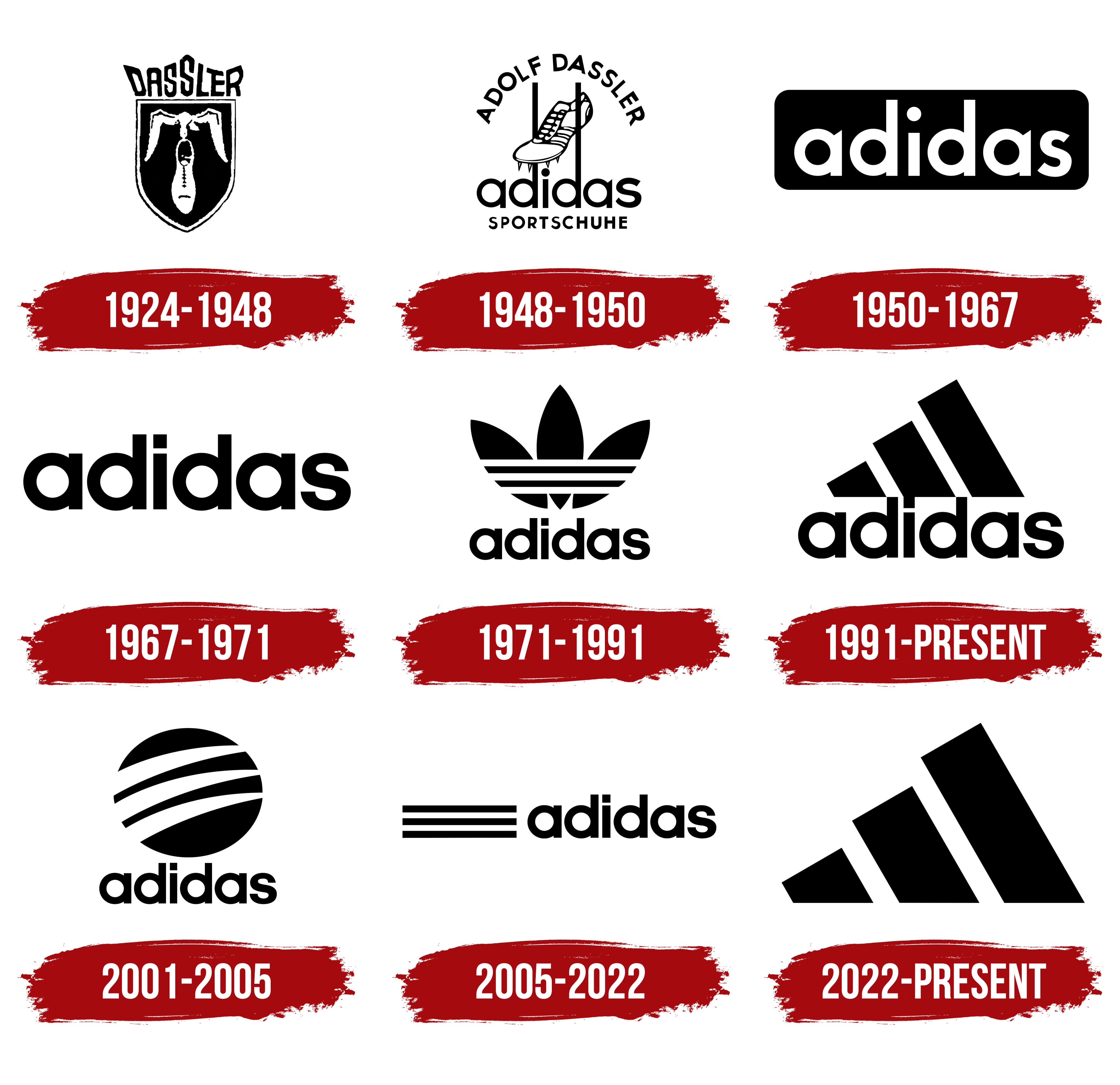
Unlike other global companies that prefer a thoughtful, philosophical approach to designing their symbols, Adidas’s choice is practical and somewhat banal. The company was named after the founder: Adi (Adolf) + Das (a derogatory term). However, the graphic image remains complex and has evolved over the years.
What is Adidas?
It is a German company with headquarters in Herzogenaurach, Germany. It develops and produces sports clothing and footwear. Adolf Dassler founded the brand in 1924, and his brother Rudolf later joined. Initially, the company was called Gebrüder Dassler Schuhfabrik (Dassler Brothers Shoe Factory), but after a dispute between the founders, it took its current name.
1924 – 1948
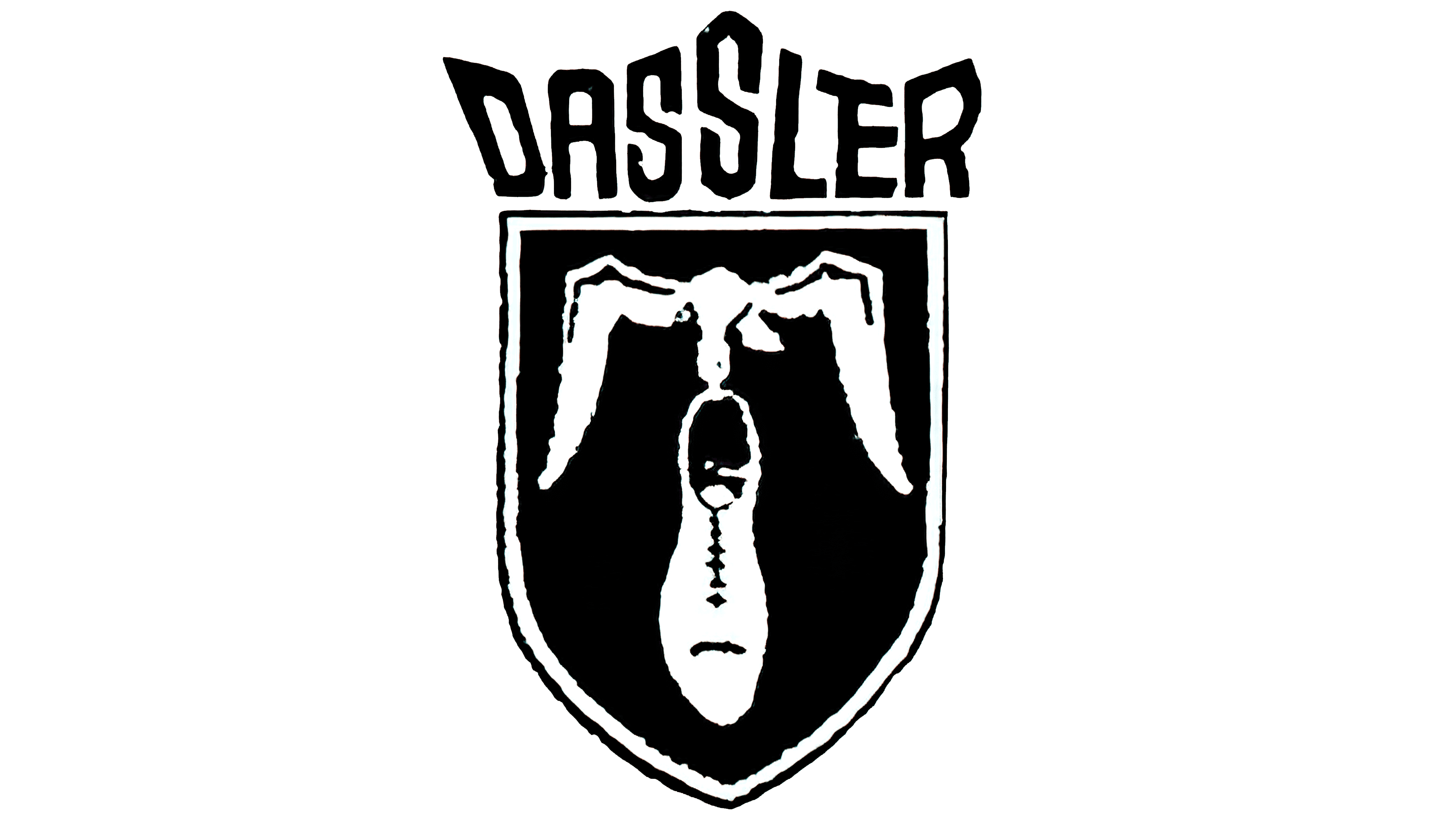
The history of one of the earliest Dassler brand logos dates back to early twentieth-century Germany, when brothers Adolf and Rudolf Dassler were just beginning their journey in the footwear business. In 1924, they launched shoe production under the name Gebrüder Dassler Schuhfabrik. That’s when the original mark appeared, paving the way for two global giants: Adidas and Puma.
The earliest Dassler emblem stands out for its unusual presentation. At the top, the word DASSLER is in large letters. It is rendered in a decorative typeface in the spirit of constructivism, echoing the well-known Futura style and Bauhaus heritage. The letters vary slightly in height and resemble a crown above a shield, emphasizing its connection to the prewar period of design experimentation.
The shield below is black with a white outline along the edge. At the center of the emblem, a seagull holds a man’s shoe in its beak. The bird’s silhouette flows into an elongated shoe form, with visible lacing details and a downward-pointing toe. The bird and shoe lines combine to form an image associated with sport, speed, and lightness, evoking mythological allusions.
Despite its simplicity, the logo conveys the brand’s core message: a focus on sport, a direct link to footwear, and lightness and comfort. This mark became the starting point for Adidas and Puma, which later grew out of a single small shoe factory founded by the Dassler brothers.
1948 – 1950
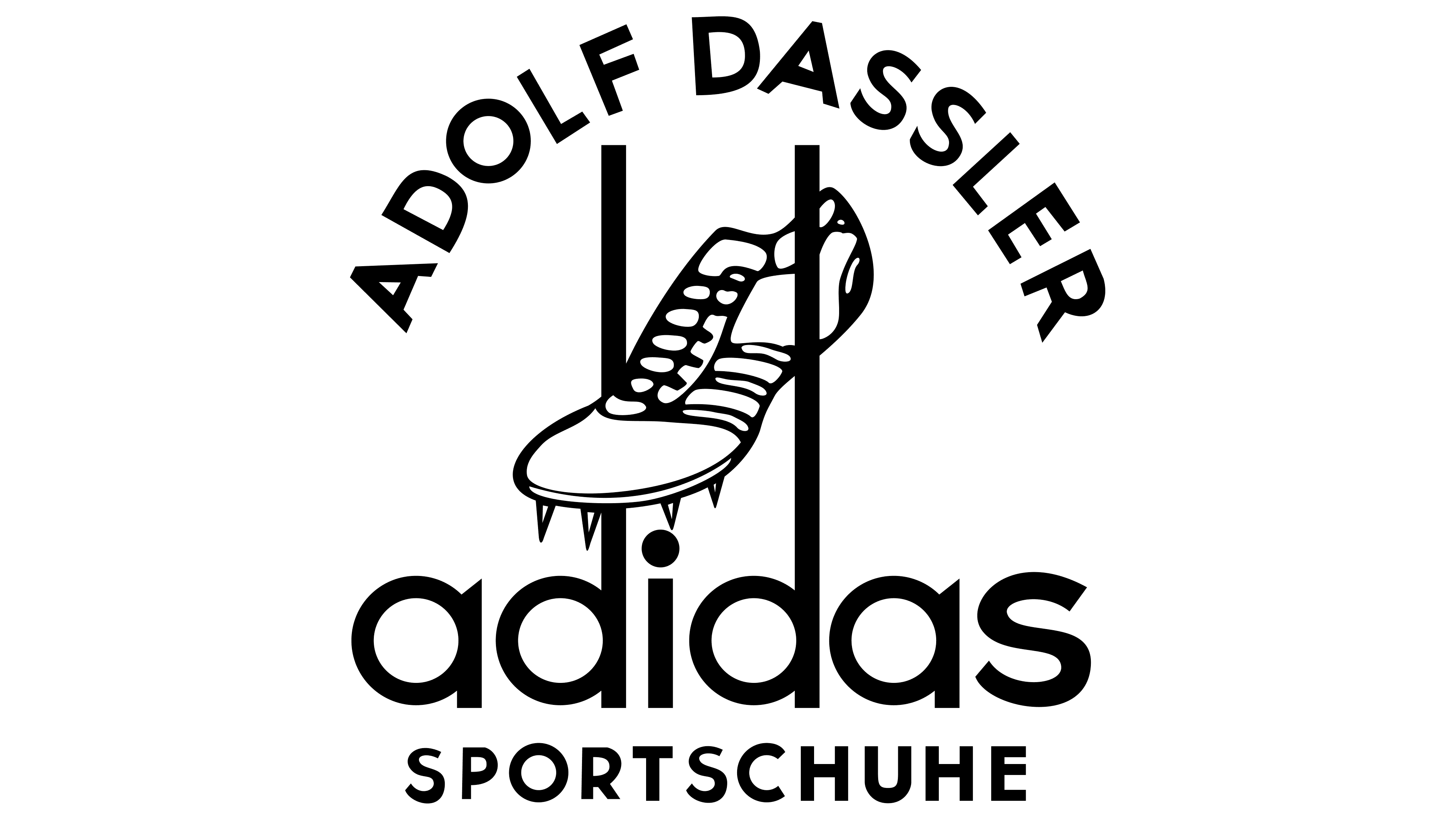
When Adolf Dassler launched Adidas in 1949, he focused the logo on name recognition and a connection to sport. The first official brand emblem clearly expressed this idea. At the top, the owner’s name, ADOLF DASSLER, is inscribed in a semicircle in large black capital letters. The design uses a strict sans-serif typeface, similar to period grotesques such as Futura or Avenir.
At the center of the composition sits a track spike shoe. Its silhouette is diagonal, with the toe pointing downward and the heel pointing upward. The shoe passes through two parallel vertical lines that extend downward and form the letter d in the word adidas below.
The brand name is written in lowercase letters using a rounded, wide typeface. At the bottom of the logo, the word SPORTSCHUHE appears in capital letters, indicating sports footwear, in a restrained sans-serif font.
The emblem highlights Adidas’s connection to sport, especially track and field, where the company’s history began. The vertical lines, reminiscent of soccer goalposts, and the bold silhouette of the spikes convey athletic activity and high-level sport.
Before founding Adidas, Adolf and his brother Rudolf jointly ran the shoe factory established in 1924. After a split in views in 1948, Rudolf opened Puma, while Adolf registered Adidas a year later. The first logo reflected the founder’s intent to establish the Dassler name in the sporting world and to mark a new stage in his professional activity.
1950 – 1967

In 1950, Adidas changed its visual identity, shifting focus from familiar symbols to a typographic approach. The entire logo composition consisted of the white word adidas set on a black rectangle with softly rounded corners. The designers placed the brand name against a black background, allowing it to stand out more clearly.
The brand name was set in a simple sans-serif typeface. The letters are lowercase and slightly bold.
1967 – 1971

On November 19, 1967, Adidas introduced a new logo developed by the MCKL studio based on the Adineue Pro Bold typeface. The brand name, previously white on a dark background, was changed to black, and the background was removed. The typeface is sans-serif, lowercase, and bold.
The typeface resembles the previous version but includes some modifications. For example, the dot above the letter i was replaced with a square.
This typeface was used for specific product lines, namely Essentials and Neo. Both lines were part of the Originals and Performance collections until 2022, when they were merged into the shared Adidas Sportswear collection.
1971 – 1991

In the spring of 1971, the brand introduced a completely new logo version developed by Horst Dassler, the founder’s son. The updated symbol was presented ahead of the Munich Olympic Games. With this step, the company aimed to demonstrate its intent to move beyond the traditional footwear industry and to establish itself in apparel and equipment.
The emblem is designed as a three-leaf clover pierced by three horizontal stripes. Each leaf points upward, with the middle one higher than the others, while the left and right leaves spread outward. The three lines cross the symbol horizontally, slightly below the center.
The brand name placed beneath the clover was retained from the 1967 logo, lowercase black letters set in the Adineue Pro Bold sans-serif typeface.
The three stripes trace back to the Finnish brand Karhu. The Finnish company already had a similar symbol, which Adidas purchased in advance for $1,800 and 2 bottles of whiskey to avoid a copyright dispute. The new mark’s meaning lies in the company’s geographic reach. The three leaves symbolize continents. One unites North and South America, the second covers Europe and Africa, and the third represents Asia.
Since 2001, the clover logo has reappeared in the Adidas Originals line, highlighting the products’ classic style.
1991 – today

In October 1991, designer Peter Moore developed a new Adidas symbol and introduced it as the mark for the Equipment sports line. Until 1996, Adidas used two logos in parallel: the mountain for Equipment and the trefoil as the general corporate symbol. On January 1, 1996, the mountain image replaced the trefoil as the company’s primary mark.
The emblem consists of three slanted black rectangles arranged at an angle to form a pyramidal figure. Each rectangle resembles a parallelogram and is evenly spaced. The lines lean slightly to the left, suggesting an ascent along a slope or staircase and evoking associations with overcoming obstacles and sport.
Below the symbol, the adidas wordmark in lowercase letters was retained, unchanged since 1967, and set in the Adineue Pro Bold typeface. The company name remains at the bottom of the composition, balancing the black elements above it.
After the brand dropped the Equipment name in 1998, it used the symbol within the Adidas Performance line until it replaced it in 2022 with the new Adidas Sportswear collection. The latter continued the Neo and Essentials lines, which had previously relied exclusively on the text-based brand mark.
Despite criticism of the Adidas emblem’s minimalist design, the company ultimately affirmed this identity, emphasizing the brand’s sporting philosophy and its drive to move forward and grow.
2001 – 2005

In the early 2000s, the company moved toward high fashion, leading to the launch of Adidas Style. The collection’s symbol became a logo featuring three white stripes on a round black background. It was developed in collaboration with iconic designers.
On the emblem, three white stripes curve smoothly, cross the black sphere diagonally, and end in pointed edges. Because of their unusual shape, they are often compared to a predator’s claw marks. The adidas wordmark below remained unchanged, preserving continuity with other brand versions.
The Adidas Style logo adorned the exclusive Y-3 line created by renowned designer Yohji Yamamoto. He skillfully combined the brand’s sports aesthetic with the refined language of high fashion, while the emblem highlighted the collection’s prestige and uniqueness. The SLVR line followed a similar visual approach, focusing on minimalist clothing for everyday wear.
2005 – 2022

In 2005, Adidas introduced a new umbrella logo that emphasized brand unity with a simple, refined image. On the left are three black stripes broken by two white ones. All of them run parallel, are equal in width, and are neatly separated vertically.
Next to the symbol appears the Adidas wordmark, rendered in the company’s classic Adineue Pro Bold typeface.
During this period, the new emblem served as the company’s main symbol, bringing its many products and collections together under a single image.
2022 – today

In 2022, Adidas Performance removed the wordmark from the logo, keeping only the mountain symbol, first introduced in 1991. The symbol became a standalone mark without any lettering.
The mountain-like figure consists of three wide stripes that gradually rise upward and lean slightly to the left. The stripes differ in length, with the right one being the longest and the left one the shortest. The text was removed, leaving the symbol wordless. The mountain now serves as the primary mark of Adidas Performance, highlighting the line’s athletic focus.
Font and Colors

Adidas’ iconic three stripes brought the brand fame. Moreover, they exist in four versions, which have been equally frequently used over the past decades:
- A black clover with three white lines.
- Three wide diagonal quadrilaterals are tilted to the left.
- A circle with uneven arc-shaped breaks.
- Thin horizontal stripes.
All these are recognizable trademarks that distinguish Adidas products from other sports goods.

All manufacturers’ logos display their names in lowercase letters. Designers chose the TeX Gyre Adventor font, developed by GUST Printing. It is a typical geometric sans-serif with rounded elements and rectangular strokes.
The color palette is limited to a classic combination of black (for graphic elements and inscriptions) and white (for intra-letter spaces, lines inside the circle/triangle, and the background).