


 L’Oréal Logo PNG
The modern, simple, minimalist L’Oréal logo carries deep symbolism. The elegant font reflects balance, subtle style, true beauty, naturalness, and purity, as well as the brand’s identity and product characteristics.
L’Oréal’s history begins in 1907, when Eugène Schueller developed a synthetic hair dye called Auréale in Paris. He produced it himself and sold it to local hairdressers. In 1909, he founded Société Française de Teintures Inoffensives pour Cheveux and, by 1910, had registered the name L’Oréal and was already working with hundreds of salons.
In 1920, Schueller launched the magazine Votre Beauté and actively used new advertising formats, including radio. In 1934, the company introduced Dop, one of the first mass-market synthetic shampoos, expanding beyond professional clients and entering the consumer retail market.
After Schueller died in 1957, François Dalle took the helm and shifted the company toward growth through acquisitions. In 1964, L’Oréal acquired Lancôme, entering the premium segment. It later acquired Garnier in 1970 and Biotherm in 1973, broadening the portfolio across price levels.
In 1979, the L’Oréal Paris slogan “Because I’m Worth It” appeared, changing the tone of advertising. In 1988, the company acquired Helena Rubinstein, and in 1996, purchased Maybelline New York for $758 million, strengthening its position in the United States and competing with Procter & Gamble.
In 2006, L’Oréal acquired The Body Shop for £652 million and later sold it to Natura in 2017. In 2014, the company exchanged its Nestlé stake for a stake in Galderma, shifting toward dermatology and medical skincare.
Meaning and History
The company’s career takeoff began with the opening of the young chemist Eugène Schueller. He offered Parisian hairdressers the opportunity to dye hair with his scientific development of a unique dye called Auréale. From the start, the company moved in an innovative direction.
The L’Oréal logo is not an image or a symbol but merely a wordmark. Therefore, its appearance and writing style are crucial to maintaining the trademark’s visual identity. All letters in the company’s name are written in uppercase, but it comes in two versions: one with a larger “L” and one with a larger “O.” There is also a version made with small symbols. By varying their sizes, designers could follow grammatical rules while emphasizing the brand’s individuality.
In 1973, the cosmetic brand adopted a slogan that was reflected in certain versions of its logo. The phrase “Because I’m worth it” was proposed by 23-year-old editor Ilon Specht from McCann Erickson. It significantly increased the company’s popularity and attracted many customers.
What is L’Oréal?
It’s a French company that produces cosmetics and perfumes. Pharmacist Eugene Paul Louis Schueller founded it in 1909 after developing his hair dye formula. Later, the range expanded as the organization conducted constant beauty research. L’Oréal’s headquarters is located in the commune of Clichy near Paris.
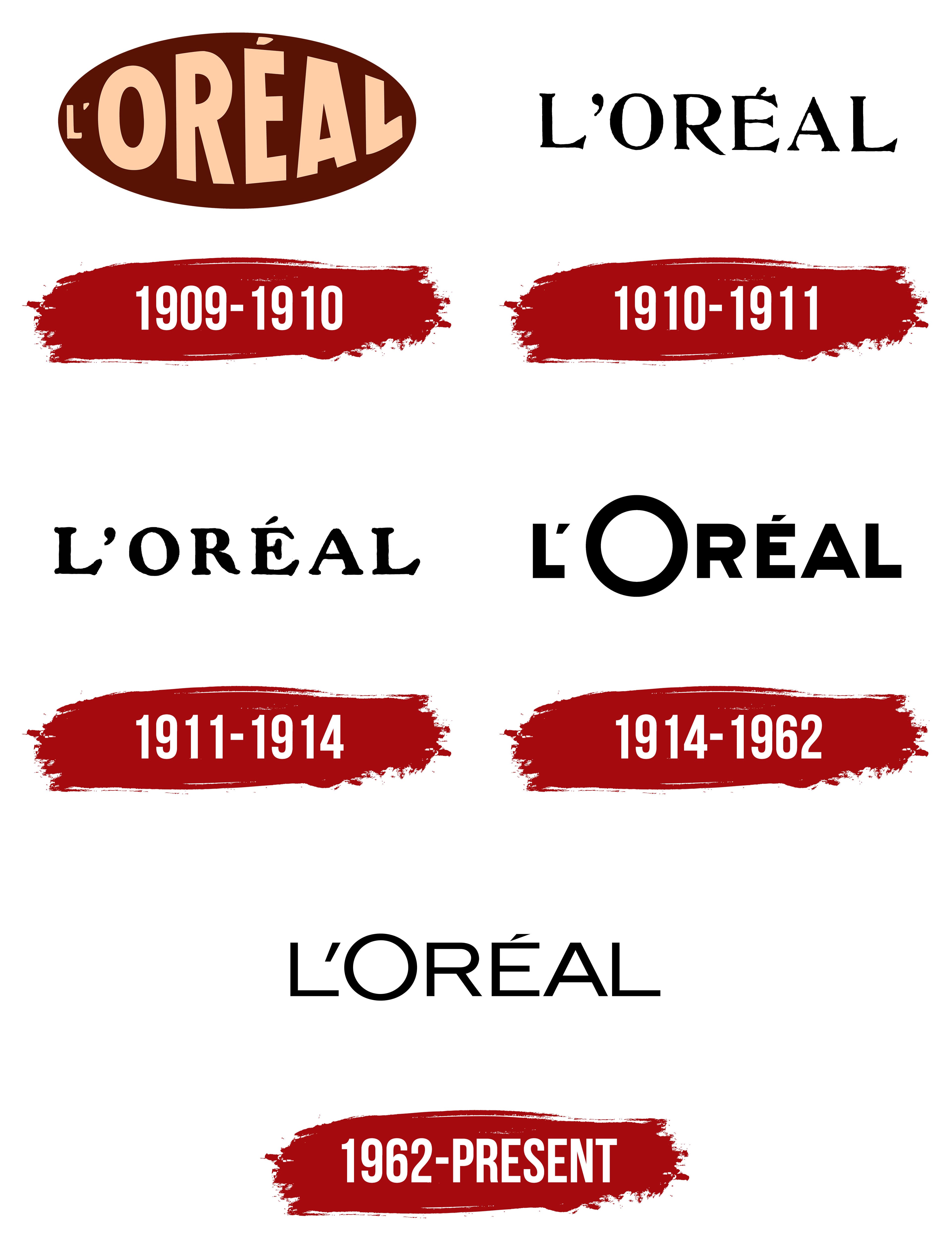
1909 – 1910
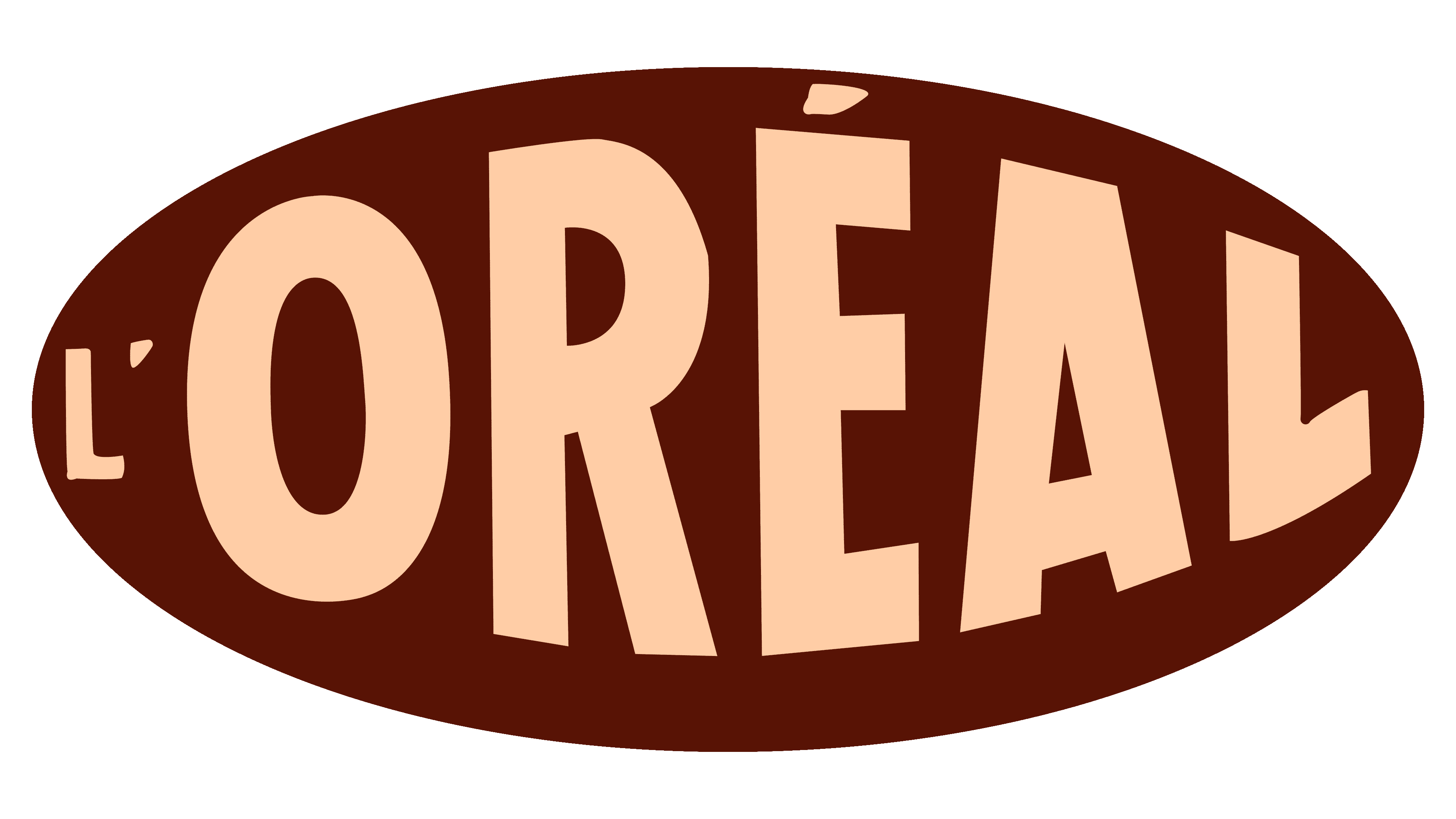
In the original logo, the word “L’Oreal” appears in a brown oval with beige letters, reminiscent of powder or foundation. The first letter, “L,” is tiny and inconspicuous. The inscription is evenly spaced throughout the oval.
1910 – 1911
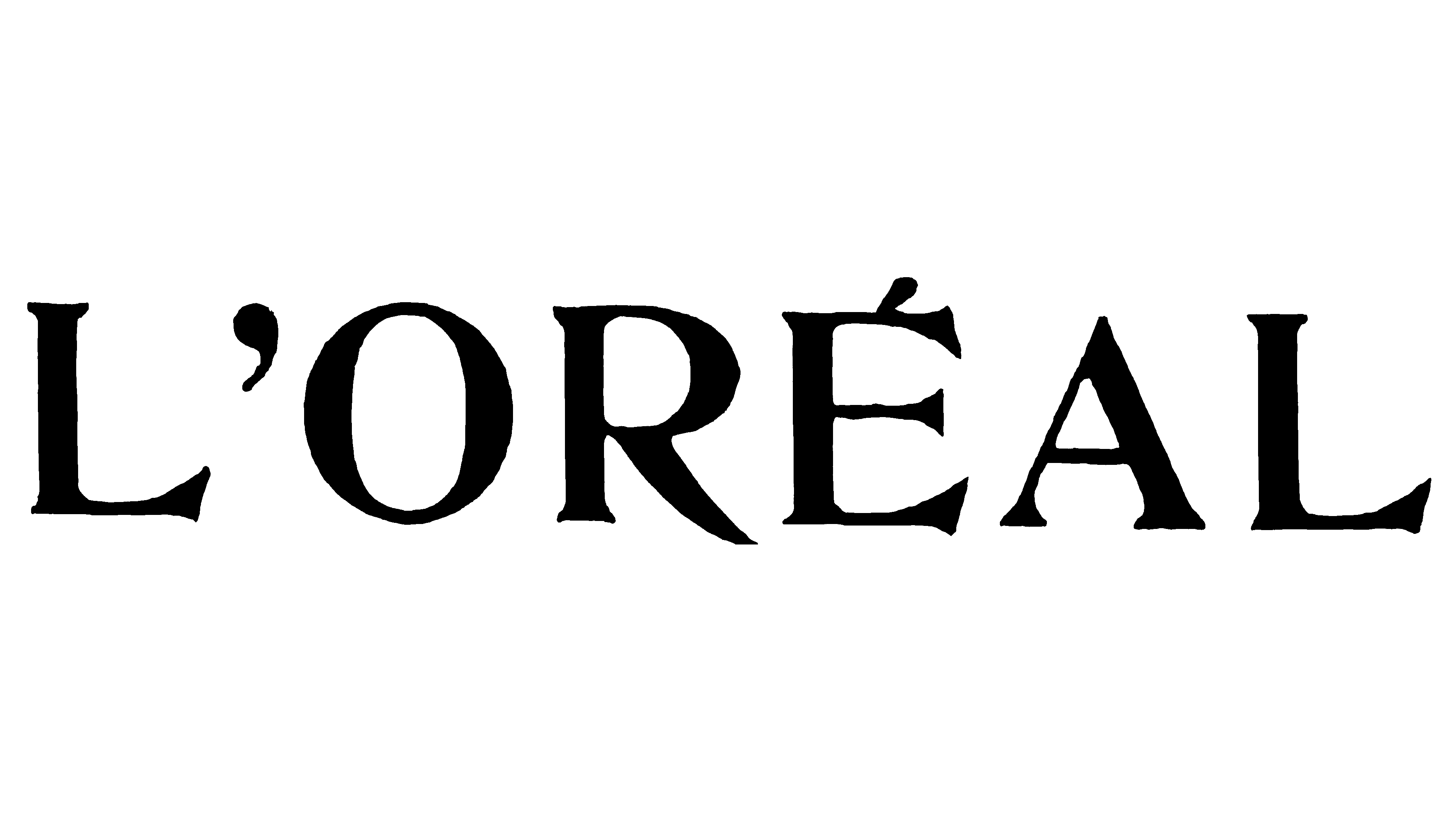
A year after its founding, L’Oréal adopted a simple logo with black lettering on a white background. It read “L’ORÉAL” in uppercase. It looked unusual because of the contrasting geometric font with thin serifs. The most non-standard was the letter “R,” which extended beyond the right leg line.
1911 – 1914
After the redesign, the font changed. The letters became rounder and bolder. At the same time, their edges blurred, partly because of rounded corners. Designers shortened the protruding leg of “R” to align the inscription horizontally.
1914 – 1962
In 1914, the L’Oréal logo changed again. Maintaining the general concept (black inscription on a white background), the developers replaced the contrasting serif font with a bold sans-serif font. At the same time, they shortened the accent mark above “É” and the apostrophe after “L,” turning them into small skewed trapezoids. The main feature was the letter “O,” which became a large, perfectly round ring.
1962 – today
The updated wordmark uses a simple, legible, expressive font. It has no serifs, and the letter “O” is larger than the rest, though all letters are uppercase. The primary color is traditionally black, with a white background.
Font and Colors
Its concision makes the brand’s symbolism recognizable and universal, making it suitable for both advertising and commercial purposes. The emblem looks equally good on product labels and on official stationery and documents. The logo is often supplemented with the words “Professionnel” or “Paris.” The first is placed at the bottom; the second is centered, under or on the leg of the last letter, “L.”
The color palette features a classic combination of light and dark tones. In the corporate version, the background is black, and the official label is white, resembling a film negative. However, the opposite arrangement is also acceptable. This elegant combination symbolizes innate style sense, as well as purity (white) and mystery (black). The logo can also be done in other palettes, depending on the adaptation. But most often, it’s dark maroon and shades of gold, sometimes with a 3D effect.
At the dawn of its career, the perfume and cosmetics company used a logo featuring a unique hand-drawn font with large letters of varying sizes. The central symbols were the largest, the outer ones the smallest. The modern version is a smooth, grotesque sans-serif font. The color palette is restrained and monochrome, with black letters on a white background.
FAQ
What does the L’Oréal logo mean?
At first glance, L’Oréal’s logo is very simple, with no hidden meanings, as it contains only the brand name. But even this minimalist design has special significance: the elegant letters symbolize balance, style, and true beauty that lies in simplicity. Black embodies mysticism, and white represents naturalness and purity.
What does the L’Oréal logo represent?
The logo contains only the inscription “L’ORÉAL.” The text is set in a black sans-serif font. All strokes are approximately the same thickness. The letters are uppercase, with the letter “O” slightly enlarged. The company name may be complemented by the words “Paris” or “Professionnel,” but these are not part of the main variant.