


 ANZ Logo PNG
“With our bank, the road is easy and straight. We comply with all laws. If your money goes through our system, all you have to do is reach out and make a profit,” says the ANZ logo. The emblem’s symbols and colors encourage trust and cooperation.
ANZ traces its origins to 1835, when the Bank of Australasia was founded in London. On December 14, 1835, it opened in Sydney, later absorbing Cornwall Bank in 1836 and expanding into Tasmania. In 1837, George Fife Angas established the Union Bank of Australia. It entered New Zealand in 1840. Both banks financed colonial trade and survived the 1841-1843 crisis.
A third institution, the English, Scottish and Australian Bank, formed in 1852, expanded through acquisitions, including the Commercial Bank of Tasmania in 1921 and the Royal Bank of Australia in 1927. On October 1, 1951, the Bank of Australasia and the Union Bank merged to form Australia and New Zealand Bank Limited. The deal aimed to strengthen their position against the Bank of New South Wales.
In 1970, ANZ merged with ES&A to form Australia and New Zealand Banking Group Limited. In 1976, the headquarters moved from London to Melbourne, reflecting a regional shift. Expansion continued through acquisitions. In 1979, ANZ absorbed Bank of Adelaide. In 1984, it acquired Grindlays Bank, expanding into 40 countries.
In 1989, ANZ acquired PostBank of New Zealand, making it a leading bank in New Zealand. Regulators blocked a proposed merger with National Australia Bank. In 2002, ANZ partnered with ING Group. In 2003, it acquired the National Bank of New Zealand for NZD 4.9 billion. Between 2009 and 2010, it purchased assets from the Royal Bank of Scotland across Asia. In 2022, ANZ announced the acquisition of Suncorp Bank, which was completed in 2024.
Meaning and History
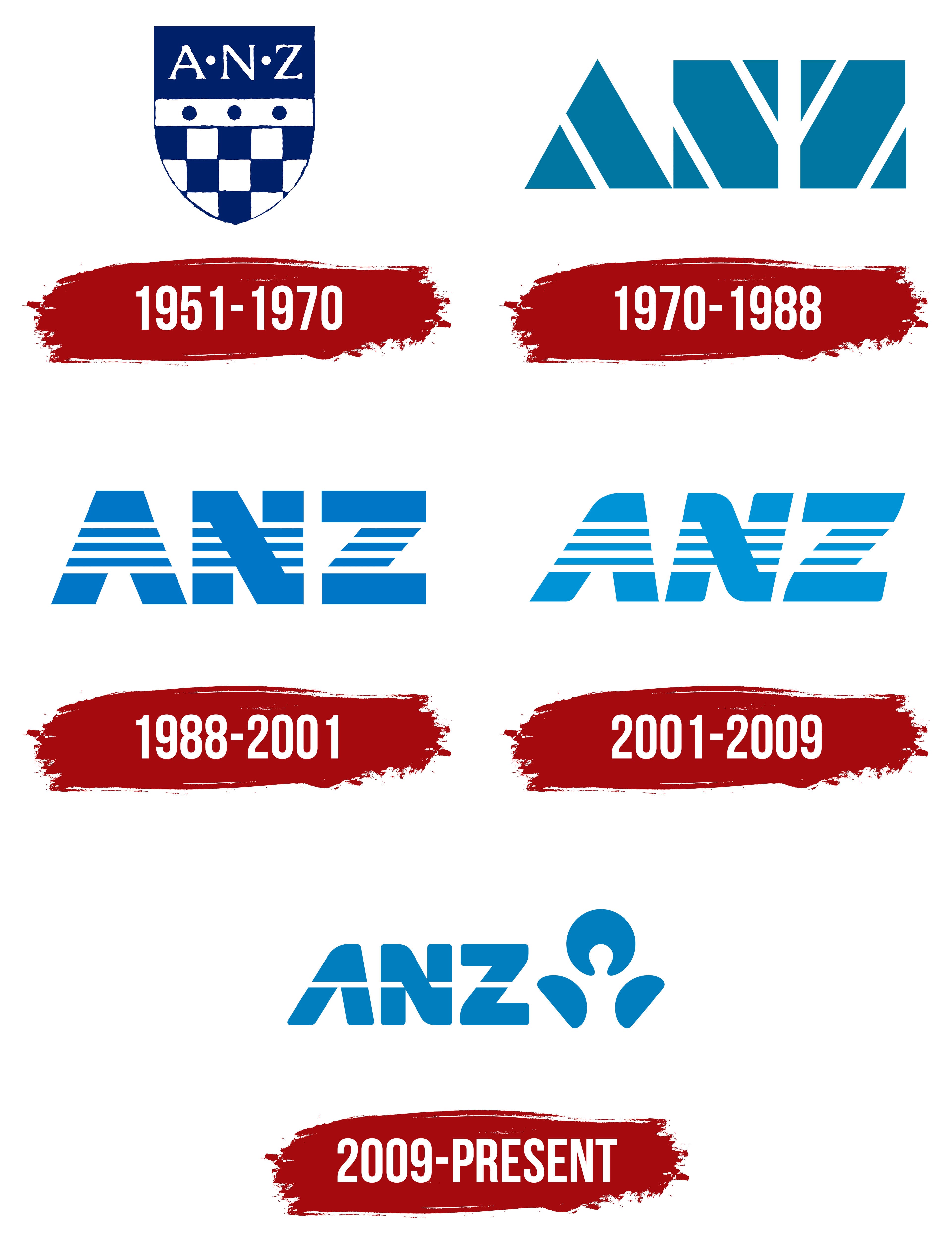
Based on the companies that founded ANZ, its roots go back far. The Bank of Australasia was established in 1835 and subsequently merged with another specialized institution, the Cornwall Bank, formed in Launceston (Van Diemen’s Land) in 1828. A group of individuals led by banker George Fife Angas founded Union Bank of Australia. Several significant mergers followed, shaping the structure of modern financial services and their logos.
At first, the company operated in Europe, and in the late 70s of the last century, it transferred its registration from the UK to Australia. It is now an extensive international banking organization. It has many subsidiaries operating in 34 countries and serving nearly 10 million people worldwide. In Australia, the bank has 570 branches with 6 million clients.
Each major stage of ANZ’s work was reflected in changes to its identity. This financial institution changed its official attributes four times. In total, it has five logos.
What is ANZ?
It’s the shortened name of Australia and New Zealand Banking Group, a large financial institution headquartered in Melbourne. ANZ’s history dates back to 1835, when the Bank of Australasia was founded. The official founding date was October 1, 1970, when several influential banking structures merged.
1951 – 1970

The debut emblem was created when two major banks merged to form ANZ. A classic shield was taken as a basis – wide at the top and narrow at the bottom. The developers have divided it into three parts. The upper segment contained an abbreviation of the bank’s full name. Thin white serifs sat against a wide blue stripe. The middle part was divided and included a thin white line with three round signs. The bottom was designed like a chessboard, with alternating blue and white squares.
1970 – 1988

In 1970, the bank redesigned its logo, opting for a visually complex but progressive design. The new concept was minimalism: the designers discarded unnecessary details and focused only on the service name. As a result, the emblem became three large geometric shapes: the triangle stood for “A,” and the vertical rectangles for “N” and “Z.” Its design was unique because it consisted of mini-elements. The first letter used a triangle and a trapezoid; the other two used triangles and mirror-reversed rhombuses. White diagonal lines separated them.
1988 – 2001

After the redesign, the inscription “ANZ” became more readable because the bank’s management abandoned the version with huge geometric shapes. In the updated emblem, the letters’ centers were linear: an alternating pattern of four white and three blue stripes of equal width. But the signs themselves remained massive, featuring rectangles, squares, and smaller triangles. The palette also changed: instead of sea green, they used cobalt.
2001 – 2009

The developers revised the bank’s identity again and offered a slightly corrected version of the old logo. It got a heavenly shade and cursive letters. They rounded some corners to convey reliability and customer loyalty.
2009 – today

The number of lanes was reduced from four to one. Although the italics are gone, the rounded corners remain. The color also remained the same. However, the designers also placed an innovation icon to the right of the bank’s name. It is an abstract graphic element. A person and a flower are intertwined simultaneously. That is, a flourishing bank user. It contains upward growth dynamics. Half-discs sit on the left and right; above them is an open circle with a white center. All elements are colored blue.
Font and Colors

The symbols of this banking institution varied from simple to complex. If the logo had only one element, it would have two: a name and a personal sign. But the color scheme remained consistent from emblem to emblem. It was always blue; only the shades varied. The emblem, made of large geometric shapes stylized as letters, looks especially futuristic. Trapezoids, elongated rhombuses, and two types of triangles were originally composed of letters.

Despite the text’s presence, we cannot speak of a standard font here, as the inscription uses an individual typeface stylized with strict geometric symbols. The sans-Serif font is used for clear inscriptions. Moreover, modern letters have never had serifs, and the abbreviation itself is in uppercase. The color scheme consists only of blue in several variations, from emerald to heavenly.
FAQ
What is the slogan of ANZ Bank?
The bank’s slogan is “Tenacious of Purpose.” The bank adopted this phrase, translated from Latin, as the family motto of its first chairman, Sir Geoffrey Gibbs.
“Tenacious of Purpose” reflects ANZ Bank’s commitment to determination and perseverance. It signifies the bank’s dedication to its mission and relentless pursuit of excellence in serving customers and stakeholders.
Is ANZ a bank name?
Yes, it is a bank name. It is one of the largest banks in Australia and New Zealand. It offers a range of financial services, including banking, lending, and investment products. The name is well recognized and trusted, reflecting a long history of service and reliability in both countries.
What does the ANZ symbol mean?
The ANZ symbol is meaningful and conveys the brand’s core values and focus areas. The logo’s three-part design stands for the key regions where the company operates: Asia Pacific, New Zealand, and Australia. These regions are important to the brand’s identity and business strategy, showing its wide reach and influence.
The negative space within the logo forms a human silhouette. This silhouette strongly represents the bank’s employees and customers. It shows that people are central to the brand’s work, highlighting the importance of human connections and the bank’s role in serving and supporting its community.
The floral shape in the design symbolizes growth and prosperity. It signifies that the brand is focused on providing financial services and fostering development and success for its customers and stakeholders.
What is the font of the ANZ logo?
The ANZ logo uses a unique, custom-made font. The designers created a special set of glyphs to make the logo stand out and represent the brand’s identity. They used a bold, uncontrasted sans-serif font as the base, giving the logo a clean, modern look.
The letters’ corners are rounded, softening the brand’s image and making it more approachable. Each letter is divided in half with horizontal stripes, adding a striking visual effect and depth.
The letter “A” has a particularly unique style. It has no horizontal bar and a slight italic slant, making it stand out. This choice sets the brand apart, giving the logo a distinctive, memorable look.
What does the ANZ logo mean?
The ANZ logo carries important meanings that reflect the brand’s values and operations.
The three parts of the logo represent the brand’s main operating regions: Asia Pacific, New Zealand, and Australia. These regions are central to the company’s strategy and identity. The logo features a human silhouette, highlighting the importance of the brand’s employees and customers. The flower shape in the logo stands for growth and well-being.
The logo represents the brand’s dedication to its key regions, focus on people, and commitment to growth and prosperity.