


 Deloitte Logo PNG
The Deloitte logo looks stark, emphasizing the seriousness of its consulting and auditing services. At the same time, a small, bright accent highlights the brand’s personality and sets it apart from competitors. This dual emblem is ideal for representing the “big four” audit companies.
Deloitte began on April 23, 1845, when William Welch Deloitte opened an accounting office on Basinghall Street in London. In 1849, Great Western Railway hired him after its shares fell, making him the first independent auditor of a public company. The firm grew with British industry, serving docks, insurers, and merchant banks. In 1890, Deloitte opened its first overseas office on Wall Street, followed by Chicago and Buenos Aires.
Other roots formed in the United States. In 1896, Charles Waldo Haskins and Elijah Watt Sells founded Haskins & Sells in New York. Another line came through George Touche, who qualified as an accountant in Edinburgh in 1883, moved to New York in 1900, and later helped form what became Touche, Niven, Bailey and Smart in 1947.
In 1952, Deloitte, Plender, Griffiths & Co. merged with Haskins & Sells to form Deloitte Haskins & Sells. Nobuzo Tohmatsu later established the Japanese branch, founding Tohmatsu & Co. in 1968. It joined Touche Ross International in 1975. By the 1980s, Deloitte competed within the Big Eight against firms such as Price Waterhouse and Ernst & Whinney.
In 1989, Deloitte Haskins & Sells and Touche Ross merged in the US as Deloitte & Touche, helping turn the Big Eight into the Big Six. Some international Deloitte partners, including the British firm, instead joined Coopers & Lybrand, which later merged with PwC. In 1993, the global network became Deloitte Touche Tohmatsu, later shortened to Deloitte. After Arthur Andersen collapsed amid the Enron scandal in 2002, Deloitte absorbed its British unit and several other practices. In 2013, Deloitte bought Monitor Group, expanding its consulting operations.
Meaning and History
Corporate identity plays a crucial role in a business’s development. Today, it is impossible to imagine a successful company without specialists in corporate design, outdoor advertising, and public relations. Together, these elements create a complete brand image in the market for goods and services, making it recognizable and increasing consumer demand as it approaches potential clients.
Depending on the tasks set for the company’s management, the original name and logo can be strongly transformed under the influence of such factors as the difficulty of selling products on the market under the wrong brand name, the lack of associations with the proposed product and its scope of application, and the inability to convey the idea, mission, and values of the brand through the created logo.
What is Deloitte?
Deloitte is one of the “Big Four” consulting and auditing firms. Its full name is Deloitte Touche Tohmatsu Limited.
1960 – 1989
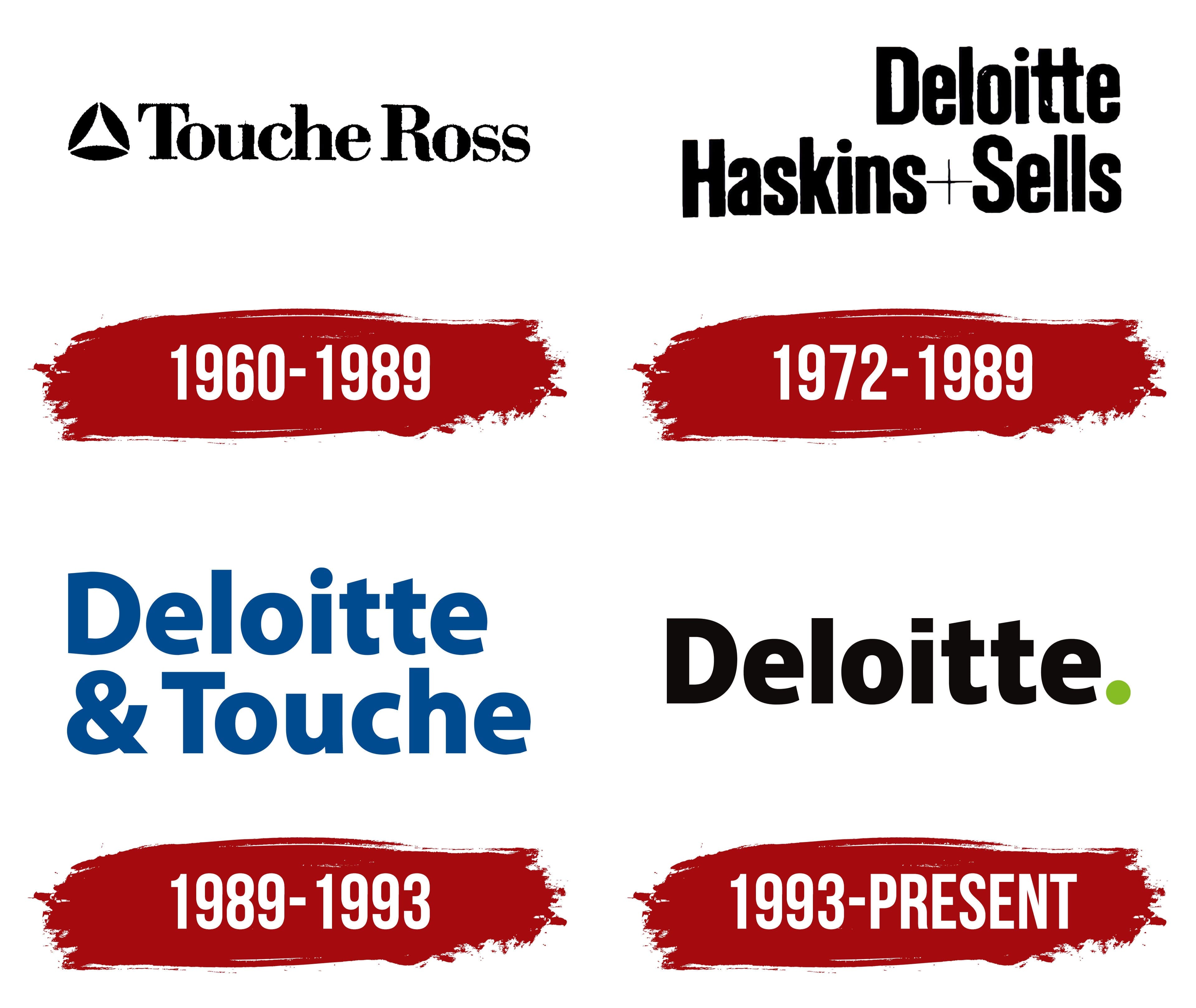
At the time, the logo was an elongated triangle composed of three black ovals. Along the right side was the inscription in large capital letters Touche Ross. In a serif font, the entire logo was shown in black. Presentable, solid, without an unnecessarily cumbersome combination of colors and shapes.
1972 – 1989

A characteristic feature of the logo was the shift of graphic accents to the right. Thus, Deloitte became the “upper floor” beneath Haskins + Sells. A part of the lower line protruded; the inscriptions appeared as steps, and the lower one was larger than the upper one. The font had also changed: it was thinner, more geometric, sans serif, again in black. It can be assumed that, with this logo, the authors sought to evoke an association with the company’s rise.
1989 – 1993
The modified logo appears for only four years. Particularly striking is the blue color of the new font and the arrangement of the words one below the other: Deloitte at the top and & Touche at the bottom. Beautiful accents and a strong composition played a role in the brand’s history.
1993 – today
Due to the change of the name, or rather the abbreviation of the word Deloitte, there was a need for a bright accent. It became a black dot at the end of the word, with a bright green spot that contrasted with the logo’s smooth black font.
The logo also has a shortened version: the letter D and a green dot. It appeared because the full logo has become familiar to the target audience, and now two graphic symbols are enough to evoke a strong association with the brand.
Font and Colors
The font used is similar to Mediator Narrow Extra Bold. It is modern and formal, which works well in an advertising campaign because it does not convey contradictory feelings. It is quite graceful, not hard, not soft, balanced. The authors of this font family are Manvel Shmavonyan and Alexander Lyubovenko.
In this case, the main colors are light green, black, and white. The bold green accent certainly conveys the company’s prosperity and makes it clear that clients will be just as happy and successful. In color psychology, green symbolizes growth, youth, reliability, help, and support.
FAQ
What does the Deloitte logo stand for?
The word “Deloitte” in the logo represents the unity of the international network. The green dot at the end denotes the organization’s initiative and its non-standard approach to problem-solving.
What is the slogan of Deloitte?
Deloitte’s slogan reflects the firm’s core principles: “To be the benchmark of excellence” and “Always one step ahead.”
Is Deloitte an LLP or an LLC?
Deloitte is a UK limited liability partnership (LLP).
Why does Deloitte have a green dot?
An advertising agency suggested placing a dot on the Deloitte logo because the usual wordmark looked too boring. The design team tried several colors, but green looked best.