


 Bank of Baroda Logo PNG
With this bank’s opening for Indians, the sun rose. The institution supports people through lending. The Bank of Baroda logo reflects the organization’s leading position in India’s financial structure.
Bank of Baroda is a banking institution founded in 1908 by Maharajas and state reformer Sayajirao Gaekwad III, along with a group of India’s richest individuals. It is currently one of the country’s top three lenders.
The career of BoB (as it is abbreviated) began with personal contributions from the Baroda region’s noble representatives, so the company started as an individual entity. Gradually, the bank expanded into Kenya and Uganda and opened branches. She later extended her influence to Europe by founding a London branch. In 1969, the bank was nationalized and came under state control, without losing its popularity or its well-deserved success in the financial sector.
Many years later, in September 2018, the institution was slated to merge with two other financial companies, Vijaya Bank and Dena Bank. This procedure was officially completed in April 2019. Since the merger initiator was BoB, which made a significant monetary contribution to the common fund, the new structure was named after him. This makes it India’s third-largest lender after SBI and ICICI Bank.
Meaning and History

One of India’s largest state-owned banks was founded in 1908 as The Bank of Baroda Limited. Indian prince Sayajirao Gaekwad III, who ruled the native principality of Baroda until 1939, created it. He rented a small office in the city center and rode an elephant there to make the first deposit: a silver plate with gold coins. Thus began the history of the Bank of Baroda, also known as BoB. Its modern sun-letter “B” logo was developed only in the 2000s. Before that, it used a “cold” white-and-blue circle with several symbolic elements that indicated the connection between a commercial financial institution and industry and agriculture.
What is the Bank of Baroda?
Bank of Baroda is one of the largest Indian credit and financial institutions. It has over 8,000 branches in India and more than 100 international offices in the USA, Australia, the UAE, Canada, the UK, and other countries. The bank was established in 1908 and was nationalized in 1969. BoB offers various services, including insurance, lending, investments, deposits, currency exchange, and international transfers.
1908 – 2005
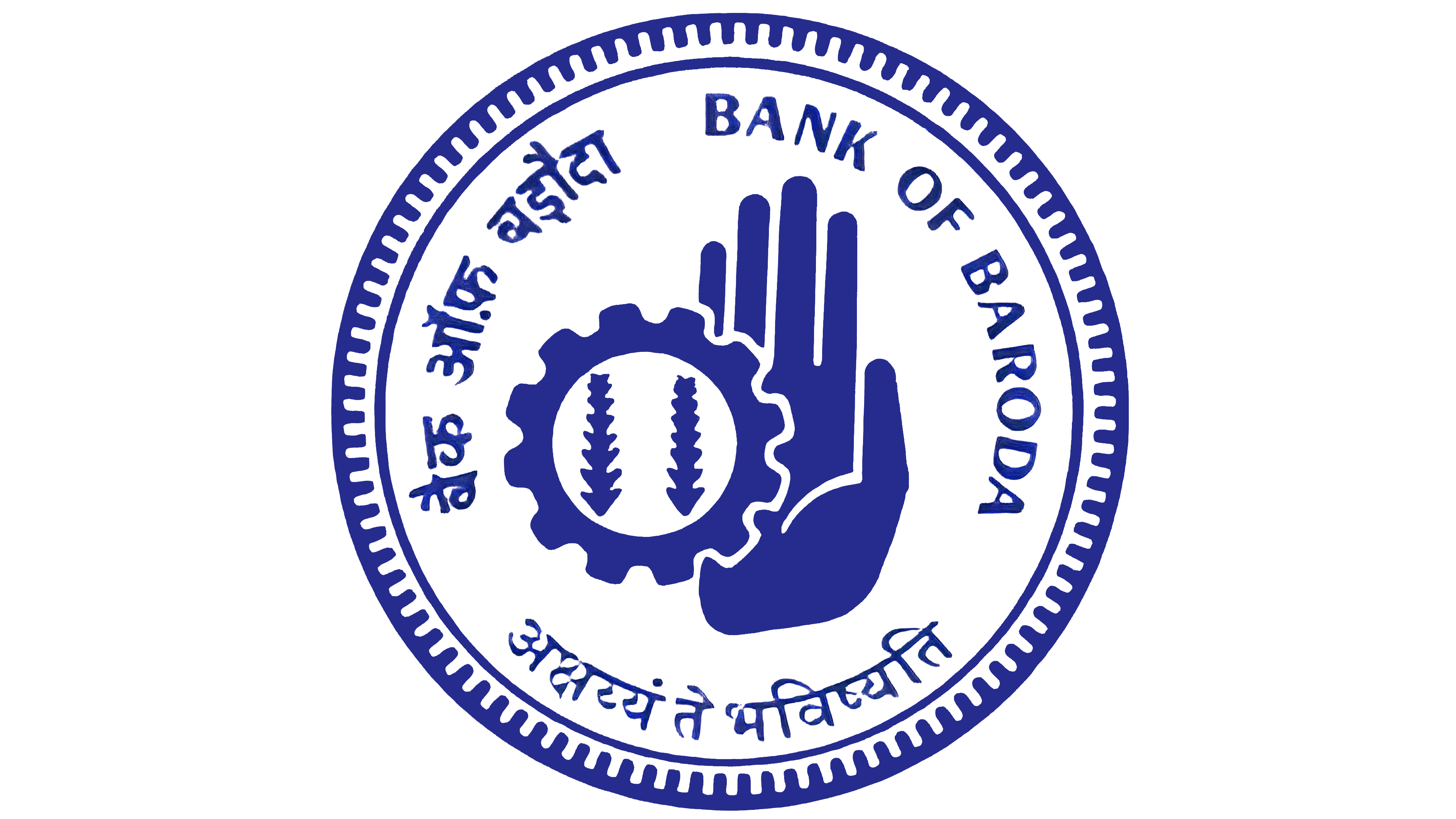
The original Bank of Baroda logo featured its name in navy blue. It sat in the upper-right corner of the circle along the border; the letters were arranged in a semi-arc. Two more inscriptions closed the ring of text: one in Gujarati and one in Hindi. These languages, along with English, dominated the region where the bank was founded, which explains their simultaneous use of the same emblem. The Sanskrit signs were meant to be read as “Akshayam te Bhavishyati,” meaning “the future is safe.” The inspirational phrase referred directly to the work of a financial institution that aspired to be the most reliable depository.
The same blue rings surrounded the text. One was even, and the second had many small notches pointing inward at the ends. In the center of the logo was a composition of a gear and two stylized ears of corn. The first element symbolized industry, and the other two symbolized agriculture. This referenced the areas of activity with which the Bank of Baroda was associated and which he helped develop. And on the right was an open palm with its fingers raised. Such a simple but symbolic gesture should be understood as a call not to worry about anything.
2005 – today
In 2005, an unknown designer designed the logo for Bank of Baroda, which was officially unveiled on June 6th. Around the same time, the financial institution signed a contract with Rahul Dravid, making this athlete, known as Mr. Dependable, a brand ambassador. These changes aimed to prepare for revolutionary reforms, open additional branches, and install thousands of ATMs across different localities. That’s why the new emblem is so positive.
Unlike the previous version, the modern logo does not feature spikelets and a gear in a circle, but rather a triple letter “B” with rays diverging in all directions. With the “solar” emblem, BoB wanted to show that he is as omnipresent as the sun and just as important to the planet. After all, this bank operates in India and more than twenty other countries. He positions himself as the one who gives life and sustains it. As for the three “Bs,” they are layered, and none of them has gaps within the letters. The first and third “B” are orange. They stand for the initials of the Bank of Baroda. The second letter, placed between them, is formed by negative space.
Obviously, the new design targets the younger generation. Because of the white, ray-like halo, it is called the Baroda Sun. This symbol represents a source of light that warms us and saves us from darkness. Similarly, BoB aims to help everyone meet their financial needs. At the same time, the bright orange color scheme represents energy and hope. It is used not only for the stylized “B” but also for inscriptions on the right. The top line is the brand name in Hindi; the bottom line is English. In the second case, the phrase is set in Univers Condensed Bold.
Font and Colors
The bank’s symbolism combines text and graphics successfully. On the left is a hand-drawn character shaped like a large “B.” The letter is double, emphasized by the right-sided outline that repeats the silhouette formed by the name “Bank of Baroda.” It contains both Bs at once. A white space of the same configuration separates the symbols. In the lower-left corner, a half-disc of the sun has rays pointing up. They are depicted as five thin stripes of different lengths.
The second part of the logo is an inscription made in two languages. At the top, it uses Hindi, one of India’s official languages. The text is written in a special calligraphic script called Devanagari, with a special connecting line. Below is the same phrase in English. This is because many people in India communicate in English, as the country was once a British colony.
Although the logo includes inscriptions in two languages, it uses the same typeface. This technique makes the emblem stylistically integral. The phrases slope slightly to the right. The first letters in words are uppercase; the rest are lowercase. A medium-thickness sans serif is used as the base font.
All elements are painted in a single palette of white and orange. The latter is a pastel shade reminiscent of a sandy desert.