


 BBVA Logo PNG ”
We will give you more than you expect,” says the BBVA logo. The image shows the bank isn’t afraid of challenges, and its employees are skilled with financial instruments. Cooperation with an institution will lead to the top.
Three major mergers define BBVA’s history. On May 28, 1857, local merchants led by Pablo de Epalza founded Banco de Bilbao in Bilbao to finance industry in the Basque region. In 1901, Banco de Vizcaya emerged in the same city, and both institutions expanded nationwide while competing for corporate clients.
In January 1988, the two banks merged to form Banco Bilbao Vizcaya, later rebranded as BBV. A parallel structure emerged in 1991, when the Spanish government created Argentaria by combining Banco Hipotecario, Caja Postal, and Banco Exterior. The group was privatized between 1993 and 1998.
On October 19, 1999, BBV and Argentaria announced a merger completed in 2000, forming BBVA, the second-largest bank in Spain after Banco Santander. The new group moved quickly into international markets.
In 1995, BBVA entered Peru and Mexico. In July 2000, it acquired control of Bancomer from BMO Financial Group and later consolidated it as its main Mexican subsidiary.
US expansion followed acquisitions between 2004 and 2007, including Valley Bank, Laredo National, and Compass Bank, which were unified under BBVA Compass. In 2014, the bank acquired Simple, signaling a shift toward digital services. In 2020, BBVA sold its US retail business to PNC Financial Services for $11.6 billion.
In Turkey, BBVA acquired a 24.9 percent stake in Garanti BBVA in 2010 and increased its share to nearly 86 percent by 2022. In June 2019, the group unified its global brand under the BBVA name.
Meaning and History
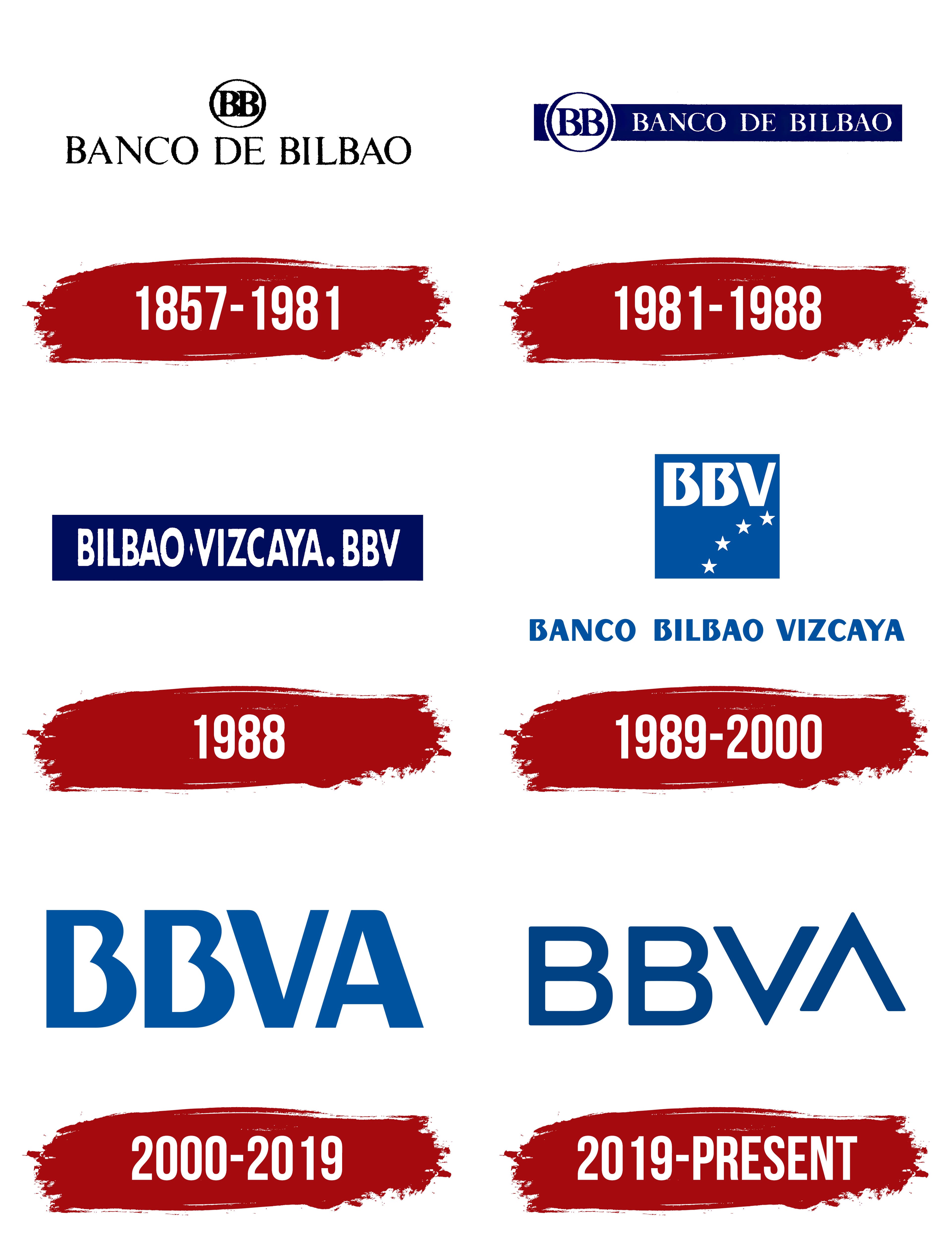
Recently, the company rebranded, modernizing its logo and unifying its branches under one name, “BBVA.” The new identity was meant to reflect the unity of all parts of the group. She also had to show the bank’s transformation, which was constantly improving but did not change its image for 19 years. In the past, redesigns were more frequent and often tied to changes in a financial institution’s structure or a search for an individual style.
What is BBVA?
BBVA stands for Banco Bilbao Vizcaya Argentaria, a Spanish company founded in 1857 as Banco de Bilbao. Since then, it has become an international financial group offering a universal range of services, from investment to insurance. It is now one of the world’s largest banking institutions, with a presence in more than 30 countries, including Romania, Italy, Turkey, and the United States. BBVA is most popular in Latin America.
1857 – 1981

In 1857, the Banco de Bilbao was founded, named after its hometown. It is one of the two predecessors of the modern BBVA. Its emblem consisted of a “BB” monogram inside the ring and was complemented by the wordmark “BANCO DE BILBAO.” All letters except “O” had short, sharp serifs. The thin font aligned with Roman tradition, and the black-and-white color scheme matched 19th-century typography.
1981 – 1988

In the 1980s. Banco de Bilbao approved the logo with a blue rectangle as the background for the lettering. The monogram has moved to the left and remains within the darkly outlined circle. The financial institution’s name was white, and the letters “BB” turned blue.
1988

In 1988, Banco de Bilbao merged with another Spanish bank, Banco de Vizcaya. When the merger agreement was signed, the newly formed Banco Bilbao Vizcaya used a rectangular logo with its name and the abbreviation “BBV” after the big dot. All lettering was in bold Futura Condensed sans serif. The color scheme resembled the Banco de Bilbao logo’s palette: white text on a dark blue background.
1989 – 2000
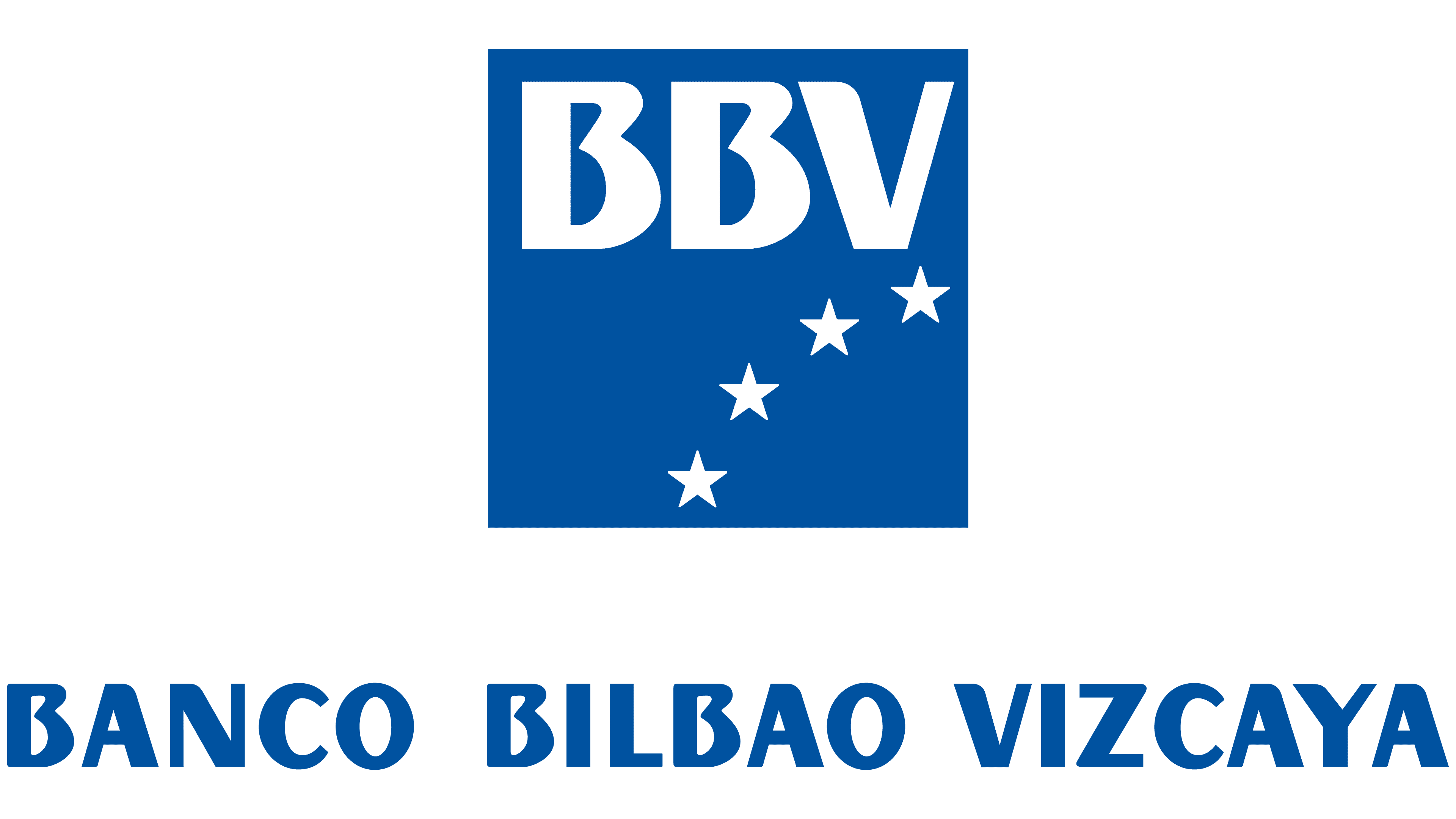
The merger procedure was completed in 1989. At the same time, the BBV brand was officially registered, and its identity changed. Specialists from Artime, Nebot & Capell designed it. They replaced the rectangle with a square, placed it on top, and added the abbreviation “BBV” and an arc of four five-pointed white stars inside. Under the rectangle was a blue inscription, “BANCO BILBAO VIZCAYA.” The font was disproportionate: the letters consisted of lines of varying thickness.
2000 – 2019
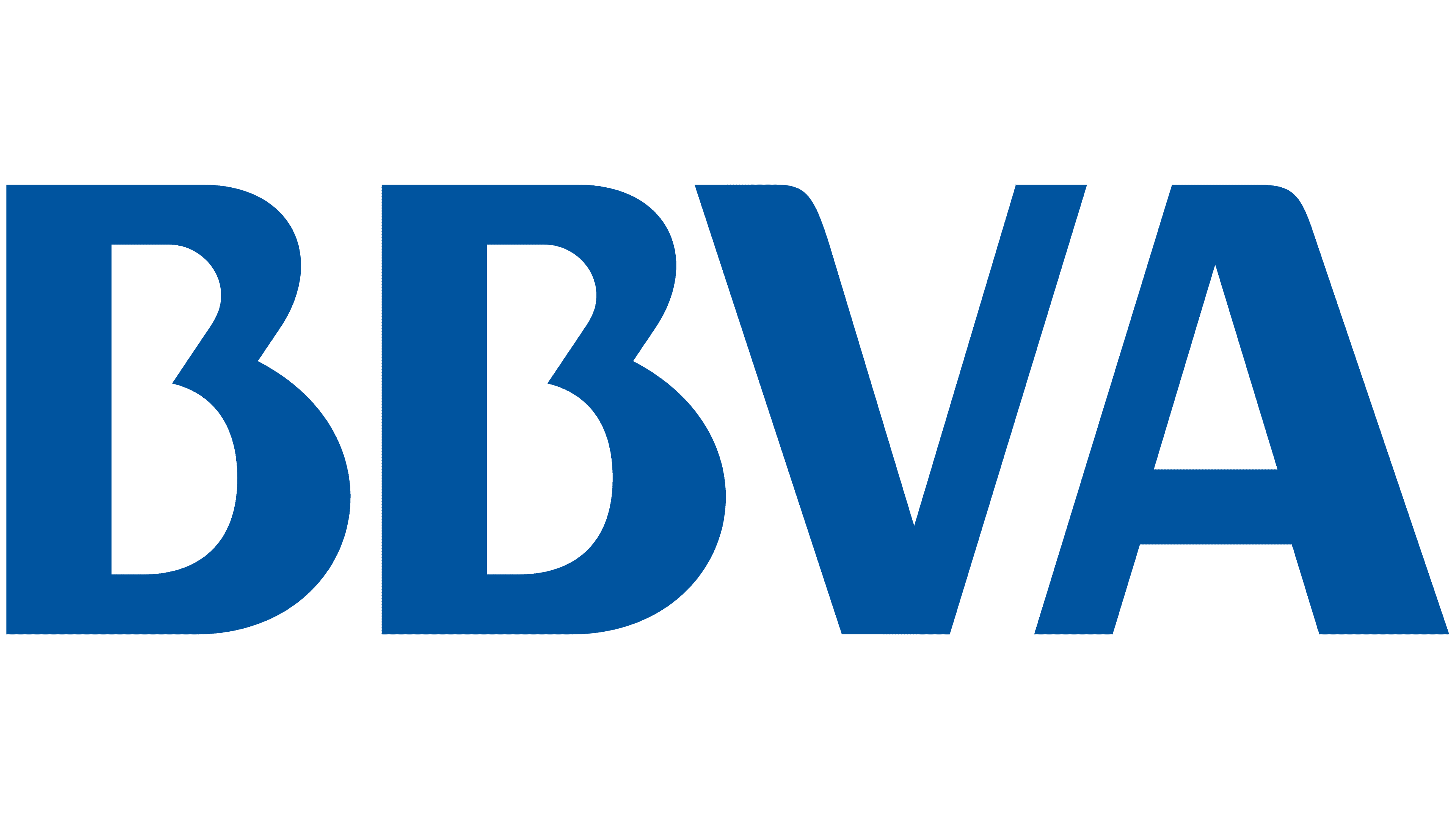
After the merger of BBV and the public bank Argentaria, Banco Bilbao Vizcaya Argentaria was formed. Its logo was much simpler than its predecessor: it contained only the blue letters “BBVA.” They used the same font as the one used to write the abbreviation in the square.
2019 – today
The brand needed a reboot, especially after the leadership change in 2019. The new president, Carlos Torres, hired the prestigious consulting firm Landor, and specialists, together with their BBVA team (50 designers from different countries), began developing a modern corporate image. Representatives of DDB and BBVA Creative agencies participated in the process. Creative searches, a survey of 5,000 people, and the creation of a corporate identity took four months.
The banking group’s restructuring took place at the structural level: all branches, except the Turkish one, adopted the common name BBVA and a single logo. The design update was not fundamental: the traditional bank signature changed fonts and added an “A” at the end. Over the next year, the wordmark was integrated into 3,000 e-applications and 8,000 offices.
The designers deliberately avoided graphics because their task was different: to depict the company’s name without additional decorative elements. They decided to play on the letters’ shape, using “V” and “A” to create a diagonal.
Two identical signs, directed in opposite directions, symbolize balance. The “A” is slightly raised above the string, so it appears to be flying upward. It suggests growth and forward movement. Both letters also resemble arrows, referencing the digital world. This iconography brings the bank closer to the Internet and technology. One arrow looks up and the other down, and that’s no coincidence. The peaks and troughs evoke stock market volatility.
Font and Colors
The biggest change in 2019 was the font update. Designers have ditched asymmetric shapes, rounded edges, and individual style in favor of typography without unnecessary elements. They took the Benton Sans BBVA typeface as a basis, but completely redesigned the last two letters. As a result, the “V” and “A” look the same and form a 180-degree angle.

The logo’s color has also changed, though not by much. It stayed dark blue, with only a slight shift to Yale Blue (#14549C).