


 BCI Logo PNG
The BCI logo is bright and optimistic. The image conveys a Latin American expression. By opening branches across North and South America, the company demonstrates its ability to unite clients with diverse views, nationalities, and appearances under its wing.
In 1937, Juan Yarur Lolas, a Chilean businessman of Lebanese origin, founded Banco de Crédito e Inversiones, known as BCI, in Santiago, Chile. The bank was created during a period of rising demand for financial services in the country, mainly among small and medium-sized enterprises that needed credit and banking support.
In its first decades, BCI focused on Chile’s commercial sector, offering banking and lending services to local entrepreneurs. Its work was tied to domestic business activity and the needs of companies operating in the Chilean market. In the 1950s and 1960s, the bank expanded its branch network in Santiago and other cities while adding new financial products to serve a broader client base.
During the political and economic difficulties of the 1970s, BCI continued to strengthen its position in the financial market. The bank improved customer service systems and began introducing new technologies into daily operations. In the 1980s, it became one of the early Chilean financial institutions to adopt automated customer service and computer-based banking processes.
In the 1990s, BCI entered a period of international expansion through correspondent relationships with major global financial institutions and offices in key financial centers. In 2004, it acquired Banco Conosur, reinforcing its retail banking business. From 2010 to 2015, BCI invested in mobile applications and internet banking. In 2016, it acquired City National Bank of Florida in the United States. From 2017 to 2023, the bank developed digital services using big data and artificial intelligence. By 2024, BCI remained one of Chile’s largest private financial institutions.
Meaning and History
What is BCI?
This major Chilean bank offers financial services for individuals, small and medium-sized businesses, and corporate clients. It provides various financial services, such as asset management, investment, and retail and commercial banking. The bank has earned a reputation for its focus on technological innovation, often setting the standard for digital banking solutions across Latin America. Outside of Chile, the bank operates in several other countries, particularly the U.S., through its subsidiary, City National Bank of Florida. Due to its global expansion, the bank serves as a bridge between South America and North America’s financial markets.
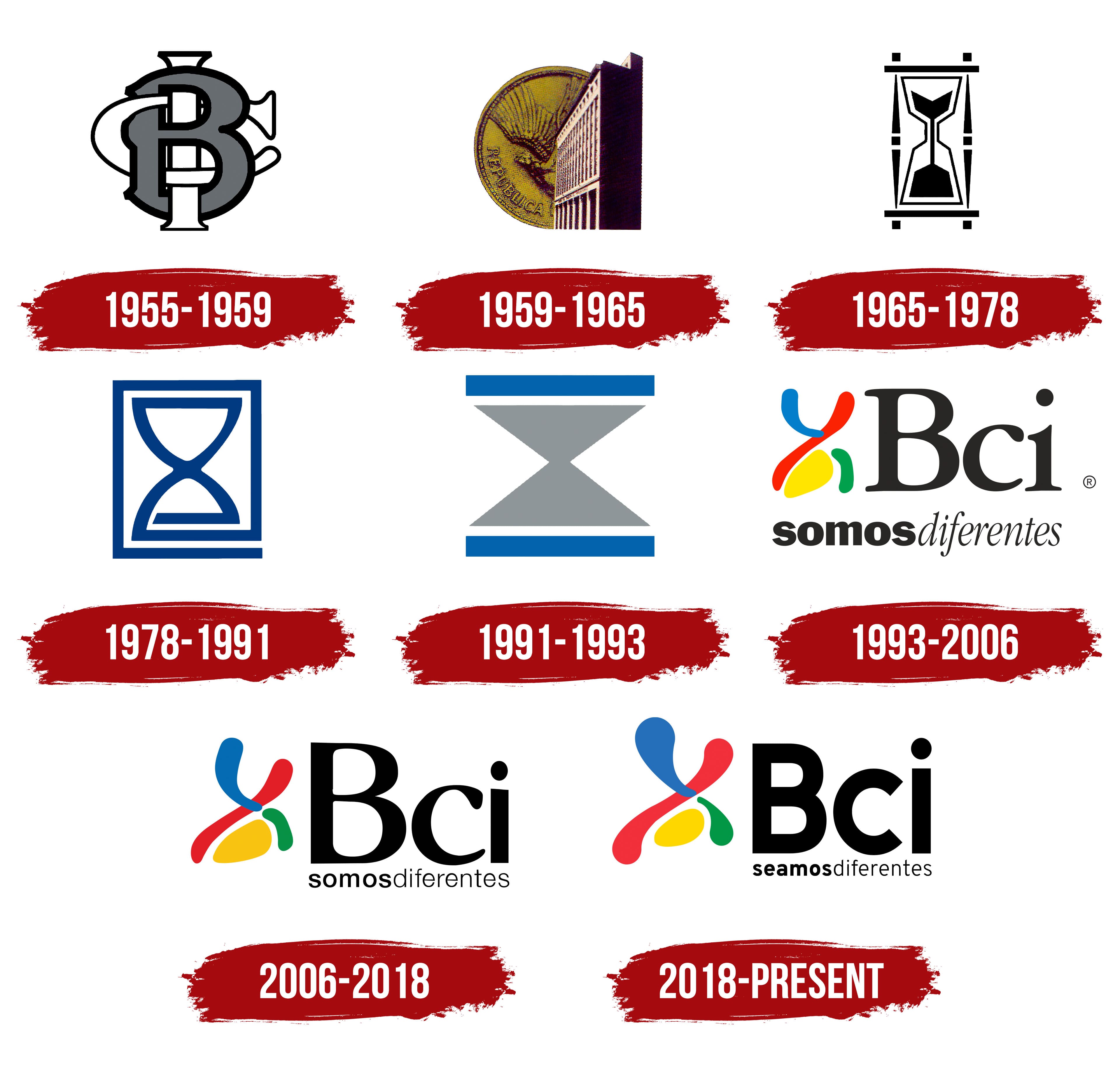
1955 – 1959

The emblem was developed when the bank’s management was transferred to the founder’s son, who was actively expanding the business. The main symbol became a monogram created from the first letters of the company’s name, Banco de Crédito e Inversiones S.A. The dense interweaving of the symbols emphasizes unity and the high level of security offered to clients.
The logo highlights the bank’s familial ties. This focus clarifies the connection between the founder, current leadership, and the next generation ready to continue the family business. Continuity creates a solid foundation for stability during times of uncertainty and change. The concept demonstrates the strength of the organization’s internal bonds and ability to act confidently even in challenging external circumstances.
1959 – 1965

The new emblem is significantly different from the previous one. It reflects ideas of progress and growth. In the background, a coin symbolizes the company’s connection to the financial sector.
The coin depicts a giant condor with outstretched wings, evoking a sense of strength and scale. In the foreground, a prominent profile of the BCI headquarters building is shown, emphasizing its achievements and importance.
The logo’s design visually underscores grandeur and accomplishments, creating associations with reliability and stability for clients.
1965 – 1978

For the first time, the emblem features an hourglass, a symbol reminding us of the relentless passage of time. The bank demonstrates resilience, reaffirming its commitment to stability and trust. The new symbol reflects respect for clients’ time, so the company implements modern technologies to speed up service processes and make them more convenient.
1978 – 1991

The emblem reflects the movement from the past to the future. The hourglass conveys the concept of time by extending a line to form an open rectangle. The line resembles a road, symbolizing the bank’s progress, openness to new opportunities, and readiness for change.
One key focus has become technological development. Clients are offered American Express international credit cards, and an online system has been implemented to connect branches and accelerate information processing.
By preserving its mission and relying on accumulated experience, the company shapes the future and reaffirms reliability and stability.
1991 – 1993

All of the bank’s debts were fully repaid, leading to the renewal of the emblem. Having completed his mission, the company’s owner died, leaving his son to lead.
The hourglass-shaped logo gained stability through its wide bases. The design emphasizes the brand’s continuity and its progression through time. The chamber is filled, with no sand grains in motion, highlighting constancy and unchanging values.
The bank’s wide blue stripes reflect its technological development and focus on modern technologies. It introduced new customer service methods, including ATM operations and automated bill payment systems.
The white layer within the symbol represents renewal, transitioning to a new level, release from the past, and progress.
1993 – 2006
The emblem was updated in 1993, following the bank’s renaming to BCI. The third generation of family owners initiated the changes, and the new owner brought a fresh perspective to the bank’s visual style.
The hourglass transformed into a modern graphic design composed of individual multicolored lines. The composition was inspired by the works of Spanish artist Joan Miró, known for his abstract style. Primary colors are tied to the corporate slogan “We Are Different.”
The name is to the right of the image and is written with an initial capital letter. The entire graphic design conveys a sense of dynamism, diversity, and openness.
2006 – 2018
The hourglass shape has been modified with a forward tilt that emphasizes movement and development. This accent reflects the company’s ability to overcome crisis periods and its confident growth.
The font design of the name has been updated: serifs have been removed, making the text visually simpler and highlighting the bank’s accessibility, the introduction of modern technologies, and the simplification of client interactions. The slogan is set in a thinner font, giving the composition a lighter, more modern appearance.
2018 – today
The figure has grown larger, and the letters have become bolder, emphasizing the company’s achievements. The bank’s slogan has transformed into a call to action: “Let’s be different!”
The changes are associated with the active expansion of the international presence and the acquisition of new banks. The expansion covered several markets, necessitating adjustments to the visual style and updates to key elements of the brand identity.