


 Benelli Logo PNG
The Benelli logo signifies leadership in its segment. It shows the premium quality and power of the company’s motorcycle engine. The emblem promises long-term reliability and maximum performance for the buyer.
Benelli’s history began in 1911 in Pesaro, when Teresa Benelli opened a workshop for her six sons. Early work focused on repairs and parts, while World War I brought technical experience. In 1919, the brothers built their first engine, followed by the Velomotore motorcycle in 1921.
In 1926, Giuseppe Benelli developed a 175 cc four-stroke engine with an overhead camshaft. Racing success followed, with Tonino Benelli winning Italian championships between 1927 and 1931. In 1939, Ted Mellors won the Isle of Man TT.
World War II destroyed the factory, but production resumed using rebuilt military bikes. In 1950, Dario Ambrosini won the 250 cc world championship. That same year, Giuseppe left to found Motobi. The two companies merged again in 1962.
In 1969, Kel Carruthers delivered another world title. Financial problems led to a 1972 sale to Alejandro de Tomaso, who also controlled Moto Guzzi and Maserati. In 1975, Benelli released the 750 Sei, the first production six-cylinder motorcycle, but high costs limited its success.
Ownership changed again in 1988 and 1995, with attempts to revive the brand through scooters and models such as the Tornado 900 Tre. Racing efforts continued but remained unprofitable.
In 2005, Qianjiang Motorcycle Group acquired Benelli, keeping design in Italy and moving production to China. In 2016, Qianjiang joined Geely Holding.
New models such as the TRK 502 and the Leoncino 500, launched in 2017, restored its market presence and competed with the Honda Africa Twin and the BMW G 310 GS.
Meaning and History
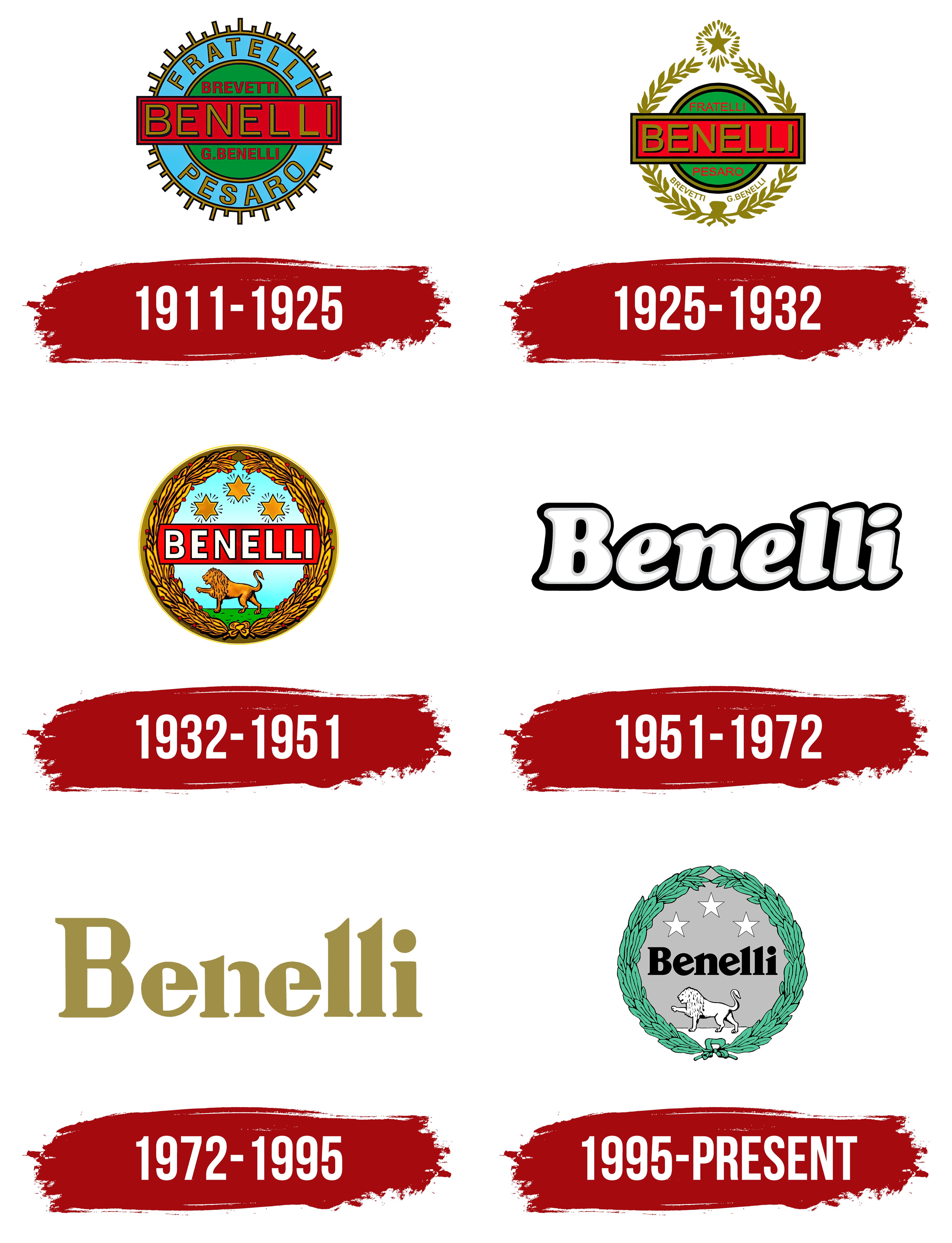
Ienelli’s history features many lion emblems. The proud predator has been decorating the shiny sides of motorcycles for at least a century, emphasizing the brand’s visual identity.
For a hundred years, only the art has changed. Once, it was primitive, which gave the animal a cartoonish appearance. But as the company evolved, the artists updated the logo, making the lion black and white. They also added deeper-meaning elements: a laurel wreath (symbolizing victory and triumph) and three stars (portending a successful future).
What is Benelli?
Benelli is an Italian motorcycle brand and the second-oldest in the country. It has existed since 1911 and continues to produce two-wheeled equipment. Currently, the Chinese company Qianjiang Motorcycle, part of the Geely Holding Group, owns the factory. The headquarters are located in Pesaro (Marche).
1911 – 1925

The Italian motorcycle brand’s debut emblem resembled a wheel with a studded tire. High and low protrusions were distributed along the entire circumference in sequence. They served as a border. A wide azure stripe followed, with two inscriptions indicating the trademark’s founders: “Fratelli” at the top and “Pesaro” at the bottom. Next was a green circle crossed horizontally by a red rectangle. The text also read “Brevetti,” “G. Benelli,” and the company name in large print. The central inscription was yellow with a black border.
1925 – 1932

In 1925, the developers redesigned the logo. It proved successful: spikes and stripes were replaced with a laurel wreath, a shining star sat at the top, and the central circle was reduced. Some of the inscriptions disappeared – only three remained. They were Benelli (in the middle), Fratelli, and Pesaro (in the green background).
1932 – 1951

The designers kept the emblem’s round shape and made some refinements. First, they finalized the laurel branches and added more detail. To make the wreath look realistic, they added veins and berries. They removed the triple frame from the rectangle, enlarged the letters, and made them white. In the upper part of the circle, symbolizing the sky, are three large stars; in the lower part, a pale green field on which the lion walks. The predator stands proudly with a raised paw, which he uses to point left.
1951 – 1972

1951 marked a turning point in the logo’s history: after a long history of a round logo with many small details, a concise text version appeared. Thus began the era of the letter logo. The letters changed significantly: they became italicized and lowercase, except for the capital “B”. The dot above the letter “i,” the developers’ oval, and the spaces between letters were painted black. All characters now have a dark outline, which makes the white characters appear hollow.
1972 – 1995

To deepen the text-logo theme, the designers changed the logo’s style. The letters are now serifed, printed, and gold-colored.
1995 – today

At the turn of the millennium, the brand brought back one of its old 1932 emblems. The adjustments were mainly to the colors and internal elements. The developers painted the laurel wreath green, the lion, stars, and earth white, and the sky and background in metal. They also removed the short strokes around the stars, which gave them a glowing effect. In the center, as before, is the company name taken from the previous logo.
Font and Colors

The current logo looks like a silver medallion with horizontal lines diverging in both directions. A shadow is cast on the bottom half of the circle, creating a gradient effect.
Inside is a green wreath with detailed leaves. It surrounds the other elements. Below is a lion walking to the left. Above are three white stars with black outlines. The company name is centered. If the word “Benelli” was previously placed in a red rectangle, no frames now confine it.

The inscription uses a vintage font with short serifs. It isn’t classic, as the designers used original typographic techniques. The tops of “n,” “l,” and “i” are slightly beveled. The connecting strokes of “e” are also uneven: they are stretched upward diagonally.