


 BSA Logo PNG
The winged BSA logo symbolized flight because the manufacturer’s motorcycles once rushed along the roads as if they had wings. As a result, a stylish hood sign testified to the vehicle’s enormous speed and power.
BSA began during the Crimean War of 1854-1856, when Britain needed mass-produced rifles and turned to Birmingham gunmakers. In June 1861, fourteen members of the Birmingham small-arms trade formed The Birmingham Small Arms Company. The factory occupied 25 acres in Small Heath, with Armory Road running alongside it. An early Turkish order for 50,000 infantry rifles gave the company a stable start.
Arms contracts were irregular, and in 1879, the factory closed for a year without orders. In the 1880s, BSA moved into bicycles, then returned to rifles during the Lee-Metford rearmament program. A motorcycle division appeared in 1903, and the first 3.5 hp BSA motorcycle debuted at the Olympia Show in 1910. That same year, BSA bought Daimler and entered the car business.
Both world wars pushed BSA back into military production. In World War I, it made 1.5 million rifles, Lewis guns, shells, aircraft parts, and a folding bicycle. In World War II, it supplied nearly 500,000 Browning guns for Spitfire and Hurricane fighters, 1.25 million Lee-Enfield rifles, 400,000 Sten guns, and more than 125,000 M20 army motorcycles. After the war, the BSA Bantam became a major civilian model, with over 250,000 built.
In 1951, BSA took over Triumph Motorcycles and became the world’s largest motorcycle maker. Models such as the BSA Gold Star strengthened its racing image. At the same time, Raleigh bought the bicycle division in 1957, and Jaguar acquired Daimler in 1960. By 1959, Honda had passed BSA in sales, with Yamaha and Suzuki adding pressure. In 1972, BSA’s motorcycle business was folded into Norton Villiers Triumph, and BSA motorcycle production ended in 1973. Mahindra Group-owned Classic Legends bought the brand in 2016 and launched a new BSA motorcycle in 2021.
Meaning and History
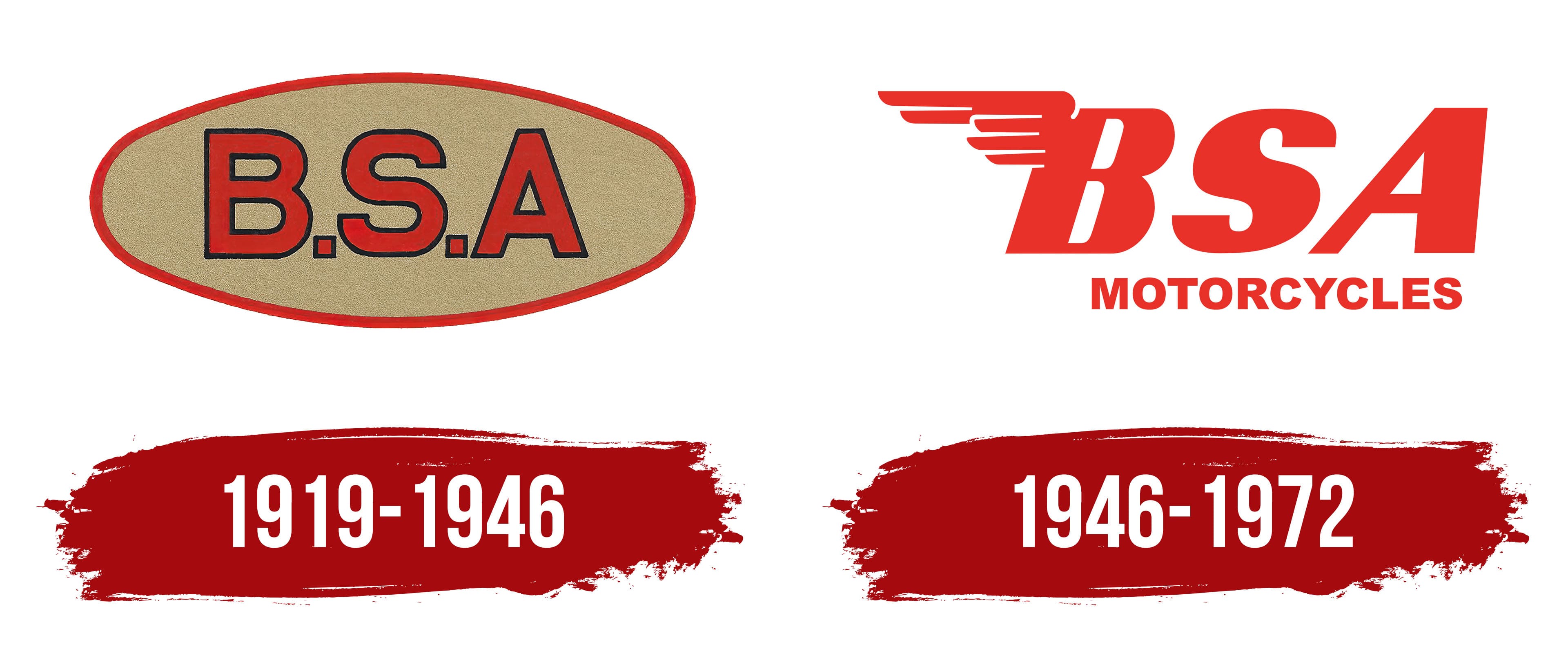
The BSA logo has evolved alongside the vehicles produced under this brand. The Birmingham Small Arms Company Limited motorcycle division opened in 1903 and spent the next seven years developing the latest bike. In 1910, the company finally completed a two-wheeled beast. As expected, its shiny gas tank was adorned with the brand name emblem.
Over time, BSA developed a winged “B” logo, personifying the idea that motorcycles fly along the roads, picking up tremendous speed. It became the company’s main symbol until the company closed in 1973. In the same year, Manganese Bronze Holdings acquired the rights to the name, and in 2016, the Indian conglomerate Mahindra Group acquired the BSA brand and continued developing motorcycles.
What is BSA?
Founded by the Birmingham Small Arms Company, BSA is a brand of motorcycles, bicycles, and scooters that began production in England in 1880.
1919 – 1946
The old logo features the BSA name with square dots after the “B” and “S.” This abbreviation is derived from the phrase “Birmingham Small Arms,” referring to a large industrial complex in Great Britain. All three letters were written in bold block type and painted in deep red. Thin black contours separated them from the beige oval, which was additionally surrounded by a red stripe.
1946 – 1972
The logo’s appearance can be associated with the end of the First World War, when a separate unit called BSA Cycles appeared.
The brand name is a winged abbreviation, BSA, with a clarifying caption in small print: motorcycles.
The letters BSA on the logo stood for Birmingham Small Arms. That is what the Birmingham Association of all arms manufacturers began to be called.
Therefore, adding the words cycles (bicycles) or motorcycles (motorcycles) to the logo’s abbreviation was important, and even necessary. This helped customers understand it was about vehicles, not weapons.
A drop in handgun demand led to a strange shift from rifles to bicycles. The owners were looking for other ways to make money. The abbreviation of the weapons joint-stock company’s name remains in the motorcycle brand’s name to this day.
The wing on the letter B in the logo had a wide meaning.
- It was said that the company’s units developed high speed. In weapons manufacturing, every part had to fit exactly. The filigree execution across all body elements made BSA motorcycles high-quality, reliable, and streamlined. This allowed them to develop maximum speed. The idea of perfect execution and assembly is confirmed by the evenly sized “feathers” on the logo’s wing.
- Wings also revealed the company’s complex history. It developed during a special period against the backdrop of three wars: the Crimean War and, in particular, the First and Second World Wars. They significantly slowed the brand’s development, but BSA still recovered from the difficulties. Wings of fortune helped her use difficulties to her advantage. For example, during World War I, she again returned to producing weapons, not forgetting motorcycles, which she now supplied to the front. And during the Second World War, she bought up less successful firms. A resilient spirit and the ability to rise above the situation helped the company make the right decisions, soar above adversity, and maintain production.
- Wings allowed the brand to outlast competitors and avoid playing by the general rules. BSA was almost the only successful company that did not promote its models through racing. She hovered in the highest circles. Thanks to the government’s release of weapons, police, the army, taxi companies, and repair teams constantly ordered the company’s models, making them recognizable and popular.
All BSA letters had a slight rightward slant, suggesting movement.
In 1973, after the merger, BSA ceased to exist. The abbreviation was revived in 1994, following the formation of the BSA Regal concern. The trademark now belongs to the Indian concern Mahindra.
Font and Colors
The logo is made in mono-color. Red embodies speed and pressure. It conveys powerful engines and modern, high-performance parts. Indicates leadership in its segment. The color is also associated with weapons and blood. Lettering font: Britannic Bold.
