


 Cagiva Logo PNG
The Cagiva logo is an Italian expression multiplied by the incredible speed of motorcycles. Each emblem element appears mobile and filled with internal energy. At the same time, they are all interconnected, as if they were parts of a single mechanism.
Cagiva grew out of a small metalworking business founded by Giovanni Castiglioni in Varese in 1950. Its name came from Castiglioni Giovanni Varese. His sons, Claudio and Gianfranco, later shifted the family’s focus from metal parts to motorcycles. In 1978, they bought the Aermacchi/AMF-Harley-Davidson factory in Schiranna, near Lake Varese.
The first Cagiva bikes were largely rebadged Aermacchi models previously sold under the Harley-Davidson brand, including 250 cc and 350 cc two-stroke singles. By 1979, production reached 40,000 motorcycles a year, with eight models from 125 cc to 350 cc. In 1983, Cagiva began using Ducati four-stroke engines from 350 cc to 1,000 cc.
In 1985, Cagiva bought Ducati, which was then close to bankruptcy. Ducati kept operating in Bologna, while Cagiva built models such as the Ala Azzurra and Elefant with Ducati engines. Under Claudio Castiglioni, engineer Massimo Bordi developed the four-valve desmodromic head that helped Ducati in international racing. The group expanded again in 1987 with Moto Morini and Husqvarna, and in 1991 with MV Agusta.
Cagiva gained visibility in racing through GP500 and rally raids. Randy Mamola brought the brand its first GP500 podium, Eddie Lawson won the 1992 Hungarian Grand Prix, and Edi Orioli won the 1990 and 1994 Paris-Dakar on the Cagiva Elefant with a Ducati V-twin engine. Financial pressure later forced the sale of Ducati and Moto Morini to Texas Pacific Group in 1996. In 1999, MV Agusta Motor became the parent company for Cagiva and Husqvarna. Harley-Davidson bought MV Agusta Motor in 2008, Claudio Castiglioni’s son bought Cagiva back in 2010, and production of the last Mito SP525 ended in 2012.
Meaning and History
What is Cagiva?
The brand was founded in 1978 by an Italian motorcycle manufacturer. During its heyday, it produced up to 40 thousand motorcycles a year. Its line includes road, sports, and tourist models, as well as scooters.
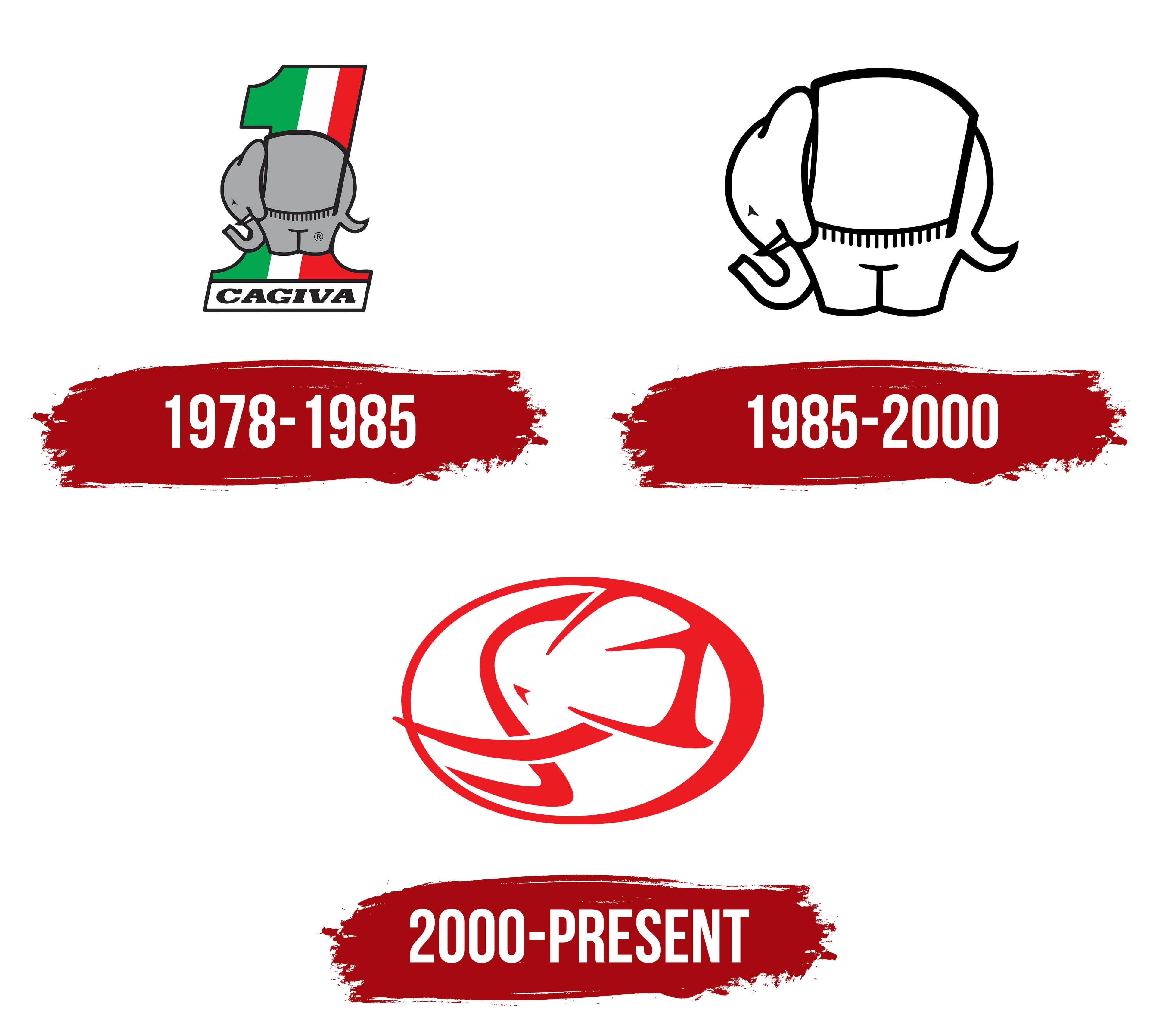
1978 – 1975

The first logo exemplifies love for one’s homeland, family, and racing.
The emblem has a large number 1, reminiscent of the image on the pedestal at the awards presentation. It showed that riders would take first place in the planet’s motorcycle races and demonstrated a desire for leadership. Showed that the company’s products would be the best. And the brothers were not mistaken. Seven years later, they were waiting for their first victories at the World Championships (1985,1986).
The number is painted in the colors of the Italian flag as a sign of love for the motherland and to indicate the plant’s location.
At the base of the figure is the name Cagiva. Italians treat their parents with great respect, and the Castiglioni brothers are no exception. Having bought the plant, they decided to name it after their father. They took the first two letters of his last name (Castiglioni), the first letter of his first name (Giovanni), and the two letters of the city where he lived (Varese). The result was the abbreviation Ca-G-Va.
Directly on the number 1 in the center is the image of an elephant. In 1983, the company began developing its models, introducing the Elefant motorcycle, an elephant-themed model. It had a powerful engine, a large size, and high ground clearance, which made it possible to overcome road obstacles while remaining easy to control. The model resembled a large animal, the ride on which gives a feeling of power. Later, on this basis, a whole series of tourist bikes was created.
The choice of an elephant as an emblem conveyed Cagiva’s power, strength, and reliability. In the future, it will even resist Japanese brands whose distribution led to the bankruptcy of many companies.
1985 – 2000

1985 is the year of victory in motocross. Things are going very well; the company has many orders and is the leader in Italy. Therefore, the less successful competitors at the outset are Ducati, Husqvarna, and Moto Morini. Factories opened abroad. Cagiva becomes a major concern. This led to a change in the logo.
All additional elements were removed, leaving a large image of an elephant. He is the prototype of the company. She is strong, powerful, and firmly on her feet. Her motorcycles are reliable and durable. The black color of the logo outline also confirms this.
An animal’s roar is similar to an engine’s roar during a race.
Interestingly, the image is rendered as a contour and has no color. This made it possible to apply the logo on any model without spoiling its color and design.
The image also hints at a rare albino elephant. Cagiva is unique among manufacturers and stands out from the rest.
2000 – today

By the 2000s, product sales were struggling, and they had to sell off previously acquired brands. The Piaggio Group extended a helping hand to the manufacturer by purchasing a 20% stake in the company. Cagiva changed its name to MV Agusta Group, rebranded, and started over.
The latest update has made the company look very elegant and modern.
Against an oval background that demonstrates the models’ streamlining and speed, lines form an elephant’s profile. Their sharpness and smoothness indicate the ease of riding and maneuverability of Cagiva motorcycles.
The tilt of the head and the tusks that go beyond the oval echo the image of the driver leaning towards the motorcycle and racing at high speed along the track.
Font and Colors
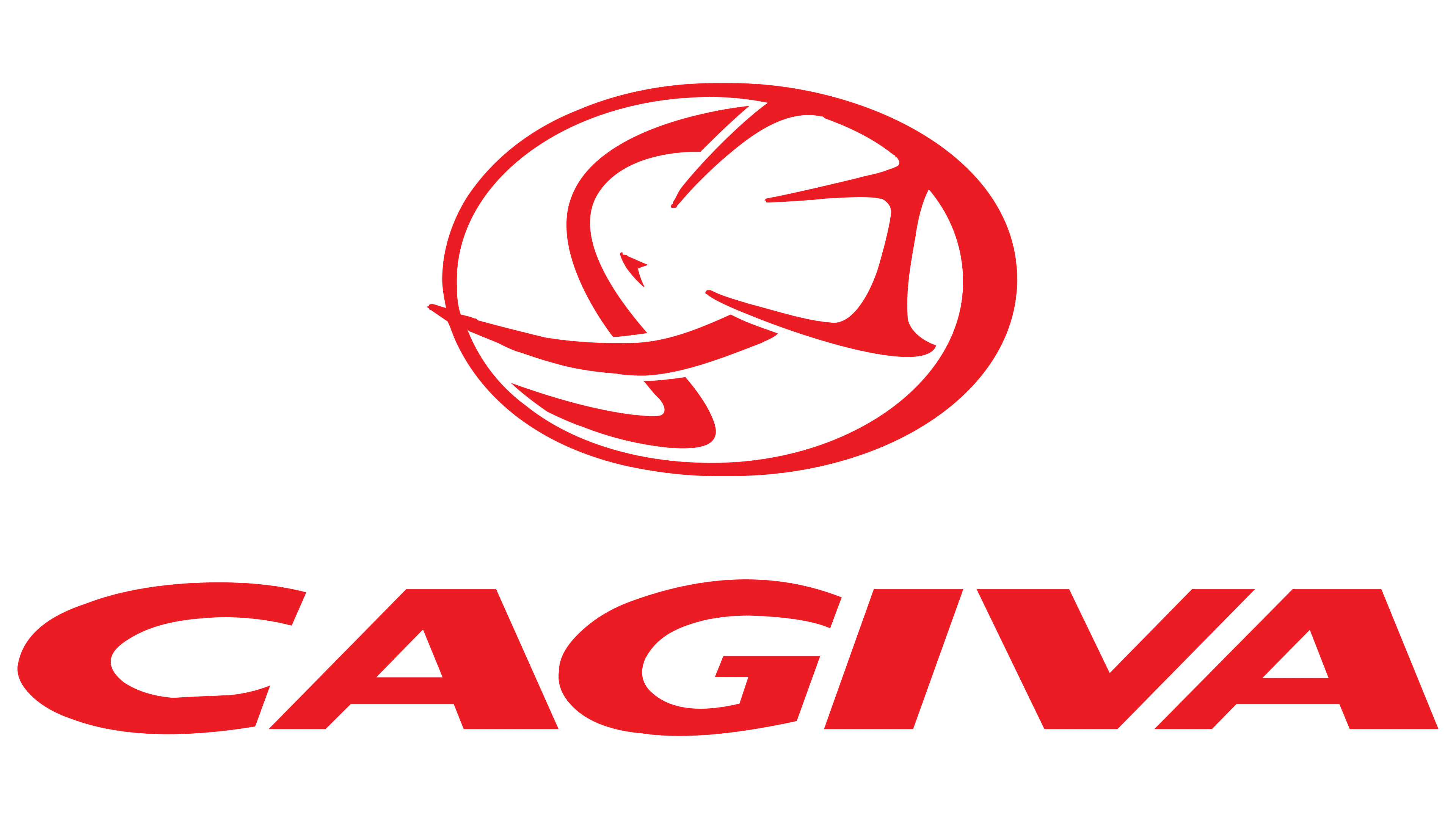
In the final version, the company’s owners settled on red. It is a symbol of fast driving, passion, and leadership.
There have been no inscriptions in the visual sign since 1985. The owners wanted Cagiva to be associated with an elephant, so its image was central to the logo. The brand was so popular in Italy that no company name was required.
The decision was also successful in maintaining the company’s permanent image despite the name change.
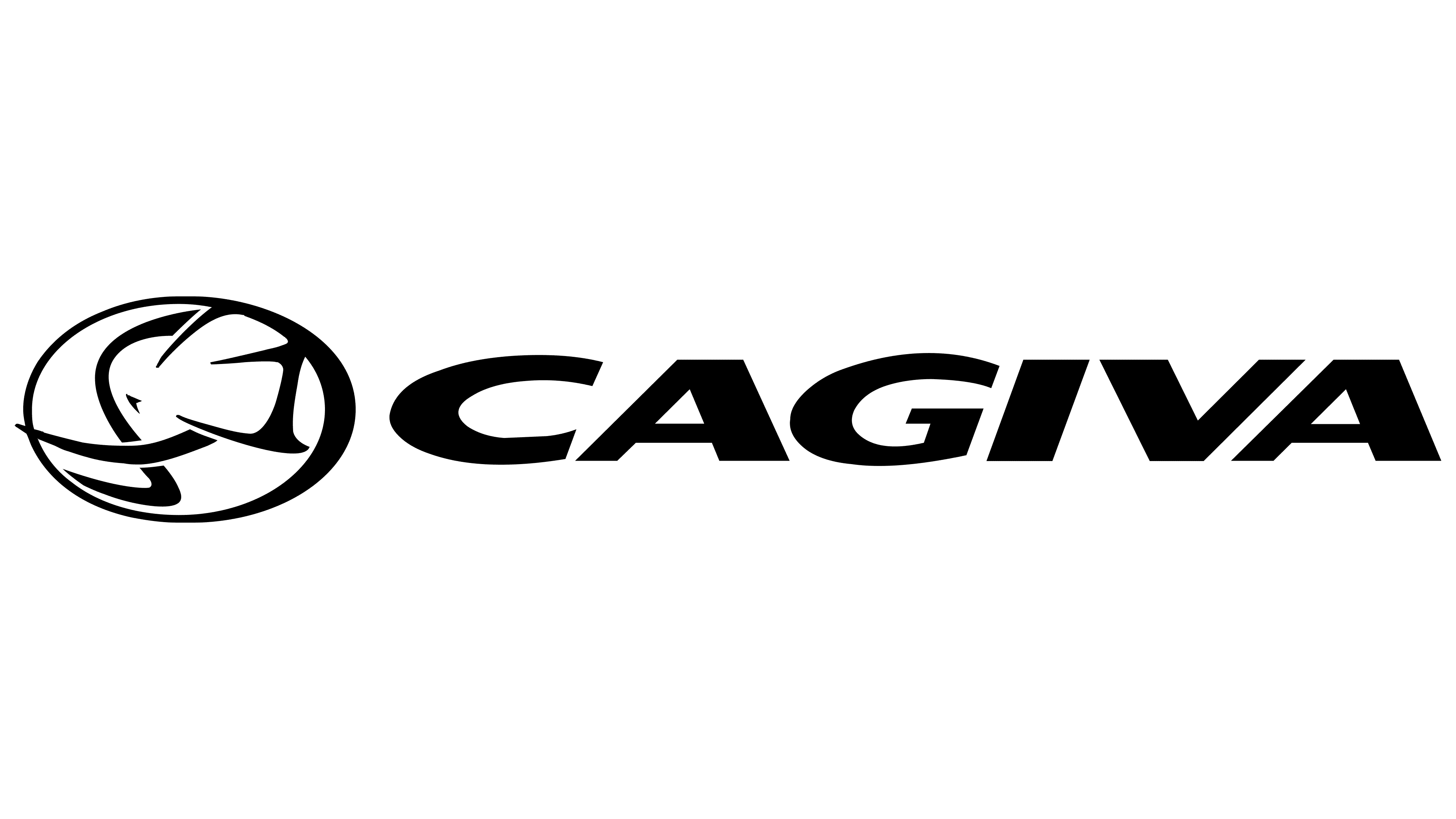
However, in some variations of the emblem, the inscription “Cagiva” is added at the bottom of the elephant in serif capital letters. The font resembles italics from CA Coronado.