


 CBRE Logo PNG
The CBRE logo does not change its strategic preferences. It is strict, business-like, and practical. The subdued color supports the visual identity’s serious tone and harmonizes the external form with the internal content. Money and its rational spending are the main ideas of the emblem.
CBRE traces its origins to 1906, when Colbert Coldwell founded a real estate firm in San Francisco after the city’s devastating earthquake. The company first worked with commercial properties and became involved in rebuilding the local business market. After Benjamin Arthur Banker joined, the firm took the name Coldwell Banker. It expanded beyond California, later adding residential real estate to its work.
A second part of the company’s background came from Britain. Richard Ellis was founded in London in 1773 as a property management and valuation firm. It operated independently for almost two centuries and gradually grew into a recognized name in European commercial real estate. In the United States, a major ownership change came in 1981, when Sears acquired Coldwell Banker as part of a move into financial and real estate services.
In 1989, Sears separated the business. The residential side was sold, while the commercial division continued as CB Commercial Real Estate Group. In 1996, CB Commercial went public, giving the company capital for expansion and acquisitions. In 1998, it merged with Richard Ellis Group, creating CB Richard Ellis and combining the American brokerage business with the British property-services firm.
The company continued to expand through acquisitions, including Insignia Financial Group in 2003 and Trammell Crow Company in 2006. In 2011, it shortened its name to CBRE Group. Later moves included the 2019 purchase of Telford Homes and investment in Turner & Townsend. CBRE competed globally with JLL and Cushman & Wakefield, while its headquarters later moved from Los Angeles to Dallas, Texas.
Meaning and History
Initially, the company was called Tucker, Lynch & Coldwell. Then it changed its name several times due to changes in management personnel. Later, it was repeatedly bought and sold until CBRE came into full force and began to acquire other firms independently to strengthen its position in the investment market.
Subsequently, the new name served as the basis for the visual identity. Designers initially proposed a minimalist option: textual, simple, business-oriented, and clear. The massive letters of the abbreviation testify to the investors’ seriousness and the scale of their work. The large signs indicate that the firm is confident in its capabilities, has unwavering business qualities, and has a stable position in the global market.
What is CBRE?
CBRE is the abbreviation for the largest commercial real estate investor, Coldwell Banker Richard Ellis, based in the United States. It was established in 1906 and operates from its headquarters in Dallas, Texas.
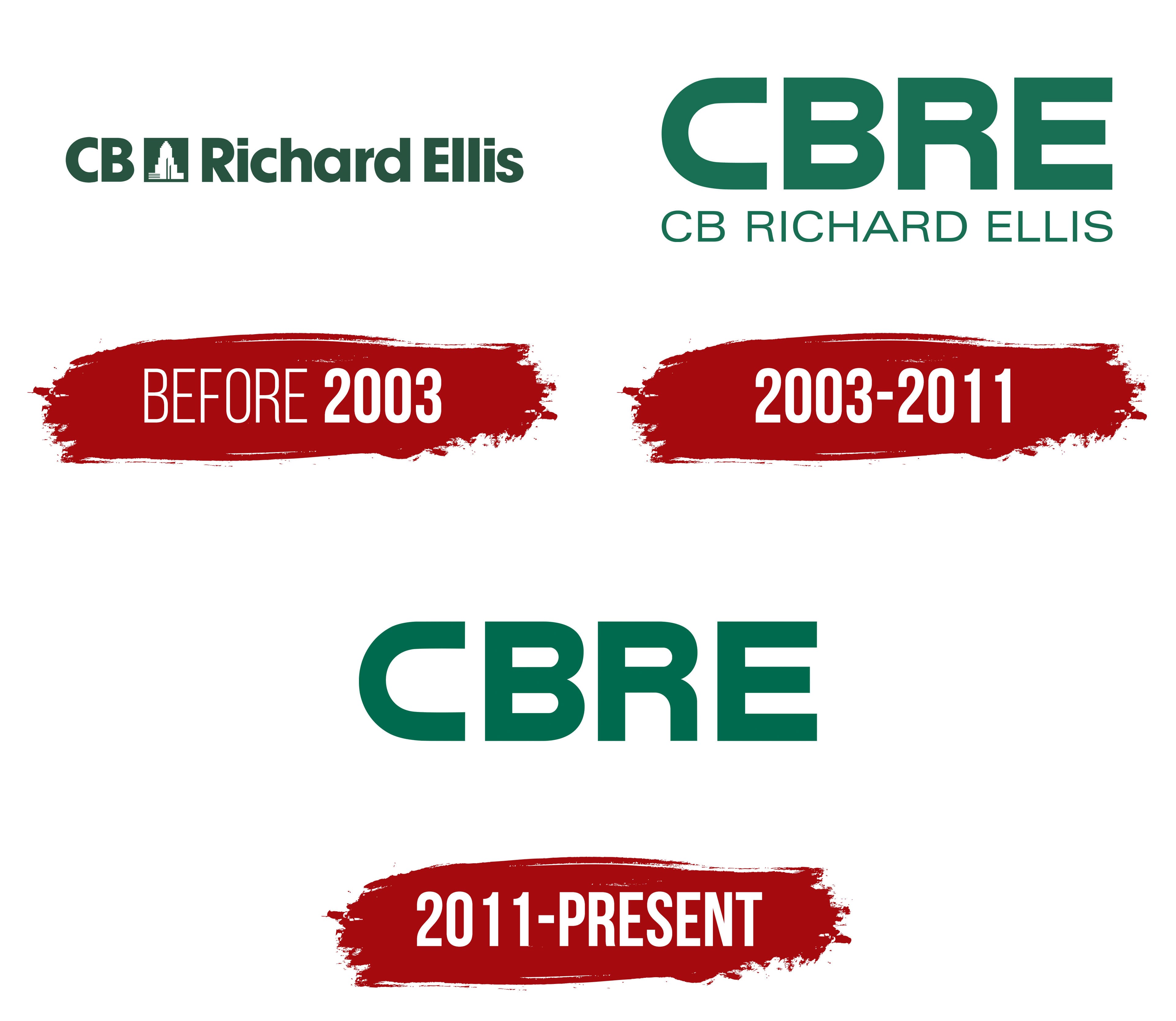
Before 2003

The logo features the company’s name in an abbreviated format. It is executed in bold, mixed-case font, both uppercase and lowercase. The first two letters are the abbreviation “CB.” The rest of the name retains the expanded writing “Richard Ellis.” Between them is a square with a high-rise building in a modern style. The multi-story building is painted white and set against a green background. This color palette is ideal for an investment company, as it is associated with finance and evokes the colors of dollar bills.
2003 – 2011

The CBRE logo of this period is entirely abbreviated. The text is divided into two lines, aligned on both sides. The top line uses all uppercase, massive letters, while the bottom uses thinner, smaller letters. They balance the large elements and add lightness to the emblem. The corporate color palette remains within the green spectrum but takes on a lighter shade.
2011 – today
There has been a significant change in the bottom row due to rebranding: instead of “CB Richard Ellis,” the impressive “CBRE Build” now appears. The bottom line also contains large, semi-bold glyphs. The top-row abbreviation is still much larger, so the letters are blocky, wide, and bold. Both inscriptions are centered. This design makes the emblem a convenient marketing tool for attracting the right category of clients: confident, business-minded.
Font and Colors

The key inscription in the CBRE logo is set in the Wagamama font, fully reflecting the company’s position on concept, work methods, and client interaction. The design is harmonized thanks to accurately representing both the expected and the actual. In other words, the letters convey the main message: the investor is reliable, stable, and durable.

Although the emblem’s color palette is restrained, it is quite expressive, with green symbolizing money, growth, and development. It is executed in the classic shades of the American dollar, setting the mood for profitable spending, undoubtedly bringing financial gain.