


 Celtic Knot Symbol PNG
Under the term “Celtic knot,” people usually group an entire range of decorative interlace patterns rather than a single sign with a fixed meaning. These ornaments appear in manuscripts, stone carving, and metalwork. Modern names and explanations for different knot types emerged much later than the images themselves.
The tradition of interwoven patterns takes shape in monasteries in Britain and Ireland during the 7th to 9th centuries. Earlier Celtic art of the La Tène period relied on spirals and vegetal motifs, while interlacing was used rarely. Later patterns continue these decorative methods but grow more complex and develop in a different historical setting.
The main surviving examples come from manuscripts. Among them are the Lindisfarne Gospels, created around the year 700, as well as manuscripts held in the collections of Durham University and Trinity College Dublin. These works are characterized by dense surface coverage and highly intricate line structures.
Attempts to explain the meaning of these patterns often rely on the idea of an unbroken line and layered structure. However, historians and museum sources indicate that original meanings have either been lost or remain uncertain. For a more precise understanding, the ornament is usually considered in three dimensions: the object’s original function, possible religious and cultural meanings in the Middle Ages, and modern interpretations.
A separate topic is the use of Celtic patterns in tattoos. Their popularity is not connected to ancient Celtic practice. According to KERA News reporting, interest in such ornaments grew out of the American blackwork movement and spread along the U.S. West Coast in the 1970s and 1980s. There is no reliable evidence of ancient Celtic tattooing. References by Julius Caesar to body painting among the Britons remain debated, partly because of the ambiguity of the word “vitrum.”
History and origins of knotwork ornament

Knotwork patterns known from Insular art of the 7th to 9th centuries developed at the intersection of Irish, northern British, and Germanic cultures. In this environment, a tradition formed of decorating manuscripts, crosses, and stone slabs with complex interlacing. Spirals and stylized animal forms are visible within the ornament. The style is known as Hiberno-Saxon and is marked by dense surface coverage with little space.
Its roots go back to the Iron Age, to the La Tène culture known for scrolls and plant-like lines. Such ornaments appear on helmets, jewelry, and sword scabbards. Compared to monastic interlace, they look simpler and less structurally dense.
The development of these patterns is closely tied to monastic scriptoria. Monks produced richly decorated books in which ornament became part of the visual framing of the text. Early codex pages from Durham show the initial stages of this style. The Lindisfarne Gospels demonstrate a high level of execution, where interlace combines with biblical scenes.
Later, the tradition reached a peak in the Book of Kells, created around the year 800 and kept in Dublin. In it, ornament plays a major role in both the presentation of the text and church practice.
Beyond manuscripts, these patterns were widely used in stone carving. In Ireland, large crosses from the 8th to 12th centuries appear, covered with interlace, geometric forms, and animal imagery. In Scotland, stones from Aberlemno dating to the late 8th century show similar motifs. Their surfaces are divided into panels filled with bands, figures, and circular patterns.
Ornaments serve different functions depending on the medium. In manuscripts, they accompany liturgical text. In stone, they reflect the influence of monasteries and their role in society. In metal, they signal the owner’s status and the level of craftsmanship. For this reason, the meaning of a pattern should be considered through a specific cultural context rather than through universal interpretations.
Symbolism and interpretations
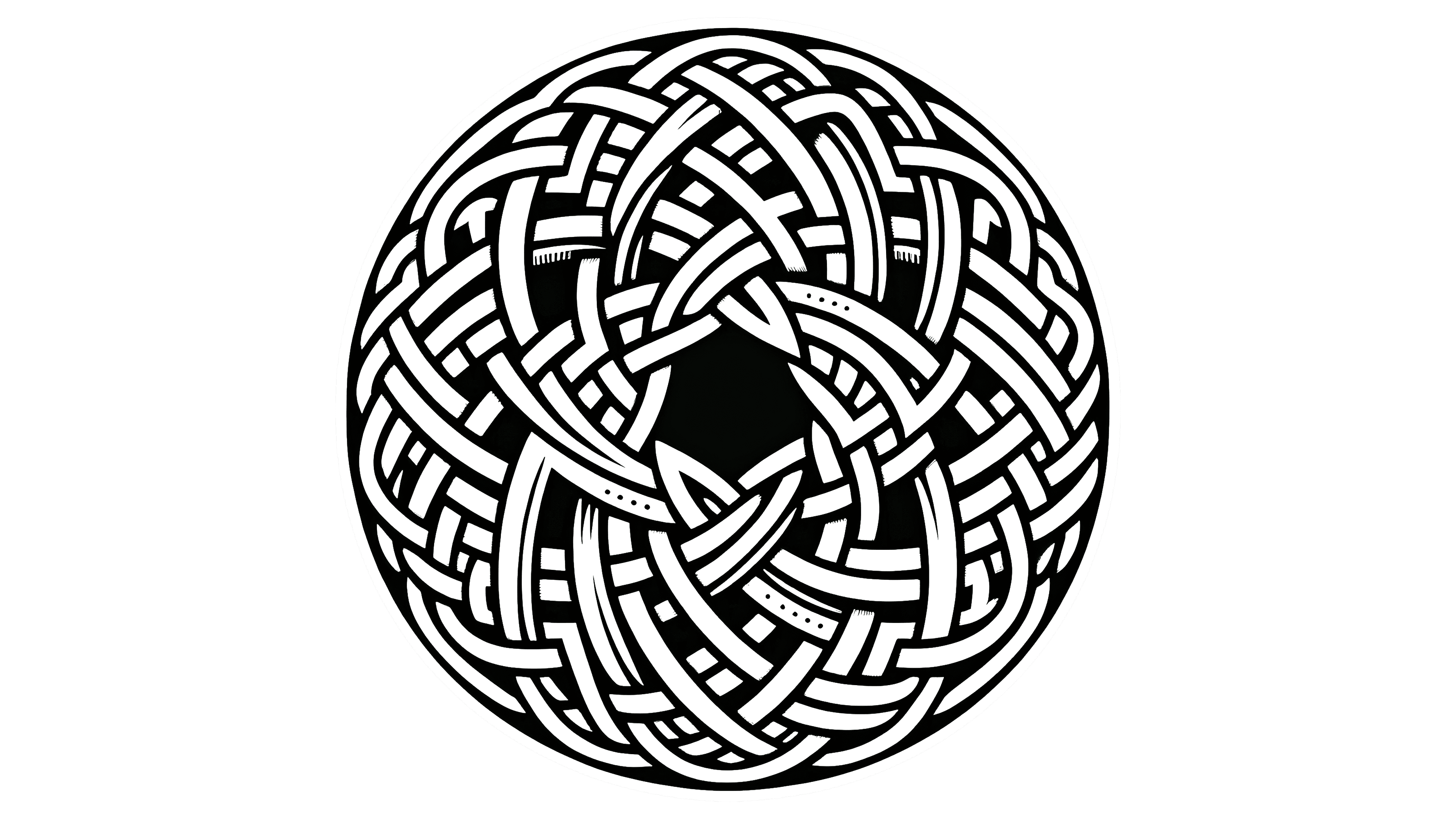
Understanding the meaning of medieval patterns is easier when viewed through the objects in which they appear. One example is the Book of Kells. Pages filled with dense interlacing were part of church rituals and enhanced the perception of the Gospel text. The ornament functioned within religious practice rather than as decoration for its own sake.
A similar situation appears with stone crosses in Ireland. They feature carved biblical scenes that helped explain the content of Scripture. Interlace formed part of a broader visual narrative about faith and the structure of the world. These crosses marked important territories and demonstrated monasteries’ influence.
Difficulties arise when patterns are interpreted too literally. Popular explanations link continuous lines to the idea of eternity and triple forms to the Trinity or to stages of life. These readings are based on modern assumptions. Medieval sources do not confirm them.
The boundary between religious and everyday objects in the early Middle Ages was fluid. Reliquaries and liturgical vessels from the National Museum of Ireland’s collection are decorated with interlacing and animal motifs. These objects reflected the status of their owners and were used in rituals. In such cases, ornament conveyed meaning without text.
Modern interpretations often blend older and newer ideas. An example is the “Dara knot.” The name is linked to the Irish word “doire,” meaning “oak grove.” The term itself is recent, emerging in a commercial context. It does not appear in medieval inscriptions.
Typology of patterns and regional variations
Interlaced patterns in manuscripts and objects varied by technique and local traits. One type is called interlace. It is built from several bands that cross in a strict over-under sequence. Another variant uses a single line closed into one design, or multiple lines joined into a unified form. These methods were used in manuscript decoration and jewelry, including the Ardagh Chalice and the Tara Brooch.
In different regions, patterns developed distinct features. In Scotland, for example, the stone from Aberlemno combines elements from several traditions. It shows triangular interlace, spirals, circles, and a key pattern ornament. Among them is the triquetra, a figure of three arcs set within compositions that include animal imagery.
In Ireland, ornament often moved from metal into stone. High crosses were covered with panels featuring animal scenes, spirals, and interlacing. Techniques used by metalworkers were transferred into stone carving, forming a unified artistic approach.
Visual features and construction principles
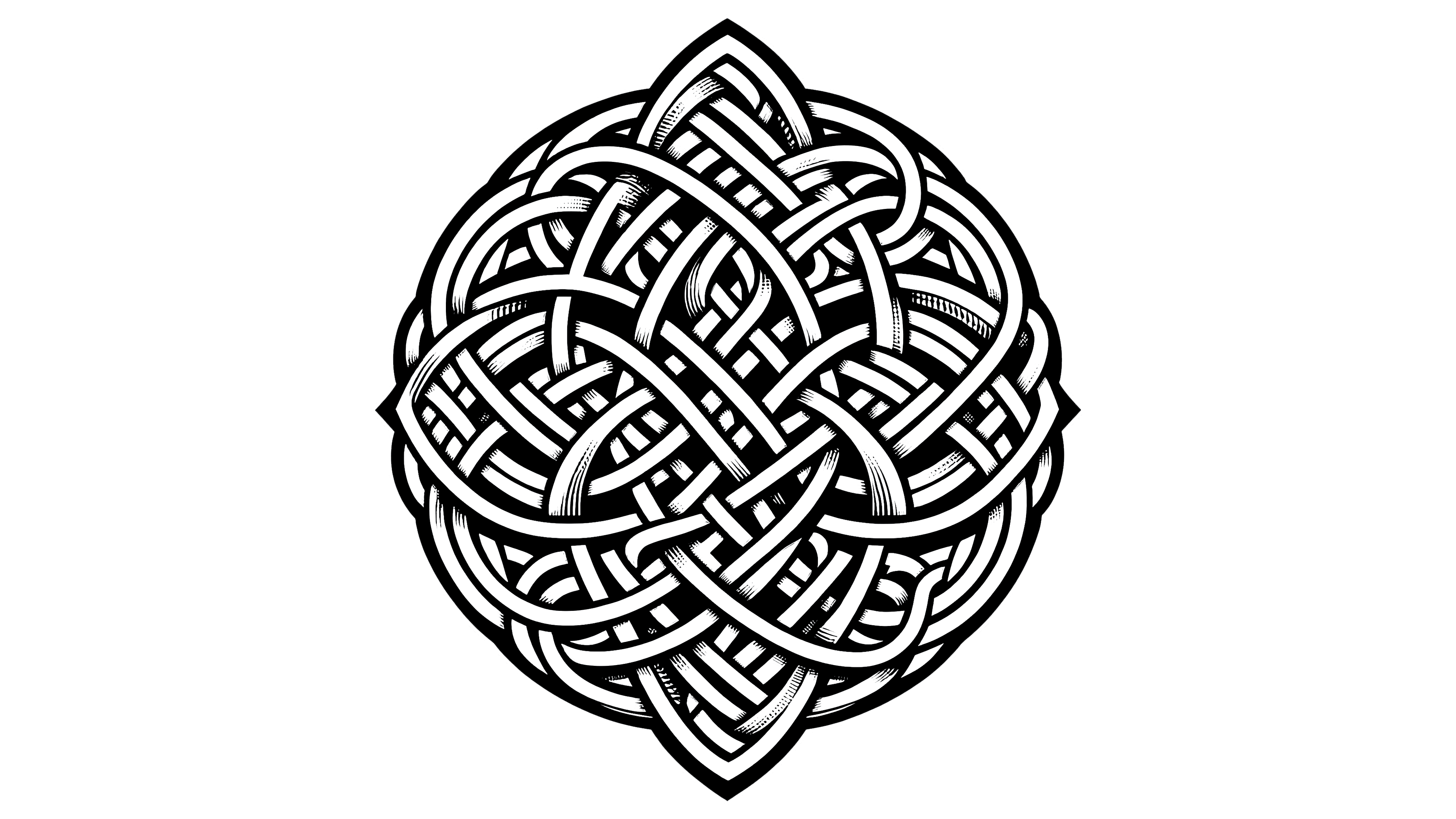
Interlaced ornament follows a fairly clear system. The surface was divided into a grid, and points were marked, similar to the layout on dice. Parallel lines were then drawn, maintaining the order of crossings above and below. In the final stage, the background was darkened to hide construction marks and leave a continuous pattern. Surviving sketches allow us to trace this process.
From a mathematical perspective, such patterns are not always “knots” in the strict sense. More often, they are interlaced, with lines crossing and diverging. Compositions include guiding elements that redirect the lines and shape the structure. For this reason, the pattern is better understood as a system of connected parts rather than a single closed knot.
The ornament relies on repetition and symmetry. These principles hold the pattern together. Despite the complex appearance, the underlying structure is relatively simple. It is close to modern algorithmic approaches, in which results are derived from defined rules.
To analyze the structure, it is useful to view the pattern in layers. The first level is the scheme of lines and their connections. The second is the order of crossings above and below. The third includes details of the bands themselves, such as thickening, and inserted figures of animals or letters. In manuscripts, this level is tied to calligraphy and page composition; in stone, to scale and placement; in metal, to filigree techniques and stone inlays.
Materials and fields of use in art
Insular interlace spread across different forms of medieval art. In manuscripts, it helped organize the page, define frames, and fill entire spreads. The Lindisfarne Gospels, created around 700, are known for so-called carpet pages where lines interweave to form dense ornament. In the Book of Kells, such patterns played a role in church rituals and enhanced the perception of the text.
Stone crosses in Ireland used ornament to convey religious narratives. Their panels combine interlacing with geometric, animal, and spiral motifs. Through these images, people were taught the content of Scripture. The crosses also marked lands associated with monasteries. In Scotland, for example, the stone from Aberlemno shows a mix of pattern types, including circular and triangular forms, as well as triquetras alongside animal figures.
Metal objects stand out for their complexity. The Ardagh Chalice is covered with fine filigree and animal imagery embedded within interlace. The Bell Shrine of St. Patrick is decorated with a cross and patterns of bands and animal figures. The Derrynaflan Paten comprises hundreds of elements and combines ornamentation with human and animal imagery.
At the end of the 19th and beginning of the 20th centuries, interest in such patterns rose again. During the Celtic Revival, they were actively used in ceramics, textiles, and jewelry. The company Liberty & Co. played a notable role in their spread. Museum exhibitions and a broader interest in ancient monuments contributed to this popularity.
Celtic knot tattoos
Tattoos using these patterns have a separate history. The ornament itself is old, but widespread use in tattooing began in the United States in the 1970s and 1980s. This was influenced by the blackwork style that developed on the West Coast. Despite associations with antiquity, there is no evidence of a Celtic tattoo tradition.
Ancient texts that mention body coloring among the Britons are more likely to refer to war paint than to tattoos. Medieval Christian sources describe skin markings negatively, associating them with pagan practices. These references do not concern decorative patterns.
In a modern context, such images are often seen as markers of origin or personal narrative. There is also a risk of simplification, where a complex culture is reduced to a set of ready-made symbols.
Tattoo artists usually focus on three aspects: the type of pattern, the level of detail and line density, and personal meaning for the individual. When working with fine interlace, line thickness matters, as thin lines can blur over time. Larger forms tend to hold up better and retain their appearance longer.
From a practical standpoint, the pattern’s structure directly affects durability. The more fine lines and the closer they are to each other, the faster the image loses its form.
Modern use, branding, and debates
The image of the Celtic knot in popular culture formed gradually. Interest in ancient monuments first led to the copying of these patterns in late-19th-century objects. Later, they became widely used in jewelry, souvenirs, and tattoos.
Museums and historical sources associate interlaced ornament with religious objects and rituals. Items such as the Derrynaflan Paten show the complexity of craftsmanship and their link to church practice. Irish crosses combine different pattern types and convey religious narratives.
Interpretation errors arise for several reasons. New names are assigned to patterns that did not exist before. Different styles and periods are grouped under a single term. There are attempts to assign a single universal meaning while ignoring historical context.
The pattern is often associated with ideas of infinity or with connections between things. In the historical context, however, it served as a means of organizing a surface and demonstrating the maker’s skill. Research shows that such ornaments are built according to strict rules, using grids and ordered line crossings.
The motif’s structural simplicity and visual form made it popular in branding. It is perceived as a sign of tradition and history. At the same time, the meaning of the pattern depends on the specific object, period, and cultural context in which it was used.