


 ChatGPT Logo PNG
ChatGPT’s simple logo belies the program’s complex artificial intelligence. Its unique structure, minimal color, clean lines, and intricate form define this virtual conversationalist’s emblem. However, rich internal content underpins its unassuming exterior, built on cutting-edge technology.
ChatGPT is tied to its creator. In December 2015, OpenAI was founded in San Francisco as a nonprofit research organization focused on safe artificial intelligence. Its founders included Sam Altman, Ilya Sutskever, Greg Brockman, Wojciech Zaremba, and John Schulman. Elon Musk publicly supported the project, while the planned $1 billion in donations reached only about $130 million by 2019.
The technical base came through the GPT models. GPT-1 appeared in 2018 with 117 million parameters. In 2019, GPT-2 reached 1.5 billion parameters, and the full release was delayed because of misuse concerns. That year, the organization adopted a capped-profit structure, allowing Microsoft to invest its first $1 billion. In 2020, GPT-3 arrived with 175 billion parameters and was offered through an API.
On November 30, 2022, ChatGPT launched as a free research prototype based on GPT-3.5. It reached 1 million users in 5 days and 100 million in 2 months, faster than Instagram or TikTok. The launch pressured Google, which soon introduced Bard. In early 2023, ChatGPT Plus cost $20 per month, Microsoft added the technology to Bing, and the ChatGPT API opened to developers.
On March 14, 2023, GPT-4 was released as a multimodal model capable of working with images. In November 2023, the board removed Sam Altman, then reinstated him after staff threatened to leave. In 2025, the company transitioned to a Public Benefit Corporation structure with nonprofit oversight. By 2026, its valuation exceeded $850 billion.
Meaning and History

Artificial intelligence represents a breakthrough in how the real world and digital virtuality interact. These two facets of the world maintain contact, enriching each other with knowledge and skills. The result is a symbiosis that aids work on multiple levels, as ChatGPT is versatile. It can serve as a conversation partner and provide prompts across various domains. The chatbot can write computer programs, adjust settings, compose music, songs, and poems, simulate chats, translate texts, generate business ideas, answer quiz questions, write plays and fairy tales, simulate ATMs, play games, and more.
Compared to its predecessor, InstructGPT, this modern program serves as a substitute for humans and approaches communication more flexibly. It makes fewer errors, avoiding potentially deceptive and harmful responses. Its logo captures its exclusivity, accuracy, simplicity, and technological sophistication well. Designers grasped the essential nature of the virtual conversationalist and offered a conceptual emblem that reflects, if not all, at least most of its characteristics.
What is ChatGPT?
ChatGPT stands for Generative Pre-trained Transformer, an artificial intelligence program. It is one of the largest chatbots and includes an initial (trial) version and a stable (enhanced) version. The former appeared online in 2022, while the latter was released in 2023. OpenAI developed it using a large language model based on its Generative Pre-trained Transformer (GPT) architecture. The program is precisely tuned to support conversations on a range of topics.
2022 – today
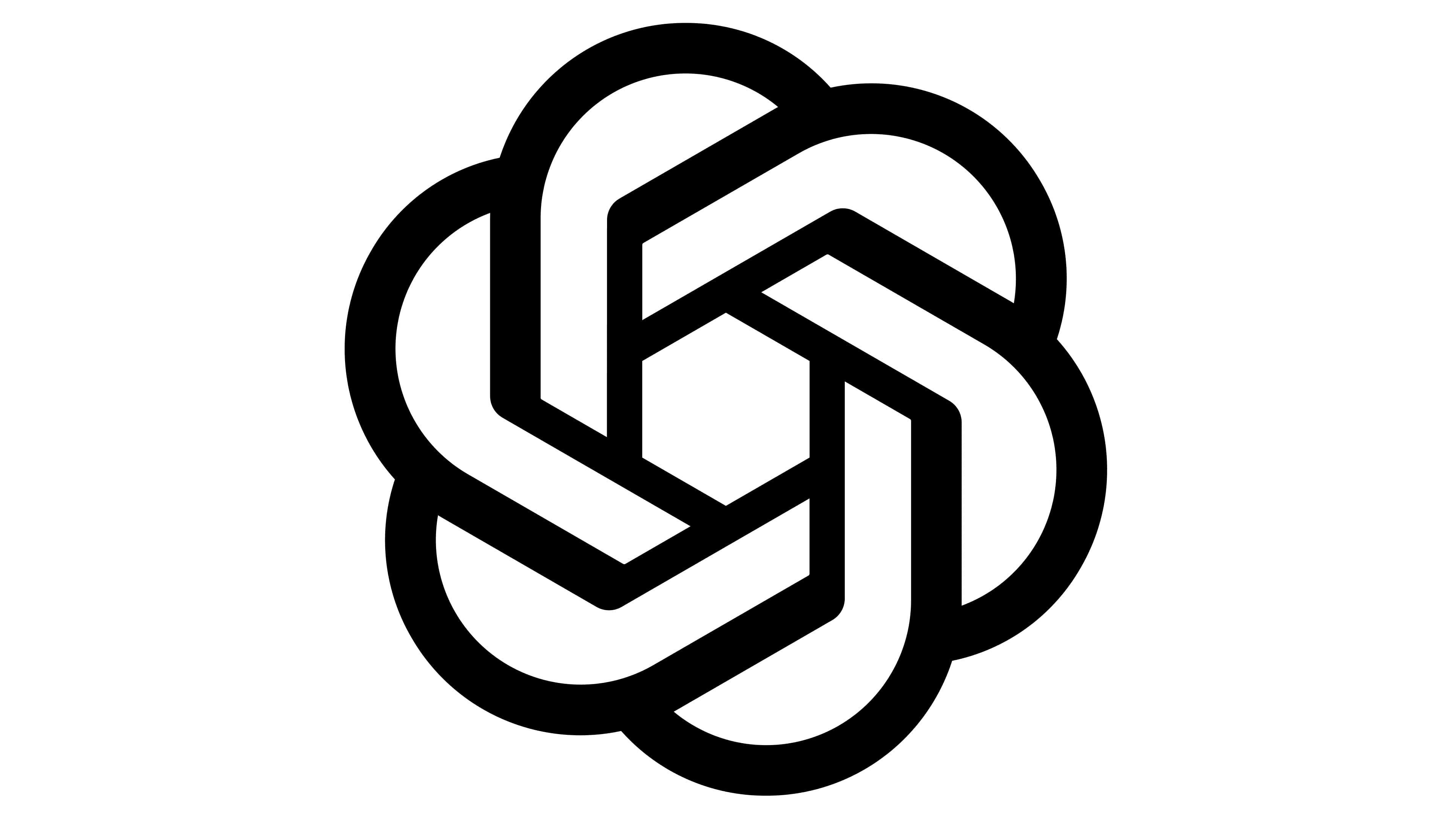
The ChatGPT logo is a compelling piece of graphic design that efficiently communicates the application’s core attributes, including its vast capabilities, reliability, strict logic, and tight integration with its foundational elements. The logo uses a strict geometric shape that evokes a vortex or a tightly woven wreath. At the core of this intricate design is a hexagon, clearly outlined in negative space by six uniform elements resembling clubs with broad contour stripes. The harmonious blend of angles and curves creates an eye-catching and balanced symbol.
The vortex-like shape clearly represents the application’s powerful capabilities and comprehensive functionality. This suggests ChatGPT isn’t just a run-of-the-mill chatbot, but a tool that can handle and generate a wide range of complex tasks. The symbol encapsulates that the application can draw users into a universe of options, capabilities, and consistent logic.
The central hexagon nods to the application’s structured approach to problem-solving. Hexagons appear in nature and engineering to represent efficiency and structural integrity. Here, the hexagon in ChatGPT’s logo is more than an aesthetic choice; it conveys the application’s commitment to delivering logical, well-structured, and reliable results.
The six identical elements that form the hexagon represent ChatGPT’s adaptability and versatility. Each club-like figure shows that ChatGPT spans multiple domains and isn’t limited to a single function. This diversity is harmonized into a cohesive whole, much like the application, which integrates various features to function as a comprehensive tool.
The blend of sharp angles and smooth curves captures ChatGPT’s dual nature. While it is powered by cutting-edge algorithms (symbolized by angles), its user interface and experience are designed to be as intuitive and user-friendly as possible (indicated by curves). This seamless marriage makes the application robust yet accessible.
In short, the ChatGPT logo captures the application’s essence: a multifaceted, reliable, and highly capable tool for a wide range of uses. The geometric intricacies aren’t just eye candy; they convey the brand’s reliability, broad functionality, and tight integration with foundational algorithms.
Font and Colors
The ChatGPT emblem contains no inscriptions, abbreviations, or individual letters because it isn’t text-based. The key emphasis is on the program’s universality, so the visual identity centers around the graphics.
The official color scheme is monochrome. This combination doesn’t distract users from the chatbot’s primary tasks and underscores its seriousness and restraint. The presence of black and white also suggests the project’s non-entertainment nature.