


 Crocs Logo PNG
Shoes that can “drive” off-road, like roller skates, embody the Crocs logo. The emblem points to soft, closed-toe sneakers that hug the feet. A key feature of the models is good airflow and comfort while walking.
Crocs began during a sailing trip in May 2002, when Scott Seamans, Lyndon “Duke” Hanson, and George Boedecker Jr. discussed ideal boat shoes on the way from Mexico to Fort Lauderdale. Seamans had found Foam Creations, a Canadian company making lightweight clogs from Croslite. This EVA-based, closed-cell resin was waterproof, slip-resistant, odor-resistant, and floatable.
The founders registered Western Brands LLC and licensed the Foam Creations design. Seamans refined the shoe shape, Boedecker raised early funding and became CEO, while Hanson handled operations. The name Crocs came from the crocodile, an animal suited to both land and water. The first model, Beach, debuted at the Fort Lauderdale Boat Show in 2002, where all 200 pairs sold on the first day.
In 2004, the company acquired Foam Creations, secured rights to Croslite, and became Crocs, Inc. The shoes soon moved beyond boating, gaining users among nurses, surgeons, chefs, waiters, and gardeners. By 2005, Crocs had sold 6 million pairs, and TDA Boulder launched the “Ugly Can Be Beautiful” campaign. In 2006, Crocs went public on NASDAQ at $21 per share, raising $208 million.
Crocs bought Jibbitz in late 2006 for $10 million after its shoe charms became a fast-growing side business. Revenue reached $847 million in 2007, but the 2008 crisis brought excess inventory, closures, and layoffs. Recovery was slow, with revenue passing $1 billion in 2011 and total sales reaching 300 million pairs by 2017. Pop-culture collaborations with Justin Bieber, Post Malone, and Bad Bunny revived demand. In 2022, Crocs bought HEYDUDE for $2.5 billion.
Meaning and History
Crocs were created as a waterproof, one-piece shoe for boaters that could be submerged. But EVA foam products quickly gained fans because they proved incredibly comfortable. High school students, in particular, appreciated these sabots and used them as school shoes. Over time, the manufacturer sought to expand his target audience, so he filed a patent application for injection-molded Crocs.
Orthopedists have concluded that they adjust to the foot individually and provide some medical benefits. In addition, this style of sabots is recommended as a breathable work shoe, and Crocs has also filed a patent for it. It also has three certificates for design and decorative elements. The company received these in 2006, and in 2007, it applied to register its name and the Crocs logo. It sent requests to more than forty jurisdictions and included not only shoes but also related products such as watches, knee pads, eyeglasses, bags, suitcases, and some types of its online stores. Along the way, the firm also bought up competing and related businesses, expanding its reach.
However, its shoes are not universally admired and remain controversial in many ways. Some people still oppose Crocs, resenting them and arguing that they look disgusting. There are even entire protest movements. But Crocs don’t give up their position; they produce them in many different types and colors. By 2021, they were already available in 20 colors, various styles, and combinations. Most importantly, they have special ventilation holes that help prevent foot sweat. But this brand has far fewer logos: only three.
What is Crocs?
These comfortable and colorful clogs, made from patented Croslite material, have become a global phenomenon. These lightweight models, with distinctive ventilation holes and unique designs, have evolved from simple beachwear into fashionable accessories worn by celebrities and people worldwide. This footwear created an entirely new category that combines functionality, comfort, and instant recognizability. Each owner can personalize their pair with decorative charms known as “Jibbitz.”
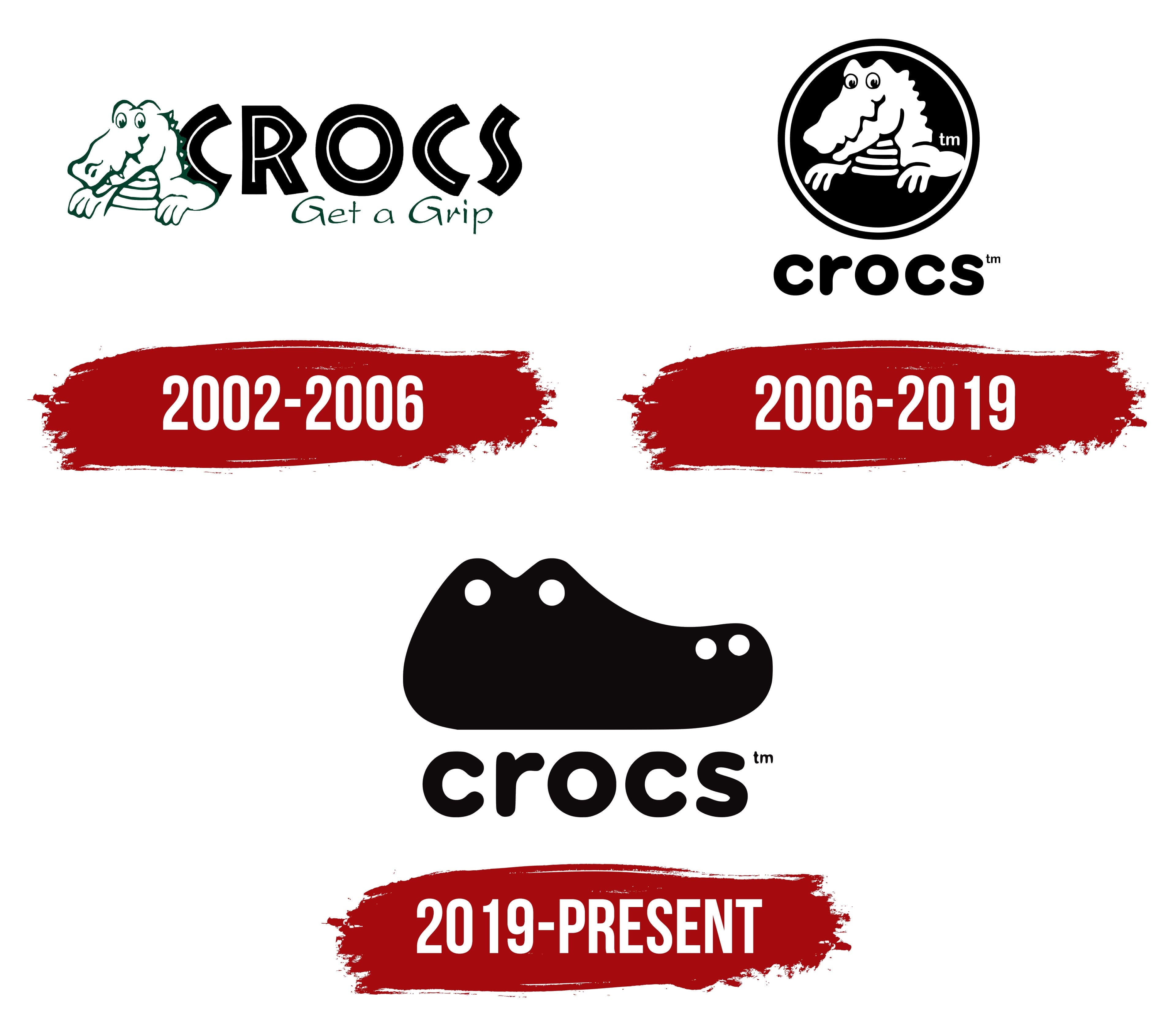
2002 – 2006

The debut logo consisted of a green crocodile. It sat on the left side of the inscription in a playful uppercase font. The letters were black with a thin white stripe in the center. It echoed the sinuous outlines, making the characters more prominent and adding to the overall dynamic. The alligator was smiling and looked good-natured despite its sharp fangs. On the right, below the company name, a slogan read: “Get a Grip.” The crocodile image was used intentionally to emphasize the shoes’ “all-terrain” nature. Like this amphibian, the shoes are perfectly adapted to both land and water.
2006 – 2019

After the redesign, the crocodile changed slightly in appearance. Its sharp teeth and spines disappeared, and its eyes became round instead of elongated, which made it look more good-natured. The animal was drawn in a circle on a black background and given a double border. The word part was placed below. It had no serifs and was lowercase. The letters looked rounded and a bit bulky, and their ends echoed the iconic shoe’s front, which the Crocs brand is known for.
2019 – today
In the current version, the legendary crocodile is preserved, but it is depicted in a symbolic form resembling Crocs. The front of the shoe is shaped like a long alligator snout, and the two miniature holes on it look like nostrils. The animal’s eyes are painted with slightly larger, contrasting-color dots and are set on high ridges. These protrusions are shaped to form a sabot hole through which the foot slips. The brand name is in the style of the previous logo. It has not been changed.
Font and Colors

The brand identity transformation degrades the crocodile image from realistic to abstract. While the early logos depicted the animal’s head and torso, the later version depicts only the head. It no longer shows anatomical details, and the alligator is recognizable only by its outline. And over time, the company’s name became a common noun and spread to its footwear. Therefore, these sabots are called “Crocs” by buyers.
The logo inscription is set in Gotham Rounded Bold, with wide, bold letters. They are not cut but rounded at the ends, which reminds one of the front of the branded shoes. An alternative option is the AG Book Rounded BQ-Bold font, which also matches the lettering’s signature style.

The emblem’s color is monotonous. If there was green at the beginning, it is now absent. Only black and white remain.