


 Detroit Pistons Logo PNG
The Detroit basketball club, founded in Indiana in 1941 as the “Fort Wayne Zollner Pistons,” reflects its history and significant characteristics in its emblem. The Detroit Pistons’ emblem demonstrates patriotism, commitment to its heritage, and professional affiliation.
Fred Zollner was an industrialist and the founder of Zollner Corporation in Fort Wayne, Indiana. In 1939, he decided to enrich the mundane routine of a piston manufacturer and establish a basketball club. He named the team the Fort Wayne Zollner Pistons. For seven years, the Pistons competed in the NBL and won the championship twice. In 1948, the club joined the BAA, which later became the NBA. Despite the team’s popularity in its hometown, management, following the trends of the time, considered relocating to a larger facility. Therefore, in 1957, the team moved to Detroit. The city’s name was a fitting choice.
Basketball clubs already existed in the capital of the Automotive State, but “hungry” fans who loved spectacles warmly welcomed the newcomers, who changed their name to the more patriotic Detroit Pistons.
The team’s owner, an avid basketball fan, also contributed significantly. Zollner provided all kinds of support to the newly formed Association and helped introduce throws and the 6-foul limit into the rules of the game. He was also the first owner to buy a private plane for team flights between cities.
Fred Zollner’s significant contribution was duly recognized: in 1999, he was inducted into the NBA Hall of Fame, and the Western Conference champions’ trophy still bears his name.
Meaning and History
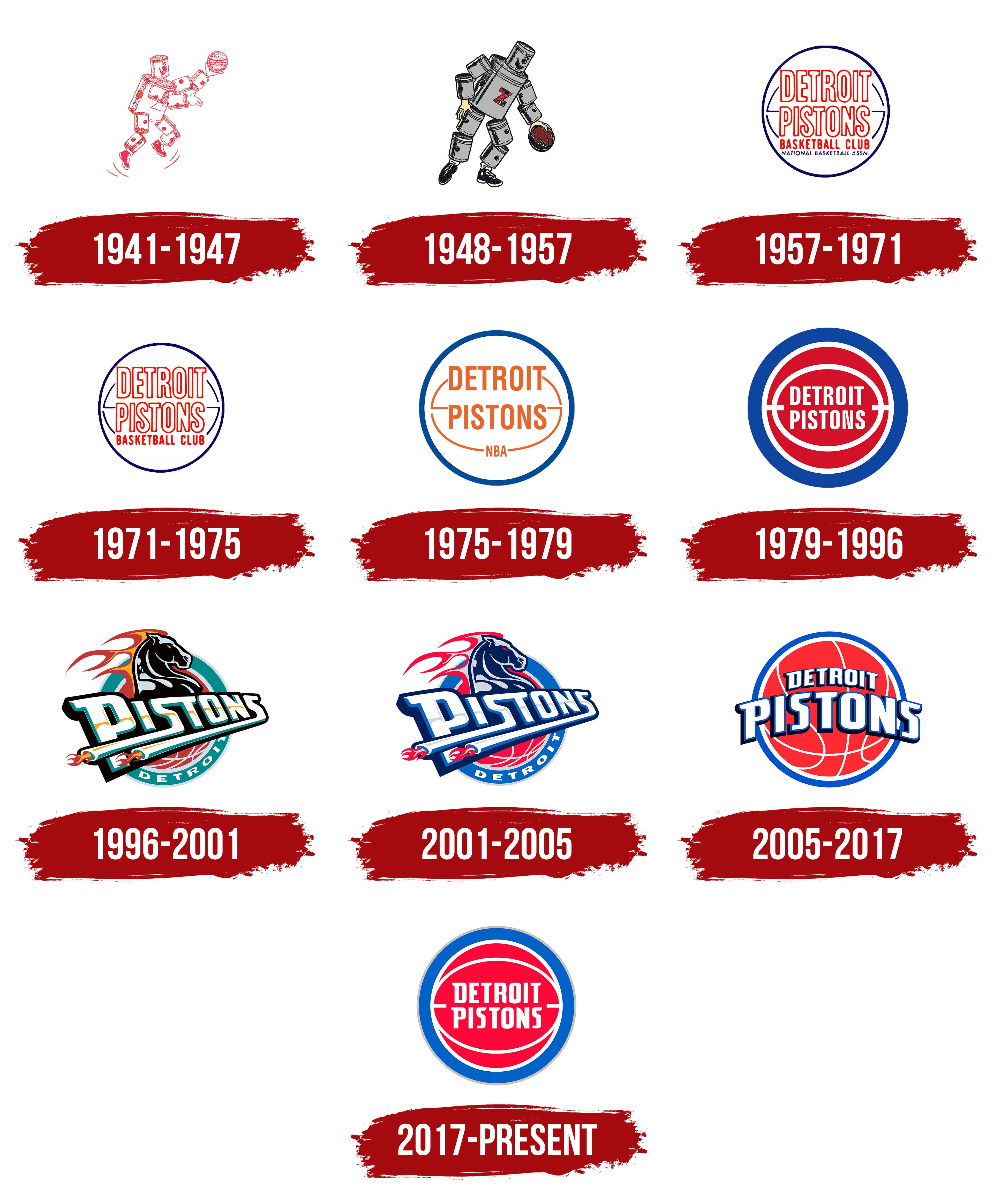
The Detroit Pistons’ sports history is long. Moreover, it includes relocations that significantly influenced the original symbolism. As a result, since 1941, the team has had numerous logos, united by only one element: a basketball. Six emblems are directly related to it, while the other four include it as a base component, accompanied by other details.
What is the Detroit Pistons?
The Detroit Pistons are a basketball team that moved from Fort Wayne (Indiana) to Detroit (Michigan) in 1957. Before that, it was known as the Fort Wayne Pistons, and earlier (from 1937 to 1948) as the Fort Wayne Zollner Pistons. Since 2017, the franchise has played at Little Caesars Arena. The club is part of the National Basketball Association and has even won three league championships.
1941 – 1947
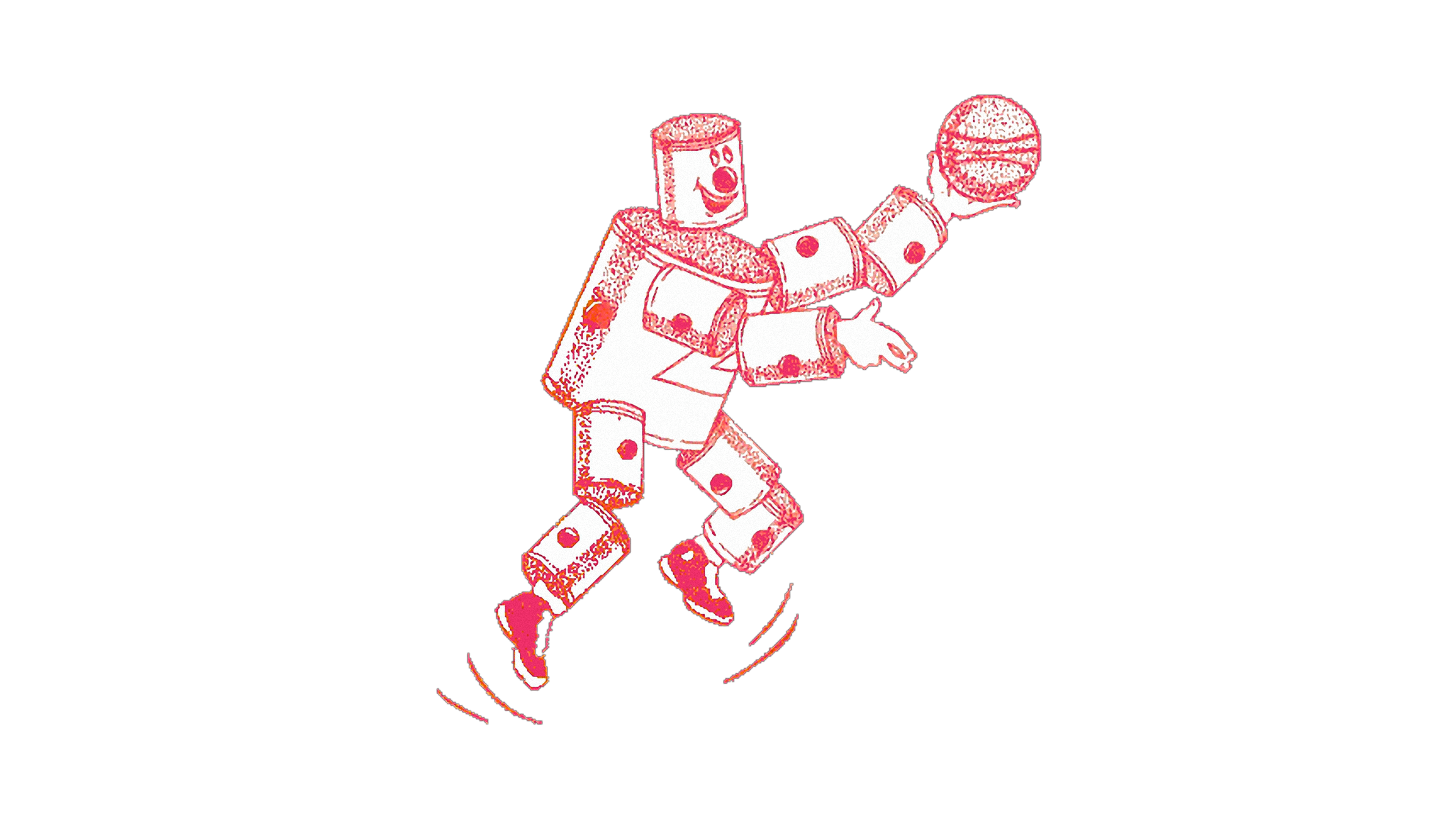
The program began as the “Fort Wayne Pistons” and adopted a corresponding symbol. It was an anthropomorphic character made of automotive pistons: two for each arm and leg, one for the head, and the largest for the torso. The improvised basketball player was tossing a ball up. All the logo’s details were red and white.
1948 – 1957
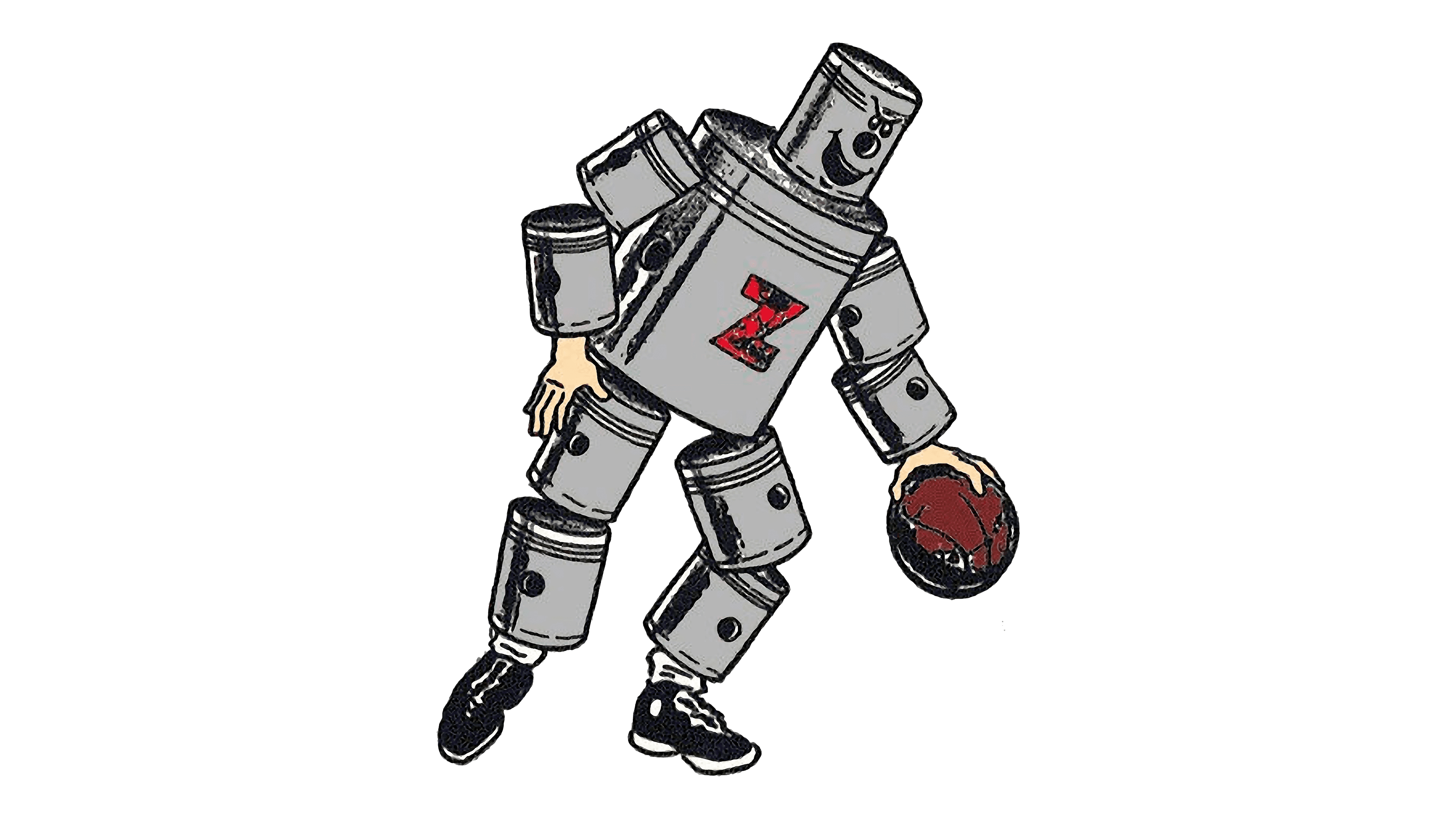
In 1948, the emblem was redesigned, making the pistons that make up the basketball player more realistic in both drawing and color. The gray “metallic” basketball player is dribbling. On his chest is a red letter “Z,” the first letter of “Zollner,” which was part of the club’s debut name.
1957 – 1971
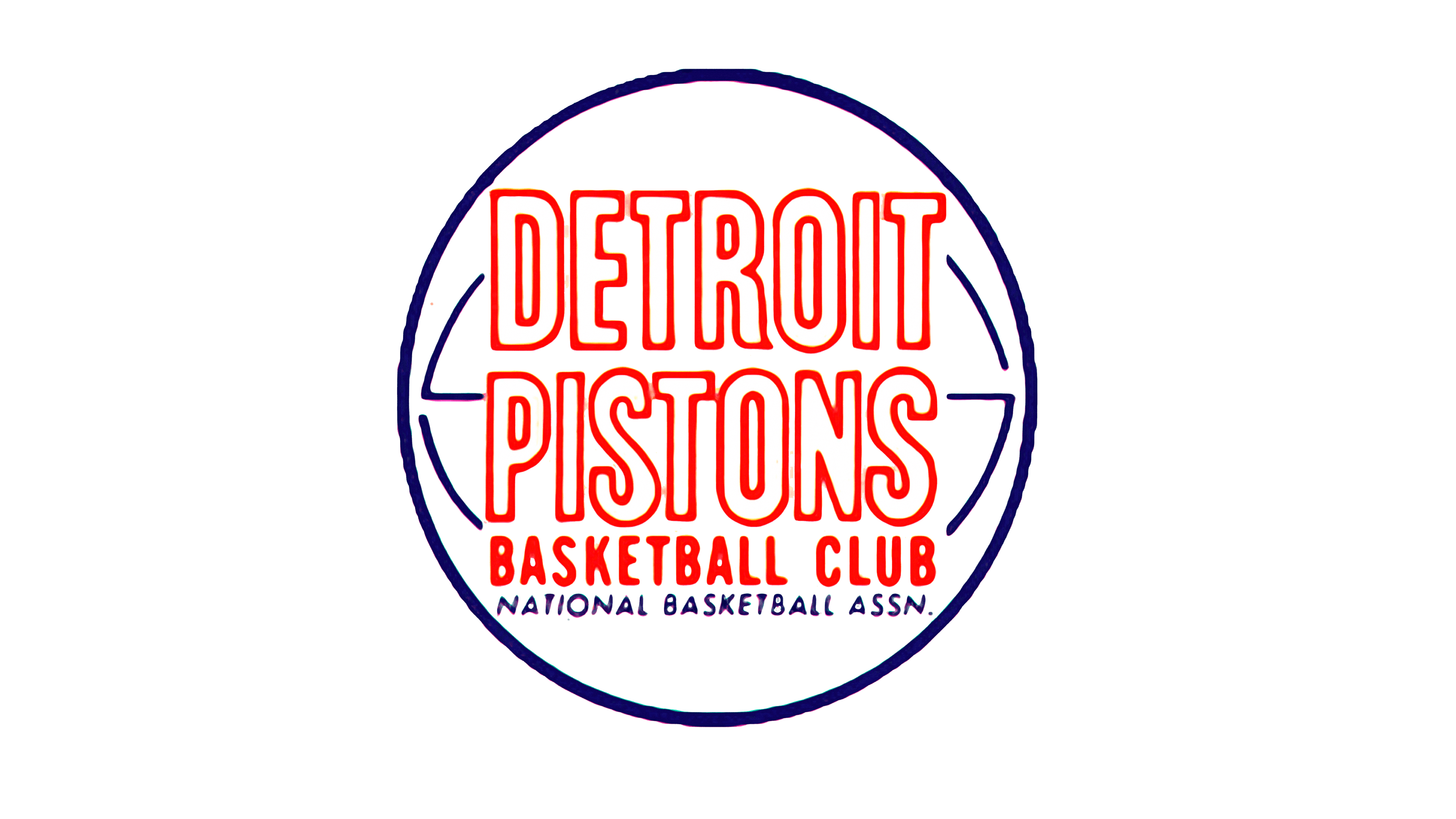
After the franchise’s relocation to Detroit, it was renamed the Detroit Pistons. The emblem also changed – it was simplified to a ball, focusing on basketball themes and text. Several inscriptions appeared on the emblem: the largest at the top, “DETROIT PISTONS,” medium in the middle, “BASKETBALL CLUB,” and small font at the bottom, “NATIONAL BASKETBALL ASSN.”
1971 – 1975
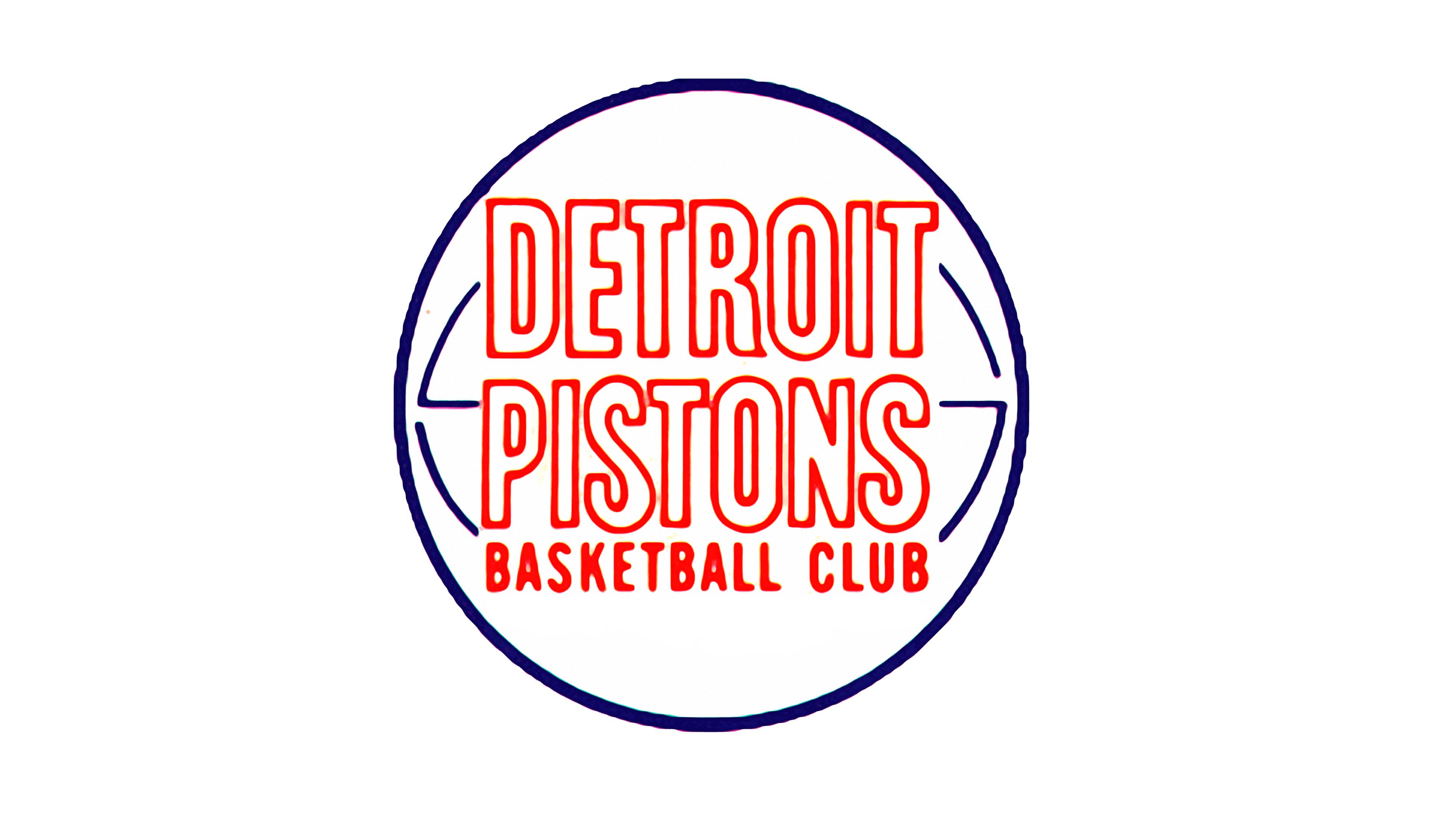
Another structural change made the logo visually simpler: the badge now depicted only a ball with two inscriptions. The designers removed the third (bottom) one.
1975 – 1979

Management made the emblem more expressive by thickening the ball’s outline. They also shortened the phrase “NATIONAL BASKETBALL ASSN” to “NBA” and changed the letter color to a muted orange.
1979 – 1996
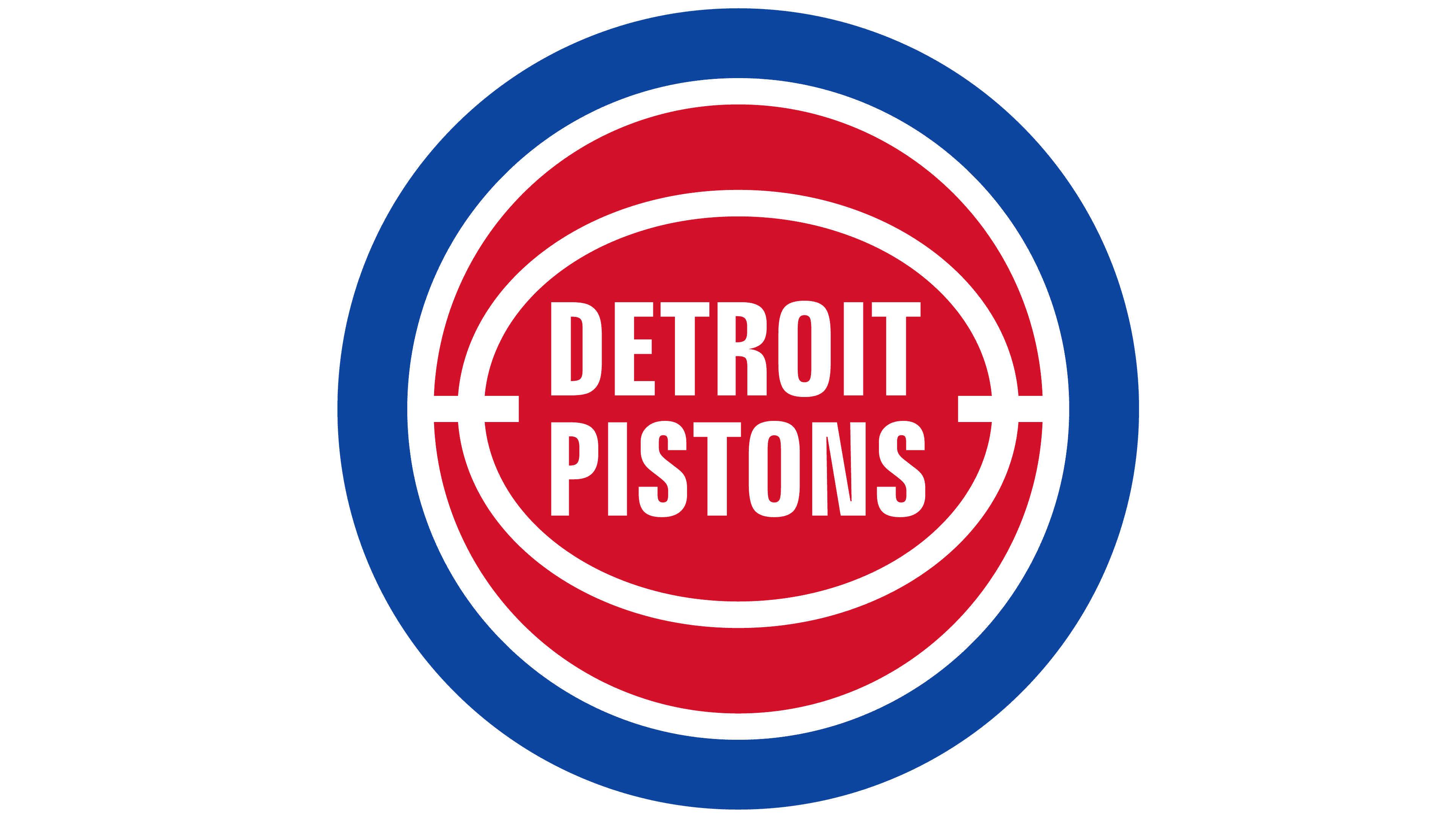
In this version, developers used the classic round disc principle, placing several round elements inside one another. In the center is a horizontal oval with the inscription “DETROIT PISTONS.” Next is a circle with a thin white stripe, followed by a wide blue ring. It occupies the entire outer side of the logo.
1996 – 2001
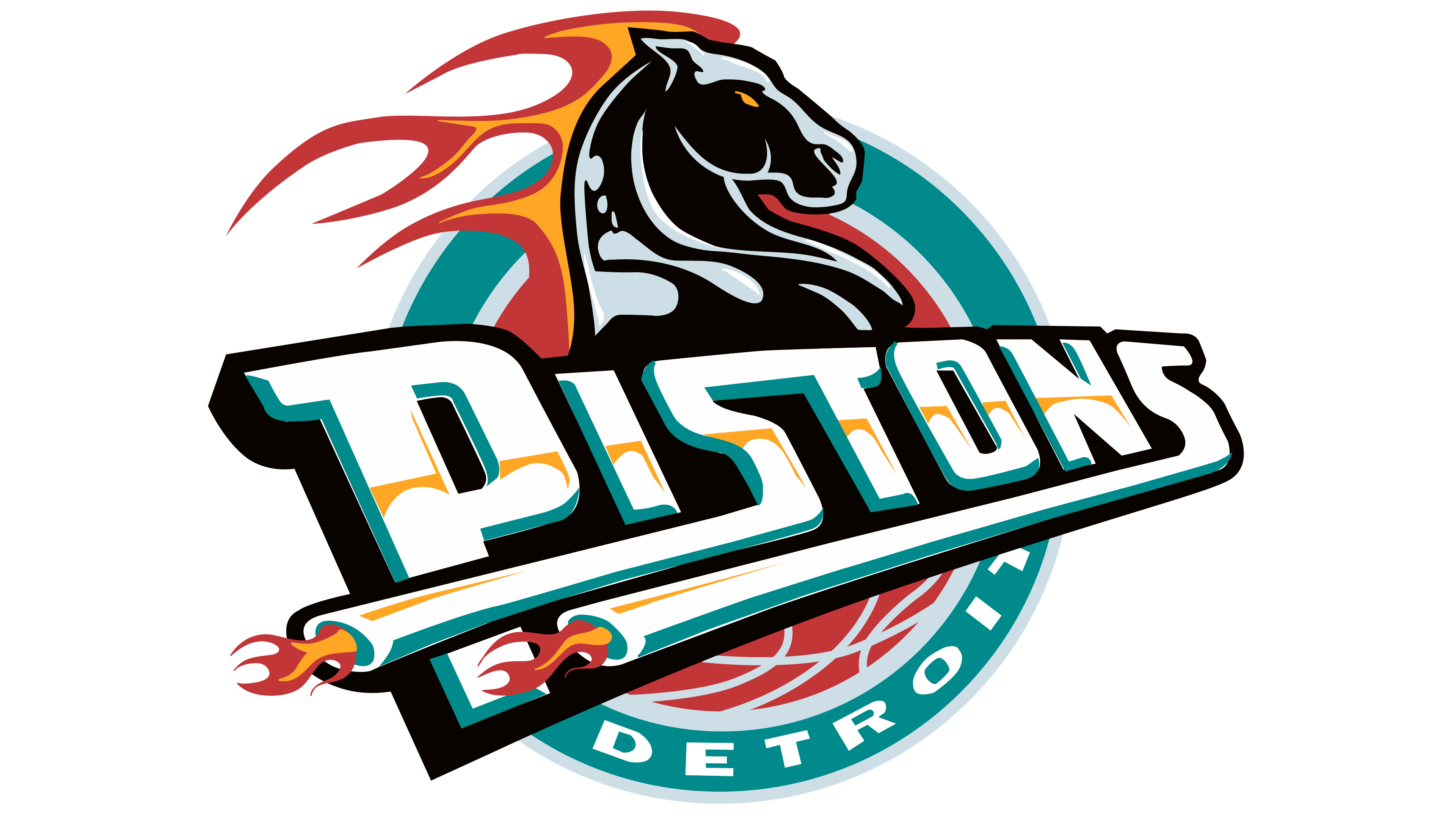
To modernize the logo and make it fresher and more appealing, the basketball team changed its design. This version introduced a nod to the transportation theme: the image of a horse (hinting at horsepower, a measure of engine power) and the elongated legs of the letter “S” (styled as car exhausts).
The logo also features a basketball (at the center), the word “PISTONS” (horizontal), and flames (in the horse’s mane). The round background still has a blue framing ring, and it features the second part of the sports club’s name: “DETROIT.”
2001 – 2005
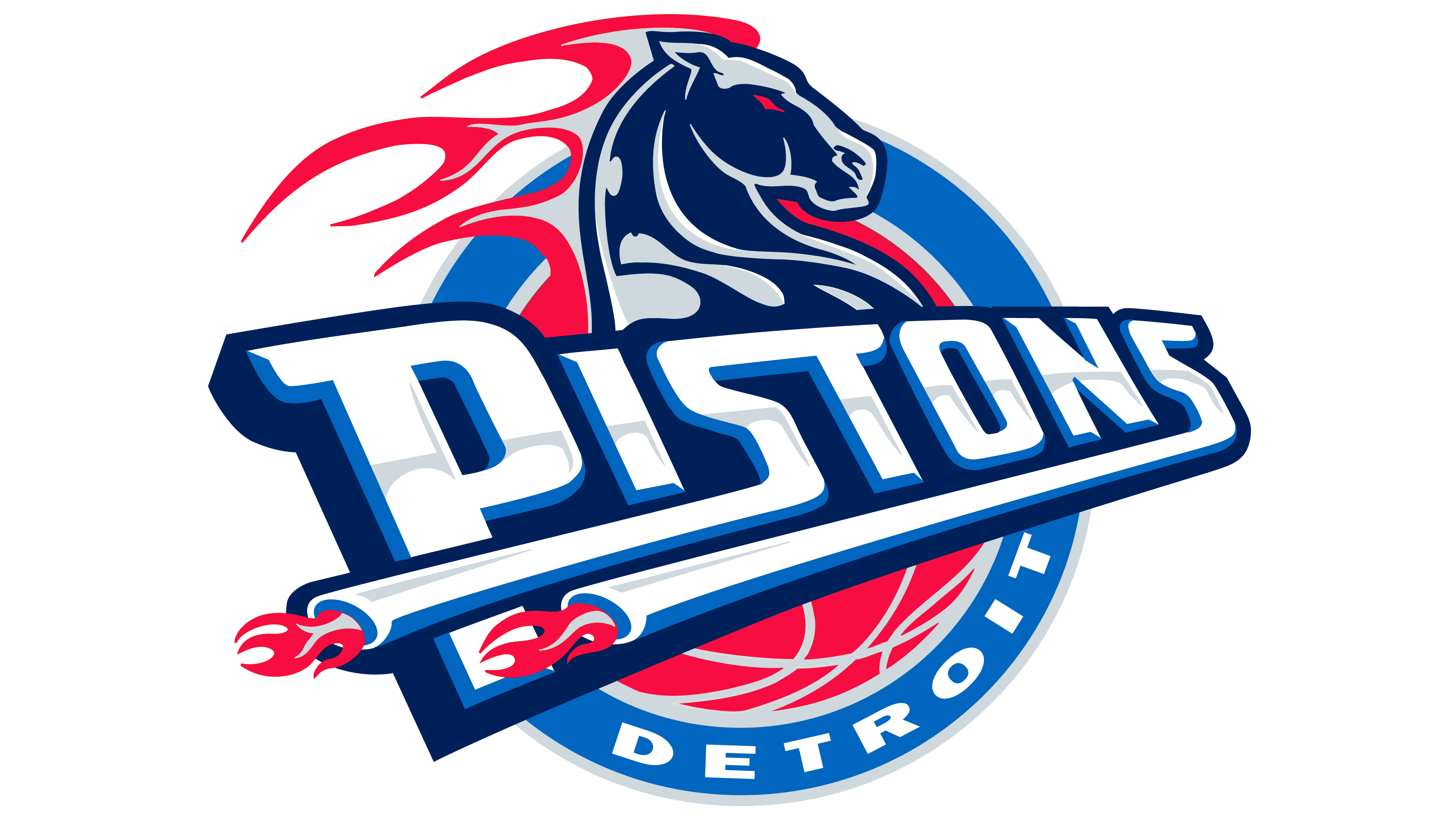
In 2001, the team added new colors to the logo. Instead of black, yellow, and turquoise, blue, red, and light blue now dominate. The gray color remained the same. The elements’ shapes were also preserved.
2005 – 2017
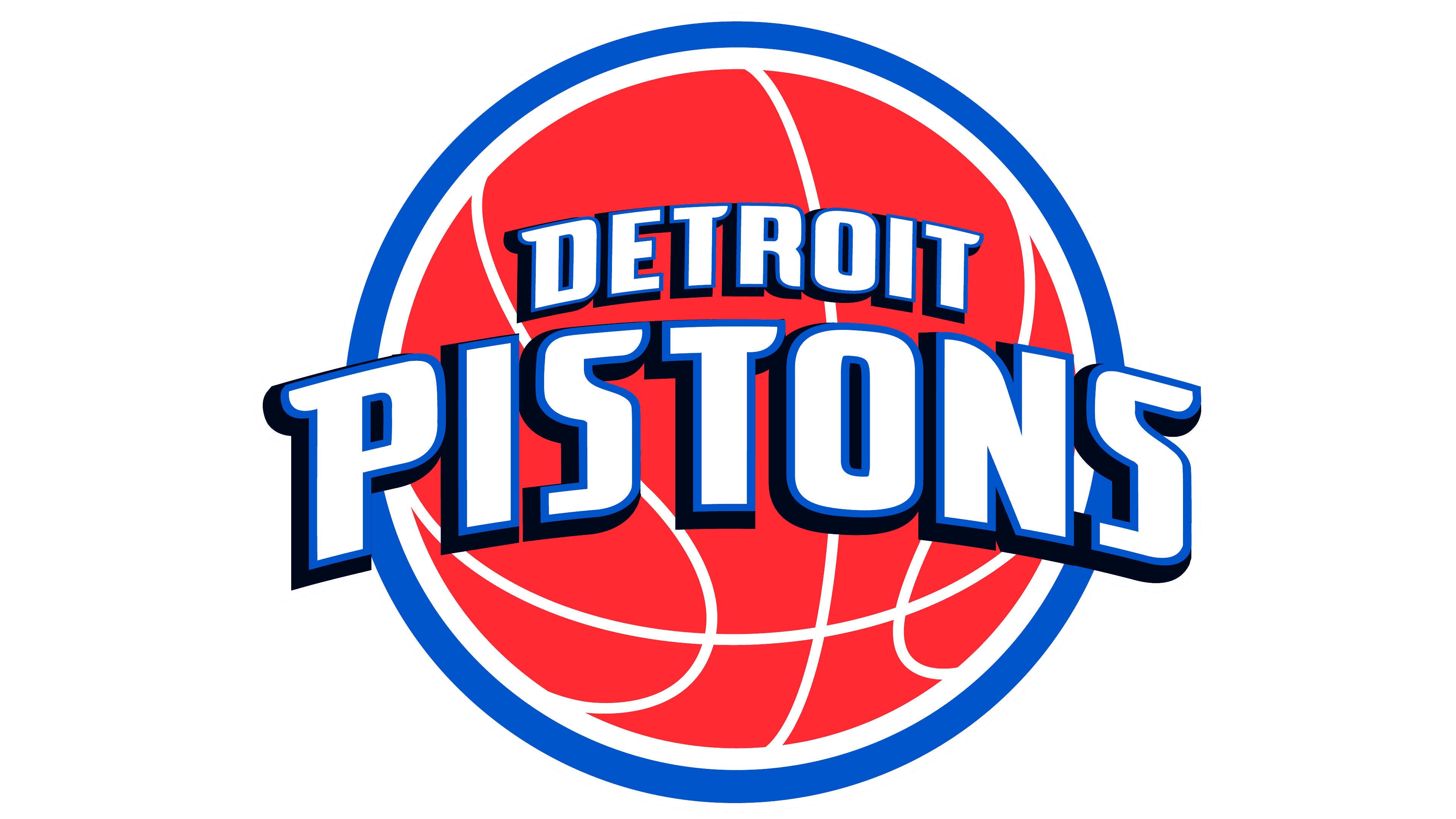
The emblem featuring the horse’s head was unpopular. Fans and journalists largely criticized this version of the “Detroit Pistons” emblem. Moreover, it was called a racing or horse-racing emblem. As a result, in the 2005/2006 season, the team’s management adopted a new simplified design. The emblem consists of a red basketball, a white inscription with shadows, and a blue-bordered circle. The palette matches the colors of the US flag. The team name is centered and shaped like an arc. The top word is small, and the bottom word is large.
2017 – today
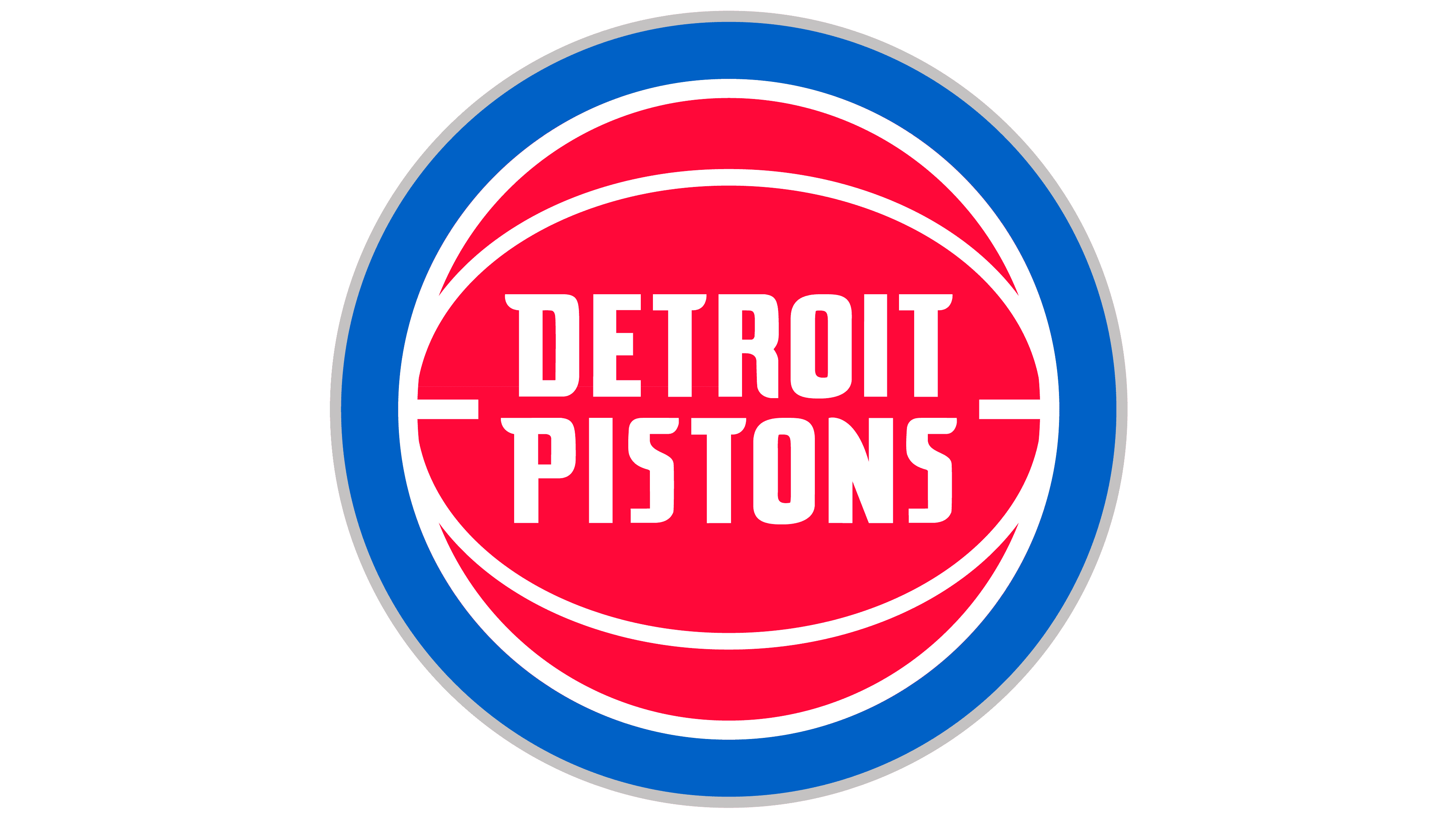
In 2017, the basketball players returned to an older emblem, namely the 1979 version. In its modern interpretation, it looks like a ball surrounded by a wide light-blue ring. The central oval features the phrase “DETROIT PISTONS,” arranged in two lines. Thin white stripes separate all elements. In Michigan, this is seen as a new chapter in the club’s history. This is the eighth emblem update for the team founded in 1941.
Font and Colors
In its current interpretation, the 80s logo looks somewhat different from its prototype. It has an elongated middle, so the oval contours directly touch the ball’s right and left edges, while the top and bottom are crescent-shaped. The outline lines are now half as thick, and the colors have lightened. The inscriptions have also changed. Chrome outlines have also appeared, which, according to the developers, are a tribute to Detroit automakers.
In previous versions, a separate font was created specifically for the Detroit Pistons logo. Early on, they were white stickers with a red outline. Subsequent changes concerned color, shape, style, and size. If the logo initially used a sans-serif font, small serifs later appeared, as seen in the letters “P” and “D.” In some cases, the letter “S” is graphically highlighted, resembling a muffler or the number “5.”
Speaking of color, the logo has always been dominated by the American flag’s palette: white, red, and blue.
FAQ
What does the Detroit Pistons logo mean?
The Detroit Pistons logo embodies the sports team’s commitment to its cause and its heritage. Basketball has been part of the team’s history, and the blue, white, and red color scheme has appeared in the logo since 1957.
Why did the “Detroit Pistons” change their logo?
The Detroit Pistons updated their logo in 2017 to reflect their move to the Little Caesars Arena in downtown Detroit. Of course, this is more of an evolution than a global change: the image of the basketball player and the red, white, and blue color scheme have stood the test of time. Designers combined traditional elements with a modern font, which has been in use since 2001.
Is “Pistons” still a team?
Yes, a basketball club with that name still exists. It plays in the Eastern Conference (NBA) and is based in Detroit, where the home arena, Little Caesars Arena, is located.
Who wears number 1 on the “Pistons”?
In 2002, Chauncey Billups was accepted into the “Detroit Pistons” team and took the number 1 spot because another basketball player was already playing under the number 4. After leaving the team in 2008, Billups returned for one more season, 2013-2014. In February 2016, the “Detroit Pistons” retired Billups’ number 1 jersey. As of 2021, no players in the club wear number 1.